 Add to Chrome
 Add to Firefox
 Add to Edge
Learning Panorama-Aware VLA for Mobile Manipulation with Whole-Body Teleoperation
Aug 03, 2026
Mobile manipulation is a key capability for embodied intelligence, enabling robots to accomplish complex multi-stage tasks in open-world environments. However, mobile manipulation poses two key challenges for vision-language-action (VLA) policies: At the data level, the efficient collection of high-quality whole-body demonstrations demands the coordinated control of both the mobile base and the robotic arms; at the model level, existing VLA models predominantly rely on local camera observations, whose limited field of view hinders global spatial understanding. To address these challenges, we develop a whole-body teleoperation system and a panoramic-aware VLA policy. The system enables coordinated control of a wheeled bimanual robot through a single VR interface and supports the acquisition of a real-world mobile manipulation dataset comprising 5.5 hours of multimodal demonstrations. Building upon this dataset, we propose PanoVLA, a panorama-aware vision-language-action policy for mobile bimanual manipulation. Built upon a Mixture-of-Transformers architecture, PanoVLA introduces global spatial context through dedicated panorama encoding and fusion modules, enabling effective integration of panoramic observations with language instructions and robot states for action generation. Evaluation on four real-world mobile manipulation tasks demonstrates that PanoVLA achieves an average stage completion rate of 91.3\% and an end-to-end success rate of 73.4\%, substantially outperforming local-view baselines. These results demonstrate that incorporating panoramic spatial context improves spatial understanding and closed-loop manipulation performance in mobile robots.

PIG-Nav: Key Insights for Pretrained Image Goal Navigation Models
Jul 23, 2025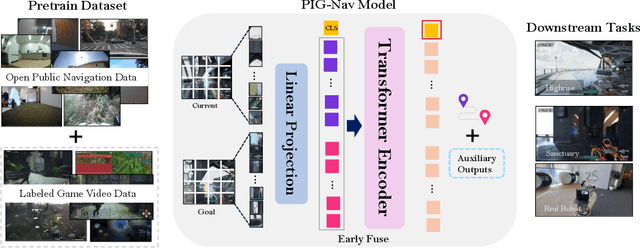
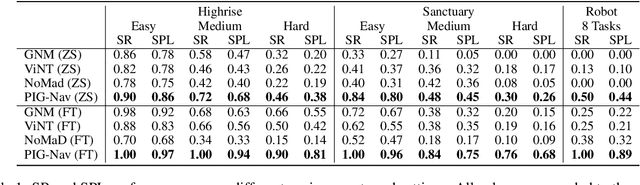
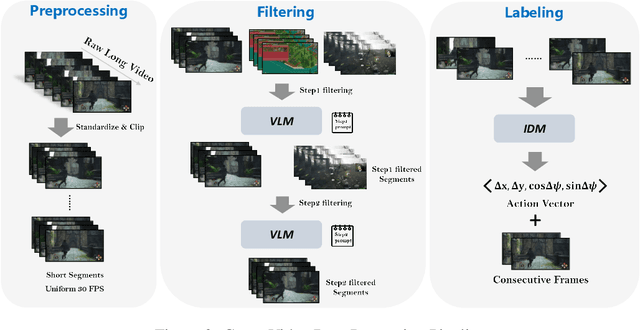
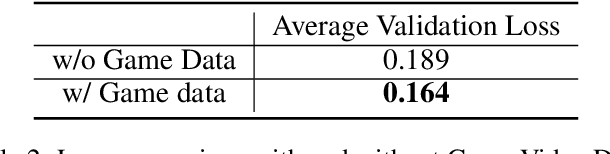
Recent studies have explored pretrained (foundation) models for vision-based robotic navigation, aiming to achieve generalizable navigation and positive transfer across diverse environments while enhancing zero-shot performance in unseen settings. In this work, we introduce PIG-Nav (Pretrained Image-Goal Navigation), a new approach that further investigates pretraining strategies for vision-based navigation models and contributes in two key areas. Model-wise, we identify two critical design choices that consistently improve the performance of pretrained navigation models: (1) integrating an early-fusion network structure to combine visual observations and goal images via appropriately pretrained Vision Transformer (ViT) image encoder, and (2) introducing suitable auxiliary tasks to enhance global navigation representation learning, thus further improving navigation performance. Dataset-wise, we propose a novel data preprocessing pipeline for efficiently labeling large-scale game video datasets for navigation model training. We demonstrate that augmenting existing open navigation datasets with diverse gameplay videos improves model performance. Our model achieves an average improvement of 22.6% in zero-shot settings and a 37.5% improvement in fine-tuning settings over existing visual navigation foundation models in two complex simulated environments and one real-world environment. These results advance the state-of-the-art in pretrained image-goal navigation models. Notably, our model maintains competitive performance while requiring significantly less fine-tuning data, highlighting its potential for real-world deployment with minimal labeled supervision.