 Add to Chrome
 Add to Firefox
 Add to Edge
MARS-RA: Rank Aggregation for Credit Assignment via Multimodal Comparisons in Embodied Multi-Agent Cooperation
Jul 30, 2026
Credit assignment is a fundamental challenge in cooperative multi-agent reinforcement learning, particularly in embodied AI settings characterized by limited and delayed feedback as well as dynamically changing numbers of active agents. We propose MARS-RA, a framework that reformulates credit assignment as a rank aggregation problem using contribution-based pairwise comparisons among agents generated by large multimodal models. This shift from absolute to relative estimation ensures robustness against noise and dynamic agent participation, converting comparison results into contribution scores for potential-based reward shaping. We provide theoretical justification for the convergence and robustness of the proposed framework, and show that Shapley values can be used as an interpretive reference. Experimental results on challenging tasks of different types indicate that MARS-RA can guide agents toward effective cooperation.

TowerMind: A Tower Defence Game Learning Environment and Benchmark for LLM as Agents
Jan 09, 2026Recent breakthroughs in Large Language Models (LLMs) have positioned them as a promising paradigm for agents, with long-term planning and decision-making emerging as core general-purpose capabilities for adapting to diverse scenarios and tasks. Real-time strategy (RTS) games serve as an ideal testbed for evaluating these two capabilities, as their inherent gameplay requires both macro-level strategic planning and micro-level tactical adaptation and action execution. Existing RTS game-based environments either suffer from relatively high computational demands or lack support for textual observations, which has constrained the use of RTS games for LLM evaluation. Motivated by this, we present TowerMind, a novel environment grounded in the tower defense (TD) subgenre of RTS games. TowerMind preserves the key evaluation strengths of RTS games for assessing LLMs, while featuring low computational demands and a multimodal observation space, including pixel-based, textual, and structured game-state representations. In addition, TowerMind supports the evaluation of model hallucination and provides a high degree of customizability. We design five benchmark levels to evaluate several widely used LLMs under different multimodal input settings. The results reveal a clear performance gap between LLMs and human experts across both capability and hallucination dimensions. The experiments further highlight key limitations in LLM behavior, such as inadequate planning validation, a lack of multifinality in decision-making, and inefficient action use. We also evaluate two classic reinforcement learning algorithms: Ape-X DQN and PPO. By offering a lightweight and multimodal design, TowerMind complements the existing RTS game-based environment landscape and introduces a new benchmark for the AI agent field. The source code is publicly available on GitHub(https://github.com/tb6147877/TowerMind).
PIG-Nav: Key Insights for Pretrained Image Goal Navigation Models
Jul 23, 2025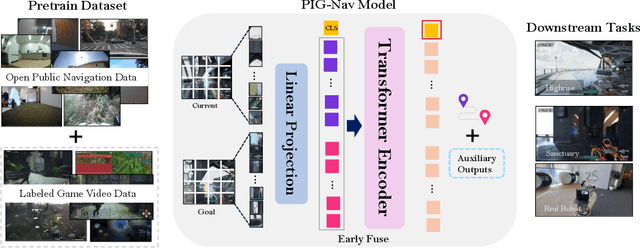
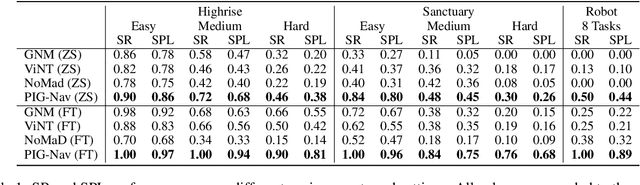
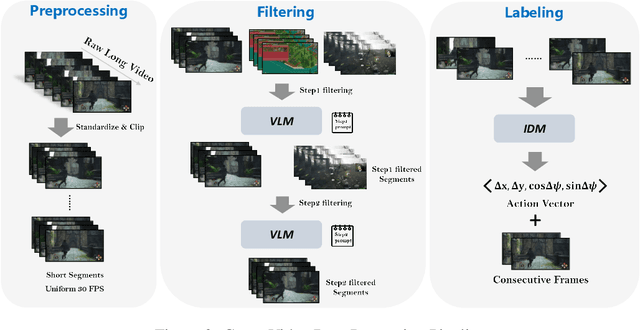
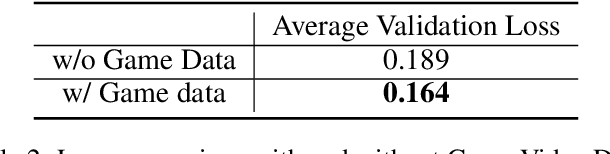
Recent studies have explored pretrained (foundation) models for vision-based robotic navigation, aiming to achieve generalizable navigation and positive transfer across diverse environments while enhancing zero-shot performance in unseen settings. In this work, we introduce PIG-Nav (Pretrained Image-Goal Navigation), a new approach that further investigates pretraining strategies for vision-based navigation models and contributes in two key areas. Model-wise, we identify two critical design choices that consistently improve the performance of pretrained navigation models: (1) integrating an early-fusion network structure to combine visual observations and goal images via appropriately pretrained Vision Transformer (ViT) image encoder, and (2) introducing suitable auxiliary tasks to enhance global navigation representation learning, thus further improving navigation performance. Dataset-wise, we propose a novel data preprocessing pipeline for efficiently labeling large-scale game video datasets for navigation model training. We demonstrate that augmenting existing open navigation datasets with diverse gameplay videos improves model performance. Our model achieves an average improvement of 22.6% in zero-shot settings and a 37.5% improvement in fine-tuning settings over existing visual navigation foundation models in two complex simulated environments and one real-world environment. These results advance the state-of-the-art in pretrained image-goal navigation models. Notably, our model maintains competitive performance while requiring significantly less fine-tuning data, highlighting its potential for real-world deployment with minimal labeled supervision.