 Add to Chrome
 Add to Firefox
 Add to Edge
FIRE: A Comprehensive Benchmark for Financial Intelligence and Reasoning Evaluation
Feb 25, 2026
We introduce FIRE, a comprehensive benchmark designed to evaluate both the theoretical financial knowledge of LLMs and their ability to handle practical business scenarios. For theoretical assessment, we curate a diverse set of examination questions drawn from widely recognized financial qualification exams, enabling evaluation of LLMs deep understanding and application of financial knowledge. In addition, to assess the practical value of LLMs in real-world financial tasks, we propose a systematic evaluation matrix that categorizes complex financial domains and ensures coverage of essential subdomains and business activities. Based on this evaluation matrix, we collect 3,000 financial scenario questions, consisting of closed-form decision questions with reference answers and open-ended questions evaluated by predefined rubrics. We conduct comprehensive evaluations of state-of-the-art LLMs on the FIRE benchmark, including XuanYuan 4.0, our latest financial-domain model, as a strong in-domain baseline. These results enable a systematic analysis of the capability boundaries of current LLMs in financial applications. We publicly release the benchmark questions and evaluation code to facilitate future research.

PIG-Nav: Key Insights for Pretrained Image Goal Navigation Models
Jul 23, 2025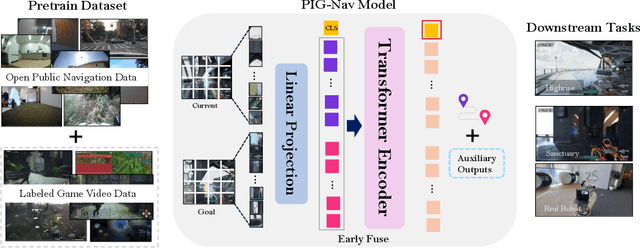
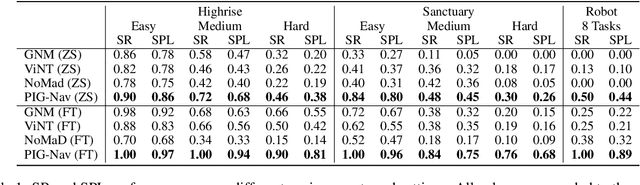
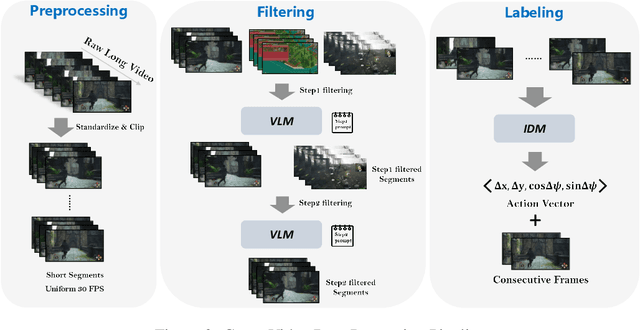
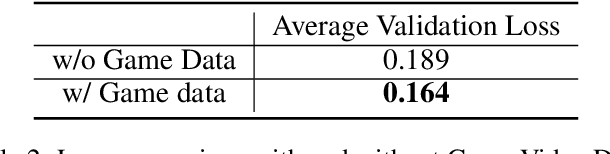
Recent studies have explored pretrained (foundation) models for vision-based robotic navigation, aiming to achieve generalizable navigation and positive transfer across diverse environments while enhancing zero-shot performance in unseen settings. In this work, we introduce PIG-Nav (Pretrained Image-Goal Navigation), a new approach that further investigates pretraining strategies for vision-based navigation models and contributes in two key areas. Model-wise, we identify two critical design choices that consistently improve the performance of pretrained navigation models: (1) integrating an early-fusion network structure to combine visual observations and goal images via appropriately pretrained Vision Transformer (ViT) image encoder, and (2) introducing suitable auxiliary tasks to enhance global navigation representation learning, thus further improving navigation performance. Dataset-wise, we propose a novel data preprocessing pipeline for efficiently labeling large-scale game video datasets for navigation model training. We demonstrate that augmenting existing open navigation datasets with diverse gameplay videos improves model performance. Our model achieves an average improvement of 22.6% in zero-shot settings and a 37.5% improvement in fine-tuning settings over existing visual navigation foundation models in two complex simulated environments and one real-world environment. These results advance the state-of-the-art in pretrained image-goal navigation models. Notably, our model maintains competitive performance while requiring significantly less fine-tuning data, highlighting its potential for real-world deployment with minimal labeled supervision.