 Add to Chrome
 Add to Firefox
 Add to Edge
Suppress and Diversify: Refining Robust Pathways for Corruption Robustness
Aug 07, 2026
Model robustness against natural image corruptions is essential for safety-critical applications. While existing methods primarily focus on implicit representation learning, we provide the first systematic exploration of computational pathways to explicitly characterize internal robustness. We identify a progressive decay of robust features across network layers and establish a functional dependency between the prevalence of these features and model performance. To exploit these insights, we propose Suppress and Diversify (S\&D), a non-intrusive refinement approach that enhances robustness by dynamically selecting robust pathways and diversifying them through symmetry-preserving transformations. S\&D is architecture-agnostic, parameter-free, and incurs zero test-time overhead. Extensive evaluations across eight benchmarks demonstrate that S\&D consistently improves performance across multiple vision tasks, diverse backbones, and complex real-world scenarios, highlighting its broad efficacy and scalability.

VTM-Nav: Harnessing Cross-Episode Experience for Object-Goal Navigation with Hierarchical Visual-Topological Memory
Jul 24, 2026Training-free ObjectNav agents increasingly use vision-language models (VLMs), yet typically discard acquired scene knowledge after each request. We study cross-episode ObjectNav, where each request is an independently initialized, single-goal episode and only self-acquired, scene-scoped memory persists across episodes. We ask whether an agent with fixed model parameters and navigation components can reuse such experience without retraining or oracle information. We introduce \method, a training-free framework with a persistent Hierarchical Visual-Topological Memory (VTM). VTM uses a coarse room topology to index room-owned visual memories, distinguishes in-room from remote-visible evidence, and retains successful approach cues. For each request, VTM-Nav re-localizes the agent in accumulated scene structure, retrieves target-relevant records from plausible rooms, and grounds memory guidance in candidates derived from the current observation. A conservative execution guard further handles local failures. Under matched 40-step comparisons, VTM-Nav exceeds the memory-reset WMNav control by 4.6, 2.0, and 0.8 SR points on HM3D v0.1, HM3D v0.2, and MP3D, respectively, with comparable or higher SPL. On HM3D, it also exceeds WMNav harnessed by textual memory by 3.1 and 5.5 SR points. These results demonstrate effective reuse of cross-episode scene experience through hierarchical visual-topological memory.
VTM-Nav: Hierarchical Visual-Topological Memory for Cross-Episode Object-Goal Navigation
Jul 16, 2026Object-goal navigation requires an embodied agent to locate and reach an instance of a specified object category in an indoor environment. Recent training-free approaches leverage vision-language models (VLMs) for open-vocabulary semantic reasoning, but are typically evaluated under an episodic protocol that resets all scene-specific state after each episode. We introduce Cross-Episode Object-Goal Navigation, in which an agent repeatedly operates in the same scene, retains only self-acquired experience, and keeps its model parameters fixed. To support experience reuse, we present \method, a training-free VLM navigation framework with a persistent hierarchical Visual-Topological Memory (VTM). The VTM organizes scene knowledge at room and object levels and retrieves relevant experience through coarse-to-fine matching, providing memory as soft guidance only when it agrees with current observations. A conservative execution guard further mitigates oscillations, blocked motions, and premature stopping. Under a controlled same-scene protocol, we evaluate \method{} on three benchmarks, HM3D v0.1, HM3D v0.2, and MP3D, and compare it with a strengthened WMNav baseline augmented with cross-episode textual memory, while keeping the VLM backbone and action pipeline identical. \method{} achieves the best performance across all three benchmarks, demonstrating the effectiveness and robustness of structured visual-topological experience reuse across datasets.
Hy-Embodied-VLM-1.0: Efficient Physical-World Agents
Jul 14, 2026Building capable embodied agents requires not only multimodal perception and understanding, but also agentic capabilities for reasoning about actions, adapting to evolving situations, and interacting with the physical world. In this report, we introduce Hy-Embodied-VLM-1.0, an efficient and powerful embodied foundation model specifically designed for embodied agents operating in the physical world. To cultivate such capabilities from the pre-training stage onward, we define an action-centric capability taxonomy comprising three progressive dimensions: Action-Relevant State Understanding, Action-Transition Reasoning, and Sequential and Adaptive Reasoning. Guided by this taxonomy, we develop a systematic data pipeline and curate data mixtures spanning both pre-training and post-training. To deliver strong physical-world understanding and interaction capabilities while supporting latency-sensitive deployment, we build our model on the Hy3-A3B language backbone and the Hy-ViT2 vision encoder. Its efficient Mixture-of-Experts architecture combines strong model capacity with high inference efficiency. We evaluate Hy-Embodied-VLM-1.0 on a comprehensive suite of 38 benchmarks covering embodied perception, physical-world understanding, and embodied reasoning. The model achieves the best performance among similarly sized models on 19 of the 38 benchmarks and substantially outperforms strong competitors, including Qwen3.6-A3B and Cosmos 3. Compared with the previous-generation Hy-Embodied-0.5 MoT-2B, Hy-Embodied-VLM-1.0 improves average performance by 8.4%. Despite activating only 3B parameters, it achieves performance close to that of the previous-generation model with 32B activated parameters. Beyond static benchmark evaluation, Hy-Embodied-VLM-1.0 also demonstrates strong performance on embodied agentic tasks requiring multi-turn interaction and long-horizon reasoning.
Representation Collapse in Sequential Post-Training of Large Language Models
May 28, 2026Large language models are now adapted through chains of post-training stages rather than through a single instruction-tuning pass. This paper studies whether such sequential post-training gradually compresses internal representations into low-rank, anisotropic, and homogeneous feature spaces. We define a measurement suite for hidden states, logits, token trajectories, and LoRA updates, and we use it to analyze supervised fine-tuning, preference optimization, safety/refusal tuning, math and code specialization, and long chain-of-thought tuning under controlled stage orderings. The central hypothesis is that excessive representation concentration is not merely a geometric curiosity: it predicts reduced plasticity during later adaptation, weaker out-of-domain generalization, and poorer calibration. We further evaluate lightweight interventions, including mixed-domain replay, feature refresh, representation diversity regularization, and LoRA update decorrelation, as ways to preserve future learnability without giving up the behavioral gains of post-training.
Towards Domain-Generalized Open-Vocabulary Object Detection: A Progressive Domain-invariant Cross-modal Alignment Method
Mar 29, 2026Open-Vocabulary Object Detection (OVOD) has achieved remarkable success in generalizing to novel categories. However, this success often rests on the implicit assumption of domain stationarity. In this work, we provide a principled revisit of the OVOD paradigm, uncovering a fundamental vulnerability: the fragile coupling between visual manifolds and textual embeddings when distribution shifts occur. We first systematically formalize Domain-Generalized Open-Vocabulary Object Detection (DG-OVOD). Through empirical analysis, we demonstrate that visual shifts do not merely add noise; they cause a collapse of the latent cross-modal space where novel category visual signals detach from their semantic anchors. Motivated by these insights, we propose Progressive Domain-invariant Cross-modal Alignment (PICA). PICA departs from uniform training by introducing a multi-level ambiguity and signal strength curriculum. It builds adaptive pseudo-word prototypes, refined via sample confidence and visual consistency, to enforce invariant cross-domain modality alignment. Our findings suggest that OVOD's robustness to domain shifts is intrinsically linked to the stability of the latent cross-modal alignment space. Our work provides both a challenging benchmark and a new perspective on building truly generalizable open-vocabulary systems that extend beyond static laboratory conditions.
Boosting Single-domain Generalized Object Detection via Vision-Language Knowledge Interaction
Apr 27, 2025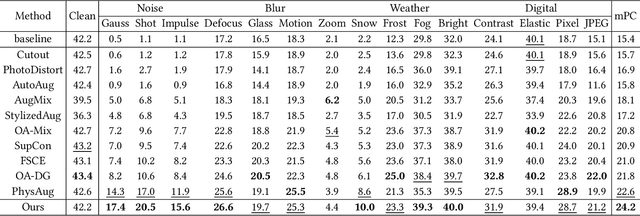
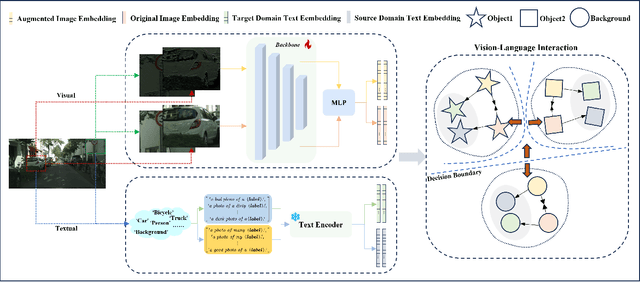
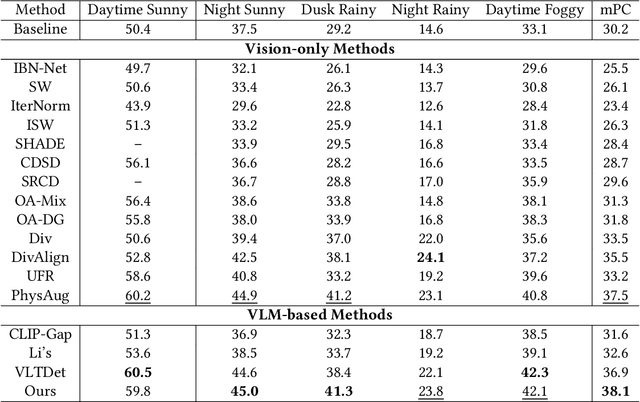
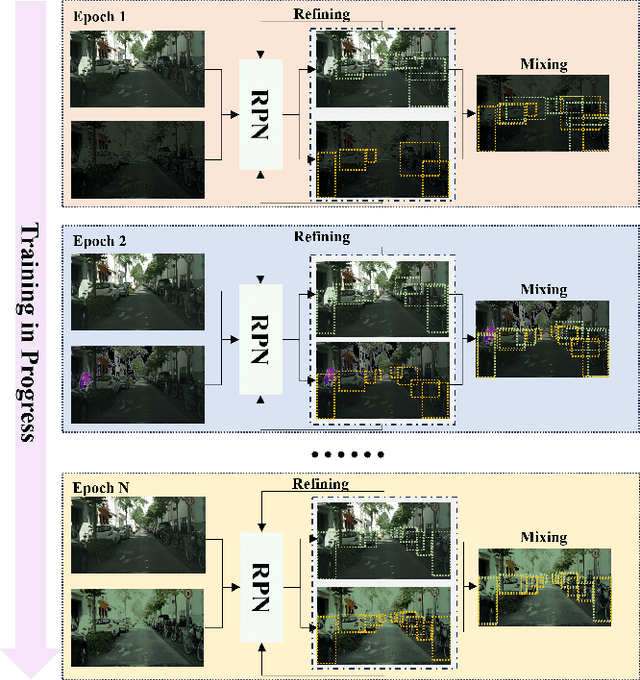
Single-Domain Generalized Object Detection~(S-DGOD) aims to train an object detector on a single source domain while generalizing well to diverse unseen target domains, making it suitable for multimedia applications that involve various domain shifts, such as intelligent video surveillance and VR/AR technologies. With the success of large-scale Vision-Language Models, recent S-DGOD approaches exploit pre-trained vision-language knowledge to guide invariant feature learning across visual domains. However, the utilized knowledge remains at a coarse-grained level~(e.g., the textual description of adverse weather paired with the image) and serves as an implicit regularization for guidance, struggling to learn accurate region- and object-level features in varying domains. In this work, we propose a new cross-modal feature learning method, which can capture generalized and discriminative regional features for S-DGOD tasks. The core of our method is the mechanism of Cross-modal and Region-aware Feature Interaction, which simultaneously learns both inter-modal and intra-modal regional invariance through dynamic interactions between fine-grained textual and visual features. Moreover, we design a simple but effective strategy called Cross-domain Proposal Refining and Mixing, which aligns the position of region proposals across multiple domains and diversifies them, enhancing the localization ability of detectors in unseen scenarios. Our method achieves new state-of-the-art results on S-DGOD benchmark datasets, with improvements of +8.8\%~mPC on Cityscapes-C and +7.9\%~mPC on DWD over baselines, demonstrating its efficacy.
Patients Speak, AI Listens: LLM-based Analysis of Online Reviews Uncovers Key Drivers for Urgent Care Satisfaction
Mar 26, 2025Investigating the public experience of urgent care facilities is essential for promoting community healthcare development. Traditional survey methods often fall short due to limited scope, time, and spatial coverage. Crowdsourcing through online reviews or social media offers a valuable approach to gaining such insights. With recent advancements in large language models (LLMs), extracting nuanced perceptions from reviews has become feasible. This study collects Google Maps reviews across the DMV and Florida areas and conducts prompt engineering with the GPT model to analyze the aspect-based sentiment of urgent care. We first analyze the geospatial patterns of various aspects, including interpersonal factors, operational efficiency, technical quality, finances, and facilities. Next, we determine Census Block Group(CBG)-level characteristics underpinning differences in public perception, including population density, median income, GINI Index, rent-to-income ratio, household below poverty rate, no insurance rate, and unemployment rate. Our results show that interpersonal factors and operational efficiency emerge as the strongest determinants of patient satisfaction in urgent care, while technical quality, finances, and facilities show no significant independent effects when adjusted for in multivariate models. Among socioeconomic and demographic factors, only population density demonstrates a significant but modest association with patient ratings, while the remaining factors exhibit no significant correlations. Overall, this study highlights the potential of crowdsourcing to uncover the key factors that matter to residents and provide valuable insights for stakeholders to improve public satisfaction with urgent care.
PhysAug: A Physical-guided and Frequency-based Data Augmentation for Single-Domain Generalized Object Detection
Dec 16, 2024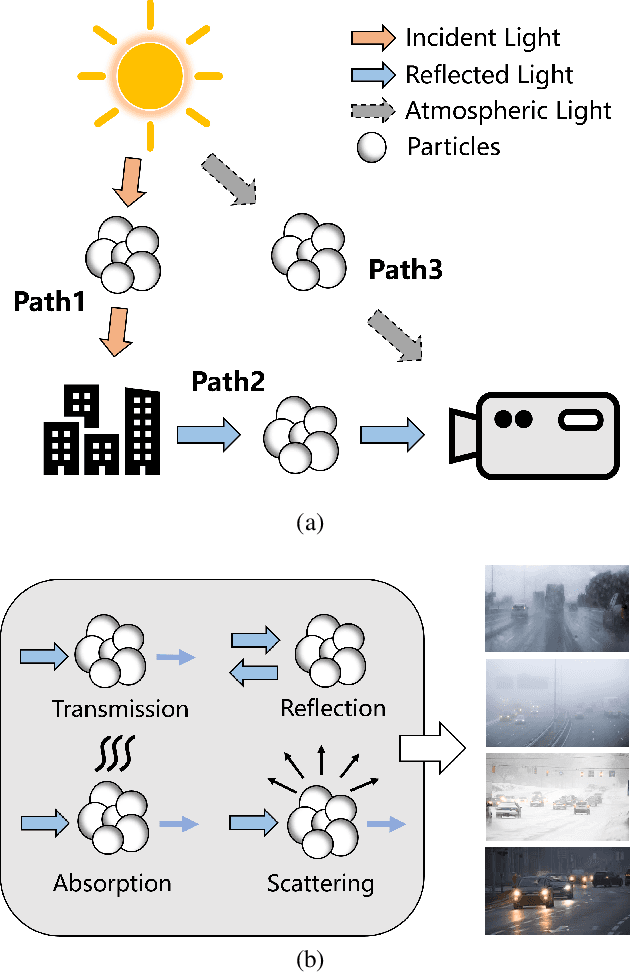


Single-Domain Generalized Object Detection~(S-DGOD) aims to train on a single source domain for robust performance across a variety of unseen target domains by taking advantage of an object detector. Existing S-DGOD approaches often rely on data augmentation strategies, including a composition of visual transformations, to enhance the detector's generalization ability. However, the absence of real-world prior knowledge hinders data augmentation from contributing to the diversity of training data distributions. To address this issue, we propose PhysAug, a novel physical model-based non-ideal imaging condition data augmentation method, to enhance the adaptability of the S-DGOD tasks. Drawing upon the principles of atmospheric optics, we develop a universal perturbation model that serves as the foundation for our proposed PhysAug. Given that visual perturbations typically arise from the interaction of light with atmospheric particles, the image frequency spectrum is harnessed to simulate real-world variations during training. This approach fosters the detector to learn domain-invariant representations, thereby enhancing its ability to generalize across various settings. Without altering the network architecture or loss function, our approach significantly outperforms the state-of-the-art across various S-DGOD datasets. In particular, it achieves a substantial improvement of $7.3\%$ and $7.2\%$ over the baseline on DWD and Cityscape-C, highlighting its enhanced generalizability in real-world settings.
Dynamically Pruned Message Passing Networks for Large-Scale Knowledge Graph Reasoning
Sep 27, 2019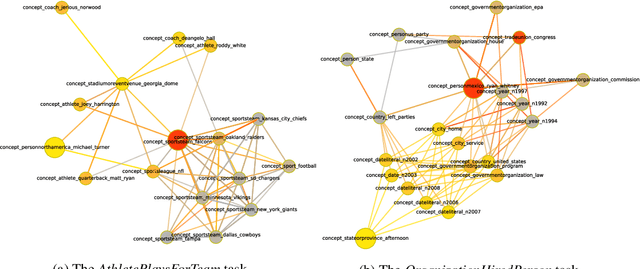
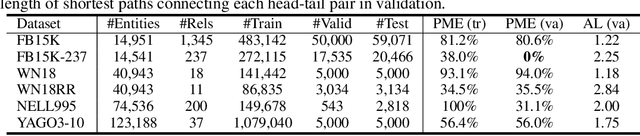
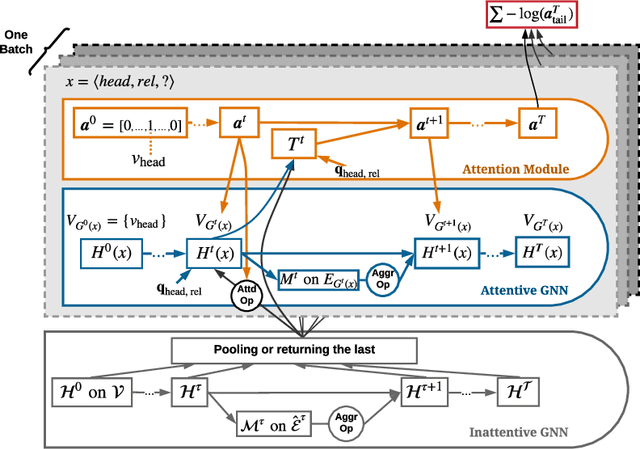
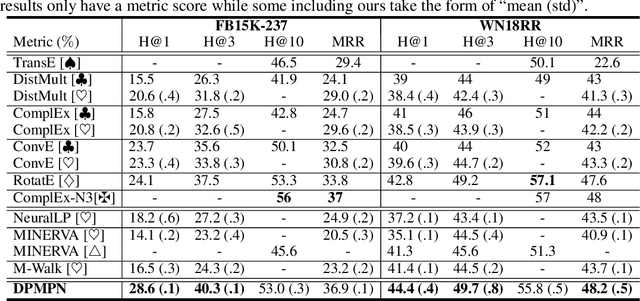
We propose Dynamically Pruned Message Passing Networks (DPMPN) for large-scale knowledge graph reasoning. In contrast to existing models, embedding-based or path-based, we learn an input-dependent subgraph to explicitly model a sequential reasoning process. Each subgraph is dynamically constructed, expanding itself selectively under a flow-style attention mechanism. In this way, we can not only construct graphical explanations to interpret prediction, but also prune message passing in Graph Neural Networks (GNNs) to scale with the size of graphs. We take the inspiration from the consciousness prior proposed by Bengio to design a two-GNN framework to encode global input-invariant graph-structured representation and learn local input-dependent one coordinated by an attention module. Experiments show the reasoning capability in our model that is providing a clear graphical explanation as well as predicting results accurately, outperforming most state-of-the-art methods in knowledge base completion tasks.