 Add to Chrome
 Add to Firefox
 Add to Edge
Lance: Unified Multimodal Modeling by Multi-Task Synergy
May 20, 2026
We present Lance, a lightweight native unified model supporting multimodal understanding, generation, and editing for both images and videos. Rather than relying on model capacity scaling or text-image-dominant designs, Lance explores a practical paradigm for unified multimodal modeling via collaborative multi-task training. It is grounded in two core principles: unified context modeling and decoupled capability pathways. Specifically, Lance is trained from scratch and employs a dual-stream mixture-of-experts architecture on shared interleaved multimodal sequences, enabling joint context learning while decoupling the pathways for understanding and generation. We further introduce modality-aware rotary positional encoding to mitigate interference among heterogeneous visual tokens and boost cross-task alignment. During training, Lance adopts a staged multi-task training paradigm with capability-oriented objectives and adaptive data scheduling to strengthen both semantic comprehension and visual generation performance. Experimental results demonstrate that Lance substantially outperforms existing open-source unified models in image and video generation, while retaining strong multimodal understanding capabilities. The homepage is available at https://lance-project.github.io.

Dynamically Pruned Message Passing Networks for Large-Scale Knowledge Graph Reasoning
Sep 27, 2019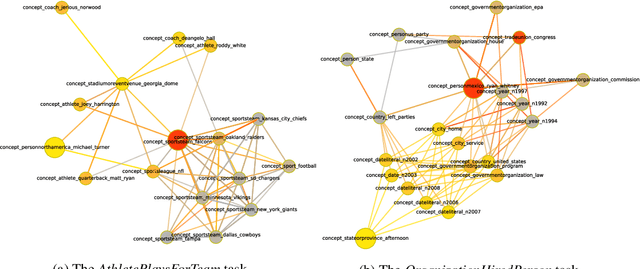
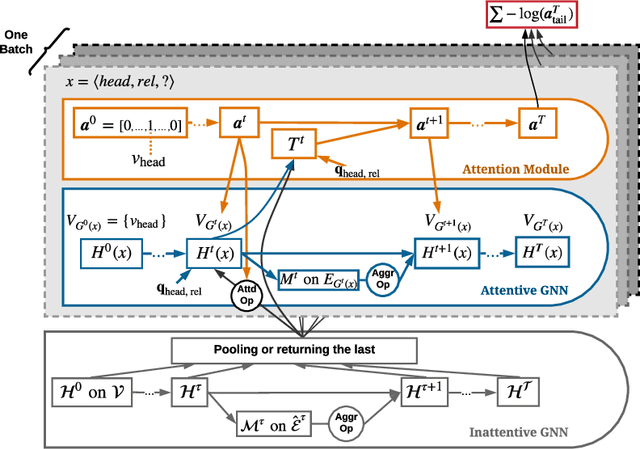
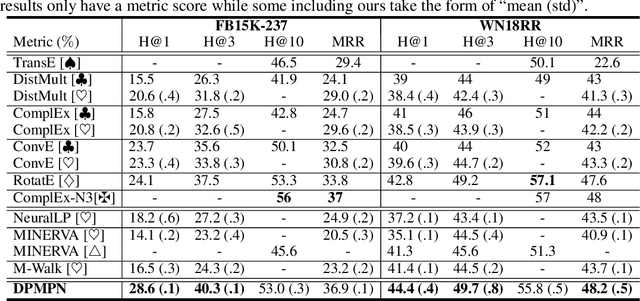
We propose Dynamically Pruned Message Passing Networks (DPMPN) for large-scale knowledge graph reasoning. In contrast to existing models, embedding-based or path-based, we learn an input-dependent subgraph to explicitly model a sequential reasoning process. Each subgraph is dynamically constructed, expanding itself selectively under a flow-style attention mechanism. In this way, we can not only construct graphical explanations to interpret prediction, but also prune message passing in Graph Neural Networks (GNNs) to scale with the size of graphs. We take the inspiration from the consciousness prior proposed by Bengio to design a two-GNN framework to encode global input-invariant graph-structured representation and learn local input-dependent one coordinated by an attention module. Experiments show the reasoning capability in our model that is providing a clear graphical explanation as well as predicting results accurately, outperforming most state-of-the-art methods in knowledge base completion tasks.