 Add to Chrome
 Add to Firefox
 Add to Edge
TFEC: Multivariate Time-Series Clustering via Temporal-Frequency Enhanced Contrastive Learning
Jan 12, 2026
Multivariate Time-Series (MTS) clustering is crucial for signal processing and data analysis. Although deep learning approaches, particularly those leveraging Contrastive Learning (CL), are prominent for MTS representation, existing CL-based models face two key limitations: 1) neglecting clustering information during positive/negative sample pair construction, and 2) introducing unreasonable inductive biases, e.g., destroying time dependence and periodicity through augmentation strategies, compromising representation quality. This paper, therefore, proposes a Temporal-Frequency Enhanced Contrastive (TFEC) learning framework. To preserve temporal structure while generating low-distortion representations, a temporal-frequency Co-EnHancement (CoEH) mechanism is introduced. Accordingly, a synergistic dual-path representation and cluster distribution learning framework is designed to jointly optimize cluster structure and representation fidelity. Experiments on six real-world benchmark datasets demonstrate TFEC's superiority, achieving 4.48% average NMI gains over SOTA methods, with ablation studies validating the design. The code of the paper is available at: https://github.com/yueliangy/TFEC.

Beyond Physical Labels: Redefining Domains for Robust WiFi-based Gesture Recognition
Jan 08, 2026In this paper, we propose GesFi, a novel WiFi-based gesture recognition system that introduces WiFi latent domain mining to redefine domains directly from the data itself. GesFi first processes raw sensing data collected from WiFi receivers using CSI-ratio denoising, Short-Time Fast Fourier Transform, and visualization techniques to generate standardized input representations. It then employs class-wise adversarial learning to suppress gesture semantic and leverages unsupervised clustering to automatically uncover latent domain factors responsible for distributional shifts. These latent domains are then aligned through adversarial learning to support robust cross-domain generalization. Finally, the system is applied to the target environment for robust gesture inference. We deployed GesFi under both single-pair and multi-pair settings using commodity WiFi transceivers, and evaluated it across multiple public datasets and real-world environments. Compared to state-of-the-art baselines, GesFi achieves up to 78% and 50% performance improvements over existing adversarial methods, and consistently outperforms prior generalization approaches across most cross-domain tasks.
Guardians of the Hair: Rescuing Soft Boundaries in Depth, Stereo, and Novel Views
Jan 06, 2026Soft boundaries, like thin hairs, are commonly observed in natural and computer-generated imagery, but they remain challenging for 3D vision due to the ambiguous mixing of foreground and background cues. This paper introduces Guardians of the Hair (HairGuard), a framework designed to recover fine-grained soft boundary details in 3D vision tasks. Specifically, we first propose a novel data curation pipeline that leverages image matting datasets for training and design a depth fixer network to automatically identify soft boundary regions. With a gated residual module, the depth fixer refines depth precisely around soft boundaries while maintaining global depth quality, allowing plug-and-play integration with state-of-the-art depth models. For view synthesis, we perform depth-based forward warping to retain high-fidelity textures, followed by a generative scene painter that fills disoccluded regions and eliminates redundant background artifacts within soft boundaries. Finally, a color fuser adaptively combines warped and inpainted results to produce novel views with consistent geometry and fine-grained details. Extensive experiments demonstrate that HairGuard achieves state-of-the-art performance across monocular depth estimation, stereo image/video conversion, and novel view synthesis, with significant improvements in soft boundary regions.
Deepfake Detection with Multi-Artifact Subspace Fine-Tuning and Selective Layer Masking
Jan 03, 2026Deepfake detection still faces significant challenges in cross-dataset and real-world complex scenarios. The root cause lies in the high diversity of artifact distributions introduced by different forgery methods, while pretrained models tend to disrupt their original general semantic structures when adapting to new artifacts. Existing approaches usually rely on indiscriminate global parameter updates or introduce additional supervision signals, making it difficult to effectively model diverse forgery artifacts while preserving semantic stability. To address these issues, this paper proposes a deepfake detection method based on Multi-Artifact Subspaces and selective layer masks (MASM), which explicitly decouples semantic representations from artifact representations and constrains the fitting strength of artifact subspaces, thereby improving generalization robustness in cross-dataset scenarios. Specifically, MASM applies singular value decomposition to model weights, partitioning pretrained weights into a stable semantic principal subspace and multiple learnable artifact subspaces. This design enables decoupled modeling of different forgery artifact patterns while preserving the general semantic subspace. On this basis, a selective layer mask strategy is introduced to adaptively regulate the update behavior of corresponding network layers according to the learning state of each artifact subspace, suppressing overfitting to any single forgery characteristic. Furthermore, orthogonality constraints and spectral consistency constraints are imposed to jointly regularize multiple artifact subspaces, guiding them to learn complementary and diverse artifact representations while maintaining a stable overall spectral structure.
Benchmarking ERP Analysis: Manual Features, Deep Learning, and Foundation Models
Jan 02, 2026Event-related potential (ERP), a specialized paradigm of electroencephalographic (EEG), reflects neurological responses to external stimuli or events, generally associated with the brain's processing of specific cognitive tasks. ERP plays a critical role in cognitive analysis, the detection of neurological diseases, and the assessment of psychological states. Recent years have seen substantial advances in deep learning-based methods for spontaneous EEG and other non-time-locked task-related EEG signals. However, their effectiveness on ERP data remains underexplored, and many existing ERP studies still rely heavily on manually extracted features. In this paper, we conduct a comprehensive benchmark study that systematically compares traditional manual features (followed by a linear classifier), deep learning models, and pre-trained EEG foundation models for ERP analysis. We establish a unified data preprocessing and training pipeline and evaluate these approaches on two representative tasks, ERP stimulus classification and ERP-based brain disease detection, across 12 publicly available datasets. Furthermore, we investigate various patch-embedding strategies within advanced Transformer architectures to identify embedding designs that better suit ERP data. Our study provides a landmark framework to guide method selection and tailored model design for future ERP analysis. The code is available at https://github.com/DL4mHealth/ERP-Benchmark.
Reflection Pretraining Enables Token-Level Self-Correction in Biological Sequence Models
Dec 24, 2025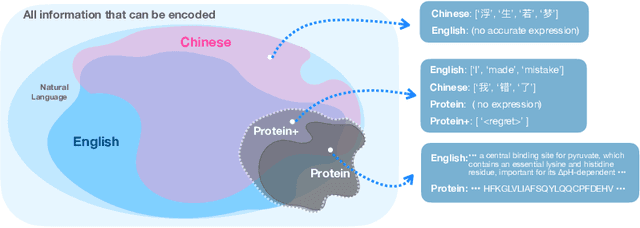
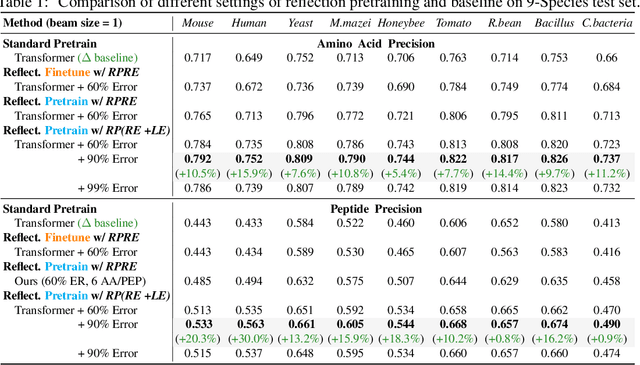
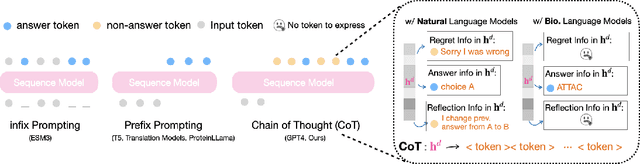
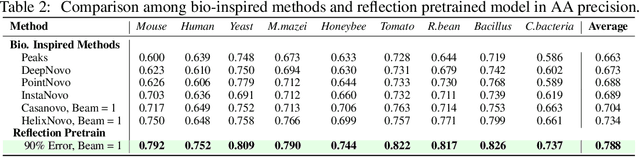
Chain-of-Thought (CoT) prompting has significantly advanced task-solving capabilities in natural language processing with large language models. Unlike standard prompting, CoT encourages the model to generate intermediate reasoning steps, non-answer tokens, that help guide the model toward more accurate final outputs. These intermediate steps enable more complex reasoning processes such as error correction, memory management, future planning, and self-reflection. However, applying CoT to non-natural language domains, such as protein and RNA language models, is not yet possible, primarily due to the limited expressiveness of their token spaces (e.g., amino acid tokens). In this work, we propose and define the concept of language expressiveness: the ability of a given language, using its tokens and grammar, to encode information. We show that the limited expressiveness of protein language severely restricts the applicability of CoT-style reasoning. To overcome this, we introduce reflection pretraining, for the first time in a biological sequence model, which enables the model to engage in intermediate reasoning through the generation of auxiliary "thinking tokens" beyond simple answer tokens. Theoretically, we demonstrate that our augmented token set significantly enhances biological language expressiveness, thereby improving the overall reasoning capacity of the model. Experimentally, our pretraining approach teaches protein models to self-correct and leads to substantial performance gains compared to standard pretraining.
Accurate de novo sequencing of the modified proteome with OmniNovo
Dec 13, 2025Post-translational modifications (PTMs) serve as a dynamic chemical language regulating protein function, yet current proteomic methods remain blind to a vast portion of the modified proteome. Standard database search algorithms suffer from a combinatorial explosion of search spaces, limiting the identification of uncharacterized or complex modifications. Here we introduce OmniNovo, a unified deep learning framework for reference-free sequencing of unmodified and modified peptides directly from tandem mass spectra. Unlike existing tools restricted to specific modification types, OmniNovo learns universal fragmentation rules to decipher diverse PTMs within a single coherent model. By integrating a mass-constrained decoding algorithm with rigorous false discovery rate estimation, OmniNovo achieves state-of-the-art accuracy, identifying 51\% more peptides than standard approaches at a 1\% false discovery rate. Crucially, the model generalizes to biological sites unseen during training, illuminating the dark matter of the proteome and enabling unbiased comprehensive analysis of cellular regulation.
CVP: Central-Peripheral Vision-Inspired Multimodal Model for Spatial Reasoning
Dec 09, 2025We present a central-peripheral vision-inspired framework (CVP), a simple yet effective multimodal model for spatial reasoning that draws inspiration from the two types of human visual fields -- central vision and peripheral vision. Existing approaches primarily rely on unstructured representations, such as point clouds, voxels, or patch features, and inject scene context implicitly via coordinate embeddings. However, this often results in limited spatial reasoning capabilities due to the lack of explicit, high-level structural understanding. To address this limitation, we introduce two complementary components into a Large Multimodal Model-based architecture: target-affinity token, analogous to central vision, that guides the model's attention toward query-relevant objects; and allocentric grid, akin to peripheral vision, that captures global scene context and spatial arrangements. These components work in tandem to enable structured, context-aware understanding of complex 3D environments. Experiments show that CVP achieves state-of-the-art performance across a range of 3D scene understanding benchmarks.
MOON Embedding: Multimodal Representation Learning for E-commerce Search Advertising
Nov 18, 2025We introduce MOON, our comprehensive set of sustainable iterative practices for multimodal representation learning for e-commerce applications. MOON has already been fully deployed across all stages of Taobao search advertising system, including retrieval, relevance, ranking, and so on. The performance gains are particularly significant on click-through rate (CTR) prediction task, which achieves an overall +20.00% online CTR improvement. Over the past three years, this project has delivered the largest improvement on CTR prediction task and undergone five full-scale iterations. Throughout the exploration and iteration of our MOON, we have accumulated valuable insights and practical experience that we believe will benefit the research community. MOON contains a three-stage training paradigm of "Pretraining, Post-training, and Application", allowing effective integration of multimodal representations with downstream tasks. Notably, to bridge the misalignment between the objectives of multimodal representation learning and downstream training, we define the exchange rate to quantify how effectively improvements in an intermediate metric can translate into downstream gains. Through this analysis, we identify the image-based search recall as a critical intermediate metric guiding the optimization of multimodal models. Over three years and five iterations, MOON has evolved along four critical dimensions: data processing, training strategy, model architecture, and downstream application. The lessons and insights gained through the iterative improvements will also be shared. As part of our exploration into scaling effects in the e-commerce field, we further conduct a systematic study of the scaling laws governing multimodal representation learning, examining multiple factors such as the number of training tokens, negative samples, and the length of user behavior sequences.
A Visual Perception-Based Tunable Framework and Evaluation Benchmark for H.265/HEVC ROI Encryption
Nov 09, 2025ROI selective encryption, as an efficient privacy protection technique, encrypts only the key regions in the video, thereby ensuring security while minimizing the impact on coding efficiency. However, existing ROI-based video encryption methods suffer from insufficient flexibility and lack of a unified evaluation system. To address these issues, we propose a visual perception-based tunable framework and evaluation benchmark for H.265/HEVC ROI encryption. Our scheme introduces three key contributions: 1) A ROI region recognition module based on visual perception network is proposed to accurately identify the ROI region in videos. 2) A three-level tunable encryption strategy is implemented while balancing security and real-time performance. 3) A unified ROI encryption evaluation benchmark is developed to provide a standardized quantitative platform for subsequent research. This triple strategy provides new solution and significant unified performance evaluation methods for ROI selective encryption field. Experimental results indicate that the proposed benchmark can comprehensively measure the performance of the ROI selective encryption. Compared to existing ROI encryption algorithms, our proposed enhanced and advanced level encryption exhibit superior performance in multiple performance metrics. In general, the proposed framework effectively meets the privacy protection requirements in H.265/HEVC and provides a reliable solution for secure and efficient processing of sensitive video content.