 Add to Chrome
 Add to Firefox
 Add to Edge
Beyond Physical Labels: Redefining Domains for Robust WiFi-based Gesture Recognition
Jan 08, 2026
In this paper, we propose GesFi, a novel WiFi-based gesture recognition system that introduces WiFi latent domain mining to redefine domains directly from the data itself. GesFi first processes raw sensing data collected from WiFi receivers using CSI-ratio denoising, Short-Time Fast Fourier Transform, and visualization techniques to generate standardized input representations. It then employs class-wise adversarial learning to suppress gesture semantic and leverages unsupervised clustering to automatically uncover latent domain factors responsible for distributional shifts. These latent domains are then aligned through adversarial learning to support robust cross-domain generalization. Finally, the system is applied to the target environment for robust gesture inference. We deployed GesFi under both single-pair and multi-pair settings using commodity WiFi transceivers, and evaluated it across multiple public datasets and real-world environments. Compared to state-of-the-art baselines, GesFi achieves up to 78% and 50% performance improvements over existing adversarial methods, and consistently outperforms prior generalization approaches across most cross-domain tasks.

Chi-Square Wavelet Graph Neural Networks for Heterogeneous Graph Anomaly Detection
May 25, 2025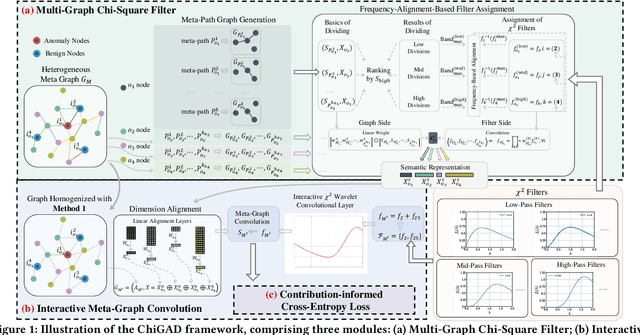
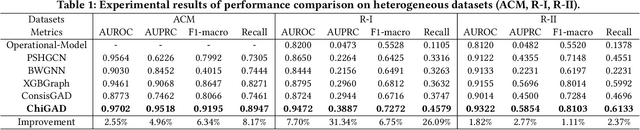
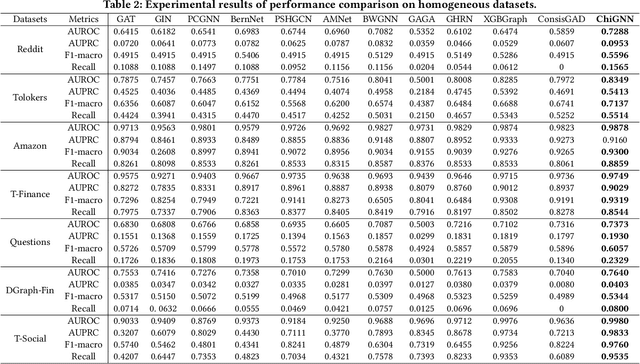
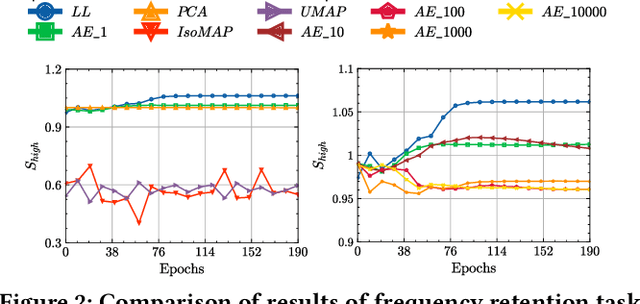
Graph Anomaly Detection (GAD) in heterogeneous networks presents unique challenges due to node and edge heterogeneity. Existing Graph Neural Network (GNN) methods primarily focus on homogeneous GAD and thus fail to address three key issues: (C1) Capturing abnormal signal and rich semantics across diverse meta-paths; (C2) Retaining high-frequency content in HIN dimension alignment; and (C3) Learning effectively from difficult anomaly samples with class imbalance. To overcome these, we propose ChiGAD, a spectral GNN framework based on a novel Chi-Square filter, inspired by the wavelet effectiveness in diverse domains. Specifically, ChiGAD consists of: (1) Multi-Graph Chi-Square Filter, which captures anomalous information via applying dedicated Chi-Square filters to each meta-path graph; (2) Interactive Meta-Graph Convolution, which aligns features while preserving high-frequency information and incorporates heterogeneous messages by a unified Chi-Square Filter; and (3) Contribution-Informed Cross-Entropy Loss, which prioritizes difficult anomalies to address class imbalance. Extensive experiments on public and industrial datasets show that ChiGAD outperforms state-of-the-art models on multiple metrics. Additionally, its homogeneous variant, ChiGNN, excels on seven GAD datasets, validating the effectiveness of Chi-Square filters. Our code is available at https://github.com/HsipingLi/ChiGAD.