 Add to Chrome
 Add to Firefox
 Add to Edge
STAR-PólyaMath: Multi-Agent Reasoning under Persistent Meta-Strategic Supervision
May 19, 2026
Frontier AI models and multi-agent systems have led to significant improvements in mathematical reasoning. However, for problems requiring extended, long-horizon reasoning, existing systems continue to suffer from fundamental reliability issues: hallucination accumulation, memory fragmentation, and imbalanced reasoning-tool trade-offs. In this paper, we introduce STAR-PólyaMath, a multi-agent framework that systematically addresses these challenges through meta-level supervision and structured Reasoner-Verifier interaction. STAR-PólyaMath is structured as an orchestrated state machine with nested challenge-step-replan loops, governed by a reasoning-free Python orchestrator that separates control from inference and bounds error propagation through trace-back and re-planning. Our key innovation is a persistent Meta-Strategist that maintains cross-attempt memory and exercises meta-level control by issuing high-level strategic guidance or mandatory directives, so the system can escape unproductive loops rather than stagnate or over-rely on tools. STAR-PólyaMath achieves state-of-the-art results on all eight top-tier competition benchmarks: AIME 2025-2026, MathArena Apex Shortlist, MathArena Apex 2025, Putnam 2025, IMO 2025, HMMT February 2026, and USAMO 2026. It obtains perfect scores on AIMEs, Putnam, and HMMT, and shows its largest margin on Apex 2025, scoring 93.75% compared with 80.21% by the strongest baseline GPT-5.5. Ablation studies show that the gains arise from the framework's orchestration rather than from model-level diversity since removing key components or substituting in mixed backbones consistently weakens performance. Code is available at https://github.com/Julius-Woo/STAR-PolyaMath.

Draft-and-Prune: Improving the Reliability of Auto-formalization for Logical Reasoning
Mar 18, 2026Auto-formalization (AF) translates natural-language reasoning problems into solver-executable programs, enabling symbolic solvers to perform sound logical deduction. In practice, however, AF pipelines are currently brittle: programs may fail to execute, or execute but encode incorrect semantics. While prior work largely mitigates syntactic failures via repairs based on solver feedback, reducing semantics failures remains a major bottleneck. We propose Draft-and-Prune (D&P), an inference-time framework that improves AF-based logical reasoning via diversity and verification. D&P first drafts multiple natural-language plans and conditions program generation on them. It further prunes executable but contradictory or ambiguous formalizations, and aggregates predictions from surviving paths via majority voting. Across four representative benchmarks (AR-LSAT, ProofWriter, PrOntoQA, LogicalDeduction), D&P substantially strengthens AF-based reasoning without extra supervision. On AR-LSAT, in the AF-only setting, D&P achieves 78.43% accuracy with GPT-4 and 78.00% accuracy with GPT-4o, significantly outperforming the strongest AF baselines MAD-LOGIC and CLOVER. D&P then attains near-ceiling performance on the other benchmarks, including 100% on PrOntoQA and LogicalDeduction.
PRAM-R: A Perception-Reasoning-Action-Memory Framework with LLM-Guided Modality Routing for Adaptive Autonomous Driving
Mar 04, 2026Multimodal perception enables robust autonomous driving but incurs unnecessary computational cost when all sensors remain active. This paper presents PRAM-R, a unified Perception-Reasoning-Action-Memory framework with LLM-Guided Modality Routing for adaptive autonomous driving. PRAM-R adopts an asynchronous dual-loop design: a fast reactive loop for perception and control, and a slow deliberative loop for reasoning-driven modality selection and memory updates. An LLM router selects and weights modalities using environmental context and sensor diagnostics, while a hierarchical memory module preserves temporal consistency and supports long-term adaptation. We conduct a two-stage evaluation: (1) synthetic stress tests for stability analysis and (2) real-world validation on the nuScenes dataset. Synthetic stress tests confirm 87.2% reduction in routing oscillations via hysteresis-based stabilization. Real-world validation on nuScenes shows 6.22% modality reduction with 20% memory recall while maintaining comparable trajectory accuracy to full-modality baselines in complex urban scenarios. Our work demonstrates that LLM-augmented architectures with hierarchical memory achieve efficient, adaptive multimodal perception in autonomous driving.
FeedbackSTS-Det: Sparse Frames-Based Spatio-Temporal Semantic Feedback Network for Infrared Small Target Detection
Jan 21, 2026Infrared small target detection (ISTD) under complex backgrounds remains a critical yet challenging task, primarily due to the extremely low signal-to-clutter ratio, persistent dynamic interference, and the lack of distinct target features. While multi-frame detection methods leverages temporal cues to improve upon single-frame approaches, existing methods still struggle with inefficient long-range dependency modeling and insufficient robustness. To overcome these issues, we propose a novel scheme for ISTD, realized through a sparse frames-based spatio-temporal semantic feedback network named FeedbackSTS-Det. The core of our approach is a novel spatio-temporal semantic feedback strategy with a closed-loop semantic association mechanism, which consists of paired forward and backward refinement modules that work cooperatively across the encoder and decoder. Moreover, both modules incorporate an embedded sparse semantic module (SSM), which performs structured sparse temporal modeling to capture long-range dependencies with low computational cost. This integrated design facilitates robust implicit inter-frame registration and continuous semantic refinement, effectively suppressing false alarms. Furthermore, our overall procedure maintains a consistent training-inference pipeline, which ensures reliable performance transfer and increases model robustness. Extensive experiments on multiple benchmark datasets confirm the effectiveness of FeedbackSTS-Det. Code and models are available at: https://github.com/IDIP-Lab/FeedbackSTS-Det.
Vibe Reasoning: Eliciting Frontier AI Mathematical Capabilities -- A Case Study on IMO 2025 Problem 6
Dec 22, 2025We introduce Vibe Reasoning, a human-AI collaborative paradigm for solving complex mathematical problems. Our key insight is that frontier AI models already possess the knowledge required to solve challenging problems -- they simply do not know how, what, or when to apply it. Vibe Reasoning transforms AI's latent potential into manifested capability through generic meta-prompts, agentic grounding, and model orchestration. We demonstrate this paradigm through IMO 2025 Problem 6, a combinatorial optimization problem where autonomous AI systems publicly reported failures. Our solution combined GPT-5's exploratory capabilities with Gemini 3 Pro's proof strengths, leveraging agentic workflows with Python code execution and file-based memory, to derive both the correct answer (2112) and a rigorous mathematical proof. Through iterative refinement across multiple attempts, we discovered the necessity of agentic grounding and model orchestration, while human prompts evolved from problem-specific hints to generic, transferable meta-prompts. We analyze why capable AI fails autonomously, how each component addresses specific failure modes, and extract principles for effective vibe reasoning. Our findings suggest that lightweight human guidance can unlock frontier models' mathematical reasoning potential. This is ongoing work; we are developing automated frameworks and conducting broader evaluations to further validate Vibe Reasoning's generality and effectiveness.
Reviving DSP for Advanced Theorem Proving in the Era of Reasoning Models
Jun 13, 2025Recent advancements, such as DeepSeek-Prover-V2-671B and Kimina-Prover-Preview-72B, demonstrate a prevailing trend in leveraging reinforcement learning (RL)-based large-scale training for automated theorem proving. Surprisingly, we discover that even without any training, careful neuro-symbolic coordination of existing off-the-shelf reasoning models and tactic step provers can achieve comparable performance. This paper introduces \textbf{DSP+}, an improved version of the Draft, Sketch, and Prove framework, featuring a \emph{fine-grained and integrated} neuro-symbolic enhancement for each phase: (1) In the draft phase, we prompt reasoning models to generate concise natural-language subgoals to benefit the sketch phase, removing thinking tokens and references to human-written proofs; (2) In the sketch phase, subgoals are autoformalized with hypotheses to benefit the proving phase, and sketch lines containing syntactic errors are masked according to predefined rules; (3) In the proving phase, we tightly integrate symbolic search methods like Aesop with step provers to establish proofs for the sketch subgoals. Experimental results show that, without any additional model training or fine-tuning, DSP+ solves 80.7\%, 32.8\%, and 24 out of 644 problems from miniF2F, ProofNet, and PutnamBench, respectively, while requiring fewer budgets compared to state-of-the-arts. DSP+ proves \texttt{imo\_2019\_p1}, an IMO problem in miniF2F that is not solved by any prior work. Additionally, DSP+ generates proof patterns comprehensible by human experts, facilitating the identification of formalization errors; For example, eight wrongly formalized statements in miniF2F are discovered. Our results highlight the potential of classical reasoning patterns besides the RL-based training. All components will be open-sourced.
Watch and Listen: Understanding Audio-Visual-Speech Moments with Multimodal LLM
May 23, 2025Humans naturally understand moments in a video by integrating visual and auditory cues. For example, localizing a scene in the video like "A scientist passionately speaks on wildlife conservation as dramatic orchestral music plays, with the audience nodding and applauding" requires simultaneous processing of visual, audio, and speech signals. However, existing models often struggle to effectively fuse and interpret audio information, limiting their capacity for comprehensive video temporal understanding. To address this, we present TriSense, a triple-modality large language model designed for holistic video temporal understanding through the integration of visual, audio, and speech modalities. Central to TriSense is a Query-Based Connector that adaptively reweights modality contributions based on the input query, enabling robust performance under modality dropout and allowing flexible combinations of available inputs. To support TriSense's multimodal capabilities, we introduce TriSense-2M, a high-quality dataset of over 2 million curated samples generated via an automated pipeline powered by fine-tuned LLMs. TriSense-2M includes long-form videos and diverse modality combinations, facilitating broad generalization. Extensive experiments across multiple benchmarks demonstrate the effectiveness of TriSense and its potential to advance multimodal video analysis. Code and dataset will be publicly released.
Proving Olympiad Inequalities by Synergizing LLMs and Symbolic Reasoning
Feb 19, 2025
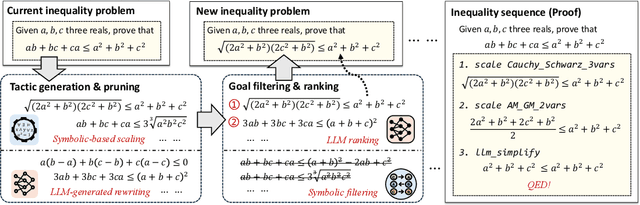


Large language models (LLMs) can prove mathematical theorems formally by generating proof steps (\textit{a.k.a.} tactics) within a proof system. However, the space of possible tactics is vast and complex, while the available training data for formal proofs is limited, posing a significant challenge to LLM-based tactic generation. To address this, we introduce a neuro-symbolic tactic generator that synergizes the mathematical intuition learned by LLMs with domain-specific insights encoded by symbolic methods. The key aspect of this integration is identifying which parts of mathematical reasoning are best suited to LLMs and which to symbolic methods. While the high-level idea of neuro-symbolic integration is broadly applicable to various mathematical problems, in this paper, we focus specifically on Olympiad inequalities (Figure~1). We analyze how humans solve these problems and distill the techniques into two types of tactics: (1) scaling, handled by symbolic methods, and (2) rewriting, handled by LLMs. In addition, we combine symbolic tools with LLMs to prune and rank the proof goals for efficient proof search. We evaluate our framework on 161 challenging inequalities from multiple mathematics competitions, achieving state-of-the-art performance and significantly outperforming existing LLM and symbolic approaches without requiring additional training data.
Multi-task Visual Grounding with Coarse-to-Fine Consistency Constraints
Jan 12, 2025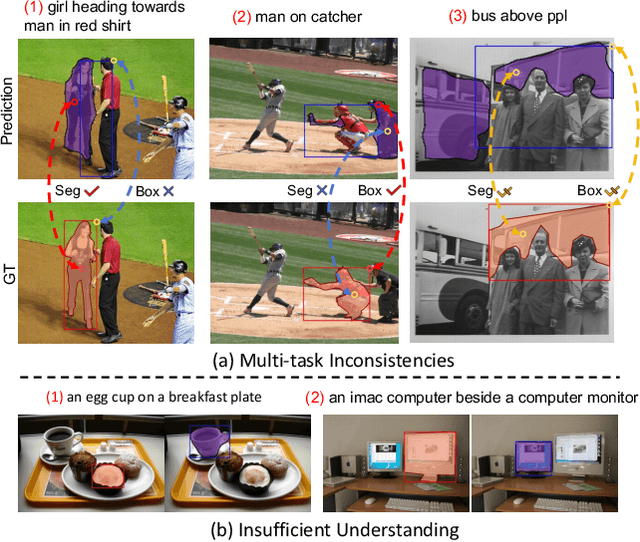


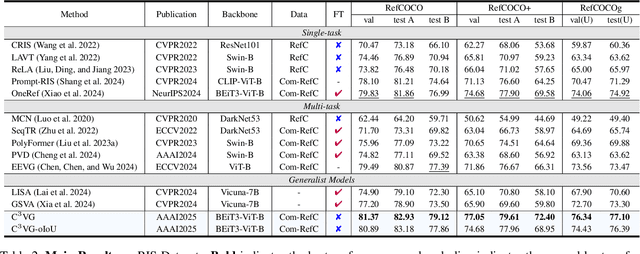
Multi-task visual grounding involves the simultaneous execution of localization and segmentation in images based on textual expressions. The majority of advanced methods predominantly focus on transformer-based multimodal fusion, aiming to extract robust multimodal representations. However, ambiguity between referring expression comprehension (REC) and referring image segmentation (RIS) is error-prone, leading to inconsistencies between multi-task predictions. Besides, insufficient multimodal understanding directly contributes to biased target perception. To overcome these challenges, we propose a Coarse-to-fine Consistency Constraints Visual Grounding architecture ($\text{C}^3\text{VG}$), which integrates implicit and explicit modeling approaches within a two-stage framework. Initially, query and pixel decoders are employed to generate preliminary detection and segmentation outputs, a process referred to as the Rough Semantic Perception (RSP) stage. These coarse predictions are subsequently refined through the proposed Mask-guided Interaction Module (MIM) and a novel explicit bidirectional consistency constraint loss to ensure consistent representations across tasks, which we term the Refined Consistency Interaction (RCI) stage. Furthermore, to address the challenge of insufficient multimodal understanding, we leverage pre-trained models based on visual-linguistic fusion representations. Empirical evaluations on the RefCOCO, RefCOCO+, and RefCOCOg datasets demonstrate the efficacy and soundness of $\text{C}^3\text{VG}$, which significantly outperforms state-of-the-art REC and RIS methods by a substantial margin. Code and model will be available at \url{https://github.com/Dmmm1997/C3VG}.
Neuro-Symbolic Data Generation for Math Reasoning
Dec 06, 2024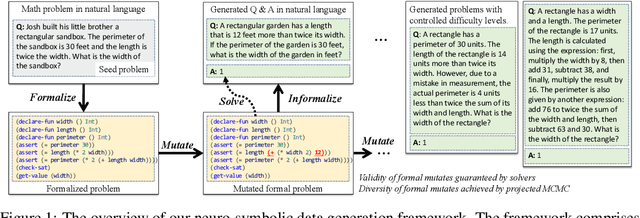
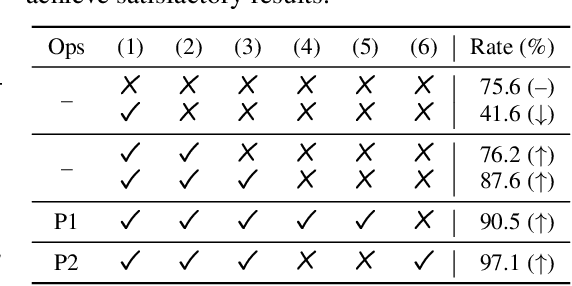
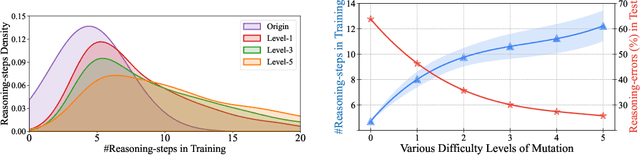
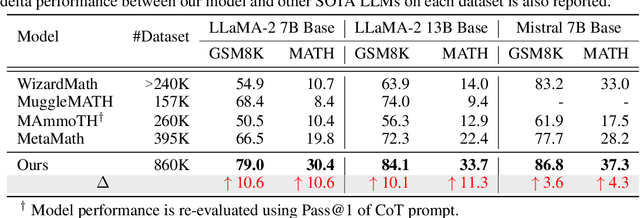
A critical question about Large Language Models (LLMs) is whether their apparent deficiency in mathematical reasoning is inherent, or merely a result of insufficient exposure to high-quality mathematical data. To explore this, we developed an automated method for generating high-quality, supervised mathematical datasets. The method carefully mutates existing math problems, ensuring both diversity and validity of the newly generated problems. This is achieved by a neuro-symbolic data generation framework combining the intuitive informalization strengths of LLMs, and the precise symbolic reasoning of math solvers along with projected Markov chain Monte Carlo sampling in the highly-irregular symbolic space. Empirical experiments demonstrate the high quality of data generated by the proposed method, and that the LLMs, specifically LLaMA-2 and Mistral, when realigned with the generated data, surpass their state-of-the-art counterparts.