 Add to Chrome
 Add to Firefox
 Add to Edge
FeedbackSTS-Det: Sparse Frames-Based Spatio-Temporal Semantic Feedback Network for Infrared Small Target Detection
Jan 21, 2026
Infrared small target detection (ISTD) under complex backgrounds remains a critical yet challenging task, primarily due to the extremely low signal-to-clutter ratio, persistent dynamic interference, and the lack of distinct target features. While multi-frame detection methods leverages temporal cues to improve upon single-frame approaches, existing methods still struggle with inefficient long-range dependency modeling and insufficient robustness. To overcome these issues, we propose a novel scheme for ISTD, realized through a sparse frames-based spatio-temporal semantic feedback network named FeedbackSTS-Det. The core of our approach is a novel spatio-temporal semantic feedback strategy with a closed-loop semantic association mechanism, which consists of paired forward and backward refinement modules that work cooperatively across the encoder and decoder. Moreover, both modules incorporate an embedded sparse semantic module (SSM), which performs structured sparse temporal modeling to capture long-range dependencies with low computational cost. This integrated design facilitates robust implicit inter-frame registration and continuous semantic refinement, effectively suppressing false alarms. Furthermore, our overall procedure maintains a consistent training-inference pipeline, which ensures reliable performance transfer and increases model robustness. Extensive experiments on multiple benchmark datasets confirm the effectiveness of FeedbackSTS-Det. Code and models are available at: https://github.com/IDIP-Lab/FeedbackSTS-Det.

ARFC-WAHNet: Adaptive Receptive Field Convolution and Wavelet-Attentive Hierarchical Network for Infrared Small Target Detection
May 15, 2025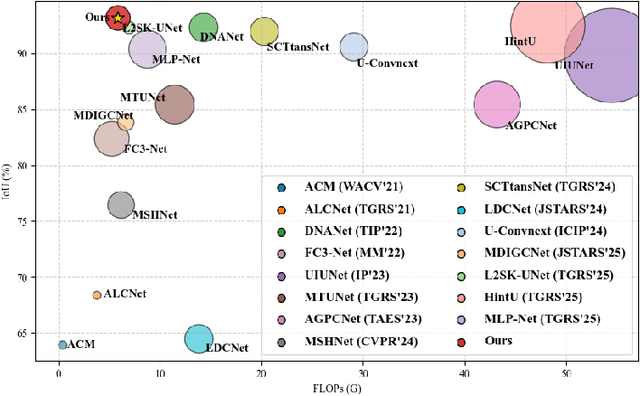
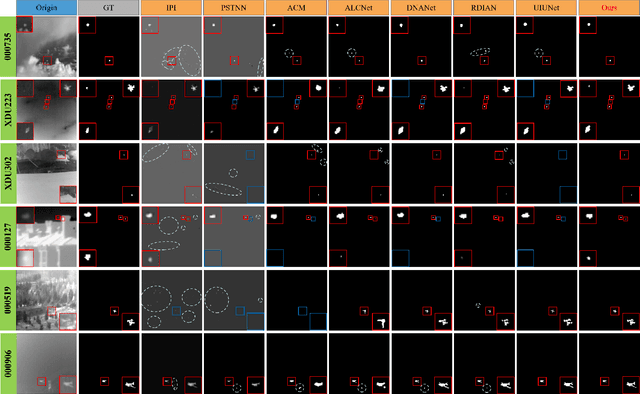
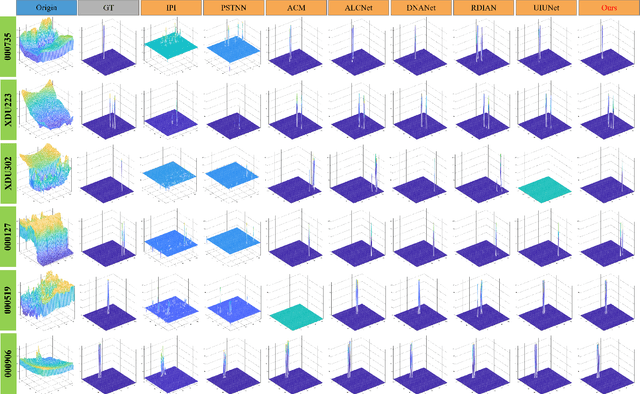
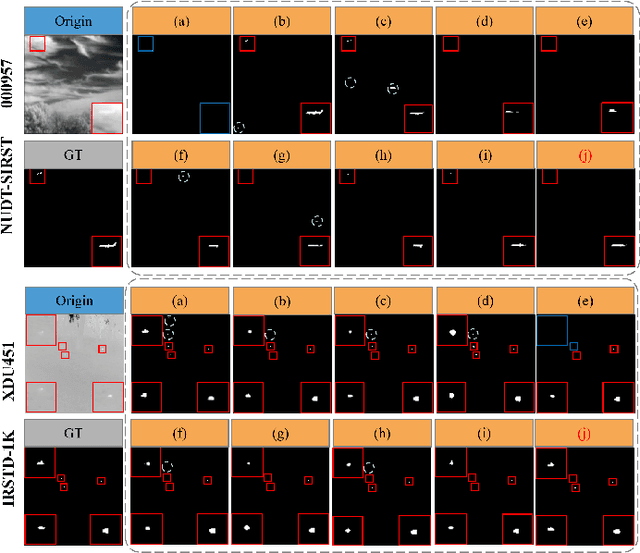
Infrared small target detection (ISTD) is critical in both civilian and military applications. However, the limited texture and structural information in infrared images makes accurate detection particularly challenging. Although recent deep learning-based methods have improved performance, their use of conventional convolution kernels limits adaptability to complex scenes and diverse targets. Moreover, pooling operations often cause feature loss and insufficient exploitation of image information. To address these issues, we propose an adaptive receptive field convolution and wavelet-attentive hierarchical network for infrared small target detection (ARFC-WAHNet). This network incorporates a multi-receptive field feature interaction convolution (MRFFIConv) module to adaptively extract discriminative features by integrating multiple convolutional branches with a gated unit. A wavelet frequency enhancement downsampling (WFED) module leverages Haar wavelet transform and frequency-domain reconstruction to enhance target features and suppress background noise. Additionally, we introduce a high-low feature fusion (HLFF) module for integrating low-level details with high-level semantics, and a global median enhancement attention (GMEA) module to improve feature diversity and expressiveness via global attention. Experiments on public datasets SIRST, NUDT-SIRST, and IRSTD-1k demonstrate that ARFC-WAHNet outperforms recent state-of-the-art methods in both detection accuracy and robustness, particularly under complex backgrounds. The code is available at https://github.com/Leaf2001/ARFC-WAHNet.