 Add to Chrome
 Add to Firefox
 Add to Edge
Vero: Can AI Agents Build Formally Verified Software Repositories?
Aug 13, 2026
AI agents are increasingly used for programming, but do not provide any guarantee on the correctness of generated code. Verified code generation, in which an agent produces both an implementation and a machine-checked proof of its specification, offers a stronger path toward trustworthy AI-generated software. Existing benchmarks in this direction either focus on individual functions or only evaluate proof generation with provided implementations. It is still an open question whether agents can make coherent implementation and proof choices across real multi-module codebases. To bridge this gap, we introduce Vero, the first benchmark to evaluate joint implementation and proof synthesis at the repository level. Vero contains 43 multi-module instances sourced from real-world repositories spanning Python, Dafny, Verus, and Coq, and covering diverse domains from cryptographic protocols to distributed systems. Each instance consists of a multi-module Lean 4 repository with predetermined API interfaces, manually curated formal specifications, and reference implementations, supporting both proof-only and code-and-proof evaluation modes. To improve benchmark reliability, Vero also includes an audit mechanism where agents are allowed to formally prove unsatisfiability of provided specification or incorrectness of reference code, which surfaces and corrects latent code and specification errors during curation. We evaluate frontier coding-agent configurations with Lean toolchain access. The strongest agent fully solves only 27 of 43 instances and closes no specifications on the hardest repositories. Vero provides a concrete testbed for measuring progress toward repository-scale verified software synthesis, where current agents still fall short. We release the benchmark, curation pipeline, and evaluation harness at https://github.com/sunblaze-ucb/vero.

P$^{3}$: Joint Program-and-Proof Planning for Verified Code Generation
Aug 10, 2026Verified code generation asks a large language model (LLM) to generate both an executable program and a machine-checkable proof that the program meets a formal specification, promising software that is correct by construction. The de facto workflow decouples the two halves of the problem: first synthesize a program, then attempt to prove it correct. We observe that this sequential pipeline can be both ineffective and inefficient in practice. A program generated without anticipating its proof can be subtly incorrect or structurally difficult to verify, forcing the LLM into brittle repair loops that alternate between patching the code and patching the proof. Inspired by Dijkstra's view that a program and its correctness argument should be developed hand in hand, we propose $P^3$, an LLM-based agentic workflow that first derives a unified program-and-proof plan from the specification, then elaborates the implementation and proof scaffold under this shared plan. To evaluate verified code generation in realistic settings, we further introduce Lean4Commit0, a repository-derived, library-level benchmark built by extracting core APIs from real-world software repositories and translating their requirements, including relational specifications across APIs, into Lean tasks. Using four frontier LLM backends, we evaluate $P^3$ on Verina, AlgoVeri, and our Lean4Commit0 benchmark, where it achieves the highest solve rate in every benchmark--model setting. Compared with the stronger baseline, it improves solve rates by 4.6--11.2 percentage points and reduces per-task API cost by up to roughly 40\% and wall-clock time by up to roughly 37\% on the difficult subset of each benchmark. A targeted ablation further shows gains of 3.3--8.3 points over implementation-only planning, isolating the benefit of planning the program and proof jointly.
Learning to Disprove: Formal Counterexample Generation with Large Language Models
Mar 19, 2026Mathematical reasoning demands two critical, complementary skills: constructing rigorous proofs for true statements and discovering counterexamples that disprove false ones. However, current AI efforts in mathematics focus almost exclusively on proof construction, often neglecting the equally important task of finding counterexamples. In this paper, we address this gap by fine-tuning large language models (LLMs) to reason about and generate counterexamples. We formalize this task as formal counterexample generation, which requires LLMs not only to propose candidate counterexamples but also to produce formal proofs that can be automatically verified in the Lean 4 theorem prover. To enable effective learning, we introduce a symbolic mutation strategy that synthesizes diverse training data by systematically extracting theorems and discarding selected hypotheses, thereby producing diverse counterexample instances. Together with curated datasets, this strategy enables a multi-reward expert iteration framework that substantially enhances both the effectiveness and efficiency of training LLMs for counterexample generation and theorem proving. Experiments on three newly collected benchmarks validate the advantages of our approach, showing that the mutation strategy and training framework yield significant performance gains.
VERINA: Benchmarking Verifiable Code Generation
May 29, 2025Large language models (LLMs) are increasingly integrated in software development, but ensuring correctness in LLM-generated code remains challenging and often requires costly manual review. Verifiable code generation -- jointly generating code, specifications, and proofs of code-specification alignment -- offers a promising path to address this limitation and further unleash LLMs' benefits in coding. Yet, there exists a significant gap in evaluation: current benchmarks often lack support for end-to-end verifiable code generation. In this paper, we introduce Verina (Verifiable Code Generation Arena), a high-quality benchmark enabling a comprehensive and modular evaluation of code, specification, and proof generation as well as their compositions. Verina consists of 189 manually curated coding tasks in Lean, with detailed problem descriptions, reference implementations, formal specifications, and extensive test suites. Our extensive evaluation of state-of-the-art LLMs reveals significant challenges in verifiable code generation, especially in proof generation, underscoring the need for improving LLM-based theorem provers in verification domains. The best model, OpenAI o4-mini, generates only 61.4% correct code, 51.0% sound and complete specifications, and 3.6% successful proofs, with one trial per task. We hope Verina will catalyze progress in verifiable code generation by providing a rigorous and comprehensive benchmark. We release our dataset on https://huggingface.co/datasets/sunblaze-ucb/verina and our evaluation code on https://github.com/sunblaze-ucb/verina.
Proving Olympiad Inequalities by Synergizing LLMs and Symbolic Reasoning
Feb 19, 2025
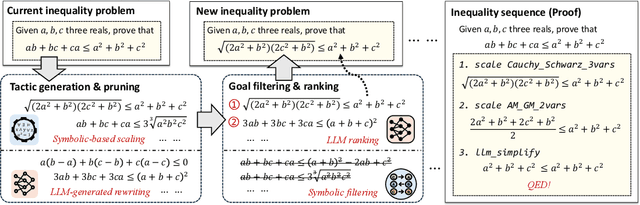


Large language models (LLMs) can prove mathematical theorems formally by generating proof steps (\textit{a.k.a.} tactics) within a proof system. However, the space of possible tactics is vast and complex, while the available training data for formal proofs is limited, posing a significant challenge to LLM-based tactic generation. To address this, we introduce a neuro-symbolic tactic generator that synergizes the mathematical intuition learned by LLMs with domain-specific insights encoded by symbolic methods. The key aspect of this integration is identifying which parts of mathematical reasoning are best suited to LLMs and which to symbolic methods. While the high-level idea of neuro-symbolic integration is broadly applicable to various mathematical problems, in this paper, we focus specifically on Olympiad inequalities (Figure~1). We analyze how humans solve these problems and distill the techniques into two types of tactics: (1) scaling, handled by symbolic methods, and (2) rewriting, handled by LLMs. In addition, we combine symbolic tools with LLMs to prune and rank the proof goals for efficient proof search. We evaluate our framework on 161 challenging inequalities from multiple mathematics competitions, achieving state-of-the-art performance and significantly outperforming existing LLM and symbolic approaches without requiring additional training data.
Spectral Journey: How Transformers Predict the Shortest Path
Feb 12, 2025Decoder-only transformers lead to a step-change in capability of large language models. However, opinions are mixed as to whether they are really planning or reasoning. A path to making progress in this direction is to study the model's behavior in a setting with carefully controlled data. Then interpret the learned representations and reverse-engineer the computation performed internally. We study decoder-only transformer language models trained from scratch to predict shortest paths on simple, connected and undirected graphs. In this setting, the representations and the dynamics learned by the model are interpretable. We present three major results: (1) Two-layer decoder-only language models can learn to predict shortest paths on simple, connected graphs containing up to 10 nodes. (2) Models learn a graph embedding that is correlated with the spectral decomposition of the line graph. (3) Following the insights, we discover a novel approximate path-finding algorithm Spectral Line Navigator (SLN) that finds shortest path by greedily selecting nodes in the space of spectral embedding of the line graph.
Goedel-Prover: A Frontier Model for Open-Source Automated Theorem Proving
Feb 11, 2025We introduce Goedel-Prover, an open-source large language model (LLM) that achieves the state-of-the-art (SOTA) performance in automated formal proof generation for mathematical problems. The key challenge in this field is the scarcity of formalized math statements and proofs, which we tackle in the following ways. We train statement formalizers to translate the natural language math problems from Numina into formal language (Lean 4), creating a dataset of 1.64 million formal statements. LLMs are used to check that the formal statements accurately preserve the content of the original natural language problems. We then iteratively build a large dataset of formal proofs by training a series of provers. Each prover succeeds in proving many statements that the previous ones could not, and these new proofs are added to the training set for the next prover. The final prover outperforms all existing open-source models in whole-proof generation. On the miniF2F benchmark, it achieves a 57.6% success rate (Pass@32), exceeding the previous best open-source model by 7.6%. On PutnamBench, Goedel-Prover successfully solves 7 problems (Pass@512), ranking first on the leaderboard. Furthermore, it generates 29.7K formal proofs for Lean Workbook problems, nearly doubling the 15.7K produced by earlier works.
Formal Mathematical Reasoning: A New Frontier in AI
Dec 20, 2024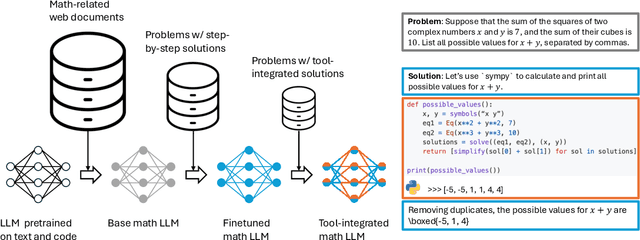
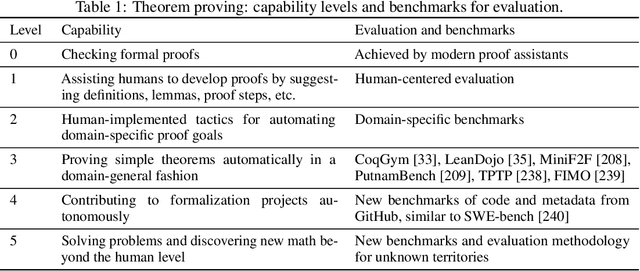
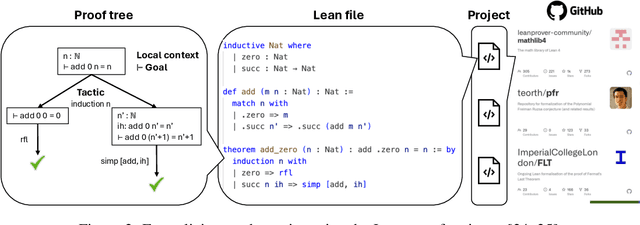
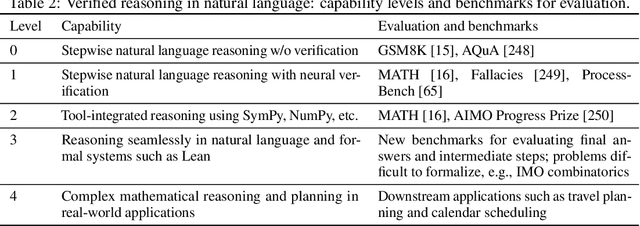
AI for Mathematics (AI4Math) is not only intriguing intellectually but also crucial for AI-driven discovery in science, engineering, and beyond. Extensive efforts on AI4Math have mirrored techniques in NLP, in particular, training large language models on carefully curated math datasets in text form. As a complementary yet less explored avenue, formal mathematical reasoning is grounded in formal systems such as proof assistants, which can verify the correctness of reasoning and provide automatic feedback. In this position paper, we advocate for formal mathematical reasoning and argue that it is indispensable for advancing AI4Math to the next level. In recent years, we have seen steady progress in using AI to perform formal reasoning, including core tasks such as theorem proving and autoformalization, as well as emerging applications such as verifiable generation of code and hardware designs. However, significant challenges remain to be solved for AI to truly master mathematics and achieve broader impact. We summarize existing progress, discuss open challenges, and envision critical milestones to measure future success. At this inflection point for formal mathematical reasoning, we call on the research community to come together to drive transformative advancements in this field.
Autoformalizing Euclidean Geometry
May 27, 2024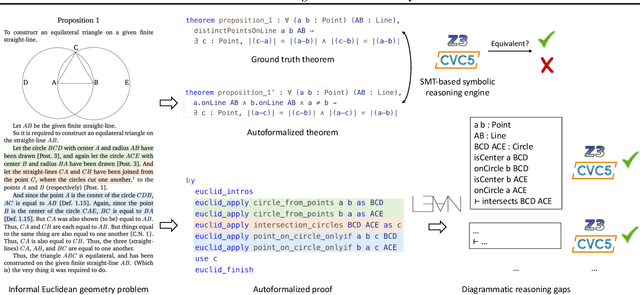
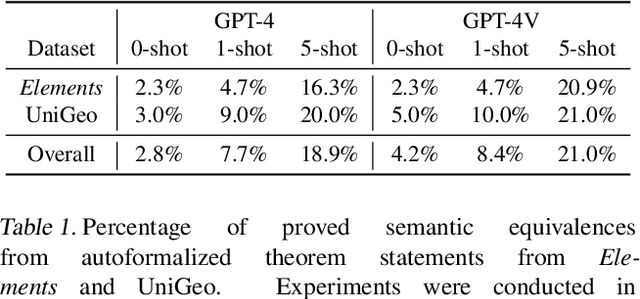
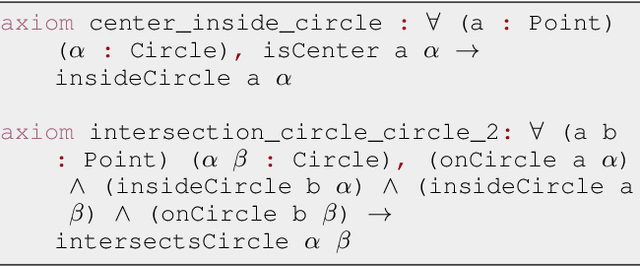
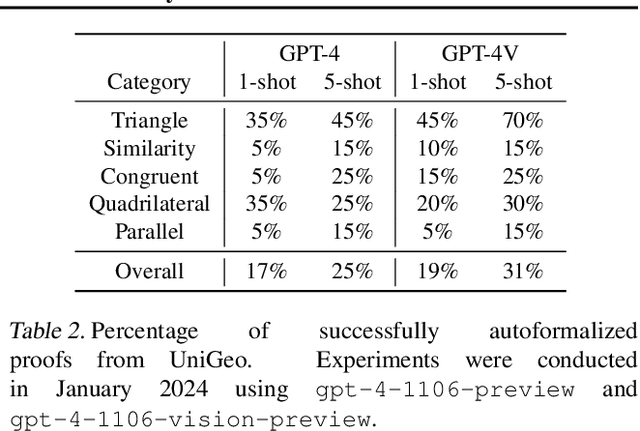
Autoformalization involves automatically translating informal math into formal theorems and proofs that are machine-verifiable. Euclidean geometry provides an interesting and controllable domain for studying autoformalization. In this paper, we introduce a neuro-symbolic framework for autoformalizing Euclidean geometry, which combines domain knowledge, SMT solvers, and large language models (LLMs). One challenge in Euclidean geometry is that informal proofs rely on diagrams, leaving gaps in texts that are hard to formalize. To address this issue, we use theorem provers to fill in such diagrammatic information automatically, so that the LLM only needs to autoformalize the explicit textual steps, making it easier for the model. We also provide automatic semantic evaluation for autoformalized theorem statements. We construct LeanEuclid, an autoformalization benchmark consisting of problems from Euclid's Elements and the UniGeo dataset formalized in the Lean proof assistant. Experiments with GPT-4 and GPT-4V show the capability and limitations of state-of-the-art LLMs on autoformalizing geometry problems. The data and code are available at https://github.com/loganrjmurphy/LeanEuclid.
Towards Large Language Models as Copilots for Theorem Proving in Lean
Apr 18, 2024Theorem proving is an important challenge for large language models (LLMs), as formal proofs can be checked rigorously by proof assistants such as Lean, leaving no room for hallucination. Existing LLM-based provers try to prove theorems in a fully autonomous mode without human intervention. In this mode, they struggle with novel and challenging theorems, for which human insights may be critical. In this paper, we explore LLMs as copilots that assist humans in proving theorems. We introduce Lean Copilot, a framework for running LLM inference in Lean. It enables programmers to build various LLM-based proof automation tools that integrate seamlessly into the workflow of Lean users. Using Lean Copilot, we build tools for suggesting proof steps (tactic suggestion), completing intermediate proof goals (proof search), and selecting relevant premises (premise selection) using LLMs. Users can use our pretrained models or bring their own ones that run either locally (with or without GPUs) or on the cloud. Experimental results demonstrate the effectiveness of our method in assisting humans and automating theorem proving process compared to existing rule-based proof automation in Lean. We open source all codes under a permissive MIT license to facilitate further research.