 Add to Chrome
 Add to Firefox
 Add to Edge
Towards Data-centric Graph Machine Learning: Review and Outlook
Sep 20, 2023
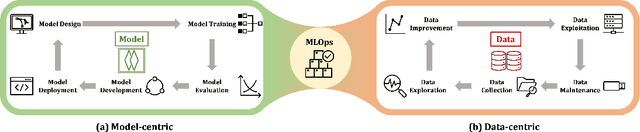
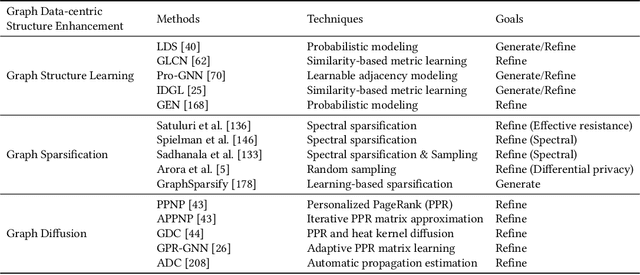
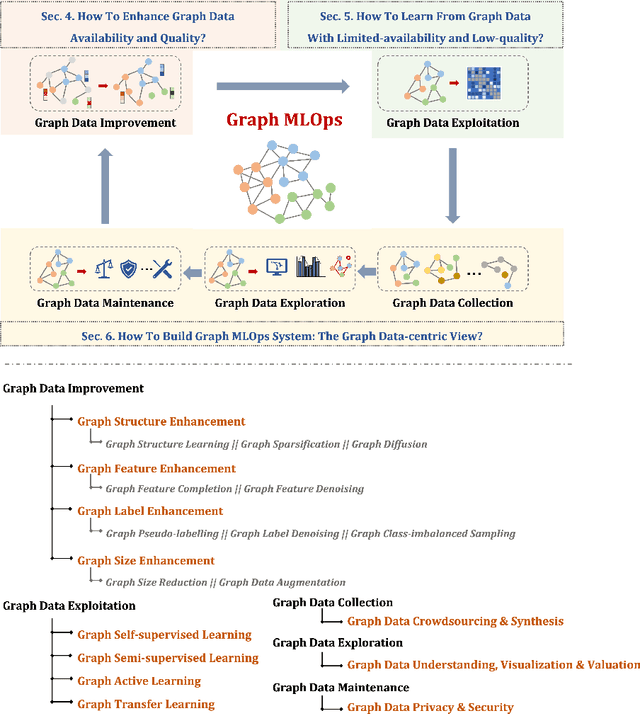
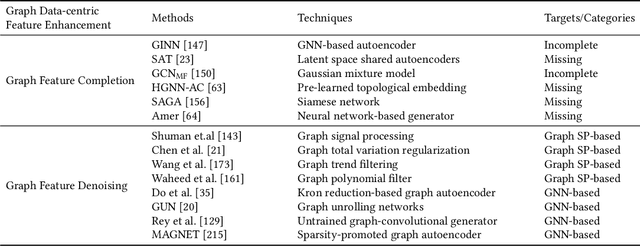
Data-centric AI, with its primary focus on the collection, management, and utilization of data to drive AI models and applications, has attracted increasing attention in recent years. In this article, we conduct an in-depth and comprehensive review, offering a forward-looking outlook on the current efforts in data-centric AI pertaining to graph data-the fundamental data structure for representing and capturing intricate dependencies among massive and diverse real-life entities. We introduce a systematic framework, Data-centric Graph Machine Learning (DC-GML), that encompasses all stages of the graph data lifecycle, including graph data collection, exploration, improvement, exploitation, and maintenance. A thorough taxonomy of each stage is presented to answer three critical graph-centric questions: (1) how to enhance graph data availability and quality; (2) how to learn from graph data with limited-availability and low-quality; (3) how to build graph MLOps systems from the graph data-centric view. Lastly, we pinpoint the future prospects of the DC-GML domain, providing insights to navigate its advancements and applications.

DiscoverPath: A Knowledge Refinement and Retrieval System for Interdisciplinarity on Biomedical Research
Sep 04, 2023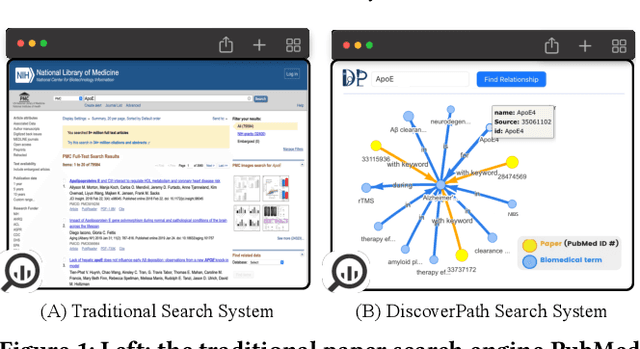


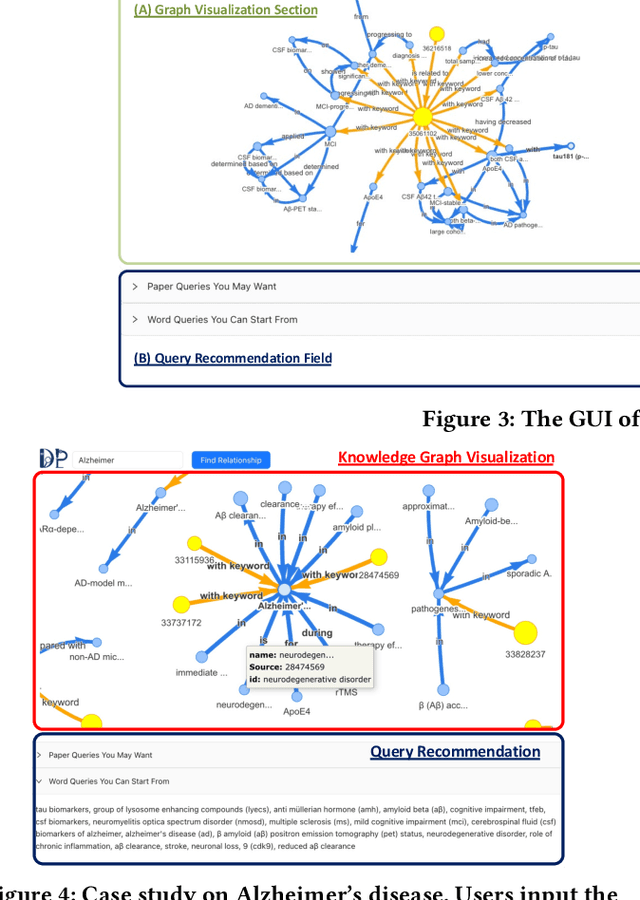
The exponential growth in scholarly publications necessitates advanced tools for efficient article retrieval, especially in interdisciplinary fields where diverse terminologies are used to describe similar research. Traditional keyword-based search engines often fall short in assisting users who may not be familiar with specific terminologies. To address this, we present a knowledge graph-based paper search engine for biomedical research to enhance the user experience in discovering relevant queries and articles. The system, dubbed DiscoverPath, employs Named Entity Recognition (NER) and part-of-speech (POS) tagging to extract terminologies and relationships from article abstracts to create a KG. To reduce information overload, DiscoverPath presents users with a focused subgraph containing the queried entity and its neighboring nodes and incorporates a query recommendation system, enabling users to iteratively refine their queries. The system is equipped with an accessible Graphical User Interface that provides an intuitive visualization of the KG, query recommendations, and detailed article information, enabling efficient article retrieval, thus fostering interdisciplinary knowledge exploration. DiscoverPath is open-sourced at https://github.com/ynchuang/DiscoverPath.
Hessian-aware Quantized Node Embeddings for Recommendation
Sep 02, 2023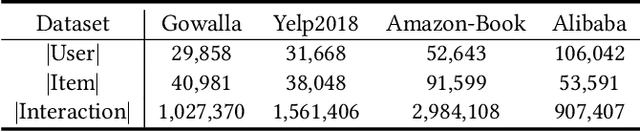
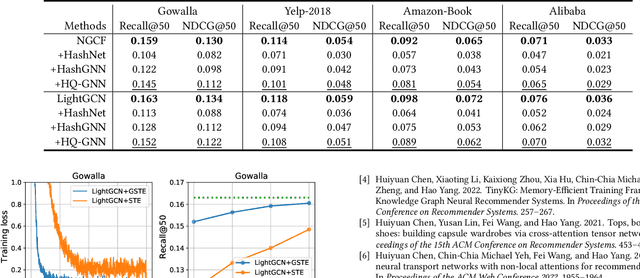

Graph Neural Networks (GNNs) have achieved state-of-the-art performance in recommender systems. Nevertheless, the process of searching and ranking from a large item corpus usually requires high latency, which limits the widespread deployment of GNNs in industry-scale applications. To address this issue, many methods compress user/item representations into the binary embedding space to reduce space requirements and accelerate inference. Also, they use the Straight-through Estimator (STE) to prevent vanishing gradients during back-propagation. However, the STE often causes the gradient mismatch problem, leading to sub-optimal results. In this work, we present the Hessian-aware Quantized GNN (HQ-GNN) as an effective solution for discrete representations of users/items that enable fast retrieval. HQ-GNN is composed of two components: a GNN encoder for learning continuous node embeddings and a quantized module for compressing full-precision embeddings into low-bit ones. Consequently, HQ-GNN benefits from both lower memory requirements and faster inference speeds compared to vanilla GNNs. To address the gradient mismatch problem in STE, we further consider the quantized errors and its second-order derivatives for better stability. The experimental results on several large-scale datasets show that HQ-GNN achieves a good balance between latency and performance.
Tackling Diverse Minorities in Imbalanced Classification
Aug 28, 2023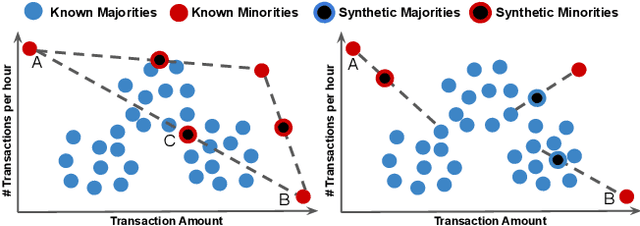

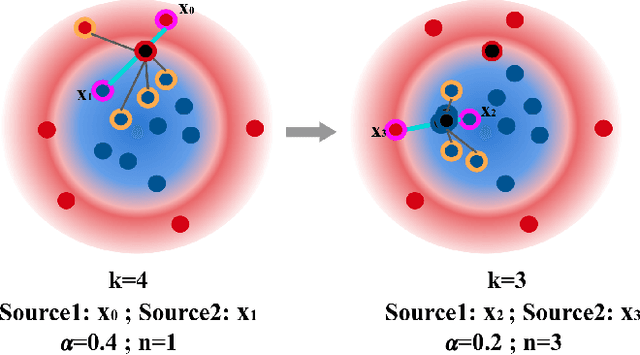

Imbalanced datasets are commonly observed in various real-world applications, presenting significant challenges in training classifiers. When working with large datasets, the imbalanced issue can be further exacerbated, making it exceptionally difficult to train classifiers effectively. To address the problem, over-sampling techniques have been developed to linearly interpolating data instances between minorities and their neighbors. However, in many real-world scenarios such as anomaly detection, minority instances are often dispersed diversely in the feature space rather than clustered together. Inspired by domain-agnostic data mix-up, we propose generating synthetic samples iteratively by mixing data samples from both minority and majority classes. It is non-trivial to develop such a framework, the challenges include source sample selection, mix-up strategy selection, and the coordination between the underlying model and mix-up strategies. To tackle these challenges, we formulate the problem of iterative data mix-up as a Markov decision process (MDP) that maps data attributes onto an augmentation strategy. To solve the MDP, we employ an actor-critic framework to adapt the discrete-continuous decision space. This framework is utilized to train a data augmentation policy and design a reward signal that explores classifier uncertainty and encourages performance improvement, irrespective of the classifier's convergence. We demonstrate the effectiveness of our proposed framework through extensive experiments conducted on seven publicly available benchmark datasets using three different types of classifiers. The results of these experiments showcase the potential and promise of our framework in addressing imbalanced datasets with diverse minorities.
Can Attention Be Used to Explain EHR-Based Mortality Prediction Tasks: A Case Study on Hemorrhagic Stroke
Aug 04, 2023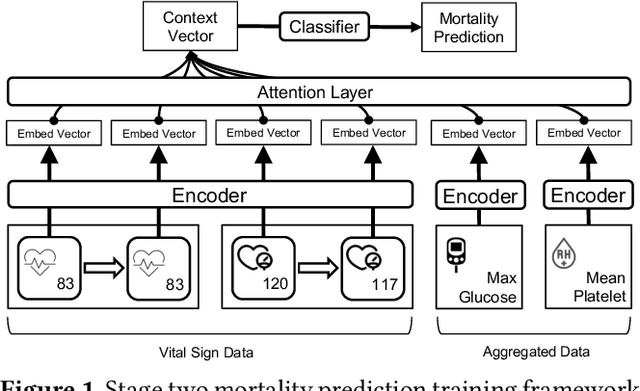
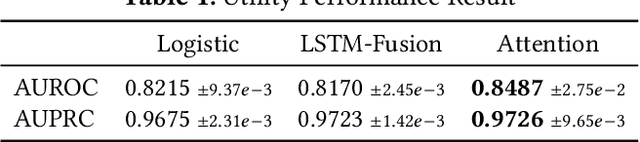
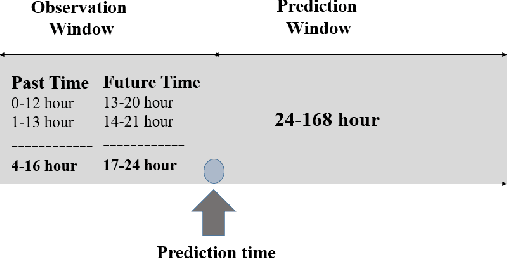
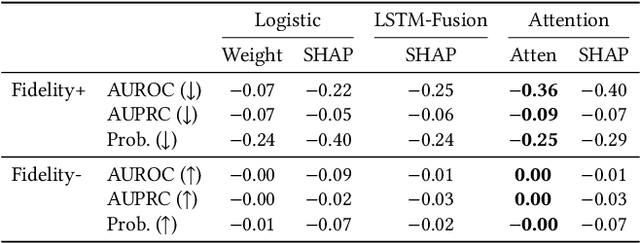
Stroke is a significant cause of mortality and morbidity, necessitating early predictive strategies to minimize risks. Traditional methods for evaluating patients, such as Acute Physiology and Chronic Health Evaluation (APACHE II, IV) and Simplified Acute Physiology Score III (SAPS III), have limited accuracy and interpretability. This paper proposes a novel approach: an interpretable, attention-based transformer model for early stroke mortality prediction. This model seeks to address the limitations of previous predictive models, providing both interpretability (providing clear, understandable explanations of the model) and fidelity (giving a truthful explanation of the model's dynamics from input to output). Furthermore, the study explores and compares fidelity and interpretability scores using Shapley values and attention-based scores to improve model explainability. The research objectives include designing an interpretable attention-based transformer model, evaluating its performance compared to existing models, and providing feature importance derived from the model.
Collaborative Graph Neural Networks for Attributed Network Embedding
Jul 22, 2023Graph neural networks (GNNs) have shown prominent performance on attributed network embedding. However, existing efforts mainly focus on exploiting network structures, while the exploitation of node attributes is rather limited as they only serve as node features at the initial layer. This simple strategy impedes the potential of node attributes in augmenting node connections, leading to limited receptive field for inactive nodes with few or even no neighbors. Furthermore, the training objectives (i.e., reconstructing network structures) of most GNNs also do not include node attributes, although studies have shown that reconstructing node attributes is beneficial. Thus, it is encouraging to deeply involve node attributes in the key components of GNNs, including graph convolution operations and training objectives. However, this is a nontrivial task since an appropriate way of integration is required to maintain the merits of GNNs. To bridge the gap, in this paper, we propose COllaborative graph Neural Networks--CONN, a tailored GNN architecture for attribute network embedding. It improves model capacity by 1) selectively diffusing messages from neighboring nodes and involved attribute categories, and 2) jointly reconstructing node-to-node and node-to-attribute-category interactions via cross-correlation. Experiments on real-world networks demonstrate that CONN excels state-of-the-art embedding algorithms with a great margin.
Towards Assumption-free Bias Mitigation
Jul 09, 2023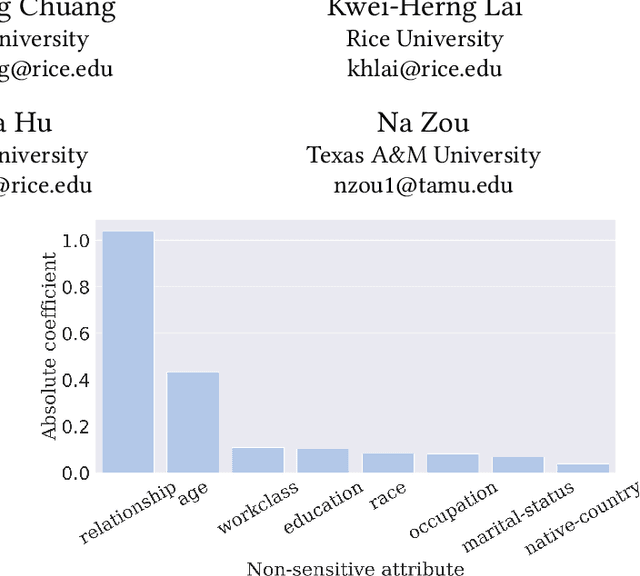
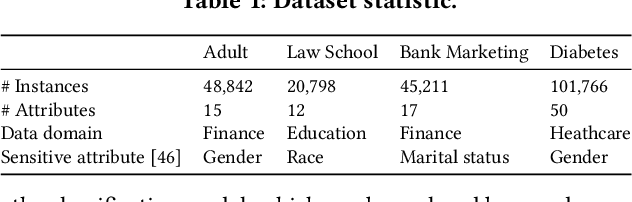
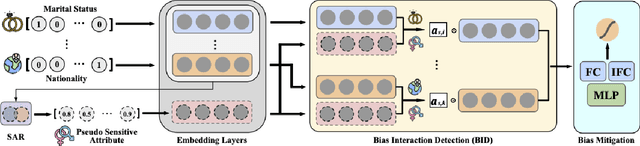
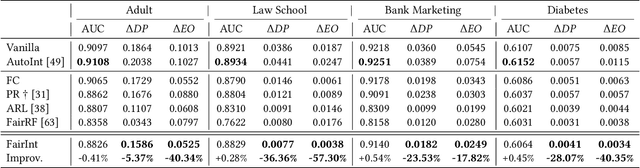
Despite the impressive prediction ability, machine learning models show discrimination towards certain demographics and suffer from unfair prediction behaviors. To alleviate the discrimination, extensive studies focus on eliminating the unequal distribution of sensitive attributes via multiple approaches. However, due to privacy concerns, sensitive attributes are often either unavailable or missing in real-world scenarios. Therefore, several existing works alleviate the bias without sensitive attributes. Those studies face challenges, either in inaccurate predictions of sensitive attributes or the need to mitigate unequal distribution of manually defined non-sensitive attributes related to bias. The latter requires strong assumptions about the correlation between sensitive and non-sensitive attributes. As data distribution and task goals vary, the strong assumption on non-sensitive attributes may not be valid and require domain expertise. In this work, we propose an assumption-free framework to detect the related attributes automatically by modeling feature interaction for bias mitigation. The proposed framework aims to mitigate the unfair impact of identified biased feature interactions. Experimental results on four real-world datasets demonstrate that our proposed framework can significantly alleviate unfair prediction behaviors by considering biased feature interactions.
FFB: A Fair Fairness Benchmark for In-Processing Group Fairness Methods
Jun 15, 2023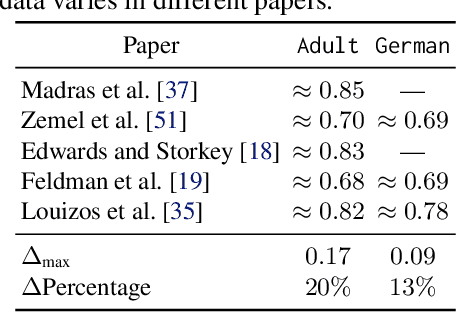
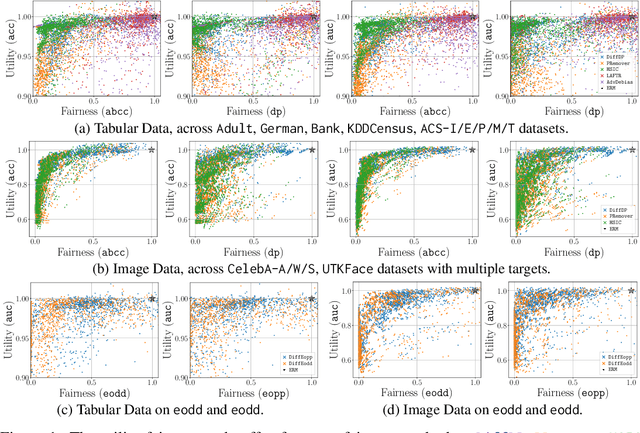
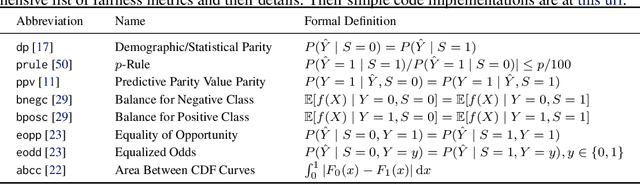
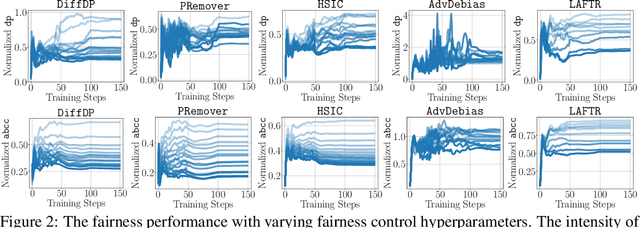
This paper introduces the Fair Fairness Benchmark (\textsf{FFB}), a benchmarking framework for in-processing group fairness methods. Ensuring fairness in machine learning is critical for ethical and legal compliance. However, there exist challenges in comparing and developing of fairness methods due to inconsistencies in experimental settings, lack of accessible algorithmic implementations, and limited extensibility of current fairness packages and tools. To address these issues, we introduce an open-source, standardized benchmark for evaluating in-processing group fairness methods and provide a comprehensive analysis of state-of-the-art methods to ensure different notions of group fairness. This work offers the following key contributions: the provision of flexible, extensible, minimalistic, and research-oriented open-source code; the establishment of unified fairness method benchmarking pipelines; and extensive benchmarking, which yields key insights from $\mathbf{45,079}$ experiments. We believe our work will significantly facilitate the growth and development of the fairness research community. The benchmark, including code and running logs, is available at https://github.com/ahxt/fair_fairness_benchmark
Efficient GNN Explanation via Learning Removal-based Attribution
Jun 09, 2023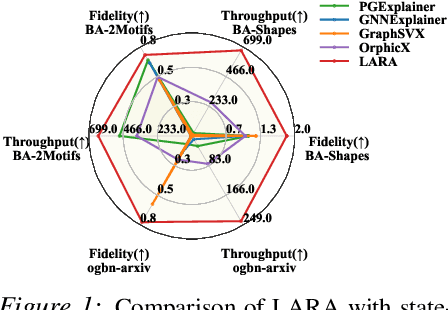

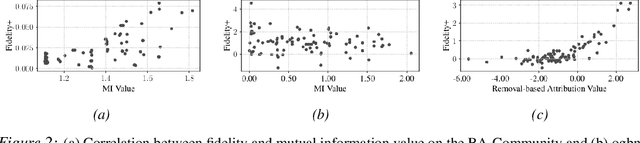
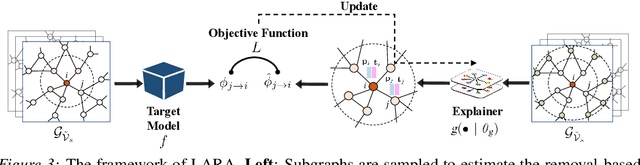
As Graph Neural Networks (GNNs) have been widely used in real-world applications, model explanations are required not only by users but also by legal regulations. However, simultaneously achieving high fidelity and low computational costs in generating explanations has been a challenge for current methods. In this work, we propose a framework of GNN explanation named LeArn Removal-based Attribution (LARA) to address this problem. Specifically, we introduce removal-based attribution and demonstrate its substantiated link to interpretability fidelity theoretically and experimentally. The explainer in LARA learns to generate removal-based attribution which enables providing explanations with high fidelity. A strategy of subgraph sampling is designed in LARA to improve the scalability of the training process. In the deployment, LARA can efficiently generate the explanation through a feed-forward pass. We benchmark our approach with other state-of-the-art GNN explanation methods on six datasets. Results highlight the effectiveness of our framework regarding both efficiency and fidelity. In particular, LARA is 3.5 times faster and achieves higher fidelity than the state-of-the-art method on the large dataset ogbn-arxiv (more than 160K nodes and 1M edges), showing its great potential in real-world applications. Our source code is available at https://anonymous.4open.science/r/LARA-10D8/README.md.
Editable Graph Neural Network for Node Classifications
May 24, 2023Despite Graph Neural Networks (GNNs) have achieved prominent success in many graph-based learning problem, such as credit risk assessment in financial networks and fake news detection in social networks. However, the trained GNNs still make errors and these errors may cause serious negative impact on society. \textit{Model editing}, which corrects the model behavior on wrongly predicted target samples while leaving model predictions unchanged on unrelated samples, has garnered significant interest in the fields of computer vision and natural language processing. However, model editing for graph neural networks (GNNs) is rarely explored, despite GNNs' widespread applicability. To fill the gap, we first observe that existing model editing methods significantly deteriorate prediction accuracy (up to $50\%$ accuracy drop) in GNNs while a slight accuracy drop in multi-layer perception (MLP). The rationale behind this observation is that the node aggregation in GNNs will spread the editing effect throughout the whole graph. This propagation pushes the node representation far from its original one. Motivated by this observation, we propose \underline{E}ditable \underline{G}raph \underline{N}eural \underline{N}etworks (EGNN), a neighbor propagation-free approach to correct the model prediction on misclassified nodes. Specifically, EGNN simply stitches an MLP to the underlying GNNs, where the weights of GNNs are frozen during model editing. In this way, EGNN disables the propagation during editing while still utilizing the neighbor propagation scheme for node prediction to obtain satisfactory results. Experiments demonstrate that EGNN outperforms existing baselines in terms of effectiveness (correcting wrong predictions with lower accuracy drop), generalizability (correcting wrong predictions for other similar nodes), and efficiency (low training time and memory) on various graph datasets.