 Add to Chrome
 Add to Firefox
 Add to Edge
Clarify Before Executing: A Self-Evolving Agent for Resolving Intent Asymmetry in 3D Tool Orchestration
Jul 17, 2026
A fundamental intent asymmetry plagues modern 3D asset creation: while state-of-the-art 3D toolchains demand precise, executable parameters, ordinary users typically provide vague, underspecified instructions. Current 3D agents treat this ambiguity as noise, defaulting to blind execution under a single-turn assumption. To address this limitation, we introduce CLARE, a clarification-aware and evolutionary 3D agent that treats intent asymmetry not as an execution error, but as an opportunity for strategic dialogue. By decoupling the generation pipeline into four specialized cognitive roles, CLARE intercepts and resolves underspecified instructions before invoking computationally expensive 3D tools to seamlessly execute tasks across five diverse domains: text-to-3D generation, single-view reconstruction, multi-view reconstruction, point cloud editing, and post-processing. Crucially, rather than relying on rigid manual rules, CLARE self-evolves its clarification policy via simulated multi-turn interactions. By optimizing a Multi-turn Reward, the agent internalizes the delicate balance between interaction efficiency and task completion. To rigorously test this, we construct 3D-Clarify, a comprehensive benchmark comprising 620 interaction scenarios with systematically injected ambiguity, missing information, and mistaken details. CLARE achieves state-of-the-art performance, with 60.40% and 43.34% success rates on single-step and multi-step tasks, respectively, more than doubling existing baselines. Both quantitative and qualitative results demonstrate that proactive clarification is the missing key to robust 3D execution. Code is available at https://github.com/xyzhu1225/CLARE.

TerraZero: Procedural Driving Simulation for Zero-Demonstration Self-Play at Scale
Jul 14, 2026Training robust autonomous driving agents requires a simulator that is fast enough for reinforcement learning at scale, realistic enough to ground behavior in real-world map structure, and diverse enough to cover the safety-critical long tail that logged data rarely contains. We present TerraZero, a procedural driving simulator and self-play training stack. A configurable C engine runs simulation on the CPU and policy inference on the GPU over a zero-copy path, sustaining 1.3M agent-steps per second on a single server-grade GPU, far faster than existing object-level simulators, while keeping fidelity lighter single-agent systems omit: heterogeneous agents, multiple dynamics models, and full traffic-rule enforcement. TerraZero treats logged data only as a source of real-world map geometry, populating each map with randomized rule-based road users and signal controllers and randomizing agent dynamics, rewards, and sizes per episode, so a map yields an unbounded set of scenarios. Every reported policy trains from scratch by reinforcement learning alone on a compute-efficient self-play recipe across GPUs, with zero human demonstrations and no fallback planner at inference. Policies generalize zero-shot across cities and datasets, including emergent left-hand-traffic driving without explicit supervision. As an ego policy, TerraZero is the first fully learned policy to top the InterPlan long-tail benchmark, ahead of larger learned planners; on routine-driving val14 it ranks among the best approaches and is the safest, posting the best collision and time-to-collision scores. On Waymo Open Sim Agents realism the same recipe outperforms other demonstration-free methods and is competitive with the strongest reference-anchored self-play method. One stack serves both roles: driving policies across dynamics for cars and trucks, and sim agents that jointly control vehicles, pedestrians, and cyclists.
TerraTransfer: Learning End-to-End Driving Policies Without Expert Demonstrations
Jun 16, 2026End-to-end autonomous driving has achieved state-of-the-art performance on benchmarks and real-world deployments. Its standard training recipe, however, is expensive across all stages: collecting and labeling millions of driving frames is costly, and closed-loop RL on images is bottlenecked by the per-step cost of photorealistic rendering plus a forward pass through a large vision backbone. Self-play in vectorized simulators changes the economics: millions of rollout steps per second, and a state distribution naturally rich in collisions, near-misses, and recoveries that no driving log contains. Our approach exploits this asymmetry by decoupling learning to drive from learning to see. We pretrain a single policy by self-play, then align its latent space with a pretrained vision backbone, through the action KL divergence and a batch-relational low-rank structural loss. The action target comes from the self-play policy, so alignment never supervises against a logged trajectory: a paired dataset of (image, scene-state) frames suffices, with no need for the curated expert demonstrations that imitation pretraining is built on. On photorealistic 3D Gaussian splatting closed-loop scenarios, the resulting end-to-end policy matches or exceeds prior end-to-end methods.
Towards Long-horizon Embodied Agents with Tool-Aligned Vision-Language-Action Models
May 13, 2026Vision-language-action (VLA) models are effective robot action executors, but they remain limited on long-horizon tasks due to the dual burden of extended closed-loop planning and diverse physical operations. We therefore propose VLAs-as-Tools, a strategy that distributes this burden across a high-level vision language model (VLM) agent for temporal reasoning and a family of specialized VLA tools for diverse local physical operations. The VLM handles scene analysis, global planning, and recovery, while each VLA tool executes a bounded subtask. To tightly couple agent planning with VLA tool execution in long-horizon tasks, we introduce a VLA tool-family interface that exposes explicit tool selection and in-execution progress feedback, enabling efficient event-triggered agent replanning without continuous agent polling. To obtain diverse specialized VLA tools that faithfully follow agent invocations, we further propose Tool-Aligned Post-Training (TAPT), which constructs invocation-aligned training units for instruction following and adopts tool-family residual adapters for efficient tool specialization. Experiments show that VLAs-as-Tools improves the success rate of $π_{0.5}$ by 4.8 points on LIBERO-Long and 23.1 points on RoboTwin, and further enhances invocation fidelity by 15.0 points as measured by Non-biased Rate. Code will be released.
Online Reasoning Video Object Segmentation
Apr 13, 2026Reasoning video object segmentation predicts pixel-level masks in videos from natural-language queries that may involve implicit and temporally grounded references. However, existing methods are developed and evaluated in an offline regime, where the entire video is available at inference time and future frames can be exploited for retrospective disambiguation, deviating from real-world deployments that require strictly causal, frame-by-frame decisions. We study Online Reasoning Video Object Segmentation (ORVOS), where models must incrementally interpret queries using only past and current frames without revisiting previous predictions, while handling referent shifts as events unfold. To support evaluation, we introduce ORVOSB, a benchmark with frame-level causal annotations and referent-shift labels, comprising 210 videos, 12,907 annotated frames, and 512 queries across five reasoning categories. We further propose a baseline with continually-updated segmentation prompts and a structured temporal token reservoir for long-horizon reasoning under bounded computation. Experiments show that existing methods struggle under strict causality and referent shifts, while our baseline establishes a strong foundation for future research.
Memory-Efficient Transfer Learning with Fading Side Networks via Masked Dual Path Distillation
Apr 10, 2026Memory-efficient transfer learning (METL) approaches have recently achieved promising performance in adapting pre-trained models to downstream tasks. They avoid applying gradient backpropagation in large backbones, thus significantly reducing the number of trainable parameters and high memory consumption during fine-tuning. However, since they typically employ a lightweight and learnable side network, these methods inevitably introduce additional memory and time overhead during inference, which contradicts the ultimate goal of efficient transfer learning. To address the above issue, we propose a novel approach dubbed Masked Dual Path Distillation (MDPD) to accelerate inference while retaining parameter and memory efficiency in fine-tuning with fading side networks. Specifically, MDPD develops a framework that enhances the performance by mutually distilling the frozen backbones and learnable side networks in fine-tuning, and discard the side network during inference without sacrificing accuracy. Moreover, we design a novel feature-based knowledge distillation method for the encoder structure with multiple layers. Extensive experiments on distinct backbones across vision/language-only and vision-and-language tasks demonstrate that our method not only accelerates inference by at least 25.2\% while keeping parameter and memory consumption comparable, but also remarkably promotes the accuracy compared to SOTA approaches. The source code is available at https://github.com/Zhang-VKk/MDPD.
FutureVLA: Joint Visuomotor Prediction for Vision-Language-Action Model
Mar 11, 2026Predictive foresight is important to intelligent embodied agents. Since the motor execution of a robot is intrinsically constrained by its visual perception of environmental geometry, effectively anticipating the future requires capturing this tightly coupled visuomotor interplay. While recent vision-language-action models attempt to incorporate future guidance, they struggle with this joint modeling. Existing explicit methods divert capacity to task-irrelevant visual details, whereas implicit methods relying on sparse frame pairs disrupt temporal continuity. By heavily relying on visual reconstruction, these methods become visually dominated, entangling static scene context with dynamic action intent. We argue that effective joint visuomotor predictive modeling requires both temporal continuity and visually-conditioned supervision decoupling. To this end, we propose FutureVLA, featuring a novel Joint Visuomotor Predictive Architecture. FutureVLA is designed to extract joint visuomotor embeddings by first decoupling visual and motor information, and then jointly encoding generalized physical priors. Specifically, in the pretraining stage, we leverage heterogeneous manipulation datasets and introduce a Joint Visuomotor Gating mechanism to structurally separate visual state preservation from temporal action modeling. It allows the motor stream to focus on continuous physical dynamics while explicitly querying visual tokens for environmental constraints, yielding highly generalizable joint visuomotor embeddings. Subsequently, in the post-training stage, we employ a latent embeddings alignment strategy, enabling diverse downstream VLA models to internalize these temporal priors without modifying their inference architectures. Extensive experiments demonstrate that FutureVLA consistently improves VLA frameworks.
Memory-Guided View Refinement for Dynamic Human-in-the-loop EQA
Mar 10, 2026Embodied Question Answering (EQA) has traditionally been evaluated in temporally stable environments where visual evidence can be accumulated reliably. However, in dynamic, human-populated scenes, human activities and occlusions introduce significant perceptual non-stationarity: task-relevant cues are transient and view-dependent, while a store-then-retrieve strategy over-accumulates redundant evidence and increases inference cost. This setting exposes two practical challenges for EQA agents: resolving ambiguity caused by viewpoint-dependent occlusions, and maintaining compact yet up-to-date evidence for efficient inference. To enable systematic study of this setting, we introduce DynHiL-EQA, a human-in-the-loop EQA dataset with two subsets: a Dynamic subset featuring human activities and temporal changes, and a Static subset with temporally stable observations. To address the above challenges, we present DIVRR (Dynamic-Informed View Refinement and Relevance-guided Adaptive Memory Selection), a training-free framework that couples relevance-guided view refinement with selective memory admission. By verifying ambiguous observations before committing them and retaining only informative evidence, DIVRR improves robustness under occlusions while preserving fast inference with compact memory. Extensive experiments on DynHiL-EQA and the established HM-EQA dataset demonstrate that DIVRR consistently improves over existing baselines in both dynamic and static settings while maintaining high inference efficiency.
MSGNav: Unleashing the Power of Multi-modal 3D Scene Graph for Zero-Shot Embodied Navigation
Nov 14, 2025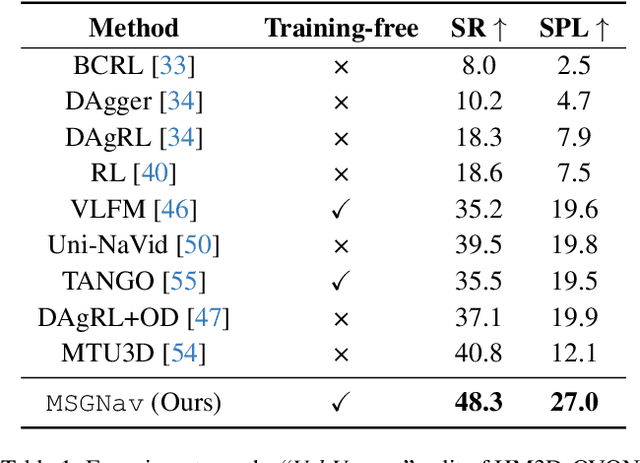
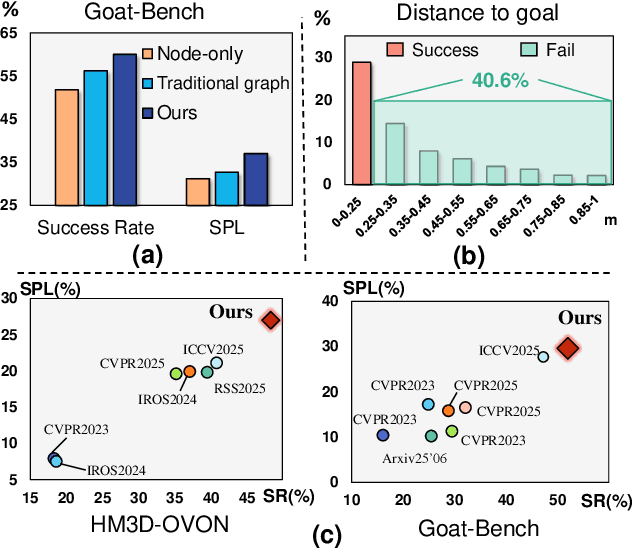
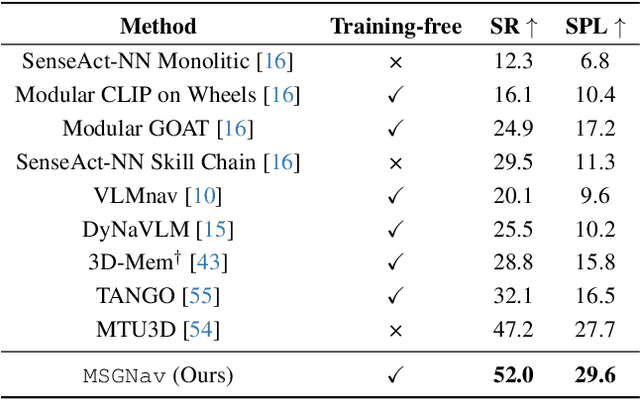
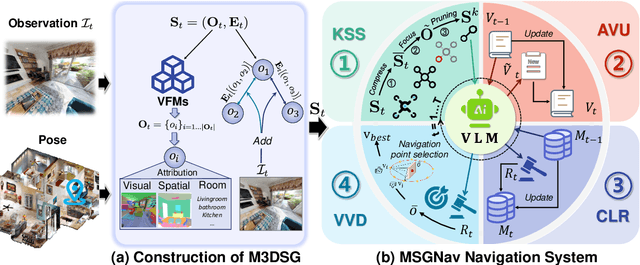
Embodied navigation is a fundamental capability for robotic agents operating. Real-world deployment requires open vocabulary generalization and low training overhead, motivating zero-shot methods rather than task-specific RL training. However, existing zero-shot methods that build explicit 3D scene graphs often compress rich visual observations into text-only relations, leading to high construction cost, irreversible loss of visual evidence, and constrained vocabularies. To address these limitations, we introduce the Multi-modal 3D Scene Graph (M3DSG), which preserves visual cues by replacing textual relation
PolySim: Bridging the Sim-to-Real Gap for Humanoid Control via Multi-Simulator Dynamics Randomization
Oct 02, 2025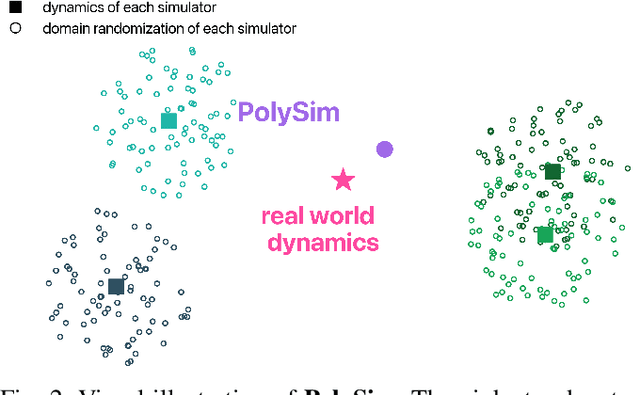
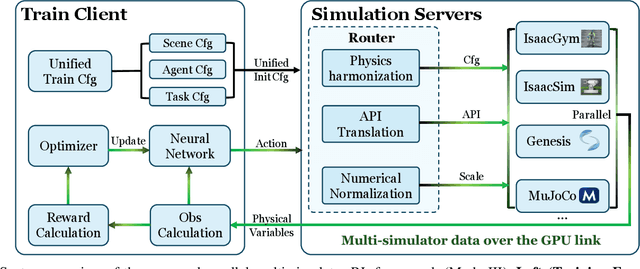
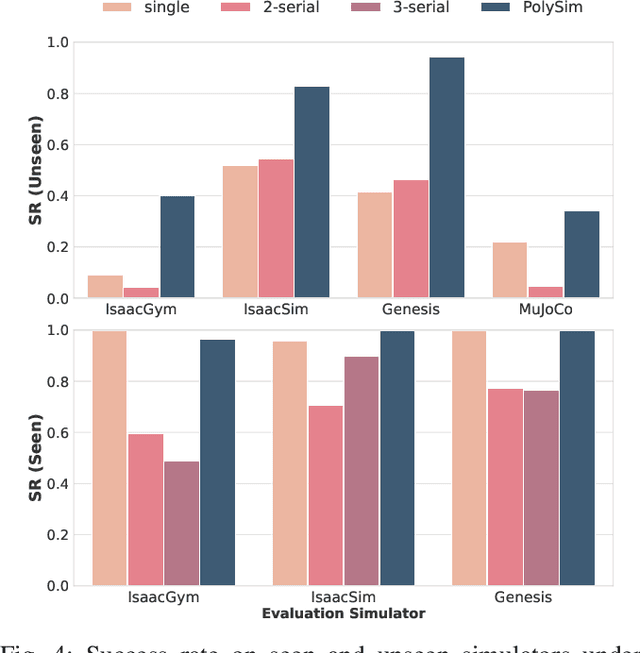
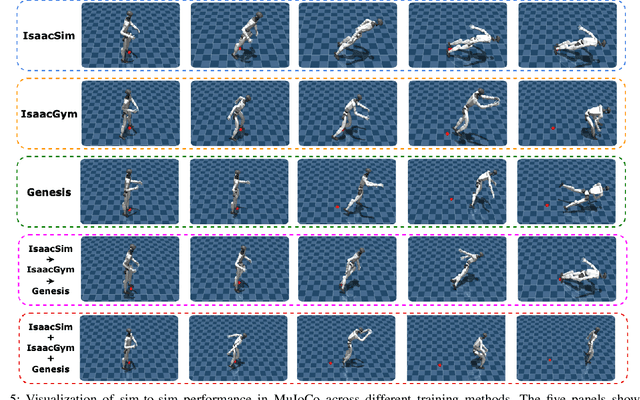
Humanoid whole-body control (WBC) policies trained in simulation often suffer from the sim-to-real gap, which fundamentally arises from simulator inductive bias, the inherent assumptions and limitations of any single simulator. These biases lead to nontrivial discrepancies both across simulators and between simulation and the real world. To mitigate the effect of simulator inductive bias, the key idea is to train policies jointly across multiple simulators, encouraging the learned controller to capture dynamics that generalize beyond any single simulator's assumptions. We thus introduce PolySim, a WBC training platform that integrates multiple heterogeneous simulators. PolySim can launch parallel environments from different engines simultaneously within a single training run, thereby realizing dynamics-level domain randomization. Theoretically, we show that PolySim yields a tighter upper bound on simulator inductive bias than single-simulator training. In experiments, PolySim substantially reduces motion-tracking error in sim-to-sim evaluations; for example, on MuJoCo, it improves execution success by 52.8 over an IsaacSim baseline. PolySim further enables zero-shot deployment on a real Unitree G1 without additional fine-tuning, showing effective transfer from simulation to the real world. We will release the PolySim code upon acceptance of this work.