 Add to Chrome
 Add to Firefox
 Add to Edge
Large-Scale Actionless Video Pre-Training via Discrete Diffusion for Efficient Policy Learning
Feb 22, 2024
Learning a generalist embodied agent capable of completing multiple tasks poses challenges, primarily stemming from the scarcity of action-labeled robotic datasets. In contrast, a vast amount of human videos exist, capturing intricate tasks and interactions with the physical world. Promising prospects arise for utilizing actionless human videos for pre-training and transferring the knowledge to facilitate robot policy learning through limited robot demonstrations. In this paper, we introduce a novel framework that leverages a unified discrete diffusion to combine generative pre-training on human videos and policy fine-tuning on a small number of action-labeled robot videos. We start by compressing both human and robot videos into unified video tokens. In the pre-training stage, we employ a discrete diffusion model with a mask-and-replace diffusion strategy to predict future video tokens in the latent space. In the fine-tuning stage, we harness the imagined future videos to guide low-level action learning trained on a limited set of robot data. Experiments demonstrate that our method generates high-fidelity future videos for planning and enhances the fine-tuned policies compared to previous state-of-the-art approaches with superior generalization ability. Our project website is available at https://video-diff.github.io/.

Entropy-Regularized Token-Level Policy Optimization for Large Language Models
Feb 09, 2024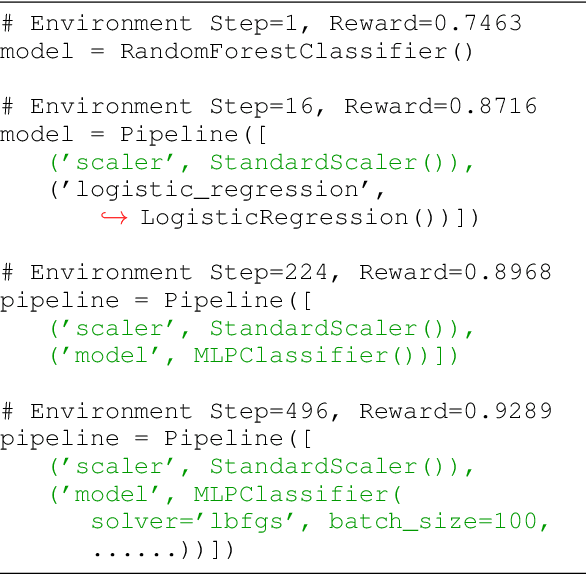
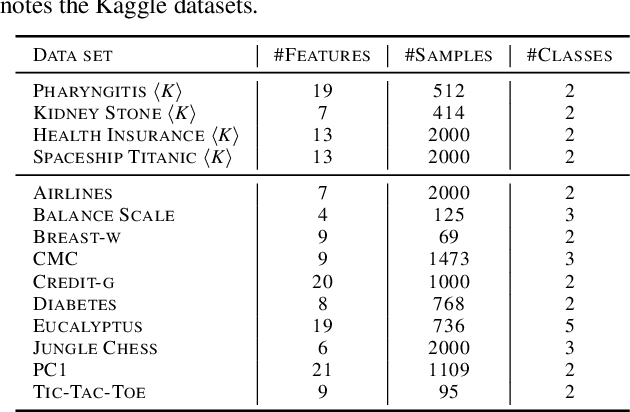
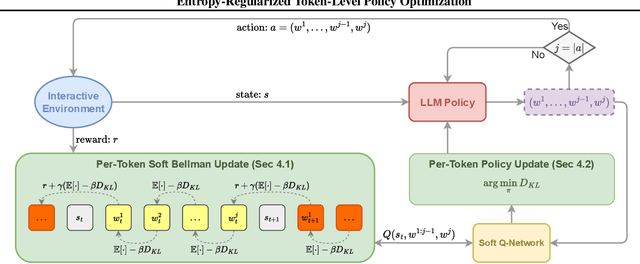
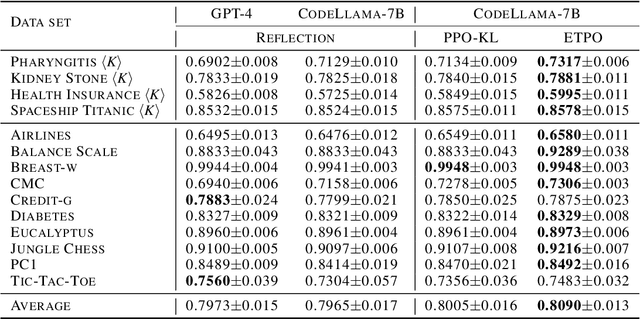
Large Language Models (LLMs) have shown promise as intelligent agents in interactive decision-making tasks. Traditional approaches often depend on meticulously designed prompts, high-quality examples, or additional reward models for in-context learning, supervised fine-tuning, or RLHF. Reinforcement learning (RL) presents a dynamic alternative for LLMs to overcome these dependencies by engaging directly with task-specific environments. Nonetheless, it faces significant hurdles: 1) instability stemming from the exponentially vast action space requiring exploration; 2) challenges in assigning token-level credit based on action-level reward signals, resulting in discord between maximizing rewards and accurately modeling corpus data. In response to these challenges, we introduce Entropy-Regularized Token-level Policy Optimization (ETPO), an entropy-augmented RL method tailored for optimizing LLMs at the token level. At the heart of ETPO is our novel per-token soft Bellman update, designed to harmonize the RL process with the principles of language modeling. This methodology decomposes the Q-function update from a coarse action-level view to a more granular token-level perspective, backed by theoretical proof of optimization consistency. Crucially, this decomposition renders linear time complexity in action exploration. We assess the effectiveness of ETPO within a simulated environment that models data science code generation as a series of multi-step interactive tasks; results show that ETPO achieves effective performance improvement on the CodeLlama-7B model and surpasses a variant PPO baseline inherited from RLHF. This underlines ETPO's potential as a robust method for refining the interactive decision-making capabilities of LLMs.
CityFlowER: An Efficient and Realistic Traffic Simulator with Embedded Machine Learning Models
Feb 09, 2024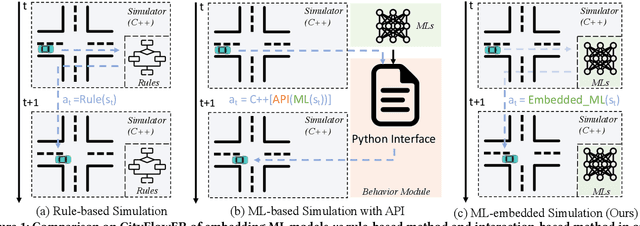
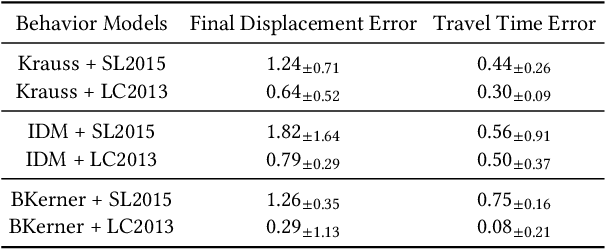
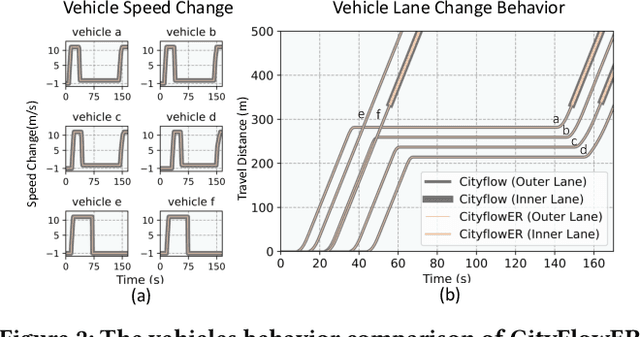
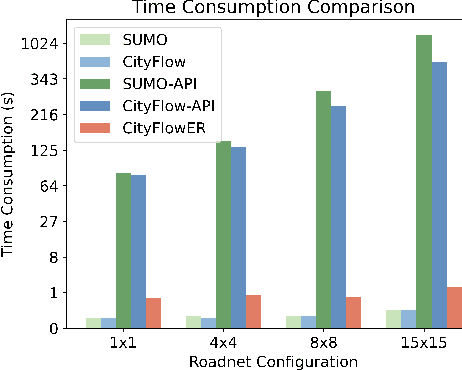
Traffic simulation is an essential tool for transportation infrastructure planning, intelligent traffic control policy learning, and traffic flow analysis. Its effectiveness relies heavily on the realism of the simulators used. Traditional traffic simulators, such as SUMO and CityFlow, are often limited by their reliance on rule-based models with hyperparameters that oversimplify driving behaviors, resulting in unrealistic simulations. To enhance realism, some simulators have provided Application Programming Interfaces (APIs) to interact with Machine Learning (ML) models, which learn from observed data and offer more sophisticated driving behavior models. However, this approach faces challenges in scalability and time efficiency as vehicle numbers increase. Addressing these limitations, we introduce CityFlowER, an advancement over the existing CityFlow simulator, designed for efficient and realistic city-wide traffic simulation. CityFlowER innovatively pre-embeds ML models within the simulator, eliminating the need for external API interactions and enabling faster data computation. This approach allows for a blend of rule-based and ML behavior models for individual vehicles, offering unparalleled flexibility and efficiency, particularly in large-scale simulations. We provide detailed comparisons with existing simulators, implementation insights, and comprehensive experiments to demonstrate CityFlowER's superiority in terms of realism, efficiency, and adaptability.
Contrastive Diffuser: Planning Towards High Return States via Contrastive Learning
Feb 06, 2024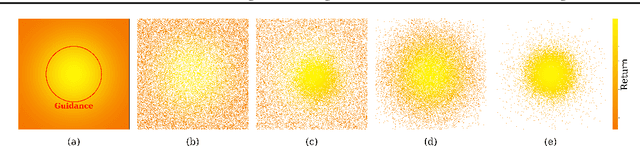
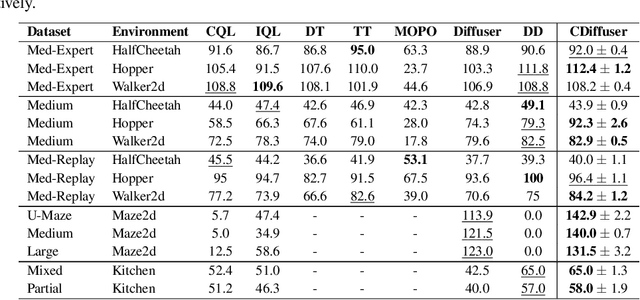
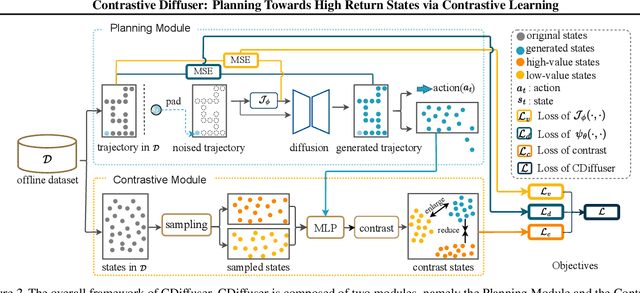
Applying diffusion models in reinforcement learning for long-term planning has gained much attention recently. Several diffusion-based methods have successfully leveraged the modeling capabilities of diffusion for arbitrary distributions. These methods generate subsequent trajectories for planning and have demonstrated significant improvement. However, these methods are limited by their plain base distributions and their overlooking of the diversity of samples, in which different states have different returns. They simply leverage diffusion to learn the distribution of offline dataset, generate the trajectories whose states share the same distribution with the offline dataset. As a result, the probability of these models reaching the high-return states is largely dependent on the dataset distribution. Even equipped with the guidance model, the performance is still suppressed. To address these limitations, in this paper, we propose a novel method called CDiffuser, which devises a return contrast mechanism to pull the states in generated trajectories towards high-return states while pushing them away from low-return states to improve the base distribution. Experiments on 14 commonly used D4RL benchmarks demonstrate the effectiveness of our proposed method.
DiffStitch: Boosting Offline Reinforcement Learning with Diffusion-based Trajectory Stitching
Feb 04, 2024


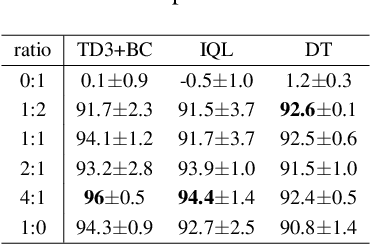
In offline reinforcement learning (RL), the performance of the learned policy highly depends on the quality of offline datasets. However, in many cases, the offline dataset contains very limited optimal trajectories, which poses a challenge for offline RL algorithms as agents must acquire the ability to transit to high-reward regions. To address this issue, we introduce Diffusion-based Trajectory Stitching (DiffStitch), a novel diffusion-based data augmentation pipeline that systematically generates stitching transitions between trajectories. DiffStitch effectively connects low-reward trajectories with high-reward trajectories, forming globally optimal trajectories to address the challenges faced by offline RL algorithms. Empirical experiments conducted on D4RL datasets demonstrate the effectiveness of DiffStitch across RL methodologies. Notably, DiffStitch demonstrates substantial enhancements in the performance of one-step methods (IQL), imitation learning methods (TD3+BC), and trajectory optimization methods (DT).
ODICE: Revealing the Mystery of Distribution Correction Estimation via Orthogonal-gradient Update
Feb 01, 2024In this study, we investigate the DIstribution Correction Estimation (DICE) methods, an important line of work in offline reinforcement learning (RL) and imitation learning (IL). DICE-based methods impose state-action-level behavior constraint, which is an ideal choice for offline learning. However, they typically perform much worse than current state-of-the-art (SOTA) methods that solely use action-level behavior constraint. After revisiting DICE-based methods, we find there exist two gradient terms when learning the value function using true-gradient update: forward gradient (taken on the current state) and backward gradient (taken on the next state). Using forward gradient bears a large similarity to many offline RL methods, and thus can be regarded as applying action-level constraint. However, directly adding the backward gradient may degenerate or cancel out its effect if these two gradients have conflicting directions. To resolve this issue, we propose a simple yet effective modification that projects the backward gradient onto the normal plane of the forward gradient, resulting in an orthogonal-gradient update, a new learning rule for DICE-based methods. We conduct thorough theoretical analyses and find that the projected backward gradient brings state-level behavior regularization, which reveals the mystery of DICE-based methods: the value learning objective does try to impose state-action-level constraint, but needs to be used in a corrected way. Through toy examples and extensive experiments on complex offline RL and IL tasks, we demonstrate that DICE-based methods using orthogonal-gradient updates (O-DICE) achieve SOTA performance and great robustness.
D2K: Turning Historical Data into Retrievable Knowledge for Recommender Systems
Jan 23, 2024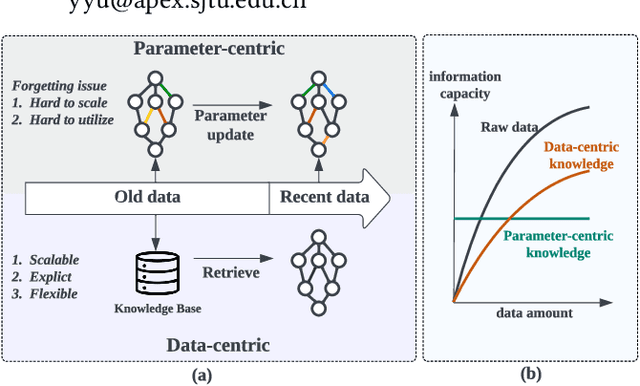
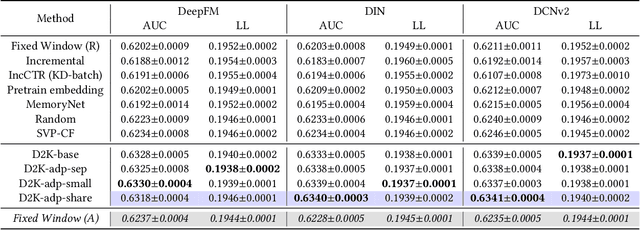
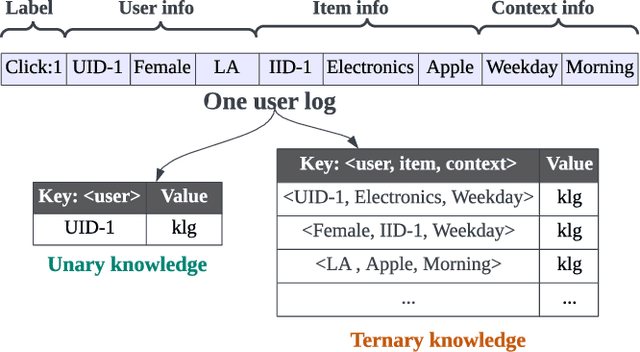
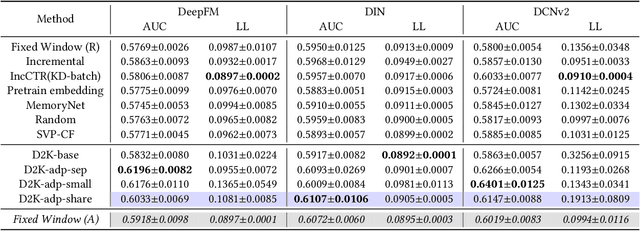
A vast amount of user behavior data is constantly accumulating on today's large recommendation platforms, recording users' various interests and tastes. Preserving knowledge from the old data while new data continually arrives is a vital problem for recommender systems. Existing approaches generally seek to save the knowledge implicitly in the model parameters. However, such a parameter-centric approach lacks scalability and flexibility -- the capacity is hard to scale, and the knowledge is inflexible to utilize. Hence, in this work, we propose a framework that turns massive user behavior data to retrievable knowledge (D2K). It is a data-centric approach that is model-agnostic and easy to scale up. Different from only storing unary knowledge such as the user-side or item-side information, D2K propose to store ternary knowledge for recommendation, which is determined by the complete recommendation factors -- user, item, and context. The knowledge retrieved by target samples can be directly used to enhance the performance of any recommendation algorithms. Specifically, we introduce a Transformer-based knowledge encoder to transform the old data into knowledge with the user-item-context cross features. A personalized knowledge adaptation unit is devised to effectively exploit the information from the knowledge base by adapting the retrieved knowledge to the target samples. Extensive experiments on two public datasets show that D2K significantly outperforms existing baselines and is compatible with a major collection of recommendation algorithms.
InfoRank: Unbiased Learning-to-Rank via Conditional Mutual Information Minimization
Jan 23, 2024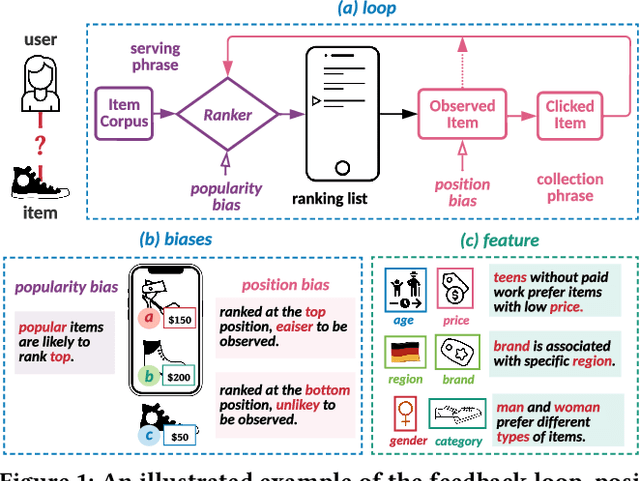
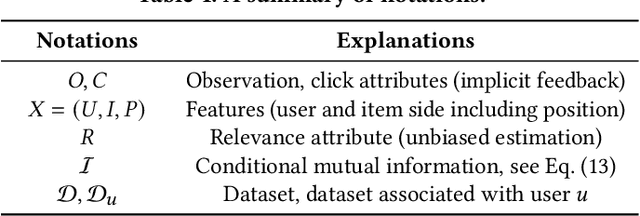
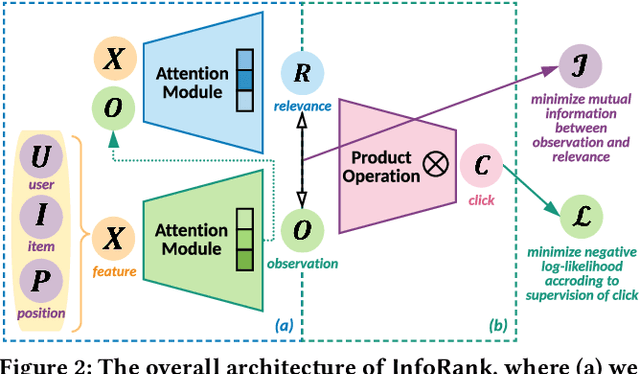
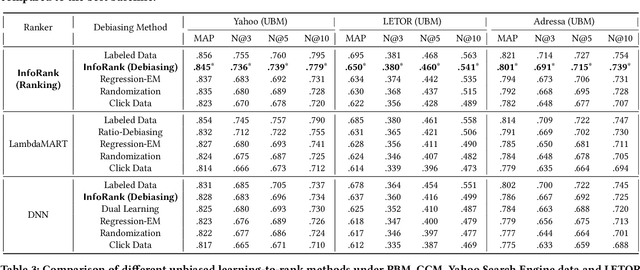
Ranking items regarding individual user interests is a core technique of multiple downstream tasks such as recommender systems. Learning such a personalized ranker typically relies on the implicit feedback from users' past click-through behaviors. However, collected feedback is biased toward previously highly-ranked items and directly learning from it would result in a "rich-get-richer" phenomenon. In this paper, we propose a simple yet sufficient unbiased learning-to-rank paradigm named InfoRank that aims to simultaneously address both position and popularity biases. We begin by consolidating the impacts of those biases into a single observation factor, thereby providing a unified approach to addressing bias-related issues. Subsequently, we minimize the mutual information between the observation estimation and the relevance estimation conditioned on the input features. By doing so, our relevance estimation can be proved to be free of bias. To implement InfoRank, we first incorporate an attention mechanism to capture latent correlations within user-item features, thereby generating estimations of observation and relevance. We then introduce a regularization term, grounded in conditional mutual information, to promote conditional independence between relevance estimation and observation estimation. Experimental evaluations conducted across three extensive recommendation and search datasets reveal that InfoRank learns more precise and unbiased ranking strategies.
GeoGalactica: A Scientific Large Language Model in Geoscience
Dec 31, 2023


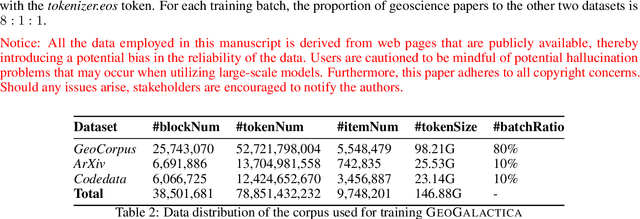
Large language models (LLMs) have achieved huge success for their general knowledge and ability to solve a wide spectrum of tasks in natural language processing (NLP). Due to their impressive abilities, LLMs have shed light on potential inter-discipline applications to foster scientific discoveries of a specific domain by using artificial intelligence (AI for science, AI4S). In the meantime, utilizing NLP techniques in geoscience research and practice is wide and convoluted, contributing from knowledge extraction and document classification to question answering and knowledge discovery. In this work, we take the initial step to leverage LLM for science, through a rather straightforward approach. We try to specialize an LLM into geoscience, by further pre-training the model with a vast amount of texts in geoscience, as well as supervised fine-tuning (SFT) the resulting model with our custom collected instruction tuning dataset. These efforts result in a model GeoGalactica consisting of 30 billion parameters. To our best knowledge, it is the largest language model for the geoscience domain. More specifically, GeoGalactica is from further pre-training of Galactica. We train GeoGalactica over a geoscience-related text corpus containing 65 billion tokens curated from extensive data sources in the big science project Deep-time Digital Earth (DDE), preserving as the largest geoscience-specific text corpus. Then we fine-tune the model with 1 million pairs of instruction-tuning data consisting of questions that demand professional geoscience knowledge to answer. In this technical report, we will illustrate in detail all aspects of GeoGalactica, including data collection, data cleaning, base model selection, pre-training, SFT, and evaluation. We open-source our data curation tools and the checkpoints of GeoGalactica during the first 3/4 of pre-training.
GFS: Graph-based Feature Synthesis for Prediction over Relational Databases
Dec 04, 2023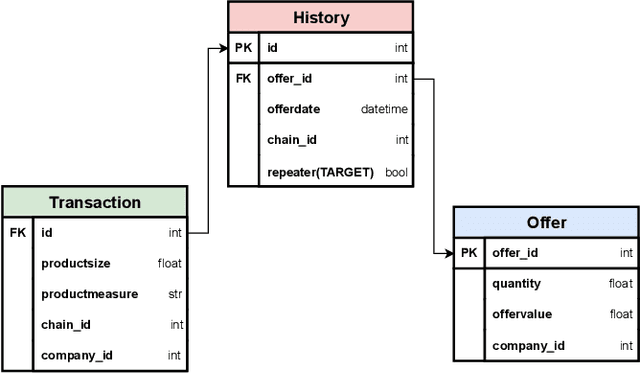
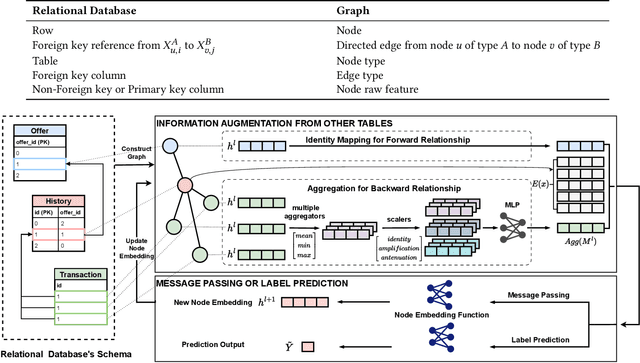
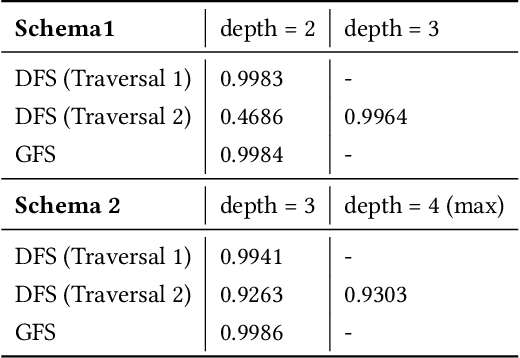
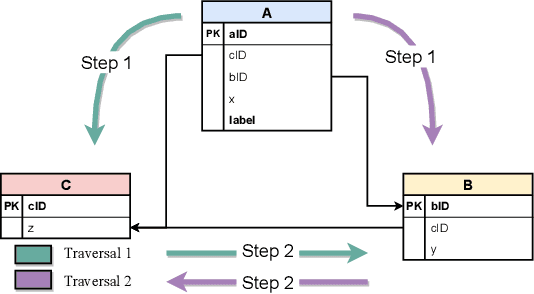
Relational databases are extensively utilized in a variety of modern information system applications, and they always carry valuable data patterns. There are a huge number of data mining or machine learning tasks conducted on relational databases. However, it is worth noting that there are limited machine learning models specifically designed for relational databases, as most models are primarily tailored for single table settings. Consequently, the prevalent approach for training machine learning models on data stored in relational databases involves performing feature engineering to merge the data from multiple tables into a single table and subsequently applying single table models. This approach not only requires significant effort in feature engineering but also destroys the inherent relational structure present in the data. To address these challenges, we propose a novel framework called Graph-based Feature Synthesis (GFS). GFS formulates the relational database as a heterogeneous graph, thereby preserving the relational structure within the data. By leveraging the inductive bias from single table models, GFS effectively captures the intricate relationships inherent in each table. Additionally, the whole framework eliminates the need for manual feature engineering. In the extensive experiment over four real-world multi-table relational databases, GFS outperforms previous methods designed for relational databases, demonstrating its superior performance.