 Add to Chrome
 Add to Firefox
 Add to Edge
AndroidReality: How Far Are Mobile Agents from the Real World?
Aug 07, 2026
Mobile agents have achieved promising results on clean online benchmarks such as AndroidWorld, yet their performance often degrades sharply in real-world deployment due to environmental variations and imperfect interface conditions. In this work, we introduce AndroidReality, a perturbation-based framework for evaluating and improving the robustness of mobile agents. Through a Markov Decision Process (MDP) perspective, we organize real-world interface variability into a principled taxonomy of perturbations along three axes: state, transition, and action. Guided by this taxonomy, we build a perturbed mobile benchmark on top of AndroidWorld with realistic and controllable perturbation injections, enabling systematic robustness evaluation of mobile agents. Our evaluation reveals substantial robustness gaps and four recurring error categories, motivating a simple training-free Test-Time Introspective Recovery (TTIR) mechanism that mitigates these failures on both perturbed and clean settings. Together, these results position robustness as a missing dimension in mobile agent evaluation and establish benchmark perturbation as an effective tool for both stress testing and surfacing latent weaknesses of mobile agents.

DADiff: Diffusion-Driven Cross-Domain Policy Adaptation for Reinforcement Learning
Jul 17, 2026Transferring policies across domains poses a vital challenge in reinforcement learning, due to the dynamics mismatch between the source and target domains. In this paper, we consider the setting of online dynamics adaptation, where policies are trained in the source domain with sufficient data, while only limited interactions with the target domain are allowed. There are a few existing works that address the dynamics mismatch by employing domain classifiers, value-guided data filtering, or representation learning. Instead, we study the domain adaptation problem from a generative modeling perspective. Specifically, we introduce DADiff, a diffusion-based framework that leverages the discrepancy between source and target domain generative trajectories in the generation process of the next state to estimate the dynamics mismatch. Both reward modification and data selection variants are developed to adapt the policy to the target domain. We also provide a theoretical analysis to show that the performance difference of a given policy between the two domains is bounded by the generative trajectory deviation. More discussions on the applicability of the variants and the connection between our theoretical analysis and the prior work are further provided. We conduct extensive experiments in environments with various shifts to validate the effectiveness of our method. The results demonstrate that our method provides superior performance compared to existing approaches, effectively addressing the dynamics mismatch. We provide the code of our method at https://github.com/hanyang-chen/DADiff-release
ShadeBench: A Benchmark Dataset for Building Shade Simulation in Sustainable Society
May 19, 2026Urban heat exposure is becoming an increasingly critical challenge due to the intensifying urban heat island effect. Fine-grained shade patterns, especially those induced by urban buildings, strongly influence pedestrians' thermal exposure and outdoor activity planning. However, accurately modeling and analyzing urban shade at scale remains difficult because of the lack of large-scale datasets and systematic evaluation frameworks. To address this challenge, we present ShadeBench, a comprehensive dataset and benchmark for urban shade understanding. ShadeBench contains geographically diverse urban scenes with temporally varying simulated shade maps and textual descriptions, together with aligned satellite imagery, building skeleton representations, and 3D building meshes. Built upon this multimodal dataset, ShadeBench supports a range of downstream tasks, including shade generation, shade segmentation, and 3D building reconstruction. We further establish standardized evaluation protocols and baseline methods for these tasks. By enabling scalable and fine-grained shade analysis, ShadeBench provides a foundation for data-driven urban climate research and supports future studies in heat-resilient urban planning and decision-making. The code and dataset are publicly available at https://darl-genai.github.io/shadebench/.
Position: Uncertainty Quantification in LLMs is Just Unsupervised Clustering
May 19, 2026Uncertainty Quantification (UQ) is widely regarded as the primary safeguard for deploying Large Language Models (LLMs) in high-stakes domains. However, we argue that the field suffers from a category error: mainstream UQ methods for LLMs are just unsupervised clustering algorithms. We demonstrate that most current approaches inherently quantify the internal consistency of the model's generations rather than their external correctness. Consequently, current methods are fundamentally blind to factual reality and fail to detect ``confident hallucinations,'' where models exhibit high confidence in stable but incorrect answers. Therefore, the current UQ methods may create a deceptive sense of safety when deploying the models with uncertainty. In detail, we identify three critical pathologies resulting from this dependence on internal state: a hyperparameter sensitivity crisis that renders deployment unsafe, an internal evaluation cycle that conflates stability with truth, and a fundamental lack of ground truth that forces reliance on unstable proxy metrics to evaluate uncertainty. To resolve this impasse, we advocate for a paradigm shift to UQ and outline a roadmap for the research community to adopt better evaluation metrics and settings, implement mechanism changes for native uncertainty, and anchor verification in objective truth, ensuring that model confidence serves as a reliable proxy for reality.
LangMARL: Natural Language Multi-Agent Reinforcement Learning
Apr 01, 2026Large language model (LLM) agents struggle to autonomously evolve coordination strategies in dynamic environments, largely because coarse global outcomes obscure the causal signals needed for local policy refinement. We identify this bottleneck as a multi-agent credit assignment problem, which has long been studied in classical multi-agent reinforcement learning (MARL) but remains underaddressed in LLM-based systems. Building on this observation, we propose LangMARL, a framework that brings credit assignment and policy gradient evolution from cooperative MARL into the language space. LangMARL introduces agent-level language credit assignment, pioneers gradient evolution in language space for policy improvement, and summarizes task-relevant causal relations from replayed trajectories to provide dense feedback and improve convergence under sparse rewards. Extensive experiments across diverse cooperative multi-agent tasks demonstrate improved sample efficiency, interpretability, and strong generalization.
Measuring What Matters: Scenario-Driven Evaluation for Trajectory Predictors in Autonomous Driving
Dec 13, 2025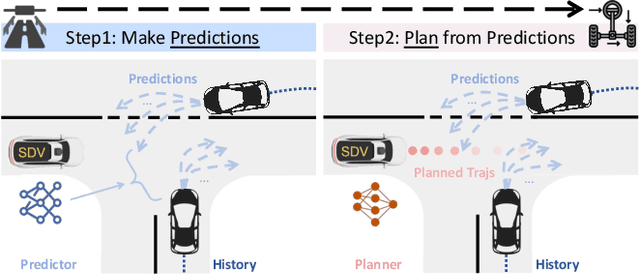
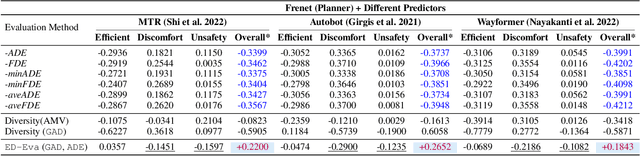
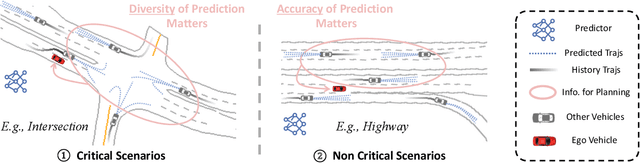
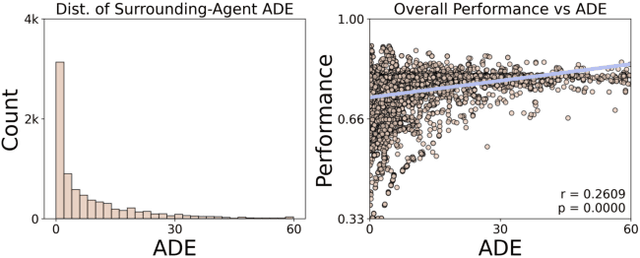
Being able to anticipate the motion of surrounding agents is essential for the safe operation of autonomous driving systems in dynamic situations. While various methods have been proposed for trajectory prediction, the current evaluation practices still rely on error-based metrics (e.g., ADE, FDE), which reveal the accuracy from a post-hoc view but ignore the actual effect the predictor brings to the self-driving vehicles (SDVs), especially in complex interactive scenarios: a high-quality predictor not only chases accuracy, but should also captures all possible directions a neighbor agent might move, to support the SDVs' cautious decision-making. Given that the existing metrics hardly account for this standard, in our work, we propose a comprehensive pipeline that adaptively evaluates the predictor's performance by two dimensions: accuracy and diversity. Based on the criticality of the driving scenario, these two dimensions are dynamically combined and result in a final score for the predictor's performance. Extensive experiments on a closed-loop benchmark using real-world datasets show that our pipeline yields a more reasonable evaluation than traditional metrics by better reflecting the correlation of the predictors' evaluation with the autonomous vehicles' driving performance. This evaluation pipeline shows a robust way to select a predictor that potentially contributes most to the SDV's driving performance.
DeepShade: Enable Shade Simulation by Text-conditioned Image Generation
Jul 16, 2025Heatwaves pose a significant threat to public health, especially as global warming intensifies. However, current routing systems (e.g., online maps) fail to incorporate shade information due to the difficulty of estimating shades directly from noisy satellite imagery and the limited availability of training data for generative models. In this paper, we address these challenges through two main contributions. First, we build an extensive dataset covering diverse longitude-latitude regions, varying levels of building density, and different urban layouts. Leveraging Blender-based 3D simulations alongside building outlines, we capture building shadows under various solar zenith angles throughout the year and at different times of day. These simulated shadows are aligned with satellite images, providing a rich resource for learning shade patterns. Second, we propose the DeepShade, a diffusion-based model designed to learn and synthesize shade variations over time. It emphasizes the nuance of edge features by jointly considering RGB with the Canny edge layer, and incorporates contrastive learning to capture the temporal change rules of shade. Then, by conditioning on textual descriptions of known conditions (e.g., time of day, solar angles), our framework provides improved performance in generating shade images. We demonstrate the utility of our approach by using our shade predictions to calculate shade ratios for real-world route planning in Tempe, Arizona. We believe this work will benefit society by providing a reference for urban planning in extreme heat weather and its potential practical applications in the environment.
GE-Chat: A Graph Enhanced RAG Framework for Evidential Response Generation of LLMs
May 15, 2025Large Language Models are now key assistants in human decision-making processes. However, a common note always seems to follow: "LLMs can make mistakes. Be careful with important info." This points to the reality that not all outputs from LLMs are dependable, and users must evaluate them manually. The challenge deepens as hallucinated responses, often presented with seemingly plausible explanations, create complications and raise trust issues among users. To tackle such issue, this paper proposes GE-Chat, a knowledge Graph enhanced retrieval-augmented generation framework to provide Evidence-based response generation. Specifically, when the user uploads a material document, a knowledge graph will be created, which helps construct a retrieval-augmented agent, enhancing the agent's responses with additional knowledge beyond its training corpus. Then we leverage Chain-of-Thought (CoT) logic generation, n-hop sub-graph searching, and entailment-based sentence generation to realize accurate evidence retrieval. We demonstrate that our method improves the existing models' performance in terms of identifying the exact evidence in a free-form context, providing a reliable way to examine the resources of LLM's conclusion and help with the judgment of the trustworthiness.
Uncertainty Quantification and Confidence Calibration in Large Language Models: A Survey
Mar 20, 2025Large Language Models (LLMs) excel in text generation, reasoning, and decision-making, enabling their adoption in high-stakes domains such as healthcare, law, and transportation. However, their reliability is a major concern, as they often produce plausible but incorrect responses. Uncertainty quantification (UQ) enhances trustworthiness by estimating confidence in outputs, enabling risk mitigation and selective prediction. However, traditional UQ methods struggle with LLMs due to computational constraints and decoding inconsistencies. Moreover, LLMs introduce unique uncertainty sources, such as input ambiguity, reasoning path divergence, and decoding stochasticity, that extend beyond classical aleatoric and epistemic uncertainty. To address this, we introduce a new taxonomy that categorizes UQ methods based on computational efficiency and uncertainty dimensions (input, reasoning, parameter, and prediction uncertainty). We evaluate existing techniques, assess their real-world applicability, and identify open challenges, emphasizing the need for scalable, interpretable, and robust UQ approaches to enhance LLM reliability.
Generative AI in Transportation Planning: A Survey
Mar 10, 2025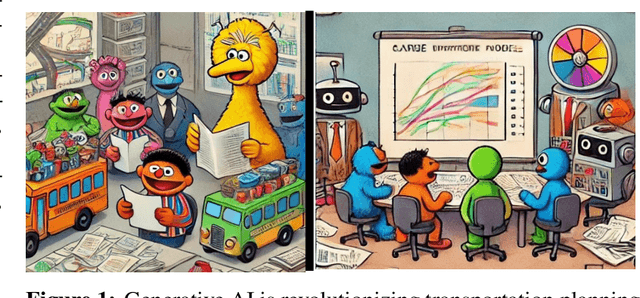
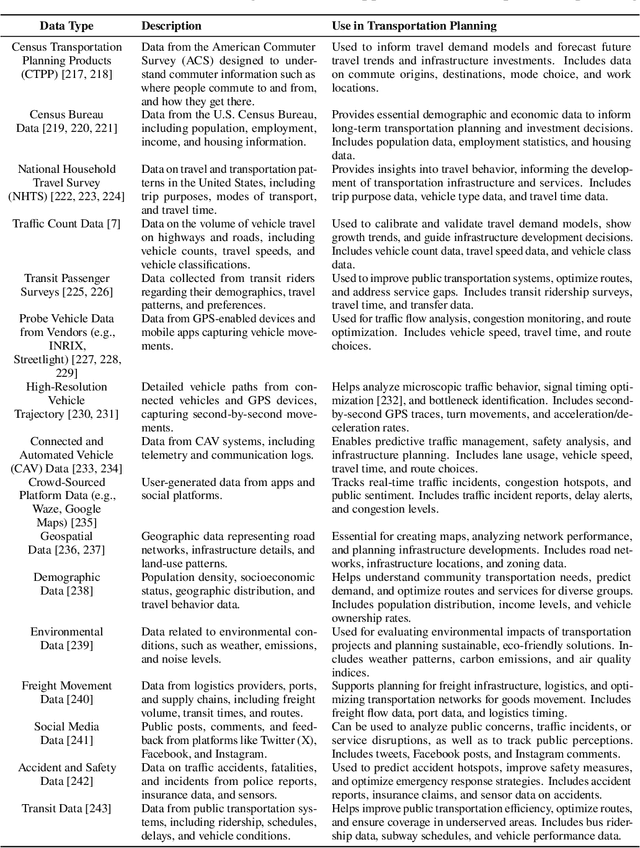
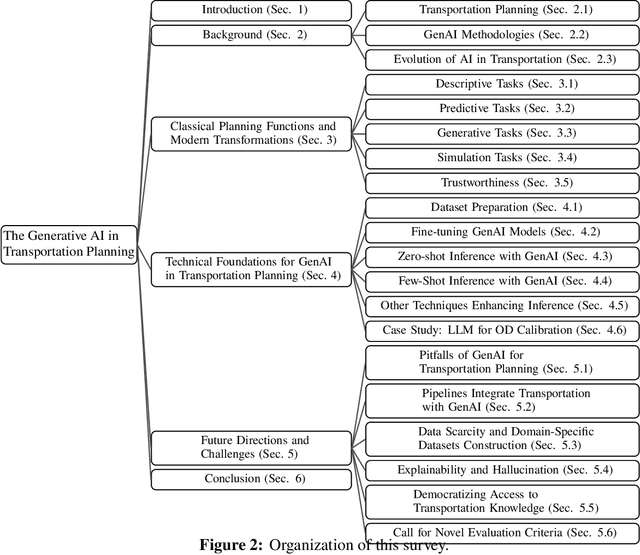
The integration of generative artificial intelligence (GenAI) into transportation planning has the potential to revolutionize tasks such as demand forecasting, infrastructure design, policy evaluation, and traffic simulation. However, there is a critical need for a systematic framework to guide the adoption of GenAI in this interdisciplinary domain. In this survey, we, a multidisciplinary team of researchers spanning computer science and transportation engineering, present the first comprehensive framework for leveraging GenAI in transportation planning. Specifically, we introduce a new taxonomy that categorizes existing applications and methodologies into two perspectives: transportation planning tasks and computational techniques. From the transportation planning perspective, we examine the role of GenAI in automating descriptive, predictive, generative, simulation, and explainable tasks to enhance mobility systems. From the computational perspective, we detail advancements in data preparation, domain-specific fine-tuning, and inference strategies, such as retrieval-augmented generation and zero-shot learning tailored to transportation applications. Additionally, we address critical challenges, including data scarcity, explainability, bias mitigation, and the development of domain-specific evaluation frameworks that align with transportation goals like sustainability, equity, and system efficiency. This survey aims to bridge the gap between traditional transportation planning methodologies and modern AI techniques, fostering collaboration and innovation. By addressing these challenges and opportunities, we seek to inspire future research that ensures ethical, equitable, and impactful use of generative AI in transportation planning.