 Add to Chrome
 Add to Firefox
 Add to Edge
EchoPilot: Training-Free Ultrasound Video Segmentation via Scale-Space Semantic Prompting and Reliability-Gated Memory
May 25, 2026
Ultrasound video segmentation is clinically valuable yet difficult due to speckle noise, weak boundaries, and rapid anatomical deformation. Recent promptable foundation models enable point-guided segmentation, but their direct deployment in ultrasound remains unreliable: a single point provides insufficient spatial context to resolve scale ambiguity, and greedy memory updates amplify early errors into severe temporal drift. We present EchoPilot, a training-free framework for ultrasound video segmentation under sparse first-frame interaction, requiring only a single point click and an anatomical category name. EchoPilot orchestrates a frozen medical vision-language model (VLM) for semantic localization, a vision foundation model (VFM) for dense geometric feature extraction, and a promptable video segmentor for mask prediction and propagation. To resolve initialization ambiguity, we propose Scale-Space Semantic Prompting, which first selects an optimal contextual view via a parameter-free S.E.E.D. (Semantic Energy-Entropy Density) criterion, and then synthesizes geometrically precise auxiliary point prompts from dense foundation features without additional user interaction. To reduce propagation drift, a Reliability-Gated Memory update is further introduced to selectively freeze the segmentor's memory bank under uncertain predictions, preventing error accumulation. We also contribute the first dynamic fetal placenta ultrasound video segmentation dataset with 671 annotated frames. Across three ultrasound video datasets, EchoPilot achieves state-of-the-art performance under the sparse-interactive setting, consistently outperforming training-free baselines and finetuned specialists.

Distinguishing Right from Wrong in Debates: Attribution Analysis of Chinese Harmful Memes
May 23, 2026Research on harmful meme detection has garnered significant attention, resulting in the development of numerous datasets and methods. However, progress in detecting Chinese harmful memes lags considerably, primarily due to two challenges: first, accurately assessing a meme's harmfulness depends heavily on understanding deep cultural context; second, many memes are semantically ambiguous, making harmfulness highly subjective. To address these issues, we focus on the interpretable detection of Chinese harmful memes by constructing the first Chinese harmful meme explanation dataset, Ex-ToxiCN-MM. This dataset offers opposing interpretations, categorized as "harmful" and "non-harmful", for each meme, aiming to rigorously evaluate a model's ability to discern and comprehend ambiguous, culturally grounded content. We built a specialized knowledge base of Chinese cultural concepts and offensive vocabulary to supply models with essential prior knowledge (C-HarmKB). To address the ambiguity and lack of background knowledge in meme attribution, we have developed a comprehensive attribution analysis framework, RIKE, which includes an Attribution Knowledge Enhancement module (AKE) and a Relative Intent Reasoning module (RIR). Extensive quantitative and qualitative experiments demonstrate that our method outperforms mainstream baseline models across multiple metrics in the task of attributing harmful memes in Chinese. The code, Ex-ToxiCN-MM dataset, and Chinese Harmful Semantic Knowledge Base (C-HarmKB) involved in this study have been open-sourced at https://github.com/wimiw123/Ex-ToxiCN-MM
Model-Free Co-Optimization of Manufacturable Sensor Layouts and Deformation Proprioception
Mar 09, 2026Flexible sensors are increasingly employed in soft robotics and wearable devices to provide proprioception of freeform deformations.Although supervised learning can train shape predictors from sensor signals, prediction accuracy strongly depends on sensor layout, which is typically determined heuristically or through trial-and-error. This work introduces a model-free, data-driven computational pipeline that jointly optimizes the number, length, and placement of flexible length-measurement sensors together with the parameters of a shape prediction network for large freeform deformations. Unlike model-based approaches, the proposed method relies solely on datasets of deformed shapes, without requiring physical simulation models, and is therefore broadly applicable to diverse robotic sensing tasks. The pipeline incorporates differentiable loss functions that account for both prediction accuracy and manufacturability constraints. By co-optimizing sensor layouts and network parameters, the method significantly improves deformation prediction accuracy over unoptimized layouts while ensuring practical feasibility. The effectiveness and generality of the approach are validated through numerical and physical experiments on multiple soft robotic and wearable systems.
ExoGS: A 4D Real-to-Sim-to-Real Framework for Scalable Manipulation Data Collection
Jan 26, 2026Real-to-Sim-to-Real technique is gaining increasing interest for robotic manipulation, as it can generate scalable data in simulation while having narrower sim-to-real gap. However, previous methods mainly focused on environment-level visual real-to-sim transfer, ignoring the transfer of interactions, which could be challenging and inefficient to obtain purely in simulation especially for contact-rich tasks. We propose ExoGS, a robot-free 4D Real-to-Sim-to-Real framework that captures both static environments and dynamic interactions in the real world and transfers them seamlessly to a simulated environment. It provides a new solution for scalable manipulation data collection and policy learning. ExoGS employs a self-designed robot-isomorphic passive exoskeleton AirExo-3 to capture kinematically consistent trajectories with millimeter-level accuracy and synchronized RGB observations during direct human demonstrations. The robot, objects, and environment are reconstructed as editable 3D Gaussian Splatting assets, enabling geometry-consistent replay and large-scale data augmentation. Additionally, a lightweight Mask Adapter injects instance-level semantics into the policy to enhance robustness under visual domain shifts. Real-world experiments demonstrate that ExoGS significantly improves data efficiency and policy generalization compared to teleoperation-based baselines. Code and hardware files have been released on https://github.com/zaixiabalala/ExoGS.
Dynamic Stream Network for Combinatorial Explosion Problem in Deformable Medical Image Registration
Dec 22, 2025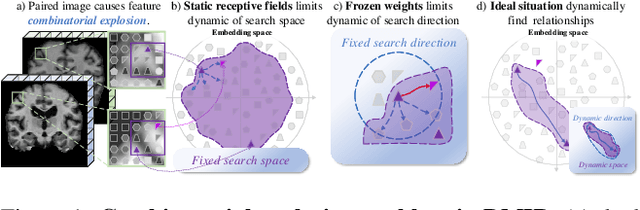
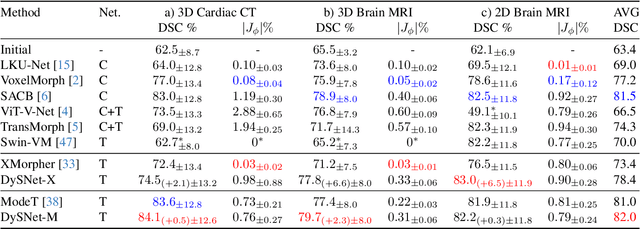
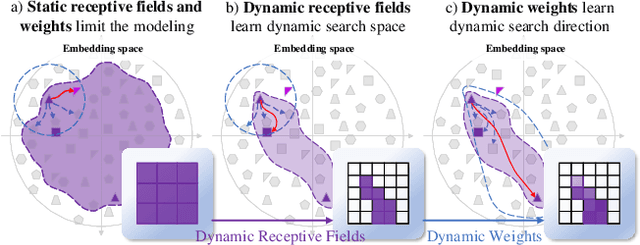
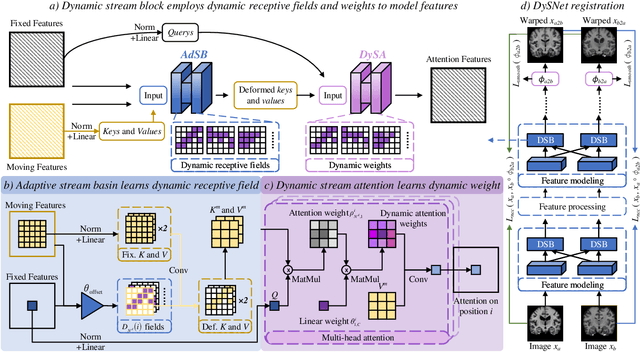
Combinatorial explosion problem caused by dual inputs presents a critical challenge in Deformable Medical Image Registration (DMIR). Since DMIR processes two images simultaneously as input, the combination relationships between features has grown exponentially, ultimately the model considers more interfering features during the feature modeling process. Introducing dynamics in the receptive fields and weights of the network enable the model to eliminate the interfering features combination and model the potential feature combination relationships. In this paper, we propose the Dynamic Stream Network (DySNet), which enables the receptive fields and weights to be dynamically adjusted. This ultimately enables the model to ignore interfering feature combinations and model the potential feature relationships. With two key innovations: 1) Adaptive Stream Basin (AdSB) module dynamically adjusts the shape of the receptive field, thereby enabling the model to focus on the feature relationships with greater correlation. 2) Dynamic Stream Attention (DySA) mechanism generates dynamic weights to search for more valuable feature relationships. Extensive experiments have shown that DySNet consistently outperforms the most advanced DMIR methods, highlighting its outstanding generalization ability. Our code will be released on the website: https://github.com/ShaochenBi/DySNet.
Neural Co-Optimization of Structural Topology, Manufacturable Layers, and Path Orientations for Fiber-Reinforced Composites
Apr 30, 2025We propose a neural network-based computational framework for the simultaneous optimization of structural topology, curved layers, and path orientations to achieve strong anisotropic strength in fiber-reinforced thermoplastic composites while ensuring manufacturability. Our framework employs three implicit neural fields to represent geometric shape, layer sequence, and fiber orientation. This enables the direct formulation of both design and manufacturability objectives - such as anisotropic strength, structural volume, machine motion control, layer curvature, and layer thickness - into an integrated and differentiable optimization process. By incorporating these objectives as loss functions, the framework ensures that the resultant composites exhibit optimized mechanical strength while remaining its manufacturability for filament-based multi-axis 3D printing across diverse hardware platforms. Physical experiments demonstrate that the composites generated by our co-optimization method can achieve an improvement of up to 33.1% in failure loads compared to composites with sequentially optimized structures and manufacturing sequences.
AirExo-2: Scaling up Generalizable Robotic Imitation Learning with Low-Cost Exoskeletons
Mar 05, 2025Scaling up imitation learning for real-world applications requires efficient and cost-effective demonstration collection methods. Current teleoperation approaches, though effective, are expensive and inefficient due to the dependency on physical robot platforms. Alternative data sources like in-the-wild demonstrations can eliminate the need for physical robots and offer more scalable solutions. However, existing in-the-wild data collection devices have limitations: handheld devices offer restricted in-hand camera observation, while whole-body devices often require fine-tuning with robot data due to action inaccuracies. In this paper, we propose AirExo-2, a low-cost exoskeleton system for large-scale in-the-wild demonstration collection. By introducing the demonstration adaptor to transform the collected in-the-wild demonstrations into pseudo-robot demonstrations, our system addresses key challenges in utilizing in-the-wild demonstrations for downstream imitation learning in real-world environments. Additionally, we present RISE-2, a generalizable policy that integrates 2D and 3D perceptions, outperforming previous imitation learning policies in both in-domain and out-of-domain tasks, even with limited demonstrations. By leveraging in-the-wild demonstrations collected and transformed by the AirExo-2 system, without the need for additional robot demonstrations, RISE-2 achieves comparable or superior performance to policies trained with teleoperated data, highlighting the potential of AirExo-2 for scalable and generalizable imitation learning. Project page: https://airexo.tech/airexo2
CrossTracker: Robust Multi-modal 3D Multi-Object Tracking via Cross Correction
Nov 28, 2024


The fusion of camera- and LiDAR-based detections offers a promising solution to mitigate tracking failures in 3D multi-object tracking (MOT). However, existing methods predominantly exploit camera detections to correct tracking failures caused by potential LiDAR detection problems, neglecting the reciprocal benefit of refining camera detections using LiDAR data. This limitation is rooted in their single-stage architecture, akin to single-stage object detectors, lacking a dedicated trajectory refinement module to fully exploit the complementary multi-modal information. To this end, we introduce CrossTracker, a novel two-stage paradigm for online multi-modal 3D MOT. CrossTracker operates in a coarse-to-fine manner, initially generating coarse trajectories and subsequently refining them through an independent refinement process. Specifically, CrossTracker incorporates three essential modules: i) a multi-modal modeling (M^3) module that, by fusing multi-modal information (images, point clouds, and even plane geometry extracted from images), provides a robust metric for subsequent trajectory generation. ii) a coarse trajectory generation (C-TG) module that generates initial coarse dual-stream trajectories, and iii) a trajectory refinement (TR) module that refines coarse trajectories through cross correction between camera and LiDAR streams. Comprehensive experiments demonstrate the superior performance of our CrossTracker over its eighteen competitors, underscoring its effectiveness in harnessing the synergistic benefits of camera and LiDAR sensors for robust multi-modal 3D MOT.
ForceMimic: Force-Centric Imitation Learning with Force-Motion Capture System for Contact-Rich Manipulation
Oct 11, 2024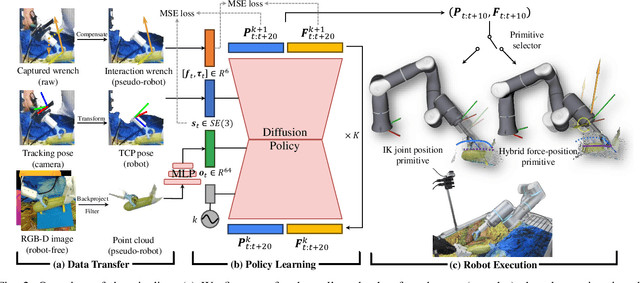
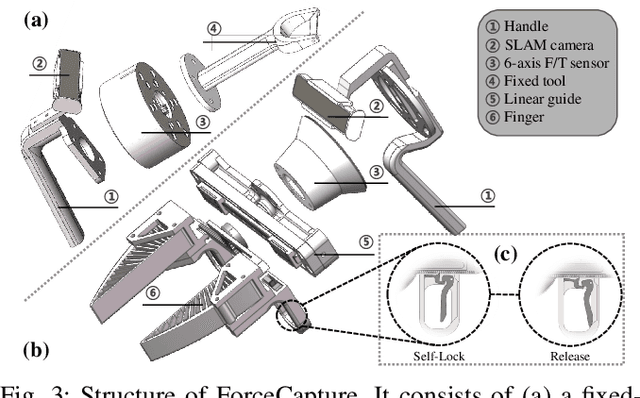
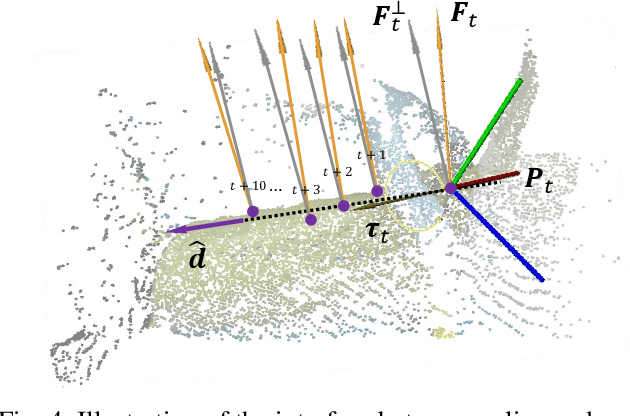
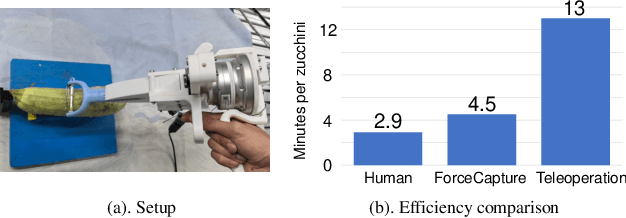
In most contact-rich manipulation tasks, humans apply time-varying forces to the target object, compensating for inaccuracies in the vision-guided hand trajectory. However, current robot learning algorithms primarily focus on trajectory-based policy, with limited attention given to learning force-related skills. To address this limitation, we introduce ForceMimic, a force-centric robot learning system, providing a natural, force-aware and robot-free robotic demonstration collection system, along with a hybrid force-motion imitation learning algorithm for robust contact-rich manipulation. Using the proposed ForceCapture system, an operator can peel a zucchini in 5 minutes, while force-feedback teleoperation takes over 13 minutes and struggles with task completion. With the collected data, we propose HybridIL to train a force-centric imitation learning model, equipped with hybrid force-position control primitive to fit the predicted wrench-position parameters during robot execution. Experiments demonstrate that our approach enables the model to learn a more robust policy under the contact-rich task of vegetable peeling, increasing the success rates by 54.5% relatively compared to state-of-the-art pure-vision-based imitation learning. Hardware, code, data and more results would be open-sourced on the project website at https://forcemimic.github.io.
Force-Centric Imitation Learning with Force-Motion Capture System for Contact-Rich Manipulation
Oct 10, 2024In most contact-rich manipulation tasks, humans apply time-varying forces to the target object, compensating for inaccuracies in the vision-guided hand trajectory. However, current robot learning algorithms primarily focus on trajectory-based policy, with limited attention given to learning force-related skills. To address this limitation, we introduce ForceMimic, a force-centric robot learning system, providing a natural, force-aware and robot-free robotic demonstration collection system, along with a hybrid force-motion imitation learning algorithm for robust contact-rich manipulation. Using the proposed ForceCapture system, an operator can peel a zucchini in 5 minutes, while force-feedback teleoperation takes over 13 minutes and struggles with task completion. With the collected data, we propose HybridIL to train a force-centric imitation learning model, equipped with hybrid force-position control primitive to fit the predicted wrench-position parameters during robot execution. Experiments demonstrate that our approach enables the model to learn a more robust policy under the contact-rich task of vegetable peeling, increasing the success rates by 54.5% relatively compared to state-of-the-art pure-vision-based imitation learning. Hardware, code, data and more results would be open-sourced on the project website at https://forcemimic.github.io.