 Add to Chrome
 Add to Firefox
 Add to Edge
Beyond Visibility Limits: A DRL-Based Navigation Strategy for Unexpected Obstacles
Mar 03, 2025
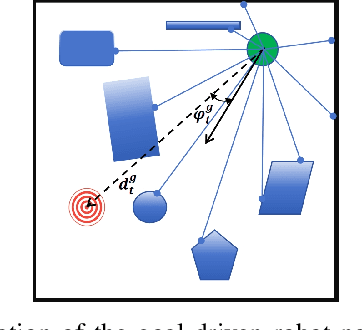
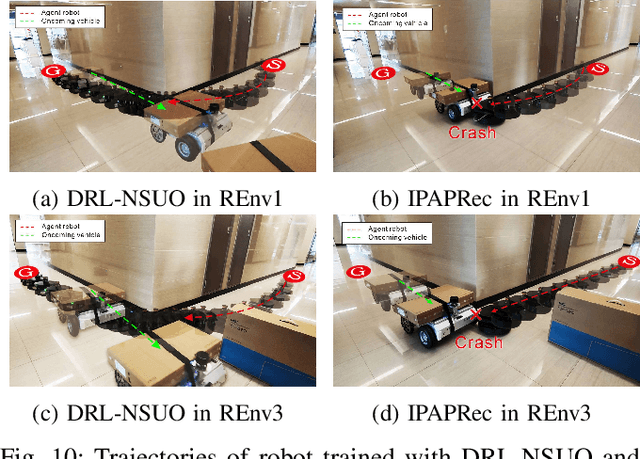
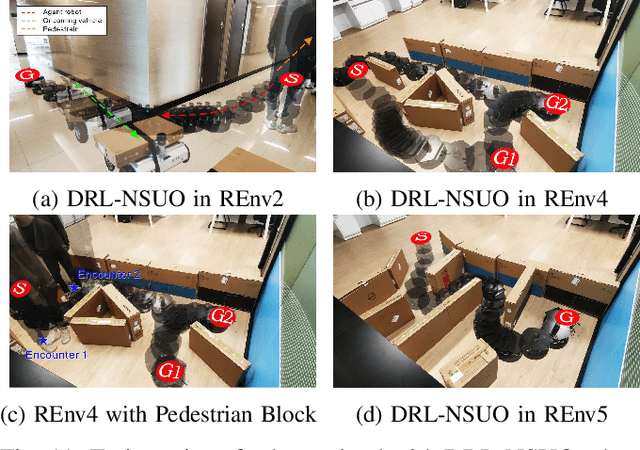
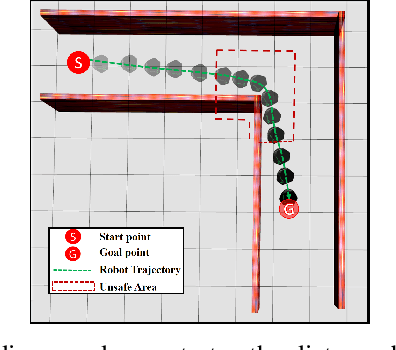
Distance-based reward mechanisms in deep reinforcement learning (DRL) navigation systems suffer from critical safety limitations in dynamic environments, frequently resulting in collisions when visibility is restricted. We propose DRL-NSUO, a novel navigation strategy for unexpected obstacles that leverages the rate of change in LiDAR data as a dynamic environmental perception element. Our approach incorporates a composite reward function with environmental change rate constraints and dynamically adjusted weights through curriculum learning, enabling robots to autonomously balance between path efficiency and safety maximization. We enhance sensitivity to nearby obstacles by implementing short-range feature preprocessing of LiDAR data. Experimental results demonstrate that this method significantly improves both robot and pedestrian safety in complex scenarios compared to traditional DRL-based methods. When evaluated on the BARN navigation dataset, our method achieved superior performance with success rates of 94.0% at 0.5 m/s and 91.0% at 1.0 m/s, outperforming conservative obstacle expansion strategies. These results validate DRL-NSUO's enhanced practicality and safety for human-robot collaborative environments, including intelligent logistics applications.

FGS-SLAM: Fourier-based Gaussian Splatting for Real-time SLAM with Sparse and Dense Map Fusion
Mar 03, 2025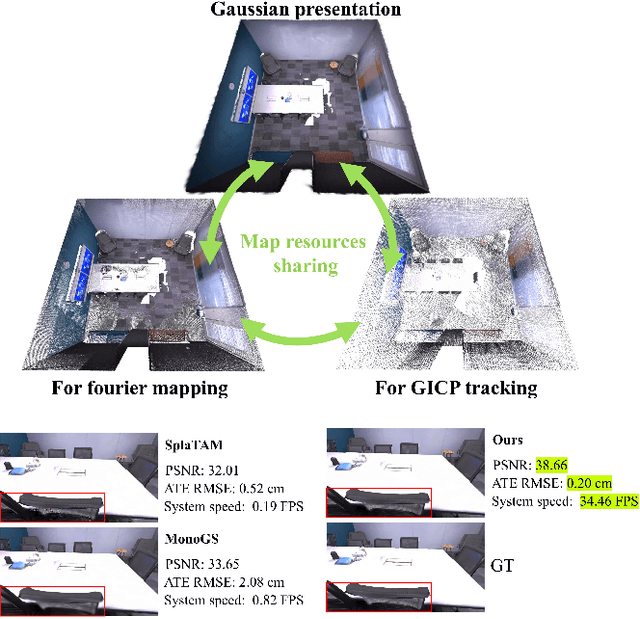
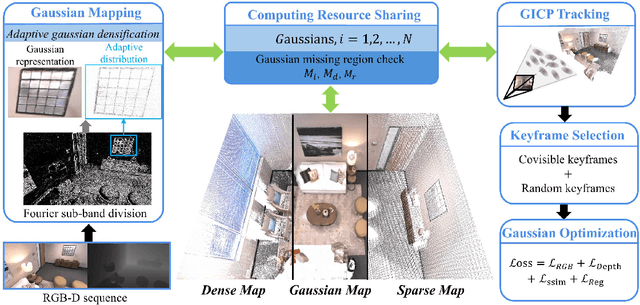
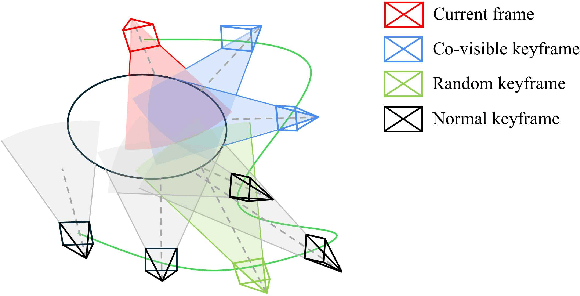
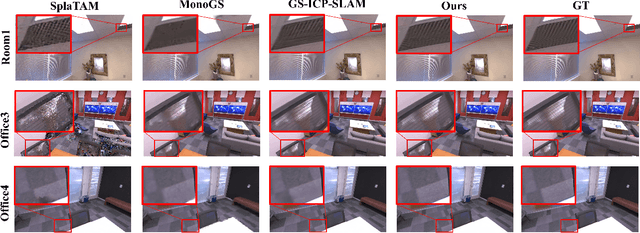
3D gaussian splatting has advanced simultaneous localization and mapping (SLAM) technology by enabling real-time positioning and the construction of high-fidelity maps. However, the uncertainty in gaussian position and initialization parameters introduces challenges, often requiring extensive iterative convergence and resulting in redundant or insufficient gaussian representations. To address this, we introduce a novel adaptive densification method based on Fourier frequency domain analysis to establish gaussian priors for rapid convergence. Additionally, we propose constructing independent and unified sparse and dense maps, where a sparse map supports efficient tracking via Generalized Iterative Closest Point (GICP) and a dense map creates high-fidelity visual representations. This is the first SLAM system leveraging frequency domain analysis to achieve high-quality gaussian mapping in real-time. Experimental results demonstrate an average frame rate of 36 FPS on Replica and TUM RGB-D datasets, achieving competitive accuracy in both localization and mapping.
EasyCraft: A Robust and Efficient Framework for Automatic Avatar Crafting
Mar 03, 2025Character customization, or 'face crafting,' is a vital feature in role-playing games (RPGs), enhancing player engagement by enabling the creation of personalized avatars. Existing automated methods often struggle with generalizability across diverse game engines due to their reliance on the intermediate constraints of specific image domain and typically support only one type of input, either text or image. To overcome these challenges, we introduce EasyCraft, an innovative end-to-end feedforward framework that automates character crafting by uniquely supporting both text and image inputs. Our approach employs a translator capable of converting facial images of any style into crafting parameters. We first establish a unified feature distribution in the translator's image encoder through self-supervised learning on a large-scale dataset, enabling photos of any style to be embedded into a unified feature representation. Subsequently, we map this unified feature distribution to crafting parameters specific to a game engine, a process that can be easily adapted to most game engines and thus enhances EasyCraft's generalizability. By integrating text-to-image techniques with our translator, EasyCraft also facilitates precise, text-based character crafting. EasyCraft's ability to integrate diverse inputs significantly enhances the versatility and accuracy of avatar creation. Extensive experiments on two RPG games demonstrate the effectiveness of our method, achieving state-of-the-art results and facilitating adaptability across various avatar engines.
Discrete-Time Hybrid Automata Learning: Legged Locomotion Meets Skateboarding
Mar 03, 2025This paper introduces Discrete-time Hybrid Automata Learning (DHAL), a framework using on-policy Reinforcement Learning to identify and execute mode-switching without trajectory segmentation or event function learning. Hybrid dynamical systems, which include continuous flow and discrete mode switching, can model robotics tasks like legged robot locomotion. Model-based methods usually depend on predefined gaits, while model-free approaches lack explicit mode-switching knowledge. Current methods identify discrete modes via segmentation before regressing continuous flow, but learning high-dimensional complex rigid body dynamics without trajectory labels or segmentation is a challenging open problem. Our approach incorporates a beta policy distribution and a multi-critic architecture to model contact-guided motions, exemplified by a challenging quadrupedal robot skateboard task. We validate our method through simulations and real-world tests, demonstrating robust performance in hybrid dynamical systems.
Exploring Rewriting Approaches for Different Conversational Tasks
Feb 26, 2025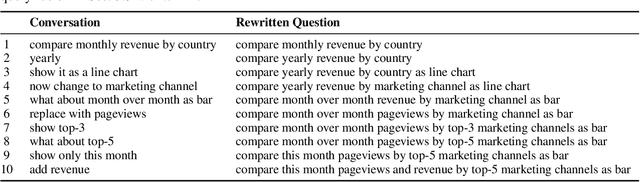
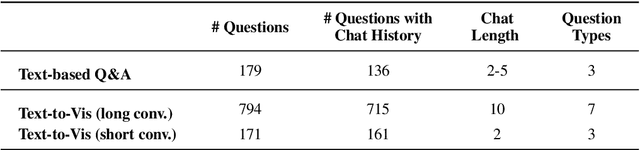
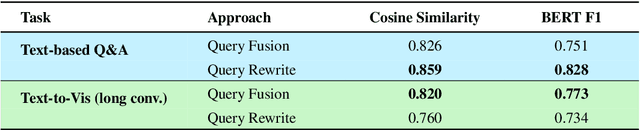
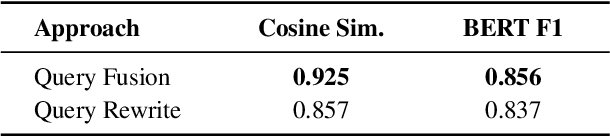
Conversational assistants often require a question rewriting algorithm that leverages a subset of past interactions to provide a more meaningful (accurate) answer to the user's question or request. However, the exact rewriting approach may often depend on the use case and application-specific tasks supported by the conversational assistant, among other constraints. In this paper, we systematically investigate two different approaches, denoted as rewriting and fusion, on two fundamentally different generation tasks, including a text-to-text generation task and a multimodal generative task that takes as input text and generates a visualization or data table that answers the user's question. Our results indicate that the specific rewriting or fusion approach highly depends on the underlying use case and generative task. In particular, we find that for a conversational question-answering assistant, the query rewriting approach performs best, whereas for a data analysis assistant that generates visualizations and data tables based on the user's conversation with the assistant, the fusion approach works best. Notably, we explore two datasets for the data analysis assistant use case, for short and long conversations, and we find that query fusion always performs better, whereas for the conversational text-based question-answering, the query rewrite approach performs best.
CodeCriticBench: A Holistic Code Critique Benchmark for Large Language Models
Feb 23, 2025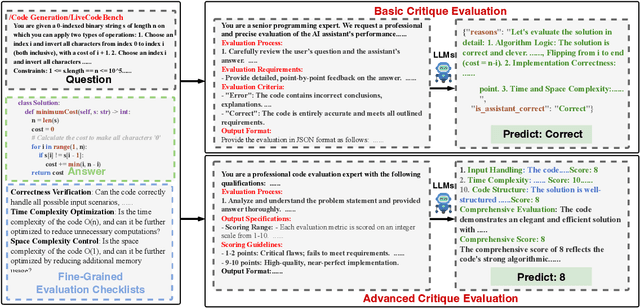
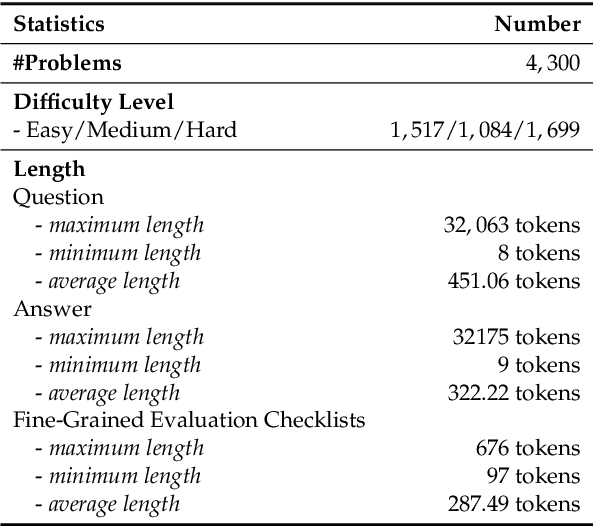
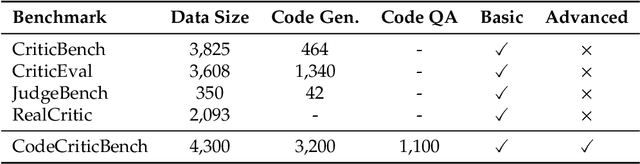
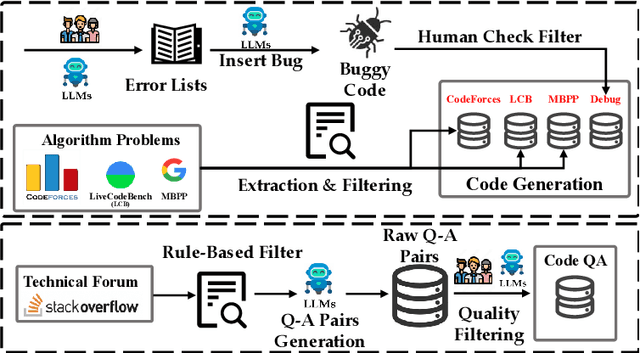
The critique capacity of Large Language Models (LLMs) is essential for reasoning abilities, which can provide necessary suggestions (e.g., detailed analysis and constructive feedback). Therefore, how to evaluate the critique capacity of LLMs has drawn great attention and several critique benchmarks have been proposed. However, existing critique benchmarks usually have the following limitations: (1). Focusing on diverse reasoning tasks in general domains and insufficient evaluation on code tasks (e.g., only covering code generation task), where the difficulty of queries is relatively easy (e.g., the code queries of CriticBench are from Humaneval and MBPP). (2). Lacking comprehensive evaluation from different dimensions. To address these limitations, we introduce a holistic code critique benchmark for LLMs called CodeCriticBench. Specifically, our CodeCriticBench includes two mainstream code tasks (i.e., code generation and code QA) with different difficulties. Besides, the evaluation protocols include basic critique evaluation and advanced critique evaluation for different characteristics, where fine-grained evaluation checklists are well-designed for advanced settings. Finally, we conduct extensive experimental results of existing LLMs, which show the effectiveness of CodeCriticBench.
Full-Step-DPO: Self-Supervised Preference Optimization with Step-wise Rewards for Mathematical Reasoning
Feb 20, 2025Direct Preference Optimization (DPO) often struggles with long-chain mathematical reasoning. Existing approaches, such as Step-DPO, typically improve this by focusing on the first erroneous step in the reasoning chain. However, they overlook all other steps and rely heavily on humans or GPT-4 to identify erroneous steps. To address these issues, we propose Full-Step-DPO, a novel DPO framework tailored for mathematical reasoning. Instead of optimizing only the first erroneous step, it leverages step-wise rewards from the entire reasoning chain. This is achieved by training a self-supervised process reward model, which automatically scores each step, providing rewards while avoiding reliance on external signals. Furthermore, we introduce a novel step-wise DPO loss, which dynamically updates gradients based on these step-wise rewards. This endows stronger reasoning capabilities to language models. Extensive evaluations on both in-domain and out-of-domain mathematical reasoning benchmarks across various base language models, demonstrate that Full-Step-DPO achieves superior performance compared to state-of-the-art baselines.
3D Gaussian Splatting aided Localization for Large and Complex Indoor-Environments
Feb 19, 2025The field of visual localization has been researched for several decades and has meanwhile found many practical applications. Despite the strong progress in this field, there are still challenging situations in which established methods fail. We present an approach to significantly improve the accuracy and reliability of established visual localization methods by adding rendered images. In detail, we first use a modern visual SLAM approach that provides a 3D Gaussian Splatting (3DGS) based map to create reference data. We demonstrate that enriching reference data with images rendered from 3DGS at randomly sampled poses significantly improves the performance of both geometry-based visual localization and Scene Coordinate Regression (SCR) methods. Through comprehensive evaluation in a large industrial environment, we analyze the performance impact of incorporating these additional rendered views.
SimpleVQA: Multimodal Factuality Evaluation for Multimodal Large Language Models
Feb 18, 2025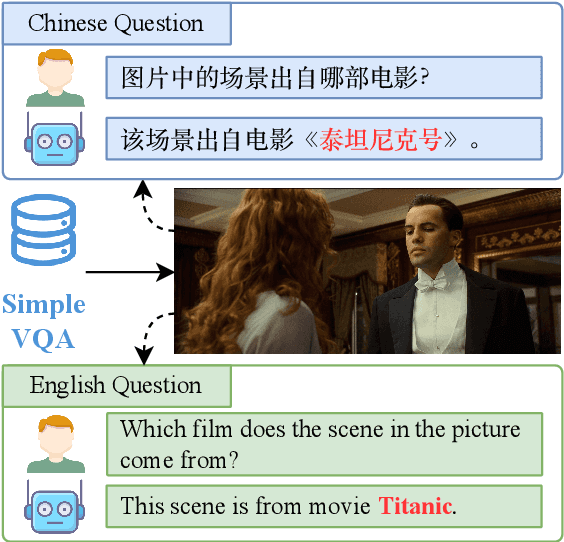
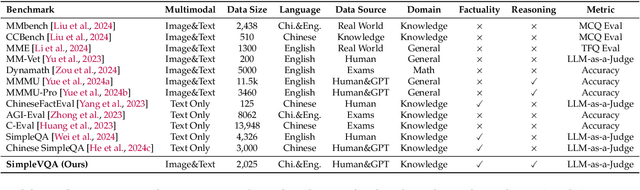
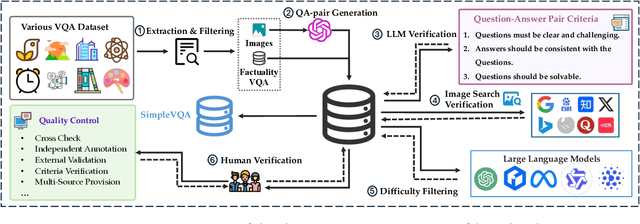
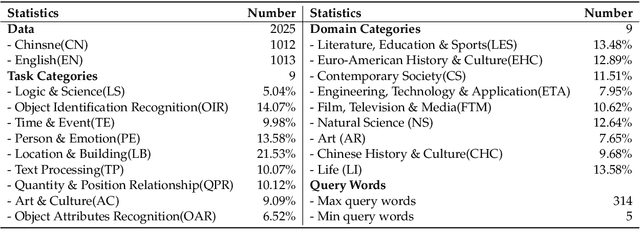
The increasing application of multi-modal large language models (MLLMs) across various sectors have spotlighted the essence of their output reliability and accuracy, particularly their ability to produce content grounded in factual information (e.g. common and domain-specific knowledge). In this work, we introduce SimpleVQA, the first comprehensive multi-modal benchmark to evaluate the factuality ability of MLLMs to answer natural language short questions. SimpleVQA is characterized by six key features: it covers multiple tasks and multiple scenarios, ensures high quality and challenging queries, maintains static and timeless reference answers, and is straightforward to evaluate. Our approach involves categorizing visual question-answering items into 9 different tasks around objective events or common knowledge and situating these within 9 topics. Rigorous quality control processes are implemented to guarantee high-quality, concise, and clear answers, facilitating evaluation with minimal variance via an LLM-as-a-judge scoring system. Using SimpleVQA, we perform a comprehensive assessment of leading 18 MLLMs and 8 text-only LLMs, delving into their image comprehension and text generation abilities by identifying and analyzing error cases.
Anti-Degeneracy Scheme for Lidar SLAM based on Particle Filter in Geometry Feature-Less Environments
Feb 17, 2025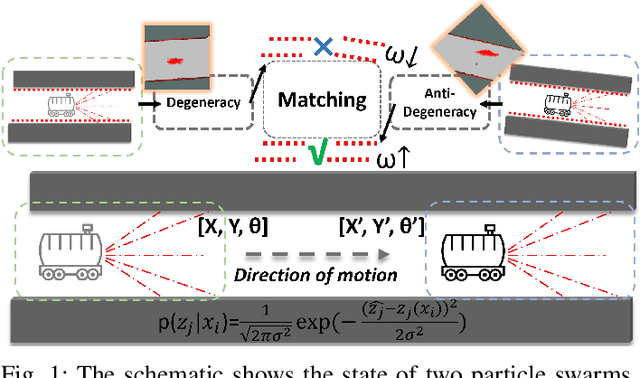
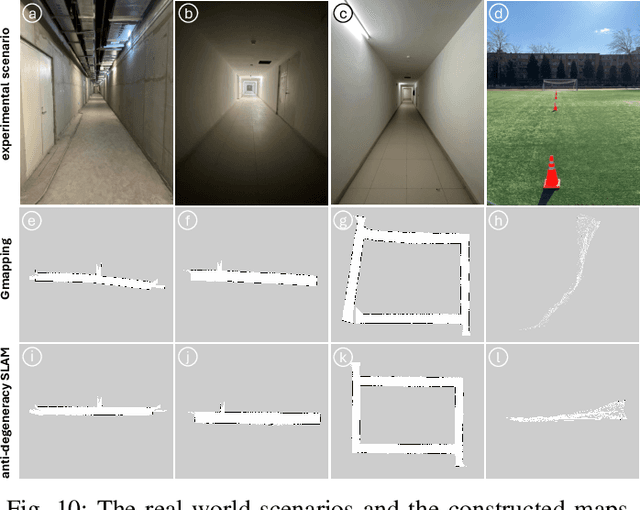
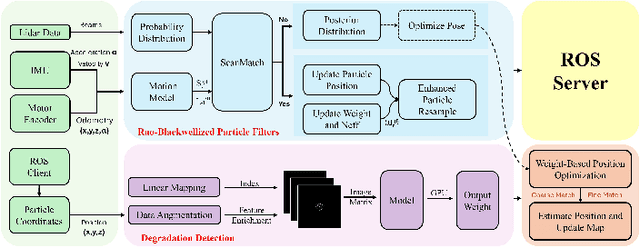
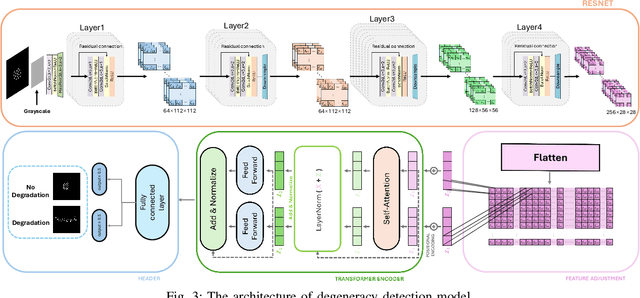
Simultaneous localization and mapping (SLAM) based on particle filtering has been extensively employed in indoor scenarios due to its high efficiency. However, in geometry feature-less scenes, the accuracy is severely reduced due to lack of constraints. In this article, we propose an anti-degeneracy system based on deep learning. Firstly, we design a scale-invariant linear mapping to convert coordinates in continuous space into discrete indexes, in which a data augmentation method based on Gaussian model is proposed to ensure the model performance by effectively mitigating the impact of changes in the number of particles on the feature distribution. Secondly, we develop a degeneracy detection model using residual neural networks (ResNet) and transformer which is able to identify degeneracy by scrutinizing the distribution of the particle population. Thirdly, an adaptive anti-degeneracy strategy is designed, which first performs fusion and perturbation on the resample process to provide rich and accurate initial values for the pose optimization, and use a hierarchical pose optimization combining coarse and fine matching, which is able to adaptively adjust the optimization frequency and the sensor trustworthiness according to the degree of degeneracy, in order to enhance the ability of searching the global optimal pose. Finally, we demonstrate the optimality of the model, as well as the improvement of the image matrix method and GPU on the computation time through ablation experiments, and verify the performance of the anti-degeneracy system in different scenarios through simulation experiments and real experiments. This work has been submitted to IEEE for publication. Copyright may be transferred without notice, after which this version may no longer be available.