 Add to Chrome
 Add to Firefox
 Add to Edge
FSUNav: A Cerebrum-Cerebellum Architecture for Fast, Safe, and Universal Zero-Shot Goal-Oriented Navigation
Apr 03, 2026
Current vision-language navigation methods face substantial bottlenecks regarding heterogeneous robot compatibility, real-time performance, and navigation safety. Furthermore, they struggle to support open-vocabulary semantic generalization and multimodal task inputs. To address these challenges, this paper proposes FSUNav: a Cerebrum-Cerebellum architecture for fast, safe, and universal zero-shot goal-oriented navigation, which innovatively integrates vision-language models (VLMs) with the proposed architecture. The cerebellum module, a high-frequency end-to-end module, develops a universal local planner based on deep reinforcement learning, enabling unified navigation across heterogeneous platforms (e.g., humanoid, quadruped, wheeled robots) to improve navigation efficiency while significantly reducing collision risk. The cerebrum module constructs a three-layer reasoning model and leverages VLMs to build an end-to-end detection and verification mechanism, enabling zero-shot open-vocabulary goal navigation without predefined IDs and improving task success rates in both simulation and real-world environments. Additionally, the framework supports multimodal inputs (e.g., text, target descriptions, and images), further enhancing generalization, real-time performance, safety, and robustness. Experimental results on MP3D, HM3D, and OVON benchmarks demonstrate that FSUNav achieves state-of-the-art performance on object, instance image, and task navigation, significantly outperforming existing methods. Real-world deployments on diverse robotic platforms further validate its robustness and practical applicability.

CeRLP: A Cross-embodiment Robot Local Planning Framework for Visual Navigation
Mar 20, 2026Visual navigation for cross-embodiment robots is challenging due to variations in robot and camera configurations, which can lead to the failure of navigation tasks. Previous approaches typically rely on collecting massive datasets across different robots, which is highly data-intensive, or fine-tuning models, which is time-consuming. Furthermore, both methods often lack explicit consideration of robot geometry. In this paper, we propose a Cross-embodiment Robot Local Planning (CeRLP) framework for general visual navigation, which abstracts visual information into a unified geometric formulation and applies to heterogeneous robots with varying physical dimensions, camera parameters, and camera types. CeRLP introduces a depth estimation scale correction method that utilizes offline pre-calibration to resolve the scale ambiguity of monocular depth estimation, thereby recovering precise metric depth images. Furthermore, CeRLP designs a visual-to-scan abstraction module that projects varying visual inputs into height-adaptive laser scans, making the policy robust to heterogeneous robots. Experiments in simulation environments demonstrate that CeRLP outperforms comparative methods, validating its robust obstacle avoidance capabilities as a local planner. Additionally, extensive real-world experiments verify the effectiveness of CeRLP in tasks such as point-to-point navigation and vision-language navigation, demonstrating its generalization across varying robot and camera configurations.
MAER-Nav: Bidirectional Motion Learning Through Mirror-Augmented Experience Replay for Robot Navigation
Mar 31, 2025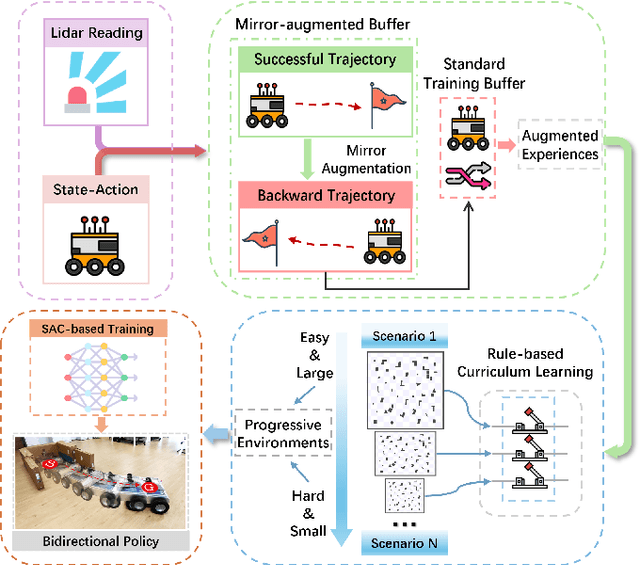
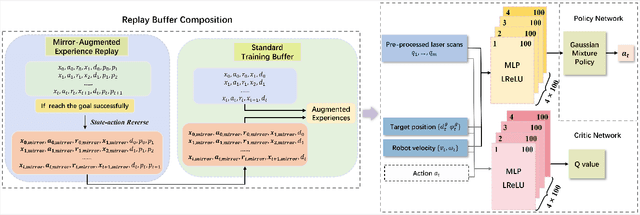
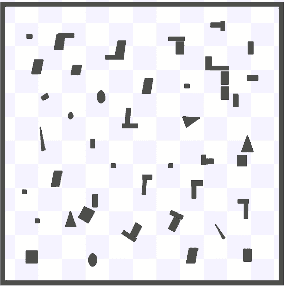
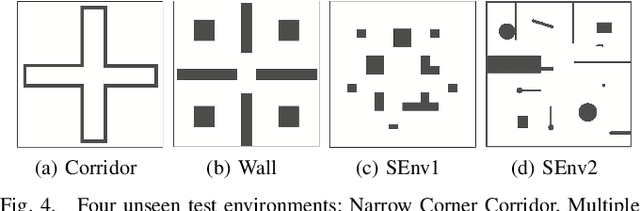
Deep Reinforcement Learning (DRL) based navigation methods have demonstrated promising results for mobile robots, but suffer from limited action flexibility in confined spaces. Conventional DRL approaches predominantly learn forward-motion policies, causing robots to become trapped in complex environments where backward maneuvers are necessary for recovery. This paper presents MAER-Nav (Mirror-Augmented Experience Replay for Robot Navigation), a novel framework that enables bidirectional motion learning without requiring explicit failure-driven hindsight experience replay or reward function modifications. Our approach integrates a mirror-augmented experience replay mechanism with curriculum learning to generate synthetic backward navigation experiences from successful trajectories. Experimental results in both simulation and real-world environments demonstrate that MAER-Nav significantly outperforms state-of-the-art methods while maintaining strong forward navigation capabilities. The framework effectively bridges the gap between the comprehensive action space utilization of traditional planning methods and the environmental adaptability of learning-based approaches, enabling robust navigation in scenarios where conventional DRL methods consistently fail.
Beyond Visibility Limits: A DRL-Based Navigation Strategy for Unexpected Obstacles
Mar 03, 2025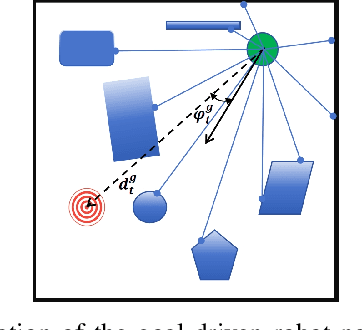
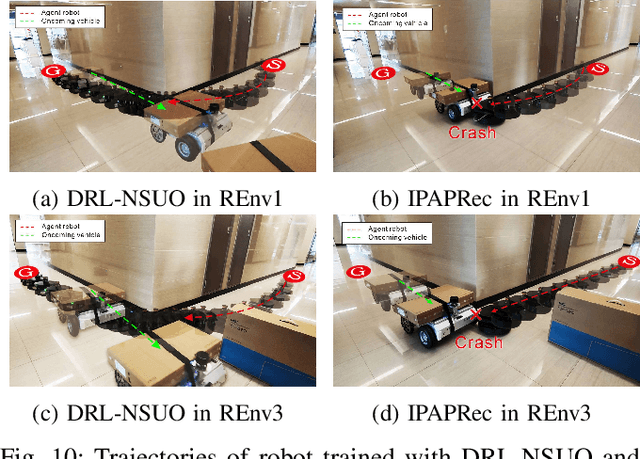
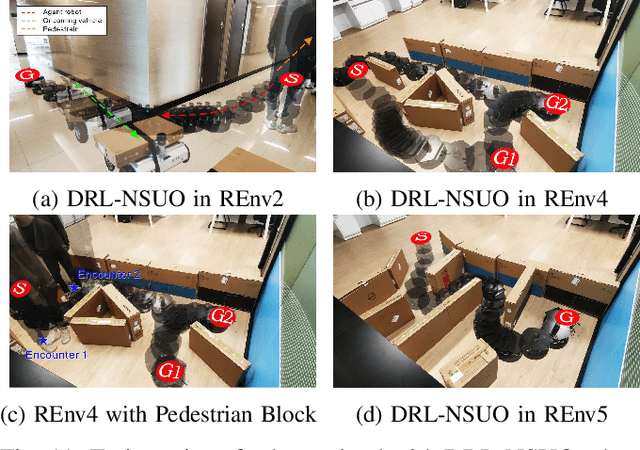
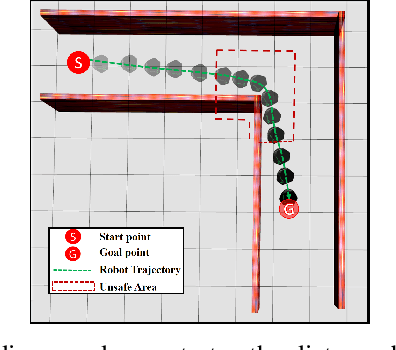
Distance-based reward mechanisms in deep reinforcement learning (DRL) navigation systems suffer from critical safety limitations in dynamic environments, frequently resulting in collisions when visibility is restricted. We propose DRL-NSUO, a novel navigation strategy for unexpected obstacles that leverages the rate of change in LiDAR data as a dynamic environmental perception element. Our approach incorporates a composite reward function with environmental change rate constraints and dynamically adjusted weights through curriculum learning, enabling robots to autonomously balance between path efficiency and safety maximization. We enhance sensitivity to nearby obstacles by implementing short-range feature preprocessing of LiDAR data. Experimental results demonstrate that this method significantly improves both robot and pedestrian safety in complex scenarios compared to traditional DRL-based methods. When evaluated on the BARN navigation dataset, our method achieved superior performance with success rates of 94.0% at 0.5 m/s and 91.0% at 1.0 m/s, outperforming conservative obstacle expansion strategies. These results validate DRL-NSUO's enhanced practicality and safety for human-robot collaborative environments, including intelligent logistics applications.
Enhancing Deep Reinforcement Learning-based Robot Navigation Generalization through Scenario Augmentation
Mar 03, 2025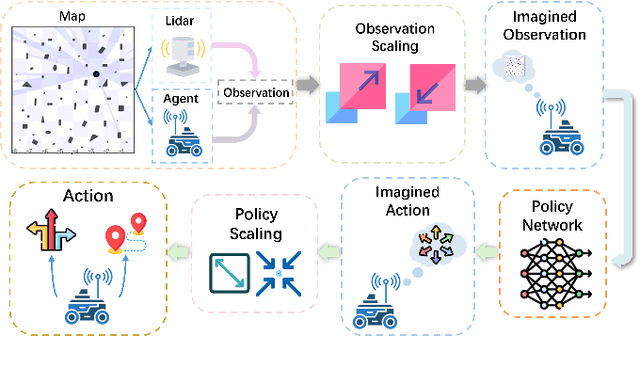
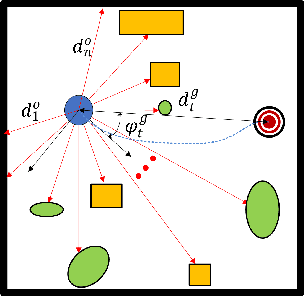
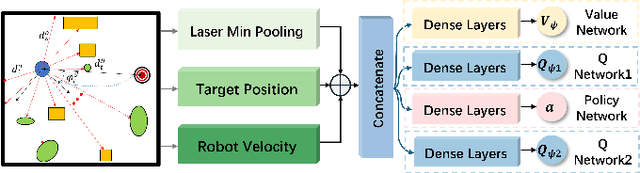
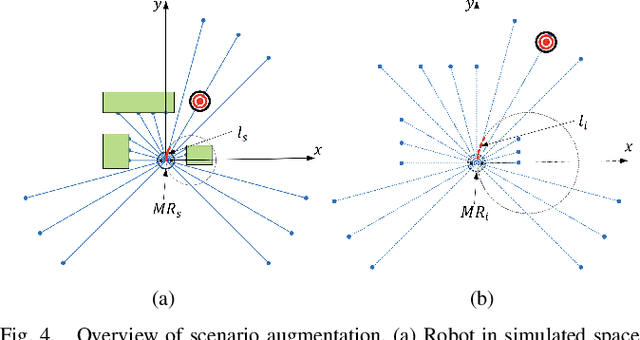
This work focuses on enhancing the generalization performance of deep reinforcement learning-based robot navigation in unseen environments. We present a novel data augmentation approach called scenario augmentation, which enables robots to navigate effectively across diverse settings without altering the training scenario. The method operates by mapping the robot's observation into an imagined space, generating an imagined action based on this transformed observation, and then remapping this action back to the real action executed in simulation. Through scenario augmentation, we conduct extensive comparative experiments to investigate the underlying causes of suboptimal navigation behaviors in unseen environments. Our analysis indicates that limited training scenarios represent the primary factor behind these undesired behaviors. Experimental results confirm that scenario augmentation substantially enhances the generalization capabilities of deep reinforcement learning-based navigation systems. The improved navigation framework demonstrates exceptional performance by producing near-optimal trajectories with significantly reduced navigation time in real-world applications.