 Add to Chrome
 Add to Firefox
 Add to Edge
FlashNav: Ultra-Fast Policy Training for Robot Navigation within 20 Seconds
Jun 14, 2026
Deep reinforcement learning has shown strong potential for robot navigation, but its practical deployment is still limited by the long wall-clock cost of policy training. This paper presents FlashNav, a GPU-first framework for ultra-fast range-based robot navigation training. To the best of our knowledge, FlashNav is the first DRL-based robot navigation framework that reaches seconds-level policy training, with the fastest deployable policy trained in less than 20 seconds. The key idea is to align simulation with the navigation MDP: FlashNav preserves the essential components for velocity-level navigation, including occupancy geometry, range sensing, goal-conditioned control, robot motion dynamics, collision handling, termination, and reset, while removing unnecessary rendering and high-fidelity physical details from the training loop. Built on a batched bitmap simulator and a fully GPU-resident training pipeline with our FastDSAC learner, FlashNav generates massive parallel navigation transitions entirely on GPU. Experiments on TurtleBot2 and Unitree Go2 show that FlashNav achieves a 100\% success-rate below 20 seconds on an RTX 5090 and remains within tens of seconds across desktop GPUs. The learned policies further transfer to physical wheeled and legged robots in static and dynamic indoor scenes, demonstrating that DRL-based navigation can be trained at seconds-level speed while preserving deployable obstacle-avoidance behavior.

AgniNav: Configuration-Driven Cross-Embodiment Local Planning for Robot Navigation
Jun 09, 2026Monocular local navigation is attractive for lightweight robots, but existing vision-based policies often couple perception to a specific body, camera height, and footprint, making transfer from wheeled bases to legged platforms dependent on retraining or active depth hardware. This paper introduces AgniNav, a configuration-driven local navigation framework that standardizes cross-embodiment transfer at the collision-envelope level. Each robot is specified by a measurable four-parameter safety envelope: collision-relevant height, front length, rear length, and half width. The height parameter conditions an image-to-scan network to predict a one-dimensional, collision-relevant pseudo-laserscan from a monocular color image, while the remaining footprint parameters configure a dimension-aware local planner for collision checking. Training uses height-conditioned column-minimum scan labels generated from paired color-depth data, allowing the same image to supervise different safety envelopes without collecting robot-specific data. To the best of our knowledge, AgniNav is the first monocular local-navigation framework that jointly conditions perception and planning on a shared collision-envelope configuration for zero-retraining deployment across wheeled, quadruped, and humanoid platforms. Real-robot experiments on a Turtlebot2, Unitree Go2, and Accelerated Evolution K1 achieve 39/40, 18/20, and 18/20 successes with 0/40, 1/20, and 2/20 collisions, respectively, while running at 30 Hz on Jetson Orin.
Do We Really Need Immediate Resets? Rethinking Collision Handling for Efficient Robot Navigation
May 04, 2026Should a single collision necessarily terminate an entire navigation episode? In most deep reinforcement learning (DRL) frameworks for robot navigation, this remains the standard practice: every collision immediately triggers a global environment reset and is penalized as a complete task failure. While a collision during deployment naturally indicates task failure, applying the same treatment during training prevents the agent from exploring challenging obstacle configurations, which slows learning progress in the early training phase. In this work, we challenge this convention and propose a Multi-Collision reset Budget (MCB) framework that decouples local collision termination from global environment resets, allowing the agent to retry difficult configurations within the same episode. Experiments on multiple simulated and real-world robotic platforms show that the framework accelerates early-stage exploration and improves both success rate and navigation efficiency over conventional single-collision reset baselines, with a small collision budget producing the largest gains.
Learning from Demonstration with Failure Awareness for Safe Robot Navigation
Apr 25, 2026Learning from demonstration is widely used for robot navigation, yet it suffers from a fundamental limitation: demonstrations consist predominantly of successful behaviors and provide limited coverage of unsafe states. This limitation leads to poor safety when the robot encounters scenarios beyond the demonstration distribution. Failure experiences, such as collisions, contain essential information about unsafe regions, but remain underutilized. The key difficulty lies in the fact that failure data do not provide valid guidance for action imitation, and their naive incorporation into policy learning often degrades performance. We address this challenge by proposing a failure-aware learning framework that explicitly decouples the roles of success and failure data. In this framework, failure experiences are used to shape value estimation in hazardous regions, while policy learning is restricted to successful demonstrations. This separation enables the effective use of failure data without corrupting policy behavior. We implement this design within an offline reinforcement learning (RL) setting and evaluate it in both simulation and real-world environments. The results show that our framework consistently reduces collision rates while preserving the task success rate, and demonstrate strong generalization across different environments and robot platforms.
FSUNav: A Cerebrum-Cerebellum Architecture for Fast, Safe, and Universal Zero-Shot Goal-Oriented Navigation
Apr 03, 2026Current vision-language navigation methods face substantial bottlenecks regarding heterogeneous robot compatibility, real-time performance, and navigation safety. Furthermore, they struggle to support open-vocabulary semantic generalization and multimodal task inputs. To address these challenges, this paper proposes FSUNav: a Cerebrum-Cerebellum architecture for fast, safe, and universal zero-shot goal-oriented navigation, which innovatively integrates vision-language models (VLMs) with the proposed architecture. The cerebellum module, a high-frequency end-to-end module, develops a universal local planner based on deep reinforcement learning, enabling unified navigation across heterogeneous platforms (e.g., humanoid, quadruped, wheeled robots) to improve navigation efficiency while significantly reducing collision risk. The cerebrum module constructs a three-layer reasoning model and leverages VLMs to build an end-to-end detection and verification mechanism, enabling zero-shot open-vocabulary goal navigation without predefined IDs and improving task success rates in both simulation and real-world environments. Additionally, the framework supports multimodal inputs (e.g., text, target descriptions, and images), further enhancing generalization, real-time performance, safety, and robustness. Experimental results on MP3D, HM3D, and OVON benchmarks demonstrate that FSUNav achieves state-of-the-art performance on object, instance image, and task navigation, significantly outperforming existing methods. Real-world deployments on diverse robotic platforms further validate its robustness and practical applicability.
CeRLP: A Cross-embodiment Robot Local Planning Framework for Visual Navigation
Mar 20, 2026Visual navigation for cross-embodiment robots is challenging due to variations in robot and camera configurations, which can lead to the failure of navigation tasks. Previous approaches typically rely on collecting massive datasets across different robots, which is highly data-intensive, or fine-tuning models, which is time-consuming. Furthermore, both methods often lack explicit consideration of robot geometry. In this paper, we propose a Cross-embodiment Robot Local Planning (CeRLP) framework for general visual navigation, which abstracts visual information into a unified geometric formulation and applies to heterogeneous robots with varying physical dimensions, camera parameters, and camera types. CeRLP introduces a depth estimation scale correction method that utilizes offline pre-calibration to resolve the scale ambiguity of monocular depth estimation, thereby recovering precise metric depth images. Furthermore, CeRLP designs a visual-to-scan abstraction module that projects varying visual inputs into height-adaptive laser scans, making the policy robust to heterogeneous robots. Experiments in simulation environments demonstrate that CeRLP outperforms comparative methods, validating its robust obstacle avoidance capabilities as a local planner. Additionally, extensive real-world experiments verify the effectiveness of CeRLP in tasks such as point-to-point navigation and vision-language navigation, demonstrating its generalization across varying robot and camera configurations.
FastDSAC: Unlocking the Potential of Maximum Entropy RL in High-Dimensional Humanoid Control
Mar 13, 2026Scaling Maximum Entropy Reinforcement Learning (RL) to high-dimensional humanoid control remains a formidable challenge, as the ``curse of dimensionality'' induces severe exploration inefficiency and training instability in expansive action spaces. Consequently, recent high-throughput paradigms have largely converged on deterministic policy gradients combined with massive parallel simulation. We challenge this compromise with FastDSAC, a framework that effectively unlocks the potential of maximum entropy stochastic policies for complex continuous control. We introduce Dimension-wise Entropy Modulation (DEM) to dynamically redistribute the exploration budget and enforce diversity, alongside a continuous distributional critic tailored to ensure value fidelity and mitigate high-dimensional value overestimation. Extensive evaluations on HumanoidBench and other continuous control tasks demonstrate that rigorously designed stochastic policies can consistently match or outperform deterministic baselines, achieving notable gains of 180\% and 400\% on the challenging \textit{Basketball} and \textit{Balance Hard} tasks.
MAER-Nav: Bidirectional Motion Learning Through Mirror-Augmented Experience Replay for Robot Navigation
Mar 31, 2025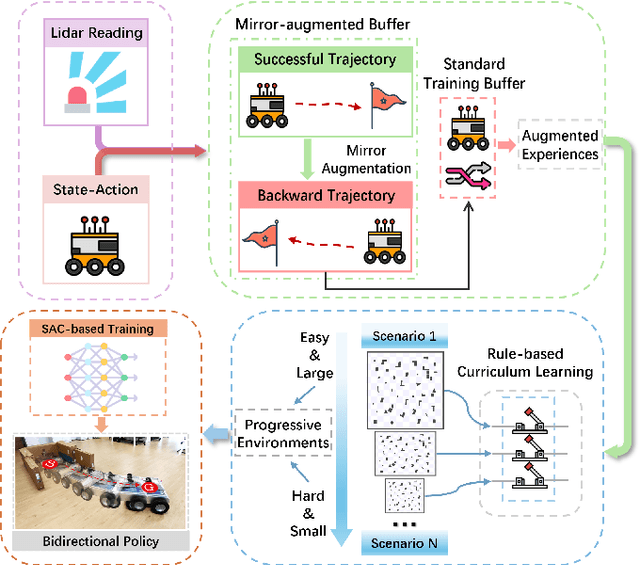
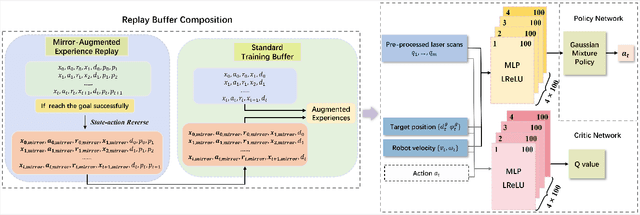
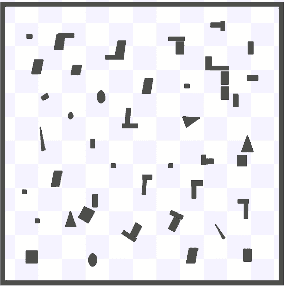
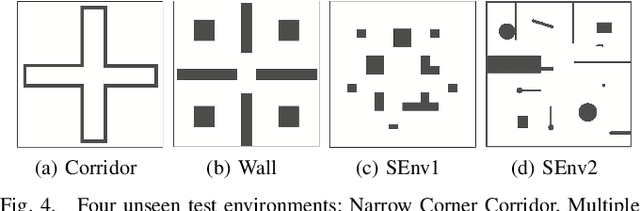
Deep Reinforcement Learning (DRL) based navigation methods have demonstrated promising results for mobile robots, but suffer from limited action flexibility in confined spaces. Conventional DRL approaches predominantly learn forward-motion policies, causing robots to become trapped in complex environments where backward maneuvers are necessary for recovery. This paper presents MAER-Nav (Mirror-Augmented Experience Replay for Robot Navigation), a novel framework that enables bidirectional motion learning without requiring explicit failure-driven hindsight experience replay or reward function modifications. Our approach integrates a mirror-augmented experience replay mechanism with curriculum learning to generate synthetic backward navigation experiences from successful trajectories. Experimental results in both simulation and real-world environments demonstrate that MAER-Nav significantly outperforms state-of-the-art methods while maintaining strong forward navigation capabilities. The framework effectively bridges the gap between the comprehensive action space utilization of traditional planning methods and the environmental adaptability of learning-based approaches, enabling robust navigation in scenarios where conventional DRL methods consistently fail.
Enhancing Deep Reinforcement Learning-based Robot Navigation Generalization through Scenario Augmentation
Mar 03, 2025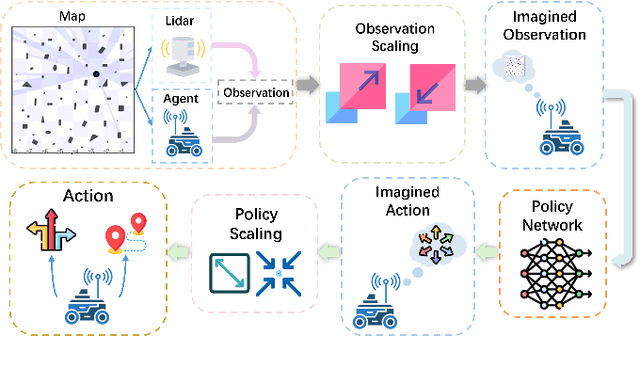
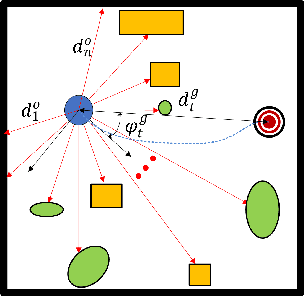
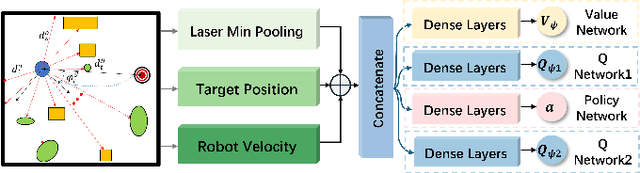
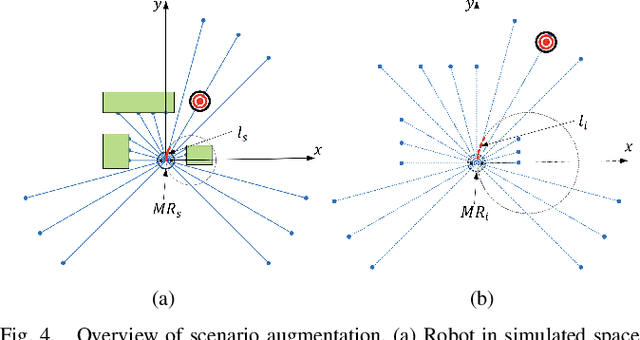
This work focuses on enhancing the generalization performance of deep reinforcement learning-based robot navigation in unseen environments. We present a novel data augmentation approach called scenario augmentation, which enables robots to navigate effectively across diverse settings without altering the training scenario. The method operates by mapping the robot's observation into an imagined space, generating an imagined action based on this transformed observation, and then remapping this action back to the real action executed in simulation. Through scenario augmentation, we conduct extensive comparative experiments to investigate the underlying causes of suboptimal navigation behaviors in unseen environments. Our analysis indicates that limited training scenarios represent the primary factor behind these undesired behaviors. Experimental results confirm that scenario augmentation substantially enhances the generalization capabilities of deep reinforcement learning-based navigation systems. The improved navigation framework demonstrates exceptional performance by producing near-optimal trajectories with significantly reduced navigation time in real-world applications.
Beyond Visibility Limits: A DRL-Based Navigation Strategy for Unexpected Obstacles
Mar 03, 2025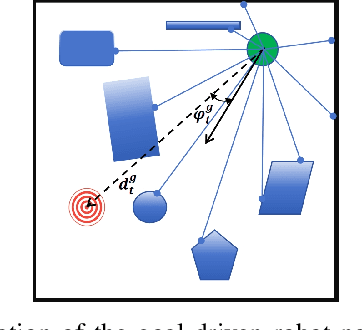
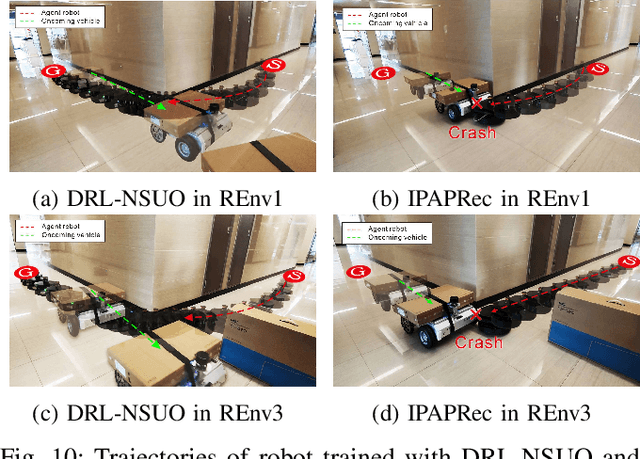
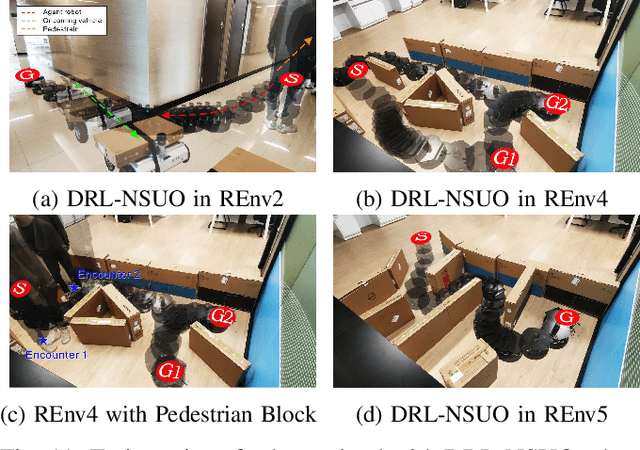
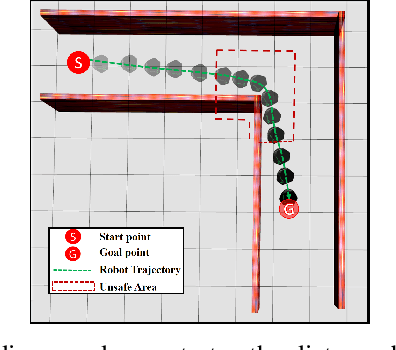
Distance-based reward mechanisms in deep reinforcement learning (DRL) navigation systems suffer from critical safety limitations in dynamic environments, frequently resulting in collisions when visibility is restricted. We propose DRL-NSUO, a novel navigation strategy for unexpected obstacles that leverages the rate of change in LiDAR data as a dynamic environmental perception element. Our approach incorporates a composite reward function with environmental change rate constraints and dynamically adjusted weights through curriculum learning, enabling robots to autonomously balance between path efficiency and safety maximization. We enhance sensitivity to nearby obstacles by implementing short-range feature preprocessing of LiDAR data. Experimental results demonstrate that this method significantly improves both robot and pedestrian safety in complex scenarios compared to traditional DRL-based methods. When evaluated on the BARN navigation dataset, our method achieved superior performance with success rates of 94.0% at 0.5 m/s and 91.0% at 1.0 m/s, outperforming conservative obstacle expansion strategies. These results validate DRL-NSUO's enhanced practicality and safety for human-robot collaborative environments, including intelligent logistics applications.