 Add to Chrome
 Add to Firefox
 Add to Edge
Embedding Hybrid Systems into Continuous Latent Vector Fields
Jun 09, 2026
This work proves that an $n$-dimensional hybrid system can be embedded into an $m$-dimensional Euclidean space equipped with a continuous vector field on its embedded image whenever $m>2n$. This result suggests that an intrinsically discontinuous hybrid system generically admits a continuous extrinsic representation that is well-posed for differentiable optimization. Building on this existence theorem, we show that a latent Neural ODE with consistency loss in both the latent and state space can accurately recover the flow of hybrid systems. Extensive experiments suggest the proposed method outperforms the existing method in learning hybrid systems with varying geometries from only time series data.

LieIPM: Lie Group Interior Point Method for Direct Trajectory Optimization of Rigid Bodies
Jun 09, 2026Designing dynamically feasible trajectories for rigid bodies is a fundamental problem in robotics. While direct methods are widely used, the existing constrained optimizers typically operate in Euclidean space and ignore the manifold structure of rigid body motions. This mismatch may introduce singularities or lead to poorly conditioned optimization problems. To bridge this gap, we develop a structure-aware framework for constrained trajectory optimization directly on matrix Lie groups. Our approach is based on the second-order rigid body models utilizing Lie group structures, which enables efficient Newton-type updates while preserving the underlying geometry. Building on this model, we propose a line-search Lie Group Interior Point Method (LieIPM) to handle constraints on the manifolds. We instantiate the framework for rigid body motion planning using Lie group variational integrators and derive closed-form intrinsic derivatives that exploit group symmetries. The LieIPM preserves the topology of rotation motions by construction and avoids singularities. Numerical results demonstrate superior robustness and faster convergence compared to general-purpose solvers and structure-exploiting optimal control methods.
A Survey of Legged Robotics in Non-Inertial Environments: Past, Present, and Future
Apr 22, 2026Legged robots have demonstrated remarkable agility on rigid, stationary ground, but their locomotion reliability remains limited in non-inertial environments, where the supporting ground moves, tilts, or accelerates. Such conditions arise in ground transportation, maritime platforms, and aerospace settings, and they introduce persistent time-varying disturbances that break the stationary-ground assumptions underlying conventional legged locomotion. This survey reviews the state of the art in modeling, state estimation, and control for legged robots in non-inertial environments. We summarize representative application domains and motion characteristics, analyze the root causes of locomotion performance degradation, and review existing methods together with their key assumptions and limitations. We further identify open problems in robot-environment coupling, observability, robustness, and experimental validation, and discuss future directions in autonomy, system-level design, bio-inspired strategies, safety, and testing. The survey aims to clarify the technical foundations of this emerging area and support the development of reliable legged robots for real-world dynamic environments.
Stein Variational Ergodic Surface Coverage with SE(3) Constraints
Mar 10, 2026Surface manipulation tasks require robots to generate trajectories that comprehensively cover complex 3D surfaces while maintaining precise end-effector poses. Existing ergodic trajectory optimization (TO) methods demonstrate success in coverage tasks, while struggling with point-cloud targets due to the nonconvex optimization landscapes and the inadequate handling of SE(3) constraints in sampling-as-optimization (SAO) techniques. In this work, we introduce a preconditioned SE(3) Stein Variational Gradient Descent (SVGD) approach for SAO ergodic trajectory generation. Our proposed approach comprises multiple innovations. First, we reformulate point-cloud ergodic coverage as a manifold-aware sampling problem. Second, we derive SE(3)-specific SVGD particle updates, and, third, we develop a preconditioner to accelerate TO convergence. Our sampling-based framework consistently identifies superior local optima compared to strong optimization-based and SAO baselines while preserving the SE(3) geometric structure. Experiments on a 3D point-cloud surface coverage benchmark and robotic surface drawing tasks demonstrate that our method achieves superior coverage quality with tractable computation in our setting relative to existing TO and SAO approaches, and is validated in real-world robot experiments.
CHyLL: Learning Continuous Neural Representations of Hybrid Systems
Dec 10, 2025Learning the flows of hybrid systems that have both continuous and discrete time dynamics is challenging. The existing method learns the dynamics in each discrete mode, which suffers from the combination of mode switching and discontinuities in the flows. In this work, we propose CHyLL (Continuous Hybrid System Learning in Latent Space), which learns a continuous neural representation of a hybrid system without trajectory segmentation, event functions, or mode switching. The key insight of CHyLL is that the reset map glues the state space at the guard surface, reformulating the state space as a piecewise smooth quotient manifold where the flow becomes spatially continuous. Building upon these insights and the embedding theorems grounded in differential topology, CHyLL concurrently learns a singularity-free neural embedding in a higher-dimensional space and the continuous flow in it. We showcase that CHyLL can accurately predict the flow of hybrid systems with superior accuracy and identify the topological invariants of the hybrid systems. Finally, we apply CHyLL to the stochastic optimal control problem.
Riemannian Direct Trajectory Optimization of Rigid Bodies on Matrix Lie Groups
May 05, 2025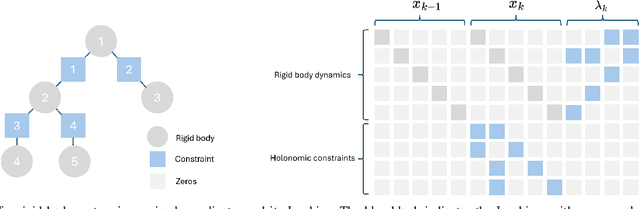
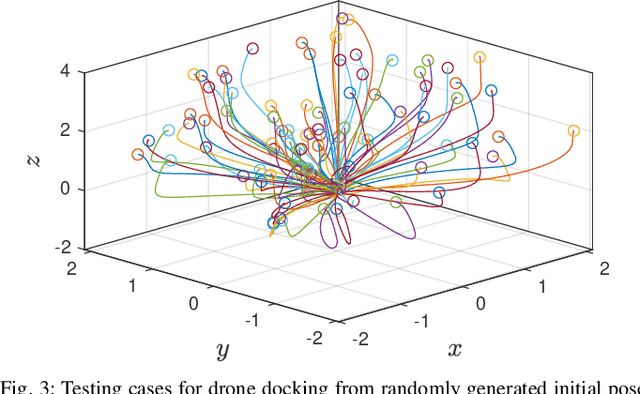
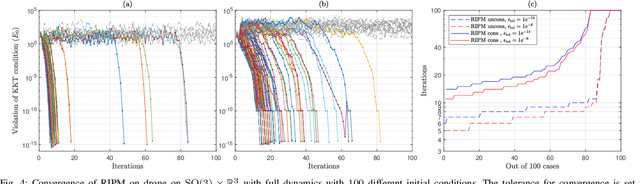
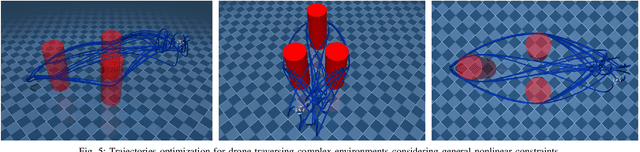
Designing dynamically feasible trajectories for rigid bodies is a fundamental problem in robotics. Although direct trajectory optimization is widely applied to solve this problem, inappropriate parameterizations of rigid body dynamics often result in slow convergence and violations of the intrinsic topological structure of the rotation group. This paper introduces a Riemannian optimization framework for direct trajectory optimization of rigid bodies. We first use the Lie Group Variational Integrator to formulate the discrete rigid body dynamics on matrix Lie groups. We then derive the closed-form first- and second-order Riemannian derivatives of the dynamics. Finally, this work applies a line-search Riemannian Interior Point Method (RIPM) to perform trajectory optimization with general nonlinear constraints. As the optimization is performed on matrix Lie groups, it is correct-by-construction to respect the topological structure of the rotation group and be free of singularities. The paper demonstrates that both the derivative evaluations and Newton steps required to solve the RIPM exhibit linear complexity with respect to the planning horizon and system degrees of freedom. Simulation results illustrate that the proposed method is faster than conventional methods by an order of magnitude in challenging robotics tasks.
Discrete-Time Hybrid Automata Learning: Legged Locomotion Meets Skateboarding
Mar 03, 2025This paper introduces Discrete-time Hybrid Automata Learning (DHAL), a framework using on-policy Reinforcement Learning to identify and execute mode-switching without trajectory segmentation or event function learning. Hybrid dynamical systems, which include continuous flow and discrete mode switching, can model robotics tasks like legged robot locomotion. Model-based methods usually depend on predefined gaits, while model-free approaches lack explicit mode-switching knowledge. Current methods identify discrete modes via segmentation before regressing continuous flow, but learning high-dimensional complex rigid body dynamics without trajectory labels or segmentation is a challenging open problem. Our approach incorporates a beta policy distribution and a multi-critic architecture to model contact-guided motions, exemplified by a challenging quadrupedal robot skateboard task. We validate our method through simulations and real-world tests, demonstrating robust performance in hybrid dynamical systems.
Legged Robot State Estimation within Non-inertial Environments
Mar 24, 2024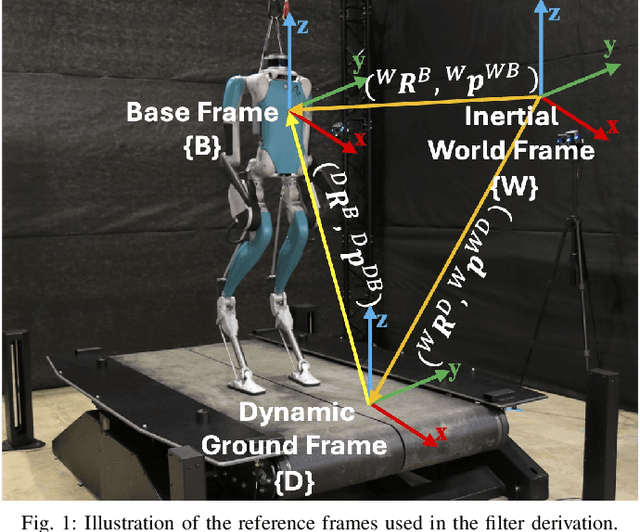
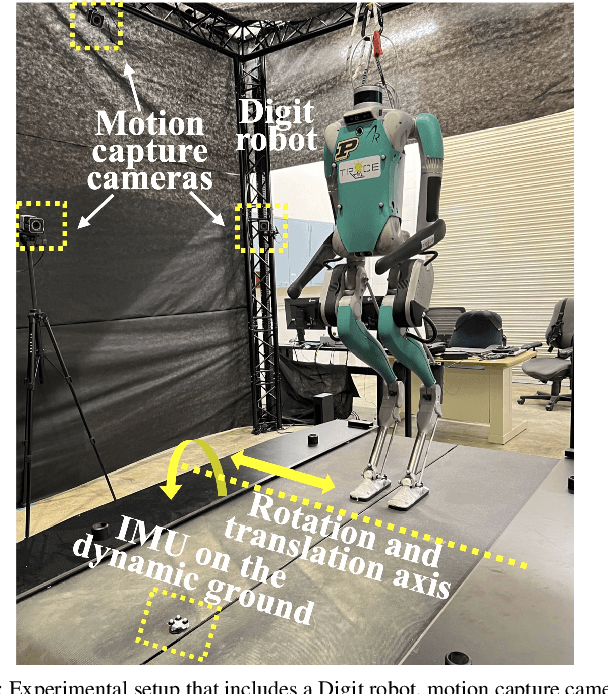
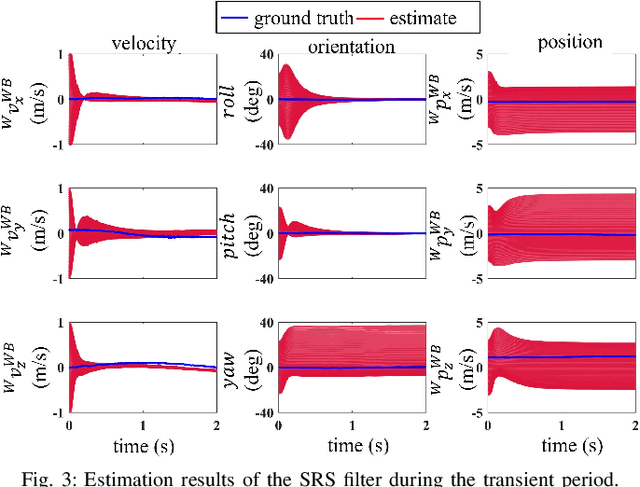
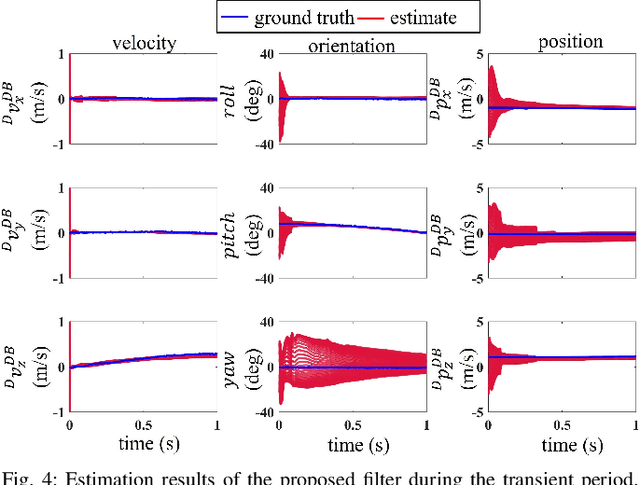
This paper investigates the robot state estimation problem within a non-inertial environment. The proposed state estimation approach relaxes the common assumption of static ground in the system modeling. The process and measurement models explicitly treat the movement of the non-inertial environments without requiring knowledge of its motion in the inertial frame or relying on GPS or sensing environmental landmarks. Further, the proposed state estimator is formulated as an invariant extended Kalman filter (InEKF) with the deterministic part of its process model obeying the group-affine property, leading to log-linear error dynamics. The observability analysis of the filter confirms that the robot's pose (i.e., position and orientation) and velocity relative to the non-inertial environment are observable. Hardware experiments on a humanoid robot moving on a rotating and translating treadmill demonstrate the high convergence rate and accuracy of the proposed InEKF even under significant treadmill pitch sway, as well as large estimation errors.
GMKF: Generalized Moment Kalman Filter for Polynomial Systems with Arbitrary Noise
Mar 08, 2024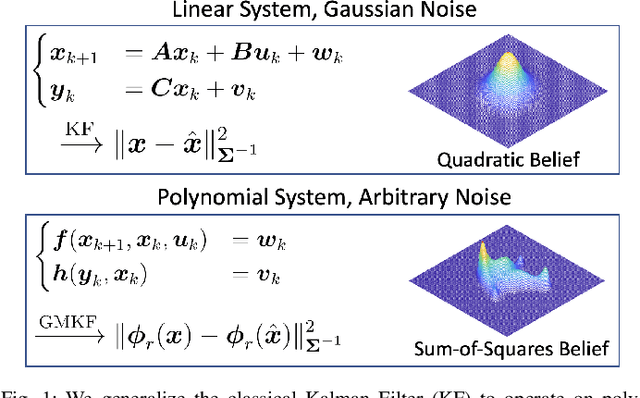
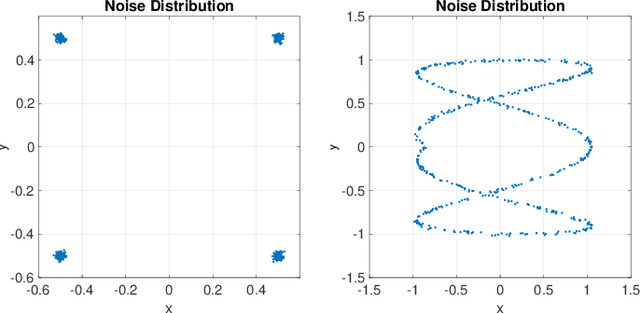

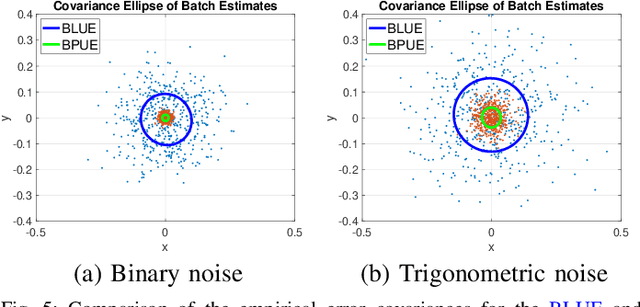
This paper develops a new filtering approach for state estimation in polynomial systems corrupted by arbitrary noise, which commonly arise in robotics. We first consider a batch setup where we perform state estimation using all data collected from the initial to the current time. We formulate the batch state estimation problem as a Polynomial Optimization Problem (POP) and relax the assumption of Gaussian noise by specifying a finite number of moments of the noise. We solve the resulting POP using a moment relaxation and prove that under suitable conditions on the rank of the relaxation, (i) we can extract a provably optimal estimate from the moment relaxation, and (ii) we can obtain a belief representation from the dual (sum-of-squares) relaxation. We then turn our attention to the filtering setup and apply similar insights to develop a GMKF for recursive state estimation in polynomial systems with arbitrary noise. The GMKF formulates the prediction and update steps as POPs and solves them using moment relaxations, carrying over a possibly non-Gaussian belief. In the linear-Gaussian case, GMKF reduces to the standard Kalman Filter. We demonstrate that GMKF performs well under highly non-Gaussian noise and outperforms common alternatives, including the Extended and Unscented Kalman Filter, and their variants on matrix Lie group.
Convex Geometric Motion Planning on Lie Groups via Moment Relaxation
May 23, 2023This paper reports a novel result: with proper robot models on matrix Lie groups, one can formulate the kinodynamic motion planning problem for rigid body systems as \emph{exact} polynomial optimization problems that can be relaxed as semidefinite programming (SDP). Due to the nonlinear rigid body dynamics, the motion planning problem for rigid body systems is nonconvex. Existing global optimization-based methods do not properly deal with the configuration space of the 3D rigid body; thus, they do not scale well to long-horizon planning problems. We use Lie groups as the configuration space in our formulation and apply the variational integrator to formulate the forced rigid body systems as quadratic polynomials. Then we leverage Lasserre's hierarchy to obtain the globally optimal solution via SDP. By constructing the motion planning problem in a sparse manner, the results show that the proposed algorithm has \emph{linear} complexity with respect to the planning horizon. This paper demonstrates the proposed method can provide rank-one optimal solutions at relaxation order two for most of the testing cases of 1) 3D drone landing using the full dynamics model and 2) inverse kinematics for serial manipulators.