 Add to Chrome
 Add to Firefox
 Add to Edge
Center-aware Residual Anomaly Synthesis for Multi-class Industrial Anomaly Detection
May 23, 2025
Anomaly detection plays a vital role in the inspection of industrial images. Most existing methods require separate models for each category, resulting in multiplied deployment costs. This highlights the challenge of developing a unified model for multi-class anomaly detection. However, the significant increase in inter-class interference leads to severe missed detections. Furthermore, the intra-class overlap between normal and abnormal samples, particularly in synthesis-based methods, cannot be ignored and may lead to over-detection. To tackle these issues, we propose a novel Center-aware Residual Anomaly Synthesis (CRAS) method for multi-class anomaly detection. CRAS leverages center-aware residual learning to couple samples from different categories into a unified center, mitigating the effects of inter-class interference. To further reduce intra-class overlap, CRAS introduces distance-guided anomaly synthesis that adaptively adjusts noise variance based on normal data distribution. Experimental results on diverse datasets and real-world industrial applications demonstrate the superior detection accuracy and competitive inference speed of CRAS. The source code and the newly constructed dataset are publicly available at https://github.com/cqylunlun/CRAS.

NTIRE 2025 challenge on Text to Image Generation Model Quality Assessment
May 22, 2025This paper reports on the NTIRE 2025 challenge on Text to Image (T2I) generation model quality assessment, which will be held in conjunction with the New Trends in Image Restoration and Enhancement Workshop (NTIRE) at CVPR 2025. The aim of this challenge is to address the fine-grained quality assessment of text-to-image generation models. This challenge evaluates text-to-image models from two aspects: image-text alignment and image structural distortion detection, and is divided into the alignment track and the structural track. The alignment track uses the EvalMuse-40K, which contains around 40K AI-Generated Images (AIGIs) generated by 20 popular generative models. The alignment track has a total of 371 registered participants. A total of 1,883 submissions are received in the development phase, and 507 submissions are received in the test phase. Finally, 12 participating teams submitted their models and fact sheets. The structure track uses the EvalMuse-Structure, which contains 10,000 AI-Generated Images (AIGIs) with corresponding structural distortion mask. A total of 211 participants have registered in the structure track. A total of 1155 submissions are received in the development phase, and 487 submissions are received in the test phase. Finally, 8 participating teams submitted their models and fact sheets. Almost all methods have achieved better results than baseline methods, and the winning methods in both tracks have demonstrated superior prediction performance on T2I model quality assessment.
Secure Transfer Learning: Training Clean Models Against Backdoor in (Both) Pre-trained Encoders and Downstream Datasets
Apr 16, 2025Transfer learning from pre-trained encoders has become essential in modern machine learning, enabling efficient model adaptation across diverse tasks. However, this combination of pre-training and downstream adaptation creates an expanded attack surface, exposing models to sophisticated backdoor embeddings at both the encoder and dataset levels--an area often overlooked in prior research. Additionally, the limited computational resources typically available to users of pre-trained encoders constrain the effectiveness of generic backdoor defenses compared to end-to-end training from scratch. In this work, we investigate how to mitigate potential backdoor risks in resource-constrained transfer learning scenarios. Specifically, we conduct an exhaustive analysis of existing defense strategies, revealing that many follow a reactive workflow based on assumptions that do not scale to unknown threats, novel attack types, or different training paradigms. In response, we introduce a proactive mindset focused on identifying clean elements and propose the Trusted Core (T-Core) Bootstrapping framework, which emphasizes the importance of pinpointing trustworthy data and neurons to enhance model security. Our empirical evaluations demonstrate the effectiveness and superiority of T-Core, specifically assessing 5 encoder poisoning attacks, 7 dataset poisoning attacks, and 14 baseline defenses across five benchmark datasets, addressing four scenarios of 3 potential backdoor threats.
An Integrated AI-Enabled System Using One Class Twin Cross Learning (OCT-X) for Early Gastric Cancer Detection
Mar 31, 2025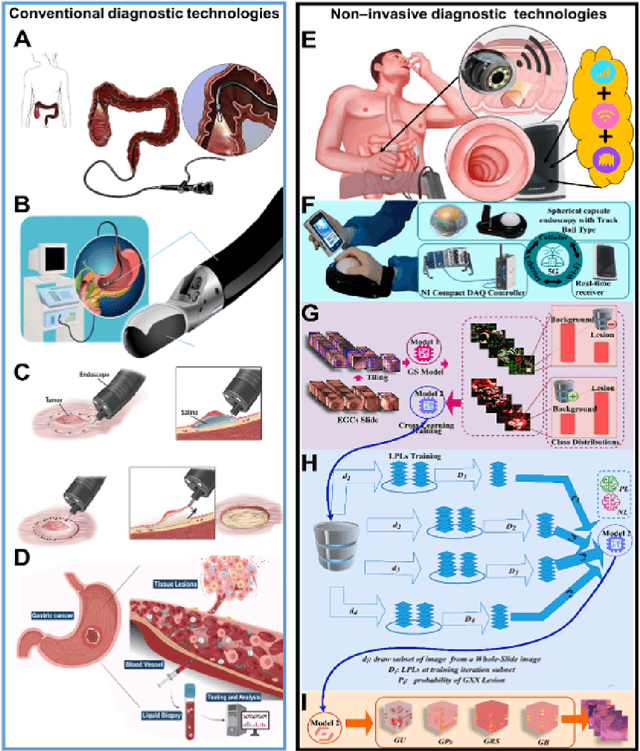
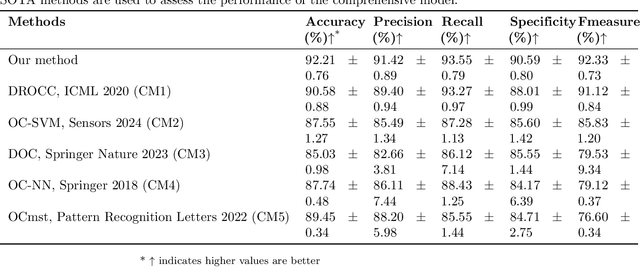
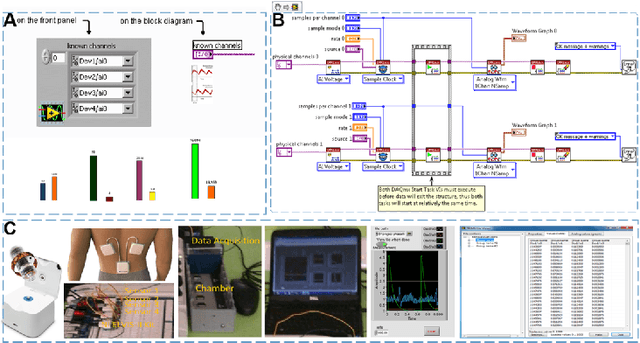
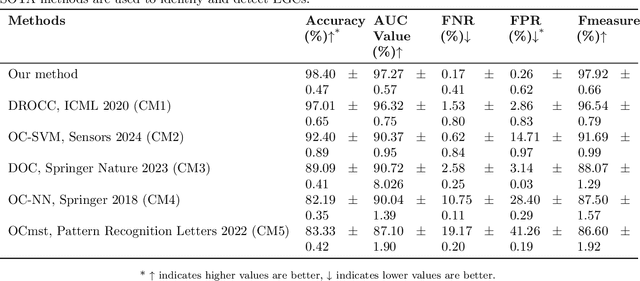
Early detection of gastric cancer, a leading cause of cancer-related mortality worldwide, remains hampered by the limitations of current diagnostic technologies, leading to high rates of misdiagnosis and missed diagnoses. To address these challenges, we propose an integrated system that synergizes advanced hardware and software technologies to balance speed-accuracy. Our study introduces the One Class Twin Cross Learning (OCT-X) algorithm. Leveraging a novel fast double-threshold grid search strategy (FDT-GS) and a patch-based deep fully convolutional network, OCT-X maximizes diagnostic accuracy through real-time data processing and seamless lesion surveillance. The hardware component includes an all-in-one point-of-care testing (POCT) device with high-resolution imaging sensors, real-time data processing, and wireless connectivity, facilitated by the NI CompactDAQ and LabVIEW software. Our integrated system achieved an unprecedented diagnostic accuracy of 99.70%, significantly outperforming existing models by up to 4.47%, and demonstrated a 10% improvement in multirate adaptability. These findings underscore the potential of OCT-X as well as the integrated system in clinical diagnostics, offering a path toward more accurate, efficient, and less invasive early gastric cancer detection. Future research will explore broader applications, further advancing oncological diagnostics. Code is available at https://github.com/liu37972/Multirate-Location-on-OCT-X-Learning.git.
MindEye-OmniAssist: A Gaze-Driven LLM-Enhanced Assistive Robot System for Implicit Intention Recognition and Task Execution
Mar 17, 2025A promising effective human-robot interaction in assistive robotic systems is gaze-based control. However, current gaze-based assistive systems mainly help users with basic grasping actions, offering limited support. Moreover, the restricted intent recognition capability constrains the assistive system's ability to provide diverse assistance functions. In this paper, we propose an open implicit intention recognition framework powered by Large Language Model (LLM) and Vision Foundation Model (VFM), which can process gaze input and recognize user intents that are not confined to predefined or specific scenarios. Furthermore, we implement a gaze-driven LLM-enhanced assistive robot system (MindEye-OmniAssist) that recognizes user's intentions through gaze and assists in completing task. To achieve this, the system utilizes open vocabulary object detector, intention recognition network and LLM to infer their full intentions. By integrating eye movement feedback and LLM, it generates action sequences to assist the user in completing tasks. Real-world experiments have been conducted for assistive tasks, and the system achieved an overall success rate of 41/55 across various undefined tasks. Preliminary results show that the proposed method holds the potential to provide a more user-friendly human-computer interaction interface and significantly enhance the versatility and effectiveness of assistive systems by supporting more complex and diverse task.
DeFine: A Decomposed and Fine-Grained Annotated Dataset for Long-form Article Generation
Mar 10, 2025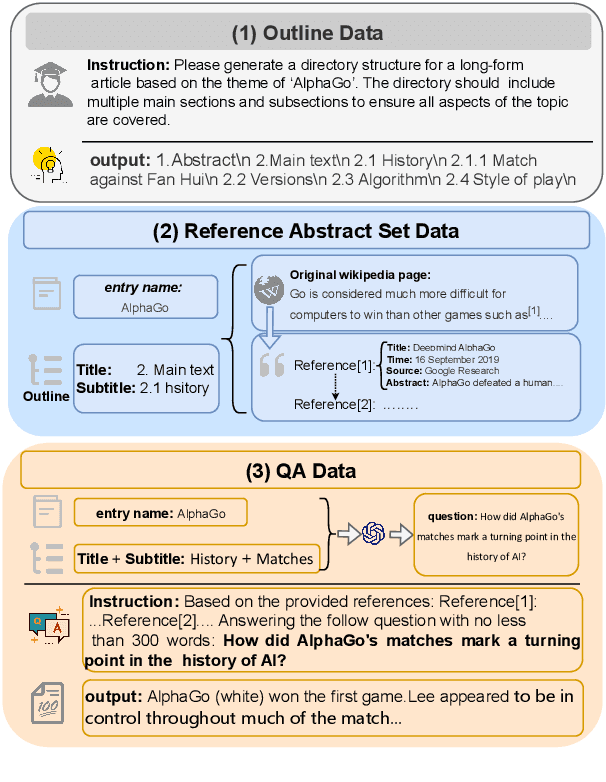
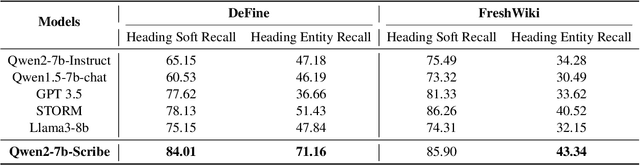
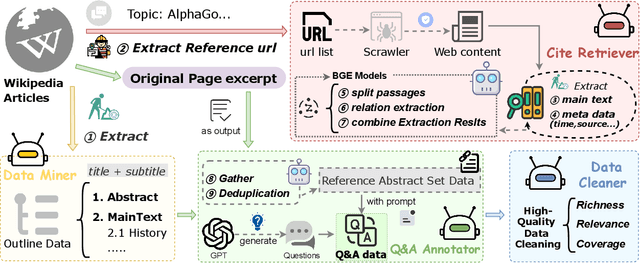
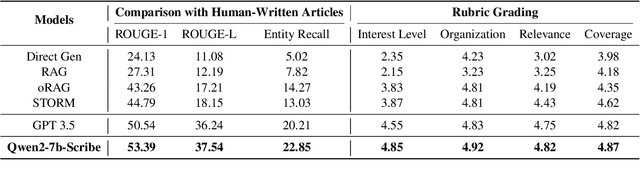
Long-form article generation (LFAG) presents challenges such as maintaining logical consistency, comprehensive topic coverage, and narrative coherence across extended articles. Existing datasets often lack both the hierarchical structure and fine-grained annotation needed to effectively decompose tasks, resulting in shallow, disorganized article generation. To address these limitations, we introduce DeFine, a Decomposed and Fine-grained annotated dataset for long-form article generation. DeFine is characterized by its hierarchical decomposition strategy and the integration of domain-specific knowledge with multi-level annotations, ensuring granular control and enhanced depth in article generation. To construct the dataset, a multi-agent collaborative pipeline is proposed, which systematically segments the generation process into four parts: Data Miner, Cite Retreiver, Q&A Annotator and Data Cleaner. To validate the effectiveness of DeFine, we designed and tested three LFAG baselines: the web retrieval, the local retrieval, and the grounded reference. We fine-tuned the Qwen2-7b-Instruct model using the DeFine training dataset. The experimental results showed significant improvements in text quality, specifically in topic coverage, depth of information, and content fidelity. Our dataset publicly available to facilitate future research.
Exploring Intrinsic Normal Prototypes within a Single Image for Universal Anomaly Detection
Mar 04, 2025Anomaly detection (AD) is essential for industrial inspection, yet existing methods typically rely on ``comparing'' test images to normal references from a training set. However, variations in appearance and positioning often complicate the alignment of these references with the test image, limiting detection accuracy. We observe that most anomalies manifest as local variations, meaning that even within anomalous images, valuable normal information remains. We argue that this information is useful and may be more aligned with the anomalies since both the anomalies and the normal information originate from the same image. Therefore, rather than relying on external normality from the training set, we propose INP-Former, a novel method that extracts Intrinsic Normal Prototypes (INPs) directly from the test image. Specifically, we introduce the INP Extractor, which linearly combines normal tokens to represent INPs. We further propose an INP Coherence Loss to ensure INPs can faithfully represent normality for the testing image. These INPs then guide the INP-Guided Decoder to reconstruct only normal tokens, with reconstruction errors serving as anomaly scores. Additionally, we propose a Soft Mining Loss to prioritize hard-to-optimize samples during training. INP-Former achieves state-of-the-art performance in single-class, multi-class, and few-shot AD tasks across MVTec-AD, VisA, and Real-IAD, positioning it as a versatile and universal solution for AD. Remarkably, INP-Former also demonstrates some zero-shot AD capability. Code is available at:https://github.com/luow23/INP-Former.
Robot Deformable Object Manipulation via NMPC-generated Demonstrations in Deep Reinforcement Learning
Feb 17, 2025In this work, we conducted research on deformable object manipulation by robots based on demonstration-enhanced reinforcement learning (RL). To improve the learning efficiency of RL, we enhanced the utilization of demonstration data from multiple aspects and proposed the HGCR-DDPG algorithm. It uses a novel high-dimensional fuzzy approach for grasping-point selection, a refined behavior-cloning method to enhance data-driven learning in Rainbow-DDPG, and a sequential policy-learning strategy. Compared to the baseline algorithm (Rainbow-DDPG), our proposed HGCR-DDPG achieved 2.01 times the global average reward and reduced the global average standard deviation to 45% of that of the baseline algorithm. To reduce the human labor cost of demonstration collection, we proposed a low-cost demonstration collection method based on Nonlinear Model Predictive Control (NMPC). Simulation experiment results show that demonstrations collected through NMPC can be used to train HGCR-DDPG, achieving comparable results to those obtained with human demonstrations. To validate the feasibility of our proposed methods in real-world environments, we conducted physical experiments involving deformable object manipulation. We manipulated fabric to perform three tasks: diagonal folding, central axis folding, and flattening. The experimental results demonstrate that our proposed method achieved success rates of 83.3%, 80%, and 100% for these three tasks, respectively, validating the effectiveness of our approach. Compared to current large-model approaches for robot manipulation, the proposed algorithm is lightweight, requires fewer computational resources, and offers task-specific customization and efficient adaptability for specific tasks.
Self-Calibrated Dual Contrasting for Annotation-Efficient Bacteria Raman Spectroscopy Clustering and Classification
Dec 28, 2024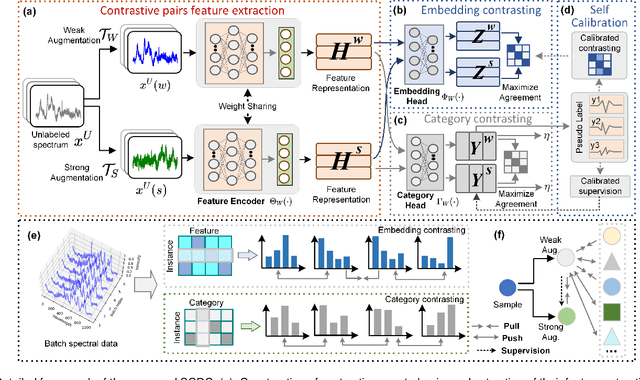
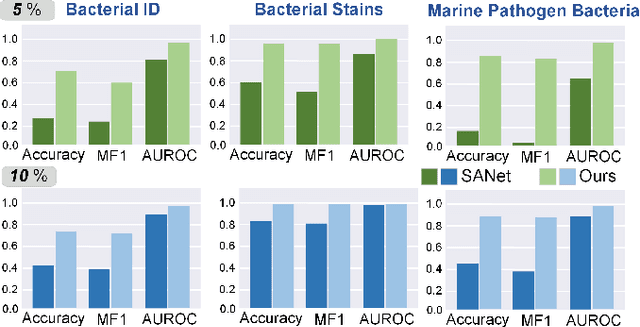
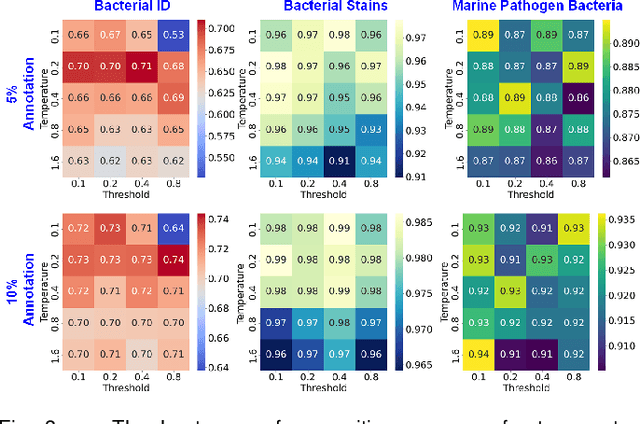
Raman scattering is based on molecular vibration spectroscopy and provides a powerful technology for pathogenic bacteria diagnosis using the unique molecular fingerprint information of a substance. The integration of deep learning technology has significantly improved the efficiency and accuracy of intelligent Raman spectroscopy (RS) recognition. However, the current RS recognition methods based on deep neural networks still require the annotation of a large amount of spectral data, which is labor-intensive. This paper presents a novel annotation-efficient Self-Calibrated Dual Contrasting (SCDC) method for RS recognition that operates effectively with few or no annotation. Our core motivation is to represent the spectrum from two different perspectives in two distinct subspaces: embedding and category. The embedding perspective captures instance-level information, while the category perspective reflects category-level information. Accordingly, we have implemented a dual contrastive learning approach from two perspectives to obtain discriminative representations, which are applicable for Raman spectroscopy recognition under both unsupervised and semi-supervised learning conditions. Furthermore, a self-calibration mechanism is proposed to enhance robustness. Validation of the identification task on three large-scale bacterial Raman spectroscopy datasets demonstrates that our SCDC method achieves robust recognition performance with very few (5$\%$ or 10$\%$) or no annotations, highlighting the potential of the proposed method for biospectral identification in annotation-efficient clinical scenarios.
VarAD: Lightweight High-Resolution Image Anomaly Detection via Visual Autoregressive Modeling
Dec 23, 2024This paper addresses a practical task: High-Resolution Image Anomaly Detection (HRIAD). In comparison to conventional image anomaly detection for low-resolution images, HRIAD imposes a heavier computational burden and necessitates superior global information capture capacity. To tackle HRIAD, this paper translates image anomaly detection into visual token prediction and proposes VarAD based on visual autoregressive modeling for token prediction. Specifically, VarAD first extracts multi-hierarchy and multi-directional visual token sequences, and then employs an advanced model, Mamba, for visual autoregressive modeling and token prediction. During the prediction process, VarAD effectively exploits information from all preceding tokens to predict the target token. Finally, the discrepancies between predicted tokens and original tokens are utilized to score anomalies. Comprehensive experiments on four publicly available datasets and a real-world button inspection dataset demonstrate that the proposed VarAD achieves superior high-resolution image anomaly detection performance while maintaining lightweight, rendering VarAD a viable solution for HRIAD. Code is available at \href{https://github.com/caoyunkang/VarAD}{\url{https://github.com/caoyunkang/VarAD}}.