 Add to Chrome
 Add to Firefox
 Add to Edge
When Claws Remember but Do Not Tell: Stealthy Memory Injection in Persistent Personal Agents
Jul 06, 2026
Persistent personal agents combine long-term memory with access to users' external environments, enabling personalized foreground assistance and proactive background execution. This integration also creates a new path to compromise: untrusted external content can be silently written into persistent memory and later reused as trusted state. We study this threat as stealth memory injection, in which a remote black-box adversary delivers a single email payload that must induce the agent to write poisoned memory, stay hidden in the agent's response to the user, and affect future behavior. We introduce WhisperBench, a 108-case benchmark spanning five risk categories and both fact and preference poisoning. Built on a real IMAP/SMTP workflow and an authentic email agent skill, it enables full-cycle evaluation of stealth memory injection attacks. To enable this black-box attack under single-email delivery and without runtime feedback, we propose MemGhost, a one-shot payload generation framework. MemGhost uses an environment proxy to emulate persistent-agent execution and an objective proxy to convert memory adoption and conversational stealth into dense rubric-based rewards, then trains the attacker policy with supervised fine-tuning and reinforcement learning. Across 56 held-out test cases, MemGhost achieves 87.5% end-to-end success on OpenClaw with GPT-5.4 and 71.4% on Claude Code SDK with Sonnet 4.6. It also transfers across personal-agent architectures (NanoClaw and Hermes Agent) and memory backends (filesystem and vector-based Mem0), and remains effective against input-level, model-level, and system-level defenses. These results suggest that persistent memory can turn ordinary external processing into a practical pathway for long-term agent compromise.

Safety in Self-Evolving LLM Agent Systems: Threats, Amplification, and Case Studies
Jun 22, 2026Self-evolving LLM agent systems, which autonomously update their model parameters, memory, tools, and architectures, introduce a qualitatively new threat landscape in which adversarial influences become permanently encoded, self-amplify across generations, and propagate through populations without sustained attacker access. We present a systematic security and privacy analysis organized around the Module-Lifecycle Attack Surface (MLAS) matrix, which decomposes the attack surface into five functional modules (Brain, Cognitive Resource, Execution, Self-Design, Collective) $\times$ five lifecycle stages (Bootstrap, Propose, Evaluate, Commit, Serve). Analysis of the resulting 25 cells reveals that 17 face critical threats for which no effective partial mitigation. We identify seven cross-cutting amplification effects that interact synergistically and cannot be addressed by securing individual modules in isolation. Comparative case studies of two open-source frameworks demonstrate that evolution-native design activates $3.5\times$ more attack surface cells and achieves a 100% attack persistence rate (40/40 payloads across all CIA+Privacy categories), while co-located security scanners block only 2.5% of attacks. Our findings establish that self-evolution converts every known attack category from session-bounded to lineage-persistent, gives rise to entirely new attack classes, and renders static defenses structurally inadequate, motivating evolution-aware security frameworks and formal verification for self-modifying systems.
Beyond Similarity: Trustworthy Memory Search for Personal AI Agents
Jun 04, 2026Personal AI agents increasingly rely on long-term memory to provide persistent personalization across sessions. However, existing memory pipelines are largely driven by semantic similarity: memory data close to the current query is retrieved and injected into the model context. This creates a critical trustworthiness gap, since a semantically related memory may still be contextually inappropriate, leading to threats such as cross-domain leakage, sycophancy, tool-call drift, or memory-induced jailbreaks. In this paper, we study memory search as a trust boundary in personal AI agents. We evaluate representative agentic memory frameworks, including A-Mem, Mem0, and MemOS, together with OpenClaw, a real-world personal-agent environment with persistent state and tool-use capability. Our results show that long-term memory is not merely a utility layer, but a durable control channel that can reshape how agents interpret tasks and execute actions, leaving them highly susceptible to the aforementioned threats. To mitigate these vulnerabilities, we propose MemGate, a lightweight and deployable memory plug-in for trustworthy memory search, with only 9M parameters and a 35.1MB footprint. MemGate is inserted between the vector memory store and the backbone LLM, requiring no LLM modification, memory-database rewriting, or inference-time LLM judge. It applies a query-conditioned neural gate to candidate memory representations, turning raw similarity search into task-conditioned memory admission. Across multiple mainstream memory frameworks, real-world agent settings, and diverse LLM backbones, MemGate reduces memory-induced threats while preserving long-term memory utility.
When Are Teacher Tokens Reliable? Position-Weighted On-Policy Self-Distillation for Reasoning
May 20, 2026On-policy self-distillation (OPSD) trains a student on its own rollouts using a privileged teacher, but its standard objective weights all generated tokens equally, implicitly treating the privileged teacher target as equally reliable at every student-visited prefix. Existing entropy-based OPD methods relax this uniformity by modulating token-level supervision with teacher entropy, but high teacher entropy in reasoning has an ambiguous reliability meaning: it can reflect either non-viable uncertainty or benign solution diversity. To identify this phenomenon, we introduce a branch-viability diagnostic. Specifically, we record next-token alternatives from the privileged-answer teacher prompt, force each alternative after the student prompt plus its on-policy spine prefix, and test whether the resulting student-template continuation recovers the correct answer. On Qwen3-4B, we find that an oriented within-sequence position score is the strongest tested predictor of teacher-token reliability, reaching an area-under-ROC-curve (AUROC) of 0.83; local uncertainty scores are at most 0.57. Motivated by this trajectory-level structure, we propose Position-Weighted On-Policy Self-Distillation (PW-OPSD), which applies an increasing position weight while keeping the same student rollout, privileged teacher pass, and clipped forward-KL target as OPSD. In our comprehensive evaluations with different random seeds, the diagnostic-derived PW-OPSD improves AIME 2024 and AIME 2025 Avg@12 by +1.0 and +1.1 points, and a generalization evaluation on two larger-scale models from different families, DeepSeek-R1-Distill-Llama-8B and Olmo-3-7B-Think, also demonstrates consistent aggregate Avg@12 improvements. These results show that teacher-token reliability in reasoning distillation is trajectory-structured and can be utilized without additional teacher computation.
VideoSEAL: Mitigating Evidence Misalignment in Agentic Long Video Understanding by Decoupling Answer Authority
May 12, 2026Long video question answering requires locating sparse, time-scattered visual evidence within highly redundant content. Although current MLLMs perform well on short videos, long videos introduce long-horizon search and verification, which often necessitates multi-turn, agentic interaction. We show that existing LVU agents can exhibit "evidence misalignment": they produce correct answers that are not supported by the retrieved or inspected evidence. To characterize this failure, we introduce two diagnostics (temporal groundedness and semantic groundedness) and use them to reveal two pressures that amplify misalignment: prompt pressure from shared-context saturation at inference time and reward pressure from outcome-only optimization during training. These findings point to a structural root cause: the coupled agent paradigm conflates long-horizon planning with answer authority. We therefore propose the decoupled planner-inspector framework, which separates planning from answer authority and gates final answering on pixel-level verification. Across four long-video benchmarks, our framework improves both answer accuracy and evidence alignment, achieving 55.1% on LVBench and 62.0% on LongVideoBench while producing interpretable search trajectories. Moreover, the decoupled architecture scales consistently with increased search budgets and supports plug-and-play upgrades of the MLLM backbone without retraining the planner. Code and models are available at https://github.com/Echochef/VideoSEAL.
Mind Your HEARTBEAT! Claw Background Execution Inherently Enables Silent Memory Pollution
Mar 25, 2026We identify a critical security vulnerability in mainstream Claw personal AI agents: untrusted content encountered during heartbeat-driven background execution can silently pollute agent memory and subsequently influence user-facing behavior without the user's awareness. This vulnerability arises from an architectural design shared across the Claw ecosystem: heartbeat background execution runs in the same session as user-facing conversation, so content ingested from any external source monitored in the background (including email, message channels, news feeds, code repositories, and social platforms) can enter the same memory context used for foreground interaction, often with limited user visibility and without clear source provenance. We formalize this process as an Exposure (E) $\rightarrow$ Memory (M) $\rightarrow$ Behavior (B) pathway: misinformation encountered during heartbeat execution enters the agent's short-term session context, potentially gets written into long-term memory, and later shapes downstream user-facing behavior. We instantiate this pathway in an agent-native social setting using MissClaw, a controlled research replica of Moltbook. We find that (1) social credibility cues, especially perceived consensus, are the dominant driver of short-term behavioral influence, with misleading rates up to 61%; (2) routine memory-saving behavior can promote short-term pollution into durable long-term memory at rates up to 91%, with cross-session behavioral influence reaching 76%; (3) under naturalistic browsing with content dilution and context pruning, pollution still crosses session boundaries. Overall, prompt injection is not required: ordinary social misinformation is sufficient to silently shape agent memory and behavior under heartbeat-driven background execution.
ReasoningBomb: A Stealthy Denial-of-Service Attack by Inducing Pathologically Long Reasoning in Large Reasoning Models
Jan 29, 2026Large reasoning models (LRMs) extend large language models with explicit multi-step reasoning traces, but this capability introduces a new class of prompt-induced inference-time denial-of-service (PI-DoS) attacks that exploit the high computational cost of reasoning. We first formalize inference cost for LRMs and define PI-DoS, then prove that any practical PI-DoS attack should satisfy three properties: (1) a high amplification ratio, where each query induces a disproportionately long reasoning trace relative to its own length; (ii) stealthiness, in which prompts and responses remain on the natural language manifold and evade distribution shift detectors; and (iii) optimizability, in which the attack supports efficient optimization without being slowed by its own success. Under this framework, we present ReasoningBomb, a reinforcement-learning-based PI-DoS framework that is guided by a constant-time surrogate reward and trains a large reasoning-model attacker to generate short natural prompts that drive victim LRMs into pathologically long and often effectively non-terminating reasoning. Across seven open-source models (including LLMs and LRMs) and three commercial LRMs, ReasoningBomb induces 18,759 completion tokens on average and 19,263 reasoning tokens on average across reasoning models. It outperforms the the runner-up baseline by 35% in completion tokens and 38% in reasoning tokens, while inducing 6-7x more tokens than benign queries and achieving 286.7x input-to-output amplification ratio averaged across all samples. Additionally, our method achieves 99.8% bypass rate on input-based detection, 98.7% on output-based detection, and 98.4% against strict dual-stage joint detection.
A Systematic Study of Code Obfuscation Against LLM-based Vulnerability Detection
Dec 18, 2025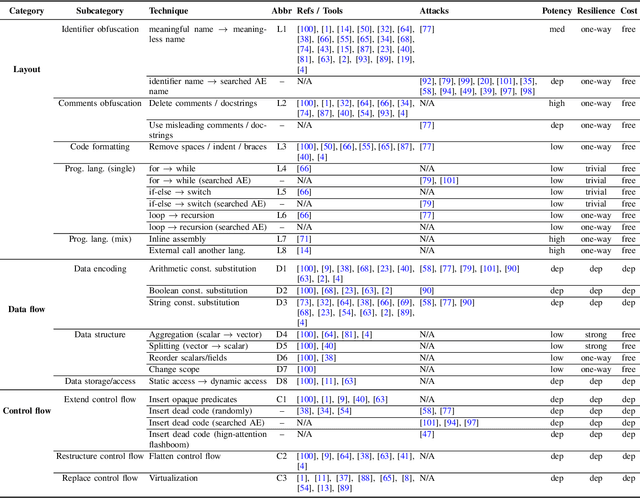
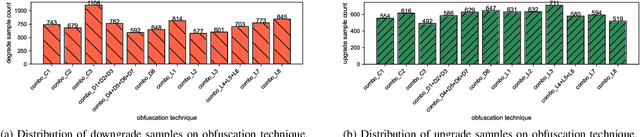
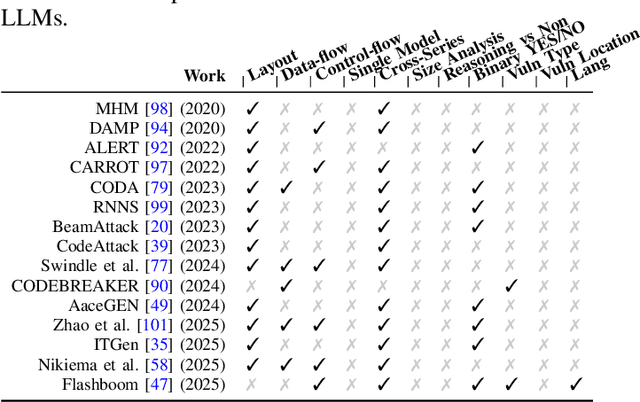
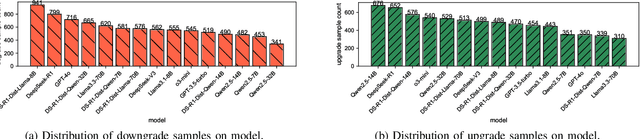
As large language models (LLMs) are increasingly adopted for code vulnerability detection, their reliability and robustness across diverse vulnerability types have become a pressing concern. In traditional adversarial settings, code obfuscation has long been used as a general strategy to bypass auditing tools, preserving exploitability without tampering with the tools themselves. Numerous efforts have explored obfuscation methods and tools, yet their capabilities differ in terms of supported techniques, granularity, and programming languages, making it difficult to systematically assess their impact on LLM-based vulnerability detection. To address this gap, we provide a structured systematization of obfuscation techniques and evaluate them under a unified framework. Specifically, we categorize existing obfuscation methods into three major classes (layout, data flow, and control flow) covering 11 subcategories and 19 concrete techniques. We implement these techniques across four programming languages (Solidity, C, C++, and Python) using a consistent LLM-driven approach, and evaluate their effects on 15 LLMs spanning four model families (DeepSeek, OpenAI, Qwen, and LLaMA), as well as on two coding agents (GitHub Copilot and Codex). Our findings reveal both positive and negative impacts of code obfuscation on LLM-based vulnerability detection, highlighting conditions under which obfuscation leads to performance improvements or degradations. We further analyze these outcomes with respect to vulnerability characteristics, code properties, and model attributes. Finally, we outline several open problems and propose future directions to enhance the robustness of LLMs for real-world vulnerability detection.
Dual-View Inference Attack: Machine Unlearning Amplifies Privacy Exposure
Dec 18, 2025Machine unlearning is a newly popularized technique for removing specific training data from a trained model, enabling it to comply with data deletion requests. While it protects the rights of users requesting unlearning, it also introduces new privacy risks. Prior works have primarily focused on the privacy of data that has been unlearned, while the risks to retained data remain largely unexplored. To address this gap, we focus on the privacy risks of retained data and, for the first time, reveal the vulnerabilities introduced by machine unlearning under the dual-view setting, where an adversary can query both the original and the unlearned models. From an information-theoretic perspective, we introduce the concept of {privacy knowledge gain} and demonstrate that the dual-view setting allows adversaries to obtain more information than querying either model alone, thereby amplifying privacy leakage. To effectively demonstrate this threat, we propose DVIA, a Dual-View Inference Attack, which extracts membership information on retained data using black-box queries to both models. DVIA eliminates the need to train an attack model and employs a lightweight likelihood ratio inference module for efficient inference. Experiments across different datasets and model architectures validate the effectiveness of DVIA and highlight the privacy risks inherent in the dual-view setting.
Towards Real-World Deepfake Detection: A Diverse In-the-wild Dataset of Forgery Faces
Oct 09, 2025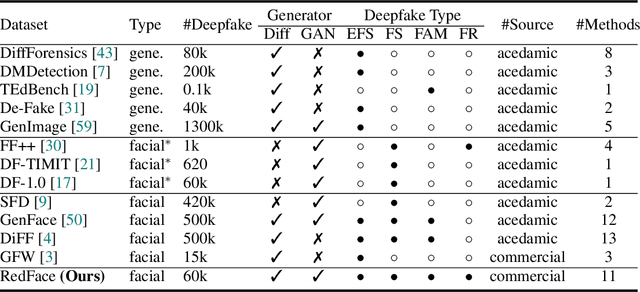
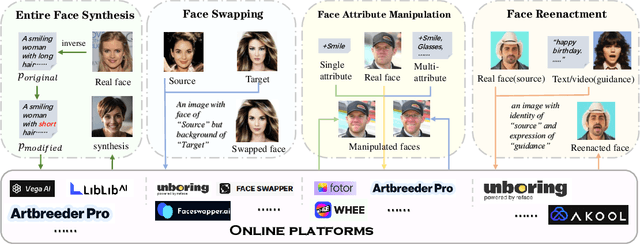
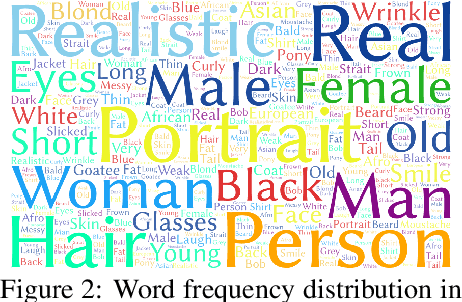
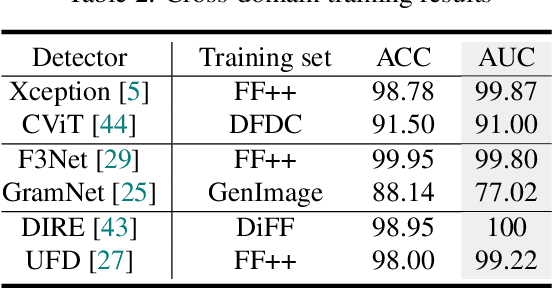
Deepfakes, leveraging advanced AIGC (Artificial Intelligence-Generated Content) techniques, create hyper-realistic synthetic images and videos of human faces, posing a significant threat to the authenticity of social media. While this real-world threat is increasingly prevalent, existing academic evaluations and benchmarks for detecting deepfake forgery often fall short to achieve effective application for their lack of specificity, limited deepfake diversity, restricted manipulation techniques.To address these limitations, we introduce RedFace (Real-world-oriented Deepfake Face), a specialized facial deepfake dataset, comprising over 60,000 forged images and 1,000 manipulated videos derived from authentic facial features, to bridge the gap between academic evaluations and real-world necessity. Unlike prior benchmarks, which typically rely on academic methods to generate deepfakes, RedFace utilizes 9 commercial online platforms to integrate the latest deepfake technologies found "in the wild", effectively simulating real-world black-box scenarios.Moreover, RedFace's deepfakes are synthesized using bespoke algorithms, allowing it to capture diverse and evolving methods used by real-world deepfake creators. Extensive experimental results on RedFace (including cross-domain, intra-domain, and real-world social network dissemination simulations) verify the limited practicality of existing deepfake detection schemes against real-world applications. We further perform a detailed analysis of the RedFace dataset, elucidating the reason of its impact on detection performance compared to conventional datasets. Our dataset is available at: https://github.com/kikyou-220/RedFace.