 Add to Chrome
 Add to Firefox
 Add to Edge
URA-Net: Uncertainty-Integrated Anomaly Perception and Restoration Attention Network for Unsupervised Anomaly Detection
Mar 24, 2026
Unsupervised anomaly detection plays a pivotal role in industrial defect inspection and medical image analysis, with most methods relying on the reconstruction framework. However, these methods may suffer from over-generalization, enabling them to reconstruct anomalies well, which leads to poor detection performance. To address this issue, instead of focusing solely on normality reconstruction, we propose an innovative Uncertainty-Integrated Anomaly Perception and Restoration Attention Network (URA-Net), which explicitly restores abnormal patterns to their corresponding normality. First, unlike traditional image reconstruction methods, we utilize a pre-trained convolutional neural network to extract multi-level semantic features as the reconstruction target. To assist the URA-Net learning to restore anomalies, we introduce a novel feature-level artificial anomaly synthesis module to generate anomalous samples for training. Subsequently, a novel uncertainty-integrated anomaly perception module based on Bayesian neural networks is introduced to learn the distributions of anomalous and normal features. This facilitates the estimation of anomalous regions and ambiguous boundaries, laying the foundation for subsequent anomaly restoration. Then, we propose a novel restoration attention mechanism that leverages global normal semantic information to restore detected anomalous regions, thereby obtaining defect-free restored features. Finally, we employ residual maps between input features and restored features for anomaly detection and localization. The comprehensive experimental results on two industrial datasets, MVTec AD and BTAD, along with a medical image dataset, OCT-2017, unequivocally demonstrate the effectiveness and superiority of the proposed method.

Template-Based Feature Aggregation Network for Industrial Anomaly Detection
Mar 24, 2026Industrial anomaly detection plays a crucial role in ensuring product quality control. Therefore, proposing an effective anomaly detection model is of great significance. While existing feature-reconstruction methods have demonstrated excellent performance, they face challenges with shortcut learning, which can lead to undesirable reconstruction of anomalous features. To address this concern, we present a novel feature-reconstruction model called the \textbf{T}emplate-based \textbf{F}eature \textbf{A}ggregation \textbf{Net}work (TFA-Net) for anomaly detection via template-based feature aggregation. Specifically, TFA-Net first extracts multiple hierarchical features from a pre-trained convolutional neural network for a fixed template image and an input image. Instead of directly reconstructing input features, TFA-Net aggregates them onto the template features, effectively filtering out anomalous features that exhibit low similarity to normal template features. Next, TFA-Net utilizes the template features that have already fused normal features in the input features to refine feature details and obtain the reconstructed feature map. Finally, the defective regions can be located by comparing the differences between the input and reconstructed features. Additionally, a random masking strategy for input features is employed to enhance the overall inspection performance of the model. Our template-based feature aggregation schema yields a nontrivial and meaningful feature reconstruction task. The simple, yet efficient, TFA-Net exhibits state-of-the-art detection performance on various real-world industrial datasets. Additionally, it fulfills the real-time demands of industrial scenarios, rendering it highly suitable for practical applications in the industry. Code is available at https://github.com/luow23/TFA-Net.
A Feature Shuffling and Restoration Strategy for Universal Unsupervised Anomaly Detection
Mar 24, 2026Unsupervised anomaly detection is vital in industrial fields, with reconstruction-based methods favored for their simplicity and effectiveness. However, reconstruction methods often encounter an identical shortcut issue, where both normal and anomalous regions can be well reconstructed and fail to identify outliers. The severity of this problem increases with the complexity of the normal data distribution. Consequently, existing methods may exhibit excellent detection performance in a specific scenario, but their performance sharply declines when transferred to another scenario. This paper focuses on establishing a universal model applicable to anomaly detection tasks across different settings, termed as universal anomaly detection. In this work, we introduce a novel, straightforward yet efficient framework for universal anomaly detection: \uline{F}eature \uline{S}huffling and \uline{R}estoration (FSR), which can alleviate the identical shortcut issue across different settings. First and foremost, FSR employs multi-scale features with rich semantic information as reconstruction targets, rather than raw image pixels. Subsequently, these multi-scale features are partitioned into non-overlapping feature blocks, which are randomly shuffled and then restored to their original state using a restoration network. This simple paradigm encourages the model to focus more on global contextual information. Additionally, we introduce a novel concept, the shuffling rate, to regulate the complexity of the FSR task, thereby alleviating the identical shortcut across different settings. Furthermore, we provide theoretical explanations for the effectiveness of FSR framework from two perspectives: network structure and mutual information. Extensive experimental results validate the superiority and efficiency of the FSR framework across different settings.Code is available at https://github.com/luow23/FSR.
Anomagic: Crossmodal Prompt-driven Zero-shot Anomaly Generation
Nov 13, 2025We propose Anomagic, a zero-shot anomaly generation method that produces semantically coherent anomalies without requiring any exemplar anomalies. By unifying both visual and textual cues through a crossmodal prompt encoding scheme, Anomagic leverages rich contextual information to steer an inpainting-based generation pipeline. A subsequent contrastive refinement strategy enforces precise alignment between synthesized anomalies and their masks, thereby bolstering downstream anomaly detection accuracy. To facilitate training, we introduce AnomVerse, a collection of 12,987 anomaly-mask-caption triplets assembled from 13 publicly available datasets, where captions are automatically generated by multimodal large language models using structured visual prompts and template-based textual hints. Extensive experiments demonstrate that Anomagic trained on AnomVerse can synthesize more realistic and varied anomalies than prior methods, yielding superior improvements in downstream anomaly detection. Furthermore, Anomagic can generate anomalies for any normal-category image using user-defined prompts, establishing a versatile foundation model for anomaly generation.
Center-aware Residual Anomaly Synthesis for Multi-class Industrial Anomaly Detection
May 23, 2025Anomaly detection plays a vital role in the inspection of industrial images. Most existing methods require separate models for each category, resulting in multiplied deployment costs. This highlights the challenge of developing a unified model for multi-class anomaly detection. However, the significant increase in inter-class interference leads to severe missed detections. Furthermore, the intra-class overlap between normal and abnormal samples, particularly in synthesis-based methods, cannot be ignored and may lead to over-detection. To tackle these issues, we propose a novel Center-aware Residual Anomaly Synthesis (CRAS) method for multi-class anomaly detection. CRAS leverages center-aware residual learning to couple samples from different categories into a unified center, mitigating the effects of inter-class interference. To further reduce intra-class overlap, CRAS introduces distance-guided anomaly synthesis that adaptively adjusts noise variance based on normal data distribution. Experimental results on diverse datasets and real-world industrial applications demonstrate the superior detection accuracy and competitive inference speed of CRAS. The source code and the newly constructed dataset are publicly available at https://github.com/cqylunlun/CRAS.
Exploring Intrinsic Normal Prototypes within a Single Image for Universal Anomaly Detection
Mar 04, 2025Anomaly detection (AD) is essential for industrial inspection, yet existing methods typically rely on ``comparing'' test images to normal references from a training set. However, variations in appearance and positioning often complicate the alignment of these references with the test image, limiting detection accuracy. We observe that most anomalies manifest as local variations, meaning that even within anomalous images, valuable normal information remains. We argue that this information is useful and may be more aligned with the anomalies since both the anomalies and the normal information originate from the same image. Therefore, rather than relying on external normality from the training set, we propose INP-Former, a novel method that extracts Intrinsic Normal Prototypes (INPs) directly from the test image. Specifically, we introduce the INP Extractor, which linearly combines normal tokens to represent INPs. We further propose an INP Coherence Loss to ensure INPs can faithfully represent normality for the testing image. These INPs then guide the INP-Guided Decoder to reconstruct only normal tokens, with reconstruction errors serving as anomaly scores. Additionally, we propose a Soft Mining Loss to prioritize hard-to-optimize samples during training. INP-Former achieves state-of-the-art performance in single-class, multi-class, and few-shot AD tasks across MVTec-AD, VisA, and Real-IAD, positioning it as a versatile and universal solution for AD. Remarkably, INP-Former also demonstrates some zero-shot AD capability. Code is available at:https://github.com/luow23/INP-Former.
Self-Calibrated Dual Contrasting for Annotation-Efficient Bacteria Raman Spectroscopy Clustering and Classification
Dec 28, 2024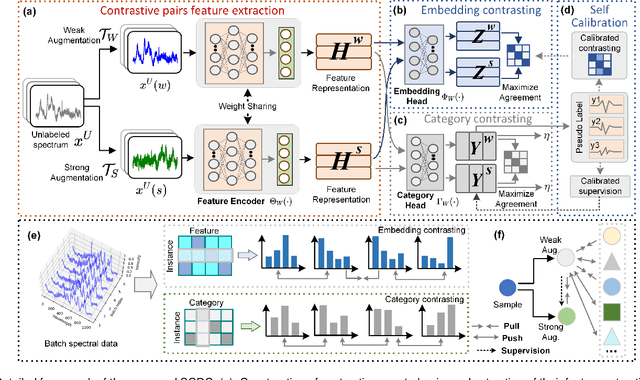
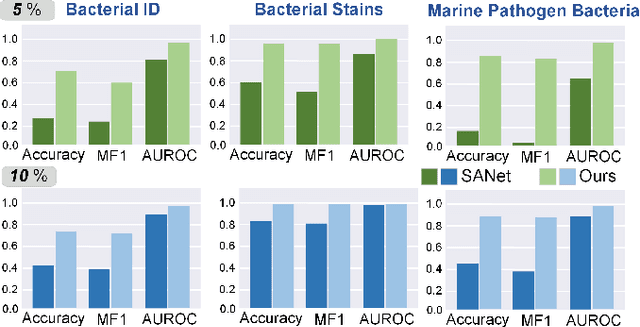
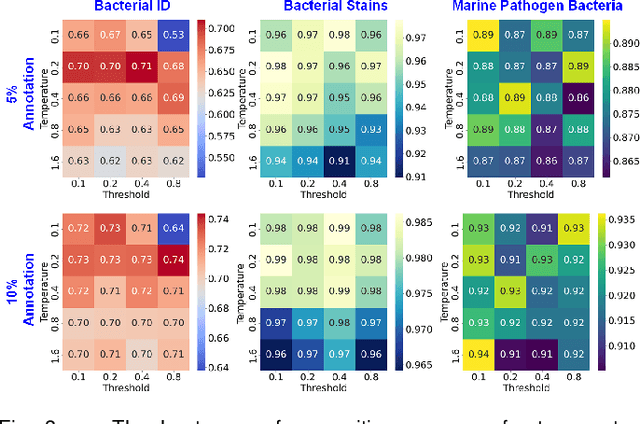
Raman scattering is based on molecular vibration spectroscopy and provides a powerful technology for pathogenic bacteria diagnosis using the unique molecular fingerprint information of a substance. The integration of deep learning technology has significantly improved the efficiency and accuracy of intelligent Raman spectroscopy (RS) recognition. However, the current RS recognition methods based on deep neural networks still require the annotation of a large amount of spectral data, which is labor-intensive. This paper presents a novel annotation-efficient Self-Calibrated Dual Contrasting (SCDC) method for RS recognition that operates effectively with few or no annotation. Our core motivation is to represent the spectrum from two different perspectives in two distinct subspaces: embedding and category. The embedding perspective captures instance-level information, while the category perspective reflects category-level information. Accordingly, we have implemented a dual contrastive learning approach from two perspectives to obtain discriminative representations, which are applicable for Raman spectroscopy recognition under both unsupervised and semi-supervised learning conditions. Furthermore, a self-calibration mechanism is proposed to enhance robustness. Validation of the identification task on three large-scale bacterial Raman spectroscopy datasets demonstrates that our SCDC method achieves robust recognition performance with very few (5$\%$ or 10$\%$) or no annotations, highlighting the potential of the proposed method for biospectral identification in annotation-efficient clinical scenarios.
VarAD: Lightweight High-Resolution Image Anomaly Detection via Visual Autoregressive Modeling
Dec 23, 2024This paper addresses a practical task: High-Resolution Image Anomaly Detection (HRIAD). In comparison to conventional image anomaly detection for low-resolution images, HRIAD imposes a heavier computational burden and necessitates superior global information capture capacity. To tackle HRIAD, this paper translates image anomaly detection into visual token prediction and proposes VarAD based on visual autoregressive modeling for token prediction. Specifically, VarAD first extracts multi-hierarchy and multi-directional visual token sequences, and then employs an advanced model, Mamba, for visual autoregressive modeling and token prediction. During the prediction process, VarAD effectively exploits information from all preceding tokens to predict the target token. Finally, the discrepancies between predicted tokens and original tokens are utilized to score anomalies. Comprehensive experiments on four publicly available datasets and a real-world button inspection dataset demonstrate that the proposed VarAD achieves superior high-resolution image anomaly detection performance while maintaining lightweight, rendering VarAD a viable solution for HRIAD. Code is available at \href{https://github.com/caoyunkang/VarAD}{\url{https://github.com/caoyunkang/VarAD}}.
AMI-Net: Adaptive Mask Inpainting Network for Industrial Anomaly Detection and Localization
Dec 16, 2024Unsupervised visual anomaly detection is crucial for enhancing industrial production quality and efficiency. Among unsupervised methods, reconstruction approaches are popular due to their simplicity and effectiveness. The key aspect of reconstruction methods lies in the restoration of anomalous regions, which current methods have not satisfactorily achieved. To tackle this issue, we introduce a novel \uline{A}daptive \uline{M}ask \uline{I}npainting \uline{Net}work (AMI-Net) from the perspective of adaptive mask-inpainting. In contrast to traditional reconstruction methods that treat non-semantic image pixels as targets, our method uses a pre-trained network to extract multi-scale semantic features as reconstruction targets. Given the multiscale nature of industrial defects, we incorporate a training strategy involving random positional and quantitative masking. Moreover, we propose an innovative adaptive mask generator capable of generating adaptive masks that effectively mask anomalous regions while preserving normal regions. In this manner, the model can leverage the visible normal global contextual information to restore the masked anomalous regions, thereby effectively suppressing the reconstruction of defects. Extensive experimental results on the MVTec AD and BTAD industrial datasets validate the effectiveness of the proposed method. Additionally, AMI-Net exhibits exceptional real-time performance, striking a favorable balance between detection accuracy and speed, rendering it highly suitable for industrial applications. Code is available at: https://github.com/luow23/AMI-Net
Adversarial Contrastive Domain-Generative Learning for Bacteria Raman Spectrum Joint Denoising and Cross-Domain Identification
Dec 11, 2024
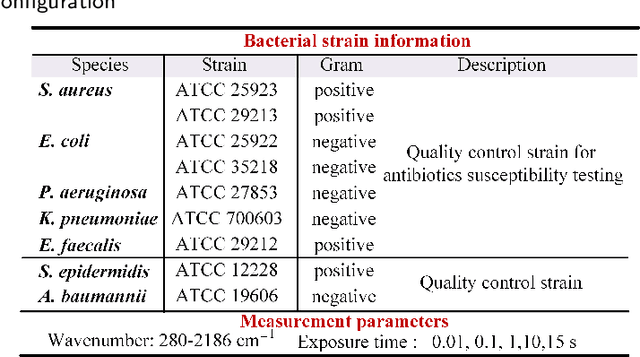
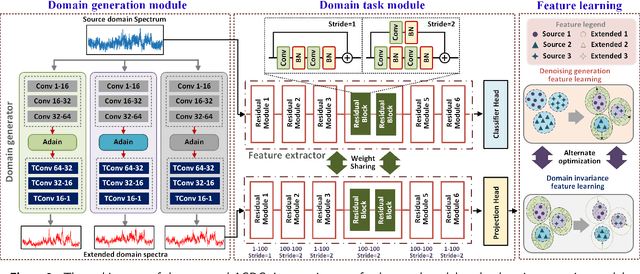
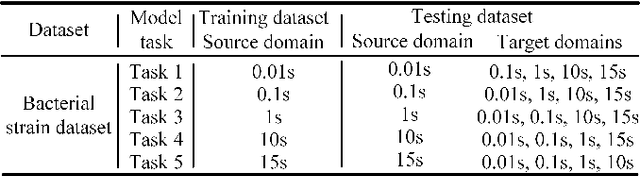
Raman spectroscopy, as a label-free detection technology, has been widely utilized in the clinical diagnosis of pathogenic bacteria. However, Raman signals are naturally weak and sensitive to the condition of the acquisition process. The characteristic spectra of a bacteria can manifest varying signal-to-noise ratios and domain discrepancies under different acquisition conditions. Consequently, existing methods often face challenges when making identification for unobserved acquisition conditions, i.e., the testing acquisition conditions are unavailable during model training. In this article, a generic framework, namely, an adversarial contrastive domain-generative learning framework, is proposed for joint Raman spectroscopy denoising and cross-domain identification. The proposed method is composed of a domain generation module and a domain task module. Through adversarial learning between these two modules, it utilizes only a single available source domain spectral data to generate extended denoised domains that are semantically consistent with the source domain and extracts domain-invariant representations. Comprehensive case studies indicate that the proposed method can simultaneously conduct spectral denoising without necessitating noise-free ground-truth and can achieve improved diagnostic accuracy and robustness under cross-domain unseen spectral acquisition conditions. This suggests that the proposed method holds remarkable potential as a diagnostic tool in real clinical cases.