 Add to Chrome
 Add to Firefox
 Add to Edge
MRAD: Zero-Shot Anomaly Detection with Memory-Driven Retrieval
Jan 31, 2026
Zero-shot anomaly detection (ZSAD) often leverages pretrained vision or vision-language models, but many existing methods use prompt learning or complex modeling to fit the data distribution, resulting in high training or inference cost and limited cross-domain stability. To address these limitations, we propose Memory-Retrieval Anomaly Detection method (MRAD), a unified framework that replaces parametric fitting with a direct memory retrieval. The train-free base model, MRAD-TF, freezes the CLIP image encoder and constructs a two-level memory bank (image-level and pixel-level) from auxiliary data, where feature-label pairs are explicitly stored as keys and values. During inference, anomaly scores are obtained directly by similarity retrieval over the memory bank. Based on the MRAD-TF, we further propose two lightweight variants as enhancements: (i) MRAD-FT fine-tunes the retrieval metric with two linear layers to enhance the discriminability between normal and anomaly; (ii) MRAD-CLIP injects the normal and anomalous region priors from the MRAD-FT as dynamic biases into CLIP's learnable text prompts, strengthening generalization to unseen categories. Across 16 industrial and medical datasets, the MRAD framework consistently demonstrates superior performance in anomaly classification and segmentation, under both train-free and training-based settings. Our work shows that fully leveraging the empirical distribution of raw data, rather than relying only on model fitting, can achieve stronger anomaly detection performance. The code will be publicly released at https://github.com/CROVO1026/MRAD.

Dexterous Manipulation Transfer via Progressive Kinematic-Dynamic Alignment
Nov 14, 2025The inherent difficulty and limited scalability of collecting manipulation data using multi-fingered robot hand hardware platforms have resulted in severe data scarcity, impeding research on data-driven dexterous manipulation policy learning. To address this challenge, we present a hand-agnostic manipulation transfer system. It efficiently converts human hand manipulation sequences from demonstration videos into high-quality dexterous manipulation trajectories without requirements of massive training data. To tackle the multi-dimensional disparities between human hands and dexterous hands, as well as the challenges posed by high-degree-of-freedom coordinated control of dexterous hands, we design a progressive transfer framework: first, we establish primary control signals for dexterous hands based on kinematic matching; subsequently, we train residual policies with action space rescaling and thumb-guided initialization to dynamically optimize contact interactions under unified rewards; finally, we compute wrist control trajectories with the objective of preserving operational semantics. Using only human hand manipulation videos, our system automatically configures system parameters for different tasks, balancing kinematic matching and dynamic optimization across dexterous hands, object categories, and tasks. Extensive experimental results demonstrate that our framework can automatically generate smooth and semantically correct dexterous hand manipulation that faithfully reproduces human intentions, achieving high efficiency and strong generalizability with an average transfer success rate of 73%, providing an easily implementable and scalable method for collecting robot dexterous manipulation data.
Anomagic: Crossmodal Prompt-driven Zero-shot Anomaly Generation
Nov 13, 2025We propose Anomagic, a zero-shot anomaly generation method that produces semantically coherent anomalies without requiring any exemplar anomalies. By unifying both visual and textual cues through a crossmodal prompt encoding scheme, Anomagic leverages rich contextual information to steer an inpainting-based generation pipeline. A subsequent contrastive refinement strategy enforces precise alignment between synthesized anomalies and their masks, thereby bolstering downstream anomaly detection accuracy. To facilitate training, we introduce AnomVerse, a collection of 12,987 anomaly-mask-caption triplets assembled from 13 publicly available datasets, where captions are automatically generated by multimodal large language models using structured visual prompts and template-based textual hints. Extensive experiments demonstrate that Anomagic trained on AnomVerse can synthesize more realistic and varied anomalies than prior methods, yielding superior improvements in downstream anomaly detection. Furthermore, Anomagic can generate anomalies for any normal-category image using user-defined prompts, establishing a versatile foundation model for anomaly generation.
Center-aware Residual Anomaly Synthesis for Multi-class Industrial Anomaly Detection
May 23, 2025Anomaly detection plays a vital role in the inspection of industrial images. Most existing methods require separate models for each category, resulting in multiplied deployment costs. This highlights the challenge of developing a unified model for multi-class anomaly detection. However, the significant increase in inter-class interference leads to severe missed detections. Furthermore, the intra-class overlap between normal and abnormal samples, particularly in synthesis-based methods, cannot be ignored and may lead to over-detection. To tackle these issues, we propose a novel Center-aware Residual Anomaly Synthesis (CRAS) method for multi-class anomaly detection. CRAS leverages center-aware residual learning to couple samples from different categories into a unified center, mitigating the effects of inter-class interference. To further reduce intra-class overlap, CRAS introduces distance-guided anomaly synthesis that adaptively adjusts noise variance based on normal data distribution. Experimental results on diverse datasets and real-world industrial applications demonstrate the superior detection accuracy and competitive inference speed of CRAS. The source code and the newly constructed dataset are publicly available at https://github.com/cqylunlun/CRAS.
Bayesian Prompt Flow Learning for Zero-Shot Anomaly Detection
Mar 13, 2025Recently, vision-language models (e.g. CLIP) have demonstrated remarkable performance in zero-shot anomaly detection (ZSAD). By leveraging auxiliary data during training, these models can directly perform cross-category anomaly detection on target datasets, such as detecting defects on industrial product surfaces or identifying tumors in organ tissues. Existing approaches typically construct text prompts through either manual design or the optimization of learnable prompt vectors. However, these methods face several challenges: 1) handcrafted prompts require extensive expert knowledge and trial-and-error; 2) single-form learnable prompts struggle to capture complex anomaly semantics; and 3) an unconstrained prompt space limit generalization to unseen categories. To address these issues, we propose Bayesian Prompt Flow Learning (Bayes-PFL), which models the prompt space as a learnable probability distribution from a Bayesian perspective. Specifically, a prompt flow module is designed to learn both image-specific and image-agnostic distributions, which are jointly utilized to regularize the text prompt space and enhance the model's generalization on unseen categories. These learned distributions are then sampled to generate diverse text prompts, effectively covering the prompt space. Additionally, a residual cross-attention (RCA) module is introduced to better align dynamic text embeddings with fine-grained image features. Extensive experiments on 15 industrial and medical datasets demonstrate our method's superior performance.
Progressive Boundary Guided Anomaly Synthesis for Industrial Anomaly Detection
Dec 23, 2024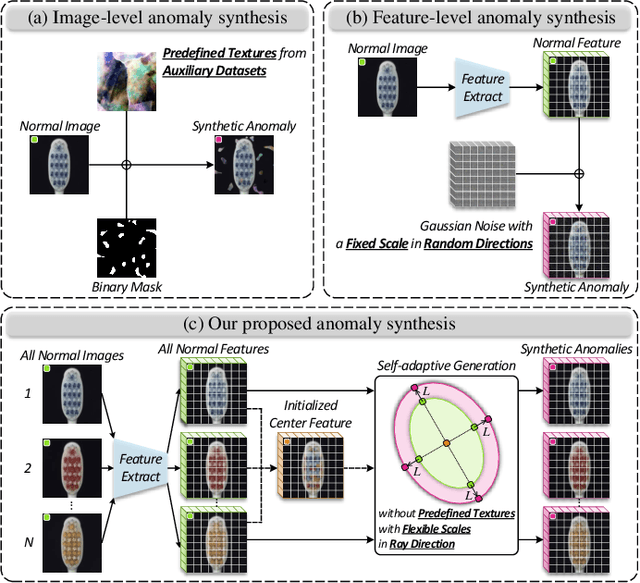
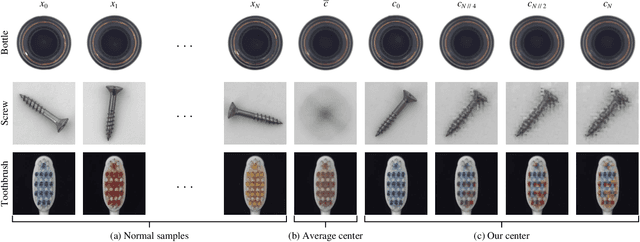
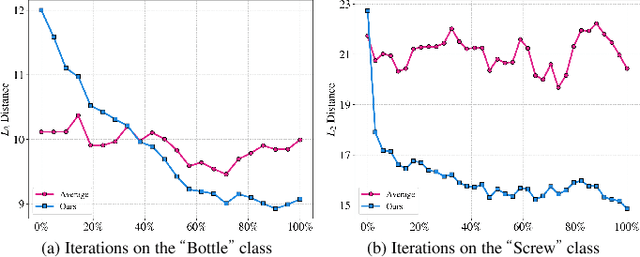
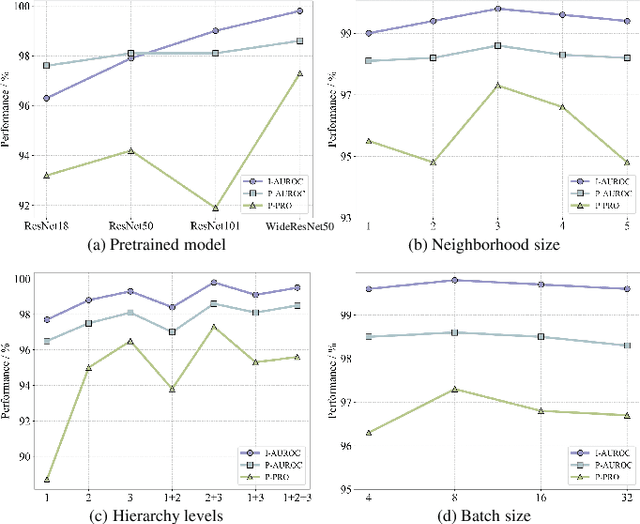
Unsupervised anomaly detection methods can identify surface defects in industrial images by leveraging only normal samples for training. Due to the risk of overfitting when learning from a single class, anomaly synthesis strategies are introduced to enhance detection capability by generating artificial anomalies. However, existing strategies heavily rely on anomalous textures from auxiliary datasets. Moreover, their limitations in the coverage and directionality of anomaly synthesis may result in a failure to capture useful information and lead to significant redundancy. To address these issues, we propose a novel Progressive Boundary-guided Anomaly Synthesis (PBAS) strategy, which can directionally synthesize crucial feature-level anomalies without auxiliary textures. It consists of three core components: Approximate Boundary Learning (ABL), Anomaly Feature Synthesis (AFS), and Refined Boundary Optimization (RBO). To make the distribution of normal samples more compact, ABL first learns an approximate decision boundary by center constraint, which improves the center initialization through feature alignment. AFS then directionally synthesizes anomalies with more flexible scales guided by the hypersphere distribution of normal features. Since the boundary is so loose that it may contain real anomalies, RBO refines the decision boundary through the binary classification of artificial anomalies and normal features. Experimental results show that our method achieves state-of-the-art performance and the fastest detection speed on three widely used industrial datasets, including MVTec AD, VisA, and MPDD. The code will be available at: https://github.com/cqylunlun/PBAS.
A Unified Anomaly Synthesis Strategy with Gradient Ascent for Industrial Anomaly Detection and Localization
Jul 12, 2024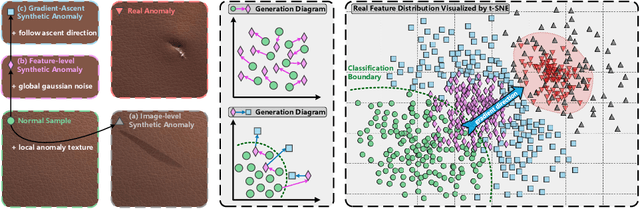
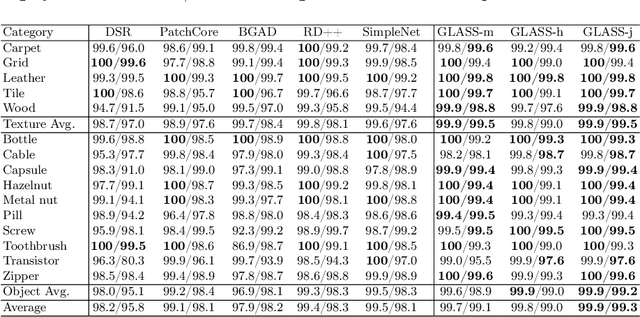
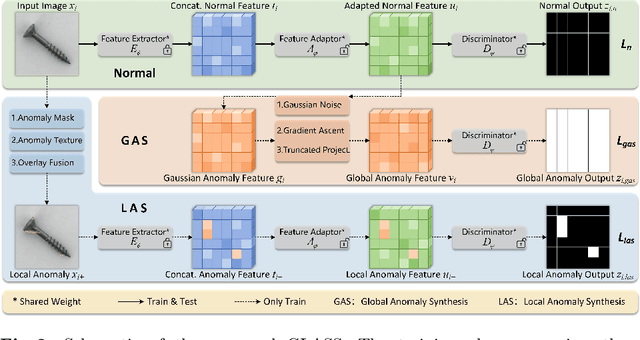
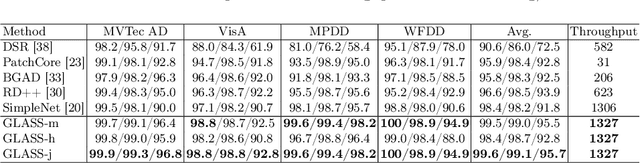
Anomaly synthesis strategies can effectively enhance unsupervised anomaly detection. However, existing strategies have limitations in the coverage and controllability of anomaly synthesis, particularly for weak defects that are very similar to normal regions. In this paper, we propose Global and Local Anomaly co-Synthesis Strategy (GLASS), a novel unified framework designed to synthesize a broader coverage of anomalies under the manifold and hypersphere distribution constraints of Global Anomaly Synthesis (GAS) at the feature level and Local Anomaly Synthesis (LAS) at the image level. Our method synthesizes near-in-distribution anomalies in a controllable way using Gaussian noise guided by gradient ascent and truncated projection. GLASS achieves state-of-the-art results on the MVTec AD (detection AUROC of 99.9\%), VisA, and MPDD datasets and excels in weak defect detection. The effectiveness and efficiency have been further validated in industrial applications for woven fabric defect detection. The code and dataset are available at: \url{https://github.com/cqylunlun/GLASS}.
A Unified Search and Recommendation Framework Based on Multi-Scenario Learning for Ranking in E-commerce
May 17, 2024


Search and recommendation (S&R) are the two most important scenarios in e-commerce. The majority of users typically interact with products in S&R scenarios, indicating the need and potential for joint modeling. Traditional multi-scenario models use shared parameters to learn the similarity of multiple tasks, and task-specific parameters to learn the divergence of individual tasks. This coarse-grained modeling approach does not effectively capture the differences between S&R scenarios. Furthermore, this approach does not sufficiently exploit the information across the global label space. These issues can result in the suboptimal performance of multi-scenario models in handling both S&R scenarios. To address these issues, we propose an effective and universal framework for Unified Search and Recommendation (USR), designed with S&R Views User Interest Extractor Layer (IE) and S&R Views Feature Generator Layer (FG) to separately generate user interests and scenario-agnostic feature representations for S&R. Next, we introduce a Global Label Space Multi-Task Layer (GLMT) that uses global labels as supervised signals of auxiliary tasks and jointly models the main task and auxiliary tasks using conditional probability. Extensive experimental evaluations on real-world industrial datasets show that USR can be applied to various multi-scenario models and significantly improve their performance. Online A/B testing also indicates substantial performance gains across multiple metrics. Currently, USR has been successfully deployed in the 7Fresh App.