 Add to Chrome
 Add to Firefox
 Add to Edge
Structure and asymptotic preserving deep neural surrogates for uncertainty quantification in multiscale kinetic equations
Jun 12, 2025
The high dimensionality of kinetic equations with stochastic parameters poses major computational challenges for uncertainty quantification (UQ). Traditional Monte Carlo (MC) sampling methods, while widely used, suffer from slow convergence and high variance, which become increasingly severe as the dimensionality of the parameter space grows. To accelerate MC sampling, we adopt a multiscale control variates strategy that leverages low-fidelity solutions from simplified kinetic models to reduce variance. To further improve sampling efficiency and preserve the underlying physics, we introduce surrogate models based on structure and asymptotic preserving neural networks (SAPNNs). These deep neural networks are specifically designed to satisfy key physical properties, including positivity, conservation laws, entropy dissipation, and asymptotic limits. By training the SAPNNs on low-fidelity models and enriching them with selected high-fidelity samples from the full Boltzmann equation, our method achieves significant variance reduction while maintaining physical consistency and asymptotic accuracy. The proposed methodology enables efficient large-scale prediction in kinetic UQ and is validated across both homogeneous and nonhomogeneous multiscale regimes. Numerical results demonstrate improved accuracy and computational efficiency compared to standard MC techniques.

ChronoTailor: Harnessing Attention Guidance for Fine-Grained Video Virtual Try-On
Jun 06, 2025Video virtual try-on aims to seamlessly replace the clothing of a person in a source video with a target garment. Despite significant progress in this field, existing approaches still struggle to maintain continuity and reproduce garment details. In this paper, we introduce ChronoTailor, a diffusion-based framework that generates temporally consistent videos while preserving fine-grained garment details. By employing a precise spatio-temporal attention mechanism to guide the integration of fine-grained garment features, ChronoTailor achieves robust try-on performance. First, ChronoTailor leverages region-aware spatial guidance to steer the evolution of spatial attention and employs an attention-driven temporal feature fusion mechanism to generate more continuous temporal features. This dual approach not only enables fine-grained local editing but also effectively mitigates artifacts arising from video dynamics. Second, ChronoTailor integrates multi-scale garment features to preserve low-level visual details and incorporates a garment-pose feature alignment to ensure temporal continuity during dynamic motion. Additionally, we collect StyleDress, a new dataset featuring intricate garments, varied environments, and diverse poses, offering advantages over existing public datasets, and will be publicly available for research. Extensive experiments show that ChronoTailor maintains spatio-temporal continuity and preserves garment details during motion, significantly outperforming previous methods.
A Generative Adaptive Replay Continual Learning Model for Temporal Knowledge Graph Reasoning
Jun 04, 2025Recent Continual Learning (CL)-based Temporal Knowledge Graph Reasoning (TKGR) methods focus on significantly reducing computational cost and mitigating catastrophic forgetting caused by fine-tuning models with new data. However, existing CL-based TKGR methods still face two key limitations: (1) They usually one-sidedly reorganize individual historical facts, while overlooking the historical context essential for accurately understanding the historical semantics of these facts; (2) They preserve historical knowledge by simply replaying historical facts, while ignoring the potential conflicts between historical and emerging facts. In this paper, we propose a Deep Generative Adaptive Replay (DGAR) method, which can generate and adaptively replay historical entity distribution representations from the whole historical context. To address the first challenge, historical context prompts as sampling units are built to preserve the whole historical context information. To overcome the second challenge, a pre-trained diffusion model is adopted to generate the historical distribution. During the generation process, the common features between the historical and current distributions are enhanced under the guidance of the TKGR model. In addition, a layer-by-layer adaptive replay mechanism is designed to effectively integrate historical and current distributions. Experimental results demonstrate that DGAR significantly outperforms baselines in reasoning and mitigating forgetting.
Don't Reinvent the Wheel: Efficient Instruction-Following Text Embedding based on Guided Space Transformation
May 30, 2025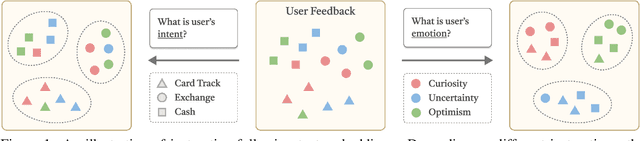
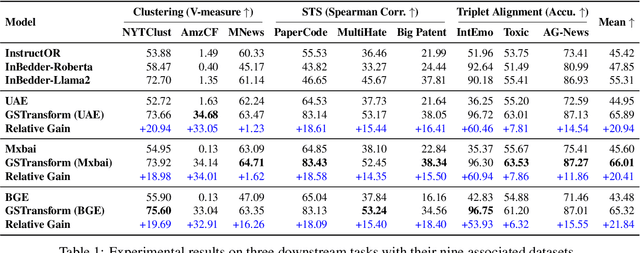
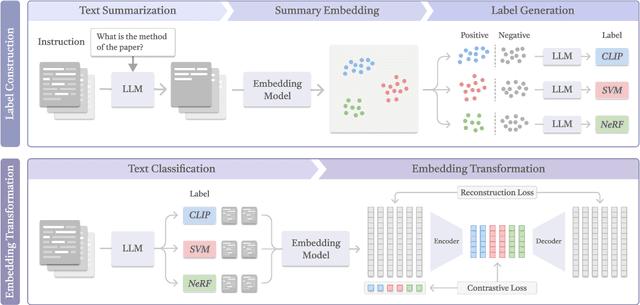

In this work, we investigate an important task named instruction-following text embedding, which generates dynamic text embeddings that adapt to user instructions, highlighting specific attributes of text. Despite recent advancements, existing approaches suffer from significant computational overhead, as they require re-encoding the entire corpus for each new instruction. To address this challenge, we propose GSTransform, a novel instruction-following text embedding framework based on Guided Space Transformation. Our key observation is that instruction-relevant information is inherently encoded in generic embeddings but remains underutilized. Instead of repeatedly encoding the corpus for each instruction, GSTransform is a lightweight transformation mechanism that adapts pre-computed embeddings in real time to align with user instructions, guided by a small amount of text data with instruction-focused label annotation. We conduct extensive experiments on three instruction-awareness downstream tasks across nine real-world datasets, demonstrating that GSTransform improves instruction-following text embedding quality over state-of-the-art methods while achieving dramatic speedups of 6~300x in real-time processing on large-scale datasets. The source code is available at https://github.com/YingchaojieFeng/GSTransform.
Causal-aware Large Language Models: Enhancing Decision-Making Through Learning, Adapting and Acting
May 30, 2025Large language models (LLMs) have shown great potential in decision-making due to the vast amount of knowledge stored within the models. However, these pre-trained models are prone to lack reasoning abilities and are difficult to adapt to new environments, further hindering their application to complex real-world tasks. To address these challenges, inspired by the human cognitive process, we propose Causal-aware LLMs, which integrate the structural causal model (SCM) into the decision-making process to model, update, and utilize structured knowledge of the environment in a ``learning-adapting-acting" paradigm. Specifically, in the learning stage, we first utilize an LLM to extract the environment-specific causal entities and their causal relations to initialize a structured causal model of the environment. Subsequently,in the adapting stage, we update the structured causal model through external feedback about the environment, via an idea of causal intervention. Finally, in the acting stage, Causal-aware LLMs exploit structured causal knowledge for more efficient policy-making through the reinforcement learning agent. The above processes are performed iteratively to learn causal knowledge, ultimately enabling the causal-aware LLMs to achieve a more accurate understanding of the environment and make more efficient decisions. Experimental results across 22 diverse tasks within the open-world game ``Crafter" validate the effectiveness of our proposed method.
AISHELL-5: The First Open-Source In-Car Multi-Channel Multi-Speaker Speech Dataset for Automatic Speech Diarization and Recognition
May 29, 2025This paper delineates AISHELL-5, the first open-source in-car multi-channel multi-speaker Mandarin automatic speech recognition (ASR) dataset. AISHLL-5 includes two parts: (1) over 100 hours of multi-channel speech data recorded in an electric vehicle across more than 60 real driving scenarios. This audio data consists of four far-field speech signals captured by microphones located on each car door, as well as near-field signals obtained from high-fidelity headset microphones worn by each speaker. (2) a collection of 40 hours of real-world environmental noise recordings, which supports the in-car speech data simulation. Moreover, we also provide an open-access, reproducible baseline system based on this dataset. This system features a speech frontend model that employs speech source separation to extract each speaker's clean speech from the far-field signals, along with a speech recognition module that accurately transcribes the content of each individual speaker. Experimental results demonstrate the challenges faced by various mainstream ASR models when evaluated on the AISHELL-5. We firmly believe the AISHELL-5 dataset will significantly advance the research on ASR systems under complex driving scenarios by establishing the first publicly available in-car ASR benchmark.
SCORPIO: Serving the Right Requests at the Right Time for Heterogeneous SLOs in LLM Inference
May 29, 2025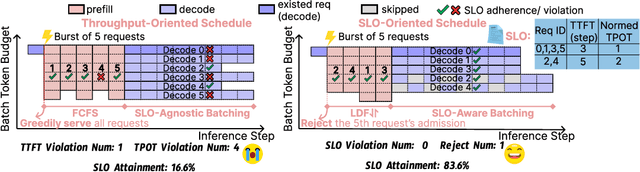
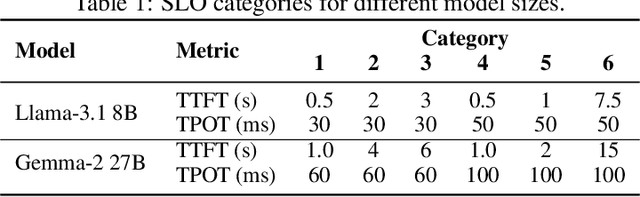
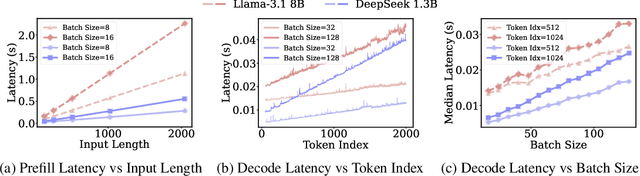
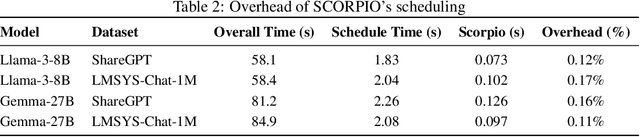
Existing Large Language Model (LLM) serving systems prioritize maximum throughput. They often neglect Service Level Objectives (SLOs) such as Time to First Token (TTFT) and Time Per Output Token (TPOT), which leads to suboptimal SLO attainment. This paper introduces SCORPIO, an SLO-oriented LLM serving system designed to maximize system goodput and SLO attainment for workloads with heterogeneous SLOs. Our core insight is to exploit SLO heterogeneity for adaptive scheduling across admission control, queue management, and batch selection. SCORPIO features a TTFT Guard, which employs least-deadline-first reordering and rejects unattainable requests, and a TPOT Guard, which utilizes a VBS-based admission control and a novel credit-based batching mechanism. Both guards are supported by a predictive module. Evaluations demonstrate that SCORPIO improves system goodput by up to 14.4X and SLO adherence by up to 46.5% compared to state-of-the-art baselines.
FCKT: Fine-Grained Cross-Task Knowledge Transfer with Semantic Contrastive Learning for Targeted Sentiment Analysis
May 28, 2025In this paper, we address the task of targeted sentiment analysis (TSA), which involves two sub-tasks, i.e., identifying specific aspects from reviews and determining their corresponding sentiments. Aspect extraction forms the foundation for sentiment prediction, highlighting the critical dependency between these two tasks for effective cross-task knowledge transfer. While most existing studies adopt a multi-task learning paradigm to align task-specific features in the latent space, they predominantly rely on coarse-grained knowledge transfer. Such approaches lack fine-grained control over aspect-sentiment relationships, often assuming uniform sentiment polarity within related aspects. This oversimplification neglects contextual cues that differentiate sentiments, leading to negative transfer. To overcome these limitations, we propose FCKT, a fine-grained cross-task knowledge transfer framework tailored for TSA. By explicitly incorporating aspect-level information into sentiment prediction, FCKT achieves fine-grained knowledge transfer, effectively mitigating negative transfer and enhancing task performance. Experiments on three datasets, including comparisons with various baselines and large language models (LLMs), demonstrate the effectiveness of FCKT. The source code is available on https://github.com/cwei01/FCKT.
BrainStratify: Coarse-to-Fine Disentanglement of Intracranial Neural Dynamics
May 26, 2025Decoding speech directly from neural activity is a central goal in brain-computer interface (BCI) research. In recent years, exciting advances have been made through the growing use of intracranial field potential recordings, such as stereo-ElectroEncephaloGraphy (sEEG) and ElectroCorticoGraphy (ECoG). These neural signals capture rich population-level activity but present key challenges: (i) task-relevant neural signals are sparsely distributed across sEEG electrodes, and (ii) they are often entangled with task-irrelevant neural signals in both sEEG and ECoG. To address these challenges, we introduce a unified Coarse-to-Fine neural disentanglement framework, BrainStratify, which includes (i) identifying functional groups through spatial-context-guided temporal-spatial modeling, and (ii) disentangling distinct neural dynamics within the target functional group using Decoupled Product Quantization (DPQ). We evaluate BrainStratify on two open-source sEEG datasets and one (epidural) ECoG dataset, spanning tasks like vocal production and speech perception. Extensive experiments show that BrainStratify, as a unified framework for decoding speech from intracranial neural signals, significantly outperforms previous decoding methods. Overall, by combining data-driven stratification with neuroscience-inspired modularity, BrainStratify offers a robust and interpretable solution for speech decoding from intracranial recordings.
Retrieval Augmented Decision-Making: A Requirements-Driven, Multi-Criteria Framework for Structured Decision Support
May 24, 2025Various industries have produced a large number of documents such as industrial plans, technical guidelines, and regulations that are structurally complex and content-wise fragmented. This poses significant challenges for experts and decision-makers in terms of retrieval and understanding. Although existing LLM-based Retrieval-Augmented Generation methods can provide context-related suggestions, they lack quantitative weighting and traceable reasoning paths, making it difficult to offer multi-level and transparent decision support. To address this issue, this paper proposes the RAD method, which integrates Multi-Criteria Decision Making with the semantic understanding capabilities of LLMs. The method automatically extracts key criteria from industry documents, builds a weighted hierarchical decision model, and generates structured reports under model guidance. The RAD framework introduces explicit weight assignment and reasoning chains in decision generation to ensure accuracy, completeness, and traceability. Experiments show that in various decision-making tasks, the decision reports generated by RAD significantly outperform existing methods in terms of detail, rationality, and structure, demonstrating its application value and potential in complex decision support scenarios.