 Add to Chrome
 Add to Firefox
 Add to Edge
QIME: Constructing Interpretable Medical Text Embeddings via Ontology-Grounded Questions
Mar 03, 2026
While dense biomedical embeddings achieve strong performance, their black-box nature limits their utility in clinical decision-making. Recent question-based interpretable embeddings represent text as binary answers to natural-language questions, but these approaches often rely on heuristic or surface-level contrastive signals and overlook specialized domain knowledge. We propose QIME, an ontology-grounded framework for constructing interpretable medical text embeddings in which each dimension corresponds to a clinically meaningful yes/no question. By conditioning on cluster-specific medical concept signatures, QIME generates semantically atomic questions that capture fine-grained distinctions in biomedical text. Furthermore, QIME supports a training-free embedding construction strategy that eliminates per-question classifier training while further improving performance. Experiments across biomedical semantic similarity, clustering, and retrieval benchmarks show that QIME consistently outperforms prior interpretable embedding methods and substantially narrows the gap to strong black-box biomedical encoders, while providing concise and clinically informative explanations.

Spatiotemporal Decision Transformer for Traffic Coordination
Feb 02, 2026Traffic signal control is a critical challenge in urban transportation, requiring coordination among multiple intersections to optimize network-wide traffic flow. While reinforcement learning has shown promise for adaptive signal control, existing methods struggle with multi-agent coordination and sample efficiency. We introduce MADT (Multi-Agent Decision Transformer), a novel approach that reformulates multi-agent traffic signal control as a sequence modeling problem. MADT extends the Decision Transformer paradigm to multi-agent settings by incorporating: (1) a graph attention mechanism for modeling spatial dependencies between intersections, (2) a|temporal transformer encoder for capturing traffic dynamics, and (3) return-to-go conditioning for target performance specification. Our approach enables offline learning from historical traffic data, with architecture design that facilitates potential online fine-tuning. Experiments on synthetic grid networks and real-world traffic scenarios demonstrate that MADT achieves state-of-the-art performance, reducing average travel time by 5-6% compared to the strongest baseline while exhibiting superior coordination among adjacent intersections.
The End of Reward Engineering: How LLMs Are Redefining Multi-Agent Coordination
Jan 13, 2026Reward engineering, the manual specification of reward functions to induce desired agent behavior, remains a fundamental challenge in multi-agent reinforcement learning. This difficulty is amplified by credit assignment ambiguity, environmental non-stationarity, and the combinatorial growth of interaction complexity. We argue that recent advances in large language models (LLMs) point toward a shift from hand-crafted numerical rewards to language-based objective specifications. Prior work has shown that LLMs can synthesize reward functions directly from natural language descriptions (e.g., EUREKA) and adapt reward formulations online with minimal human intervention (e.g., CARD). In parallel, the emerging paradigm of Reinforcement Learning from Verifiable Rewards (RLVR) provides empirical evidence that language-mediated supervision can serve as a viable alternative to traditional reward engineering. We conceptualize this transition along three dimensions: semantic reward specification, dynamic reward adaptation, and improved alignment with human intent, while noting open challenges related to computational overhead, robustness to hallucination, and scalability to large multi-agent systems. We conclude by outlining a research direction in which coordination arises from shared semantic representations rather than explicitly engineered numerical signals.
Don't Reinvent the Wheel: Efficient Instruction-Following Text Embedding based on Guided Space Transformation
May 30, 2025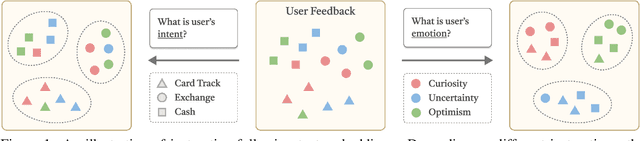
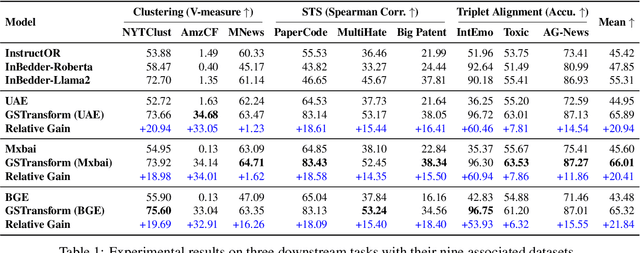
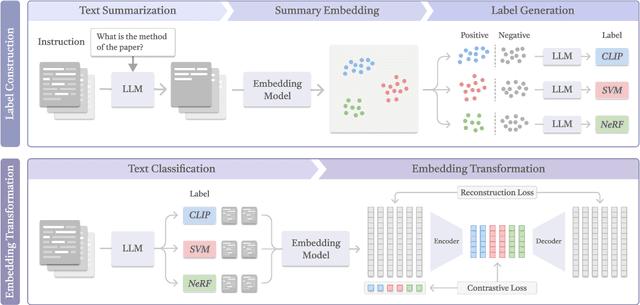

In this work, we investigate an important task named instruction-following text embedding, which generates dynamic text embeddings that adapt to user instructions, highlighting specific attributes of text. Despite recent advancements, existing approaches suffer from significant computational overhead, as they require re-encoding the entire corpus for each new instruction. To address this challenge, we propose GSTransform, a novel instruction-following text embedding framework based on Guided Space Transformation. Our key observation is that instruction-relevant information is inherently encoded in generic embeddings but remains underutilized. Instead of repeatedly encoding the corpus for each instruction, GSTransform is a lightweight transformation mechanism that adapts pre-computed embeddings in real time to align with user instructions, guided by a small amount of text data with instruction-focused label annotation. We conduct extensive experiments on three instruction-awareness downstream tasks across nine real-world datasets, demonstrating that GSTransform improves instruction-following text embedding quality over state-of-the-art methods while achieving dramatic speedups of 6~300x in real-time processing on large-scale datasets. The source code is available at https://github.com/YingchaojieFeng/GSTransform.