 Add to Chrome
 Add to Firefox
 Add to Edge
NOMANet: A Graph Neural Network Enabled Power Allocation Scheme for NOMA
Feb 08, 2025


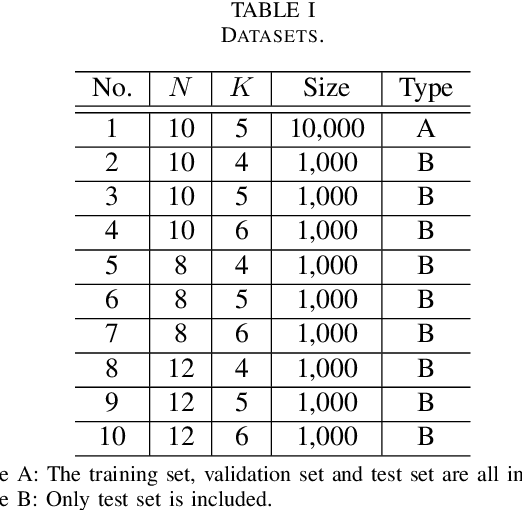
This paper proposes a graph neural network (GNN) enabled power allocation scheme for non-orthogonal multiple access (NOMA) networks. In particular, a downlink scenario with one base station serving multiple users over several subchannels is considered, where the number of subchannels is less than the number of users, and thus, some users have to share a subchannel via NOMA. Our goal is to maximize the system energy efficiency subject to the rate requirement of each user and the overall budget. We propose a deep learning based approach termed NOMA net (NOMANet) to address the considered problem. Particularly, NOMANet is GNN-based, which maps channel state information to the desired power allocation scheme for all subchannels. The multi-head attention and the residual/dense connection are adopted to enhance the feature extraction. The output of NOMANet is guaranteed to be feasible via the customized activation function and the penalty method. Numerical results show that NOMANet trained unsupervised achieves performance close to that of the successive convex approximation method but with a faster inference speed by about $700$ times. Besides, NOMANet is featured by its scalability to both users and subchannels.

Singing Voice Conversion with Accompaniment Using Self-Supervised Representation-Based Melody Features
Feb 07, 2025Melody preservation is crucial in singing voice conversion (SVC). However, in many scenarios, audio is often accompanied with background music (BGM), which can cause audio distortion and interfere with the extraction of melody and other key features, significantly degrading SVC performance. Previous methods have attempted to address this by using more robust neural network-based melody extractors, but their performance drops sharply in the presence of complex accompaniment. Other approaches involve performing source separation before conversion, but this often introduces noticeable artifacts, leading to a significant drop in conversion quality and increasing the user's operational costs. To address these issues, we introduce a novel SVC method that uses self-supervised representation-based melody features to improve melody modeling accuracy in the presence of BGM. In our experiments, we compare the effectiveness of different self-supervised learning (SSL) models for melody extraction and explore for the first time how SSL benefits the task of melody extraction. The experimental results demonstrate that our proposed SVC model significantly outperforms existing baseline methods in terms of melody accuracy and shows higher similarity and naturalness in both subjective and objective evaluations across noisy and clean audio environments.
SWIPTNet: A Unified Deep Learning Framework for SWIPT based on GNN and Transfer Learning
Feb 06, 2025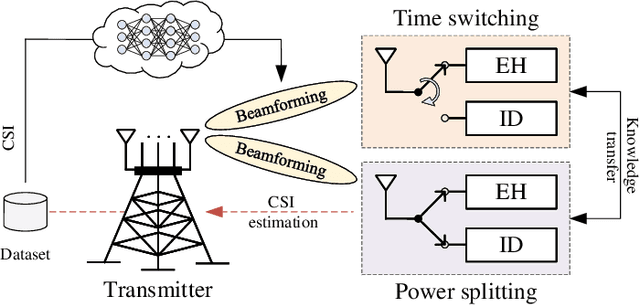
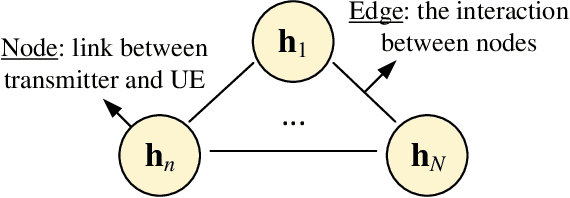
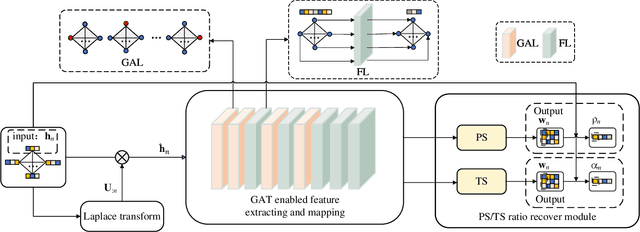
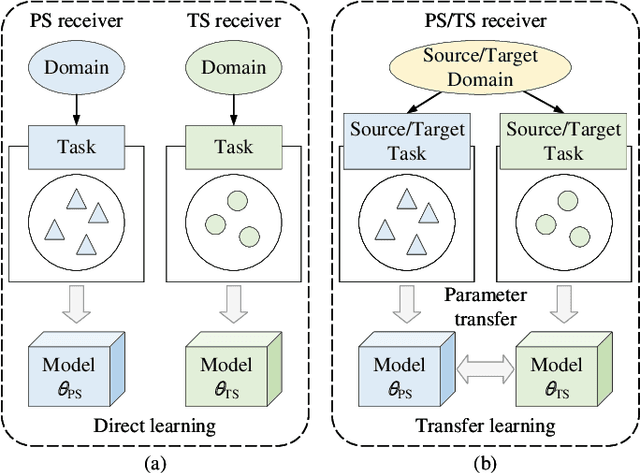
This paper investigates the deep learning based approaches for simultaneous wireless information and power transfer (SWIPT). The quality-of-service (QoS) constrained sum-rate maximization problems are, respectively, formulated for power-splitting (PS) receivers and time-switching (TS) receivers and solved by a unified graph neural network (GNN) based model termed SWIPT net (SWIPTNet). To improve the performance of SWIPTNet, we first propose a single-type output method to reduce the learning complexity and facilitate the satisfaction of QoS constraints, and then, utilize the Laplace transform to enhance input features with the structural information. Besides, we adopt the multi-head attention and layer connection to enhance feature extracting. Furthermore, we present the implementation of transfer learning to the SWIPTNet between PS and TS receivers. Ablation studies show the effectiveness of key components in the SWIPTNet. Numerical results also demonstrate the capability of SWIPTNet in achieving near-optimal performance with millisecond-level inference speed which is much faster than the traditional optimization algorithms. We also show the effectiveness of transfer learning via fast convergence and expressive capability improvement.
Graph Neural Network Enabled Fluid Antenna Systems: A Two-Stage Approach
Feb 06, 2025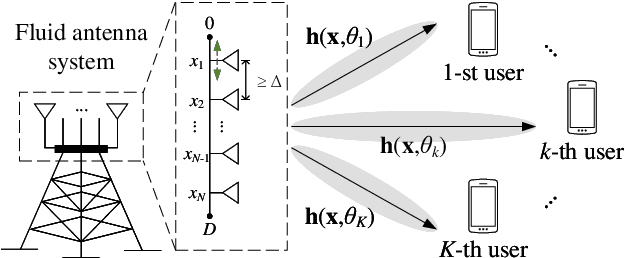
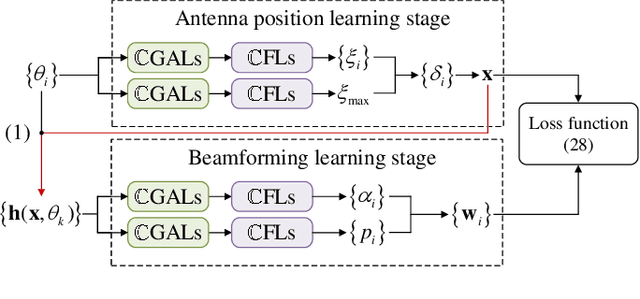
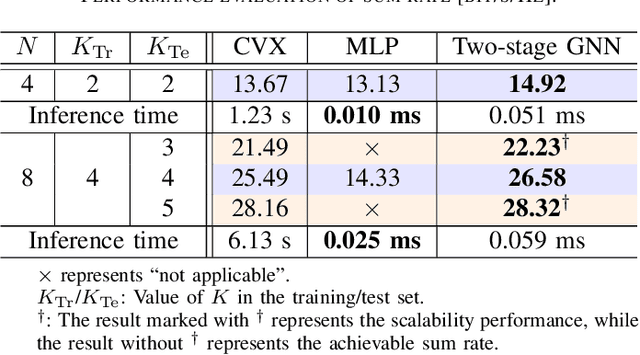
An emerging fluid antenna system (FAS) brings a new dimension, i.e., the antenna positions, to deal with the deep fading, but simultaneously introduces challenges related to the transmit design. This paper proposes an ``unsupervised learning to optimize" paradigm to optimize the FAS. Particularly, we formulate the sum-rate and energy efficiency (EE) maximization problems for a multiple-user multiple-input single-output (MU-MISO) FAS and solved by a two-stage graph neural network (GNN) where the first stage and the second stage are for the inference of antenna positions and beamforming vectors, respectively. The outputs of the two stages are jointly input into a unsupervised loss function to train the two-stage GNN. The numerical results demonstrates that the advantages of the FAS for performance improvement and the two-stage GNN for real-time and scalable optimization. Besides, the two stages can function separately.
Offline Learning for Combinatorial Multi-armed Bandits
Jan 31, 2025The combinatorial multi-armed bandit (CMAB) is a fundamental sequential decision-making framework, extensively studied over the past decade. However, existing work primarily focuses on the online setting, overlooking the substantial costs of online interactions and the readily available offline datasets. To overcome these limitations, we introduce Off-CMAB, the first offline learning framework for CMAB. Central to our framework is the combinatorial lower confidence bound (CLCB) algorithm, which combines pessimistic reward estimations with combinatorial solvers. To characterize the quality of offline datasets, we propose two novel data coverage conditions and prove that, under these conditions, CLCB achieves a near-optimal suboptimality gap, matching the theoretical lower bound up to a logarithmic factor. We validate Off-CMAB through practical applications, including learning to rank, large language model (LLM) caching, and social influence maximization, showing its ability to handle nonlinear reward functions, general feedback models, and out-of-distribution action samples that excludes optimal or even feasible actions. Extensive experiments on synthetic and real-world datasets further highlight the superior performance of CLCB.
InsQABench: Benchmarking Chinese Insurance Domain Question Answering with Large Language Models
Jan 19, 2025The application of large language models (LLMs) has achieved remarkable success in various fields, but their effectiveness in specialized domains like the Chinese insurance industry remains underexplored. The complexity of insurance knowledge, encompassing specialized terminology and diverse data types, poses significant challenges for both models and users. To address this, we introduce InsQABench, a benchmark dataset for the Chinese insurance sector, structured into three categories: Insurance Commonsense Knowledge, Insurance Structured Database, and Insurance Unstructured Documents, reflecting real-world insurance question-answering tasks.We also propose two methods, SQL-ReAct and RAG-ReAct, to tackle challenges in structured and unstructured data tasks. Evaluations show that while LLMs struggle with domain-specific terminology and nuanced clause texts, fine-tuning on InsQABench significantly improves performance. Our benchmark establishes a solid foundation for advancing LLM applications in the insurance domain, with data and code available at https://github.com/HaileyFamo/InsQABench.git.
What Limits LLM-based Human Simulation: LLMs or Our Design?
Jan 15, 2025We argue that advancing LLM-based human simulation requires addressing both LLM's inherent limitations and simulation framework design challenges. Recent studies have revealed significant gaps between LLM-based human simulations and real-world observations, highlighting these dual challenges. To address these gaps, we present a comprehensive analysis of LLM limitations and our design issues, proposing targeted solutions for both aspects. Furthermore, we explore future directions that address both challenges simultaneously, particularly in data collection, LLM generation, and evaluation. To support further research in this field, we provide a curated collection of LLM-based human simulation resources.\footnote{https://github.com/Persdre/llm-human-simulation}
ACORD: An Expert-Annotated Retrieval Dataset for Legal Contract Drafting
Jan 11, 2025Information retrieval, specifically contract clause retrieval, is foundational to contract drafting because lawyers rarely draft contracts from scratch; instead, they locate and revise the most relevant precedent. We introduce the Atticus Clause Retrieval Dataset (ACORD), the first retrieval benchmark for contract drafting fully annotated by experts. ACORD focuses on complex contract clauses such as Limitation of Liability, Indemnification, Change of Control, and Most Favored Nation. It includes 114 queries and over 126,000 query-clause pairs, each ranked on a scale from 1 to 5 stars. The task is to find the most relevant precedent clauses to a query. The bi-encoder retriever paired with pointwise LLMs re-rankers shows promising results. However, substantial improvements are still needed to effectively manage the complex legal work typically undertaken by lawyers. As the first retrieval benchmark for contract drafting annotated by experts, ACORD can serve as a valuable IR benchmark for the NLP community.
Real-Time Decision-Making for Digital Twin in Additive Manufacturing with Model Predictive Control using Time-Series Deep Neural Networks
Jan 10, 2025Digital Twin-a virtual replica of a physical system enabling real-time monitoring, model updating, prediction, and decision-making-combined with recent advances in machine learning (ML), offers new opportunities for proactive control strategies in autonomous manufacturing. However, achieving real-time decision-making with Digital Twins requires efficient optimization driven by accurate predictions of highly nonlinear manufacturing systems. This paper presents a simultaneous multi-step Model Predictive Control (MPC) framework for real-time decision-making, using a multi-variate deep neural network (DNN), named Time-Series Dense Encoder (TiDE), as the surrogate model. Different from the models in conventional MPC which only provide one-step ahead prediction, TiDE is capable of predicting future states within the prediction horizon in one shot (multi-step), significantly accelerating MPC. Using Directed Energy Deposition additive manufacturing as a case study, we demonstrate the effectiveness of the proposed MPC in achieving melt pool temperature tracking to ensure part quality, while reducing porosity defects by regulating laser power to maintain melt pool depth constraints. In this work, we first show that TiDE is capable of accurately predicting melt pool temperature and depth. Second, we demonstrate that the proposed MPC achieves precise temperature tracking while satisfying melt pool depth constraints within a targeted dilution range (10%-30%), reducing potential porosity defects. Compared to the PID controller, MPC results in smoother and less fluctuating laser power profiles with competitive or superior melt pool temperature control performance. This demonstrates MPC's proactive control capabilities, leveraging time-series prediction and real-time optimization, positioning it as a powerful tool for future Digital Twin applications and real-time process optimization in manufacturing.
Tuning-Free Long Video Generation via Global-Local Collaborative Diffusion
Jan 08, 2025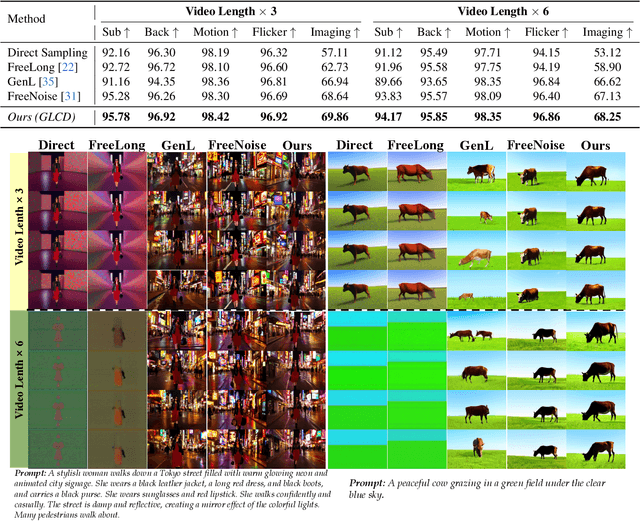

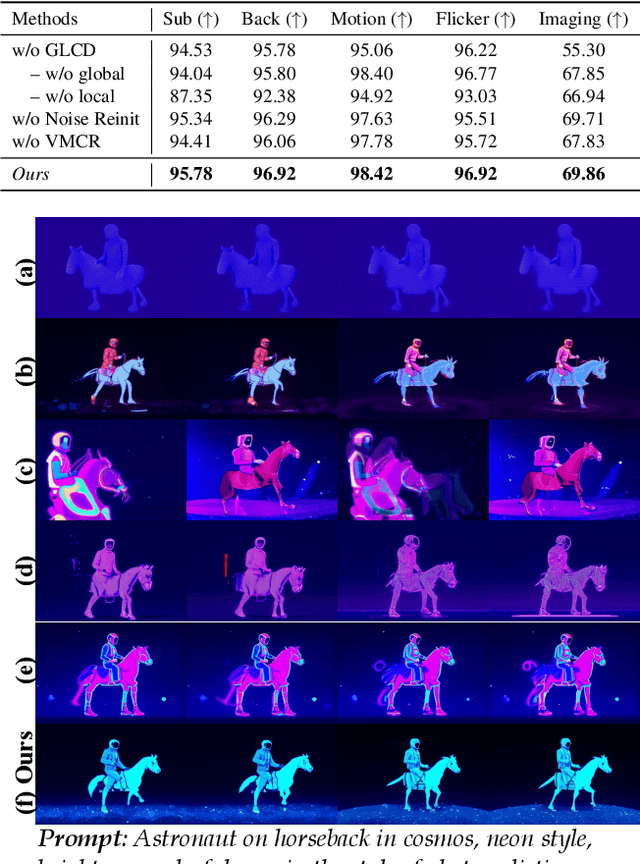

Creating high-fidelity, coherent long videos is a sought-after aspiration. While recent video diffusion models have shown promising potential, they still grapple with spatiotemporal inconsistencies and high computational resource demands. We propose GLC-Diffusion, a tuning-free method for long video generation. It models the long video denoising process by establishing denoising trajectories through Global-Local Collaborative Denoising to ensure overall content consistency and temporal coherence between frames. Additionally, we introduce a Noise Reinitialization strategy which combines local noise shuffling with frequency fusion to improve global content consistency and visual diversity. Further, we propose a Video Motion Consistency Refinement (VMCR) module that computes the gradient of pixel-wise and frequency-wise losses to enhance visual consistency and temporal smoothness. Extensive experiments, including quantitative and qualitative evaluations on videos of varying lengths (\textit{e.g.}, 3\times and 6\times longer), demonstrate that our method effectively integrates with existing video diffusion models, producing coherent, high-fidelity long videos superior to previous approaches.