 Add to Chrome
 Add to Firefox
 Add to Edge
Diff-Symbo: Text-Controlled Long-Duration Symbolic Music Generation Using Autoregressive Latent Diffusion Model
Aug 05, 2026
Text-controlled symbolic music generation has recently gained research attention due to its versatile, flexible and straightforward approach to music composition. However, previous approaches tend to generate symbolic music with compromising quality, diversity, controllability and limited duration. In this paper, we present Diff-Symbo, an innovative method that uses latent diffusion model (LDM) to generate high-quality, diverse and long-duration symbolic music. To address the lack of text-symbolic music dataset, we develop a comprehensive dataset with 19,345 text templates by employing large language model. Furthermore, we design a music information encoder to reduce the training overhead while extracting more effective control representations. Given textual descriptions, our proposed method leverages LDM to improve the quality and diversity of music generation. Our method also improves the duration and the compositional consistency of music generation through an autoregressive approach. Experimental results show significant improvements of Diff-Symbo in text controllability, duration, and the quality of generated music compared to the baseline models such as GPT-4, MuseCoco and Multitrack Music Transformer (MMT). As one of the pioneer models in this field, Diff-Symbo paves the way towards controllable and high-quality symbolic music composition based on LDM, offering valuable contributions to both music amateurs and practitioners.

AnyMatch: Supercharging Universal Multi-Modal Image Matching with Large-Scale Single-View Images
Jul 01, 2026Multi-modal image matching is essential for visual localization and multi-sensor fusion, but it is hindered by the scarcity of large-scale training data with precise geometric annotations. Existing real-world datasets suffer from prohibitive costs, limited scene diversity, and errors in SfM-MVS pipelines, while synthetic methods struggle to maintain 3D geometric consistency or achieve photorealistic appearance. To address this, we propose AnyMatch, a novel framework that leverages abundant, easily accessible single-view images at minimal cost to generate rich multi-modal training data. AnyMatch integrates monocular depth estimation, 3D reprojection, diffusion-based inpainting, and crossmodal image translation to synthesize multi-view, multi-modal image pairs with 3D geometric fidelity. Crucially, our method provides annotations that strictly adhere to 3D geometric consistency through explicit 3D reprojection, avoiding SfM-MVS error accumulation. Furthermore, AnyMatch offers strong scalability, enabling controllable scene diversity and annotation difficulty via adjustable input and camera parameters. We construct Any-syn, a large-scale synthetic multi-modal dataset using AnyMatch. Experimental results show that matching networks (e.g., LoFTR, EDM, RoMa) fine-tuned on Any-syn achieve substantial performance gains on multi-modal benchmarks, exhibiting superior generalization and robustness compared to models trained on existing data.
DSCSNet: A Dynamic Sparse Compression Sensing Network for Closely-Spaced Infrared Small Target Unmixing
Mar 22, 2026Due to the limitations of optical lens focal length and detector resolution, distant clustered infrared small targets often appear as mixed spots. The Close Small Object Unmixing (CSOU) task aims to recover the number, sub-pixel positions, and radiant intensities of individual targets from these spots, which is a highly ill-posed inverse problem. Existing methods struggle to balance the rigorous sparsity guarantees of model-driven approaches and the dynamic scene adaptability of data-driven methods. To address this dilemma, this paper proposes a Dynamic Sparse Compressed Sensing Network (DSCSNet), a deep-unfolded network that couples the Alternating Direction Method of Multipliers (ADMM) with learnable parameters. Specifically, we embed a strict $\ell_1$-norm sparsity constraint into the auxiliary variable update step of ADMM to replace the traditional $\ell_2$-norm smoothness-promoting terms, which effectively preserves the discrete energy peaks of small targets. We also integrate a self-attention-based dynamic thresholding mechanism into the reconstruction stage, which adaptively adjusts the sparsification intensity using the sparsity-enhanced information from the iterative process. These modules are jointly optimized end-to-end across the three iterative steps of ADMM. Retaining the physical logic of compressed sensing, DSCSNet achieves robust sparsity induction and scene adaptability, thus enhancing the unmixing accuracy and generalization in complex infrared scenarios. Extensive experiments on the synthetic infrared dataset CSIST-100K demonstrate that DSCSNet outperforms state-of-the-art methods in key metrics such as CSO-mAP and sub-pixel localization error.
SGMatch: Semantic-Guided Non-Rigid Shape Matching with Flow Regularization
Mar 13, 2026Establishing accurate point-to-point correspondences between non-rigid 3D shapes remains a critical challenge, particularly under non-isometric deformations and topological noise. Existing functional map pipelines suffer from ambiguities that geometric descriptors alone cannot resolve, and spatial inconsistencies inherent in the projection of truncated spectral bases to dense pointwise correspondences. In this paper, we introduce SGMatch, a learning-based framework for semantic-guided non-rigid shape matching. Specifically, we design a Semantic-Guided Local Cross-Attention module that integrates semantic features from vision foundation models into geometric descriptors while preserving local structural continuity. Furthermore, we introduce a regularization objective based on conditional flow matching, which supervises a time-varying velocity field to encourage spatial smoothness of the recovered correspondences. Experimental results on multiple benchmarks demonstrate that SGMatch achieves competitive performance across near-isometric settings and consistent improvements under non-isometric deformations and topological noise.
Multitask Learning for Earth Observation Data Classification with Hybrid Quantum Network
Jan 29, 2026Quantum machine learning (QML) has gained increasing attention as a potential solution to address the challenges of computation requirements in the future. Earth observation (EO) has entered the era of Big Data, and the computational demands for effectively analyzing large EO data with complex deep learning models have become a bottleneck. Motivated by this, we aim to leverage quantum computing for EO data classification and explore its advantages despite the current limitations of quantum devices. This paper presents a hybrid model that incorporates multitask learning to assist efficient data encoding and employs a location weight module with quantum convolution operations to extract valid features for classification. The validity of our proposed model was evaluated using multiple EO benchmarks. Additionally, we experimentally explored the generalizability of our model and investigated the factors contributing to its advantage, highlighting the potential of QML in EO data analysis.
DistillMatch: Leveraging Knowledge Distillation from Vision Foundation Model for Multimodal Image Matching
Sep 19, 2025Multimodal image matching seeks pixel-level correspondences between images of different modalities, crucial for cross-modal perception, fusion and analysis. However, the significant appearance differences between modalities make this task challenging. Due to the scarcity of high-quality annotated datasets, existing deep learning methods that extract modality-common features for matching perform poorly and lack adaptability to diverse scenarios. Vision Foundation Model (VFM), trained on large-scale data, yields generalizable and robust feature representations adapted to data and tasks of various modalities, including multimodal matching. Thus, we propose DistillMatch, a multimodal image matching method using knowledge distillation from VFM. DistillMatch employs knowledge distillation to build a lightweight student model that extracts high-level semantic features from VFM (including DINOv2 and DINOv3) to assist matching across modalities. To retain modality-specific information, it extracts and injects modality category information into the other modality's features, which enhances the model's understanding of cross-modal correlations. Furthermore, we design V2I-GAN to boost the model's generalization by translating visible to pseudo-infrared images for data augmentation. Experiments show that DistillMatch outperforms existing algorithms on public datasets.
Multi-Metric Preference Alignment for Generative Speech Restoration
Aug 24, 2025Recent generative models have significantly advanced speech restoration tasks, yet their training objectives often misalign with human perceptual preferences, resulting in suboptimal quality. While post-training alignment has proven effective in other generative domains like text and image generation, its application to generative speech restoration remains largely under-explored. This work investigates the challenges of applying preference-based post-training to this task, focusing on how to define a robust preference signal and curate high-quality data to avoid reward hacking. To address these challenges, we propose a multi-metric preference alignment strategy. We construct a new dataset, GenSR-Pref, comprising 80K preference pairs, where each chosen sample is unanimously favored by a complementary suite of metrics covering perceptual quality, signal fidelity, content consistency, and timbre preservation. This principled approach ensures a holistic preference signal. Applying Direct Preference Optimization (DPO) with our dataset, we observe consistent and significant performance gains across three diverse generative paradigms: autoregressive models (AR), masked generative models (MGM), and flow-matching models (FM) on various restoration benchmarks, in both objective and subjective evaluations. Ablation studies confirm the superiority of our multi-metric strategy over single-metric approaches in mitigating reward hacking. Furthermore, we demonstrate that our aligned models can serve as powerful ''data annotators'', generating high-quality pseudo-labels to serve as a supervision signal for traditional discriminative models in data-scarce scenarios like singing voice restoration. Demo Page:https://gensr-pref.github.io
Singing Voice Conversion with Accompaniment Using Self-Supervised Representation-Based Melody Features
Feb 07, 2025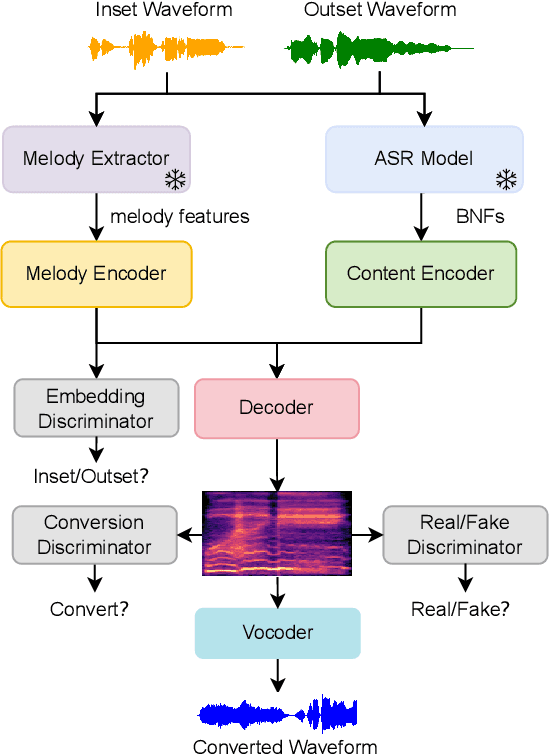
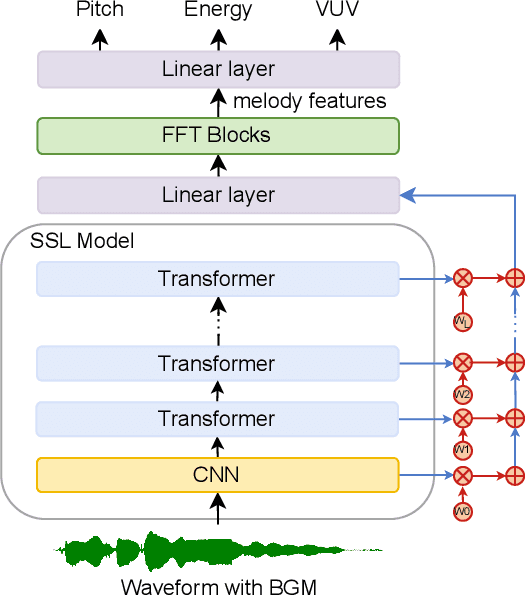
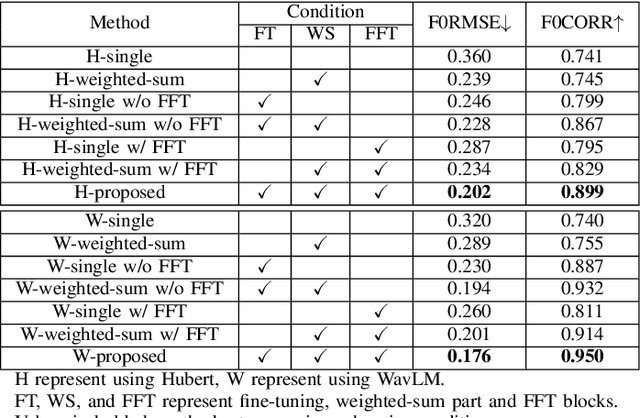
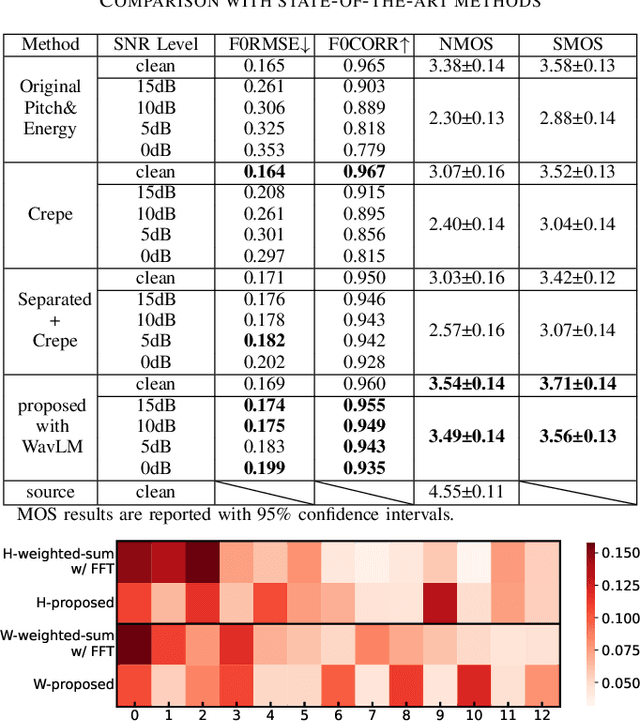
Melody preservation is crucial in singing voice conversion (SVC). However, in many scenarios, audio is often accompanied with background music (BGM), which can cause audio distortion and interfere with the extraction of melody and other key features, significantly degrading SVC performance. Previous methods have attempted to address this by using more robust neural network-based melody extractors, but their performance drops sharply in the presence of complex accompaniment. Other approaches involve performing source separation before conversion, but this often introduces noticeable artifacts, leading to a significant drop in conversion quality and increasing the user's operational costs. To address these issues, we introduce a novel SVC method that uses self-supervised representation-based melody features to improve melody modeling accuracy in the presence of BGM. In our experiments, we compare the effectiveness of different self-supervised learning (SSL) models for melody extraction and explore for the first time how SSL benefits the task of melody extraction. The experimental results demonstrate that our proposed SVC model significantly outperforms existing baseline methods in terms of melody accuracy and shows higher similarity and naturalness in both subjective and objective evaluations across noisy and clean audio environments.
AnyEnhance: A Unified Generative Model with Prompt-Guidance and Self-Critic for Voice Enhancement
Jan 26, 2025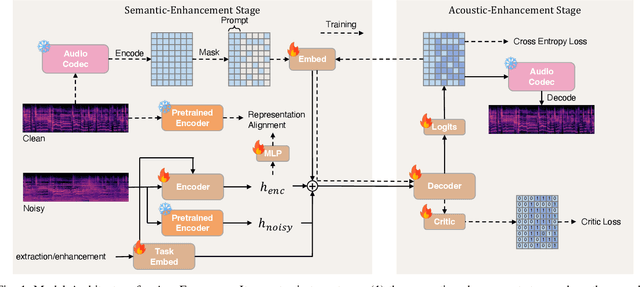
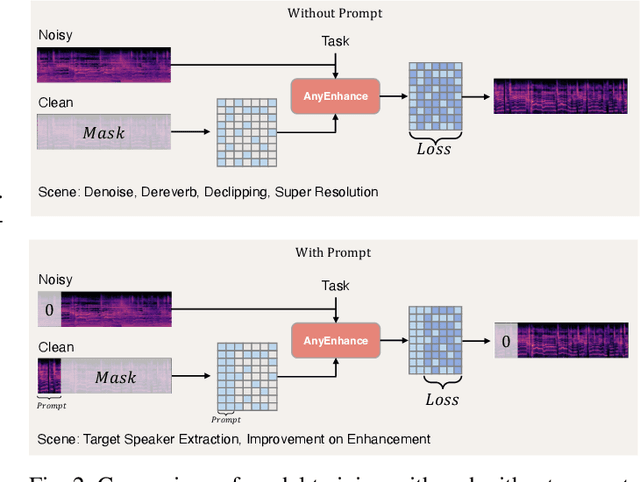
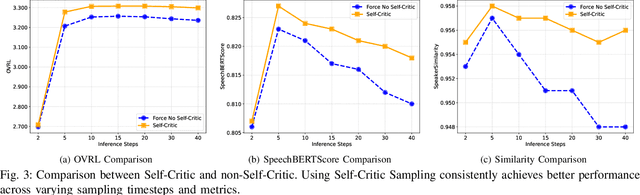
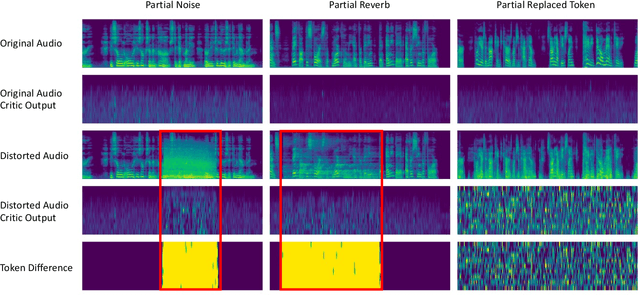
We introduce AnyEnhance, a unified generative model for voice enhancement that processes both speech and singing voices. Based on a masked generative model, AnyEnhance is capable of handling both speech and singing voices, supporting a wide range of enhancement tasks including denoising, dereverberation, declipping, super-resolution, and target speaker extraction, all simultaneously and without fine-tuning. AnyEnhance introduces a prompt-guidance mechanism for in-context learning, which allows the model to natively accept a reference speaker's timbre. In this way, it could boost enhancement performance when a reference audio is available and enable the target speaker extraction task without altering the underlying architecture. Moreover, we also introduce a self-critic mechanism into the generative process for masked generative models, yielding higher-quality outputs through iterative self-assessment and refinement. Extensive experiments on various enhancement tasks demonstrate AnyEnhance outperforms existing methods in terms of both objective metrics and subjective listening tests. Demo audios are publicly available at https://amphionspace.github.io/anyenhance/.
Rotation center identification based on geometric relationships for rotary motion deblurring
Aug 08, 2024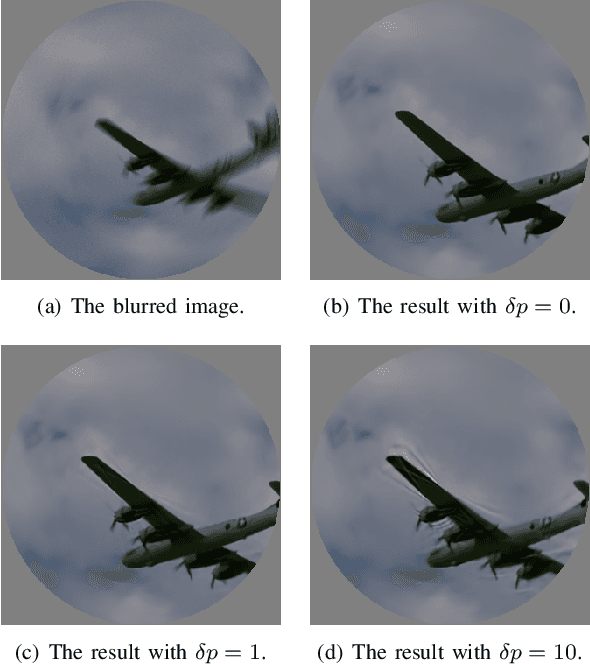
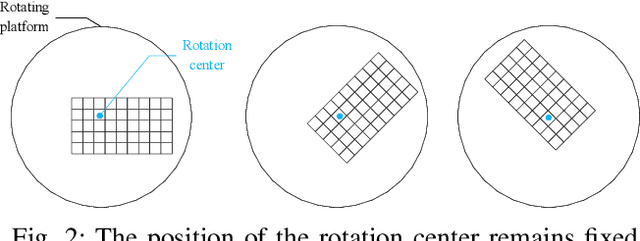
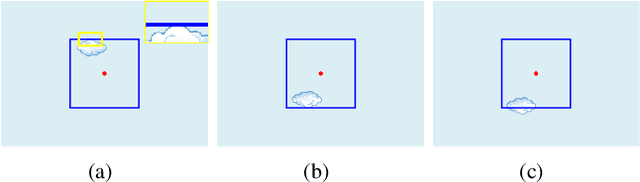
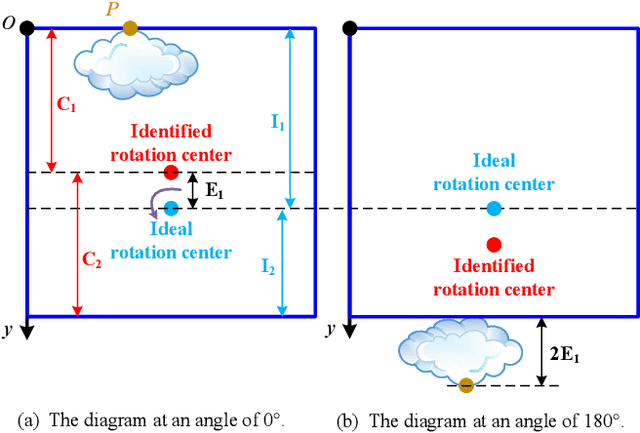
Non-blind rotary motion deblurring (RMD) aims to recover the latent clear image from a rotary motion blurred (RMB) image. The rotation center is a crucial input parameter in non-blind RMD methods. Existing methods directly estimate the rotation center from the RMB image. However they always suffer significant errors, and the performance of RMD is limited. For the assembled imaging systems, the position of the rotation center remains fixed. Leveraging this prior knowledge, we propose a geometric-based method for rotation center identification and analyze its error range. Furthermore, we construct a RMB imaging system. The experiment demonstrates that our method achieves less than 1-pixel error along a single axis (x-axis or y-axis). We utilize the constructed imaging system to capture real RMB images, and experimental results show that our method can help existing RMD approaches yield better RMD images.