 Add to Chrome
 Add to Firefox
 Add to Edge
Adaptive Digital Twin of Sheet Metal Forming via Proper Orthogonal Decomposition-Based Koopman Operator with Model Predictive Control
Nov 13, 2025


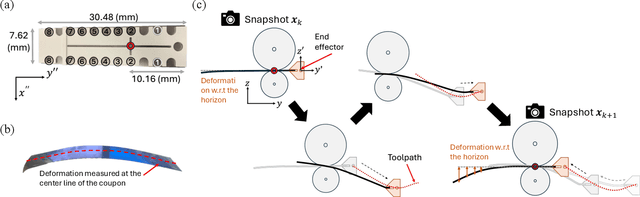
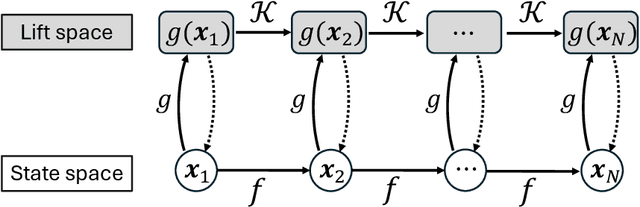
Digital Twin (DT) technologies are transforming manufacturing by enabling real-time prediction, monitoring, and control of complex processes. Yet, applying DT to deformation-based metal forming remains challenging because of the strongly coupled spatial-temporal behavior and the nonlinear relationship between toolpath and material response. For instance, sheet-metal forming by the English wheel, a highly flexible but artisan-dependent process, still lacks digital counterparts that can autonomously plan and adapt forming strategies. This study presents an adaptive DT framework that integrates Proper Orthogonal Decomposition (POD) for physics-aware dimensionality reduction with a Koopman operator for representing nonlinear system in a linear lifted space for the real-time decision-making via model predictive control (MPC). To accommodate evolving process conditions or material states, an online Recursive Least Squares (RLS) algorithm is introduced to update the operator coefficients in real time, enabling continuous adaptation of the DT model as new deformation data become available. The proposed framework is experimentally demonstrated on a robotic English Wheel sheet metal forming system, where deformation fields are measured and modeled under varying toolpaths. Results show that the adaptive DT is capable of controlling the forming process to achieve the given target shape by effectively capturing non-stationary process behaviors. Beyond this case study, the proposed framework establishes a generalizable approach for interpretable, adaptive, and computationally-efficient DT of nonlinear manufacturing systems, bridging reduced-order physics representations with data-driven adaptability to support autonomous process control and optimization.

Real-Time Decision-Making for Digital Twin in Additive Manufacturing with Model Predictive Control using Time-Series Deep Neural Networks
Jan 10, 2025Digital Twin-a virtual replica of a physical system enabling real-time monitoring, model updating, prediction, and decision-making-combined with recent advances in machine learning (ML), offers new opportunities for proactive control strategies in autonomous manufacturing. However, achieving real-time decision-making with Digital Twins requires efficient optimization driven by accurate predictions of highly nonlinear manufacturing systems. This paper presents a simultaneous multi-step Model Predictive Control (MPC) framework for real-time decision-making, using a multi-variate deep neural network (DNN), named Time-Series Dense Encoder (TiDE), as the surrogate model. Different from the models in conventional MPC which only provide one-step ahead prediction, TiDE is capable of predicting future states within the prediction horizon in one shot (multi-step), significantly accelerating MPC. Using Directed Energy Deposition additive manufacturing as a case study, we demonstrate the effectiveness of the proposed MPC in achieving melt pool temperature tracking to ensure part quality, while reducing porosity defects by regulating laser power to maintain melt pool depth constraints. In this work, we first show that TiDE is capable of accurately predicting melt pool temperature and depth. Second, we demonstrate that the proposed MPC achieves precise temperature tracking while satisfying melt pool depth constraints within a targeted dilution range (10%-30%), reducing potential porosity defects. Compared to the PID controller, MPC results in smoother and less fluctuating laser power profiles with competitive or superior melt pool temperature control performance. This demonstrates MPC's proactive control capabilities, leveraging time-series prediction and real-time optimization, positioning it as a powerful tool for future Digital Twin applications and real-time process optimization in manufacturing.