 Add to Chrome
 Add to Firefox
 Add to Edge
Multi-granularity Interactive Attention Framework for Residual Hierarchical Pronunciation Assessment
Jan 05, 2026
Automatic pronunciation assessment plays a crucial role in computer-assisted pronunciation training systems. Due to the ability to perform multiple pronunciation tasks simultaneously, multi-aspect multi-granularity pronunciation assessment methods are gradually receiving more attention and achieving better performance than single-level modeling tasks. However, existing methods only consider unidirectional dependencies between adjacent granularity levels, lacking bidirectional interaction among phoneme, word, and utterance levels and thus insufficiently capturing the acoustic structural correlations. To address this issue, we propose a novel residual hierarchical interactive method, HIA for short, that enables bidirectional modeling across granularities. As the core of HIA, the Interactive Attention Module leverages an attention mechanism to achieve dynamic bidirectional interaction, effectively capturing linguistic features at each granularity while integrating correlations between different granularity levels. We also propose a residual hierarchical structure to alleviate the feature forgetting problem when modeling acoustic hierarchies. In addition, we use 1-D convolutional layers to enhance the extraction of local contextual cues at each granularity. Extensive experiments on the speechocean762 dataset show that our model is comprehensively ahead of the existing state-of-the-art methods.

Out-of-Context Misinformation Detection via Variational Domain-Invariant Learning with Test-Time Training
Nov 15, 2025Out-of-context misinformation (OOC) is a low-cost form of misinformation in news reports, which refers to place authentic images into out-of-context or fabricated image-text pairings. This problem has attracted significant attention from researchers in recent years. Current methods focus on assessing image-text consistency or generating explanations. However, these approaches assume that the training and test data are drawn from the same distribution. When encountering novel news domains, models tend to perform poorly due to the lack of prior knowledge. To address this challenge, we propose \textbf{VDT} to enhance the domain adaptation capability for OOC misinformation detection by learning domain-invariant features and test-time training mechanisms. Domain-Invariant Variational Align module is employed to jointly encodes source and target domain data to learn a separable distributional space domain-invariant features. For preserving semantic integrity, we utilize domain consistency constraint module to reconstruct the source and target domain latent distribution. During testing phase, we adopt the test-time training strategy and confidence-variance filtering module to dynamically updating the VAE encoder and classifier, facilitating the model's adaptation to the target domain distribution. Extensive experiments conducted on the benchmark dataset NewsCLIPpings demonstrate that our method outperforms state-of-the-art baselines under most domain adaptation settings.
SWIPTNet: A Unified Deep Learning Framework for SWIPT based on GNN and Transfer Learning
Feb 06, 2025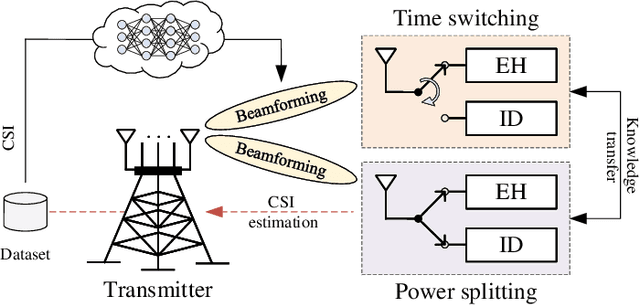
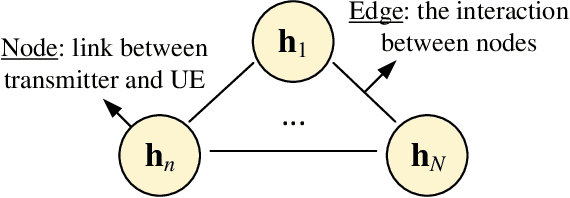
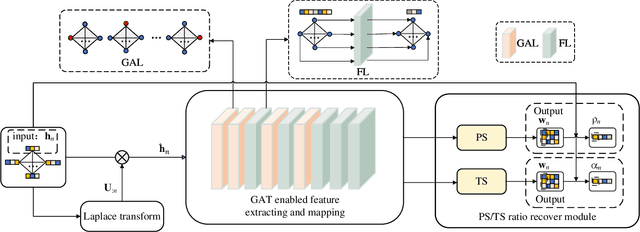
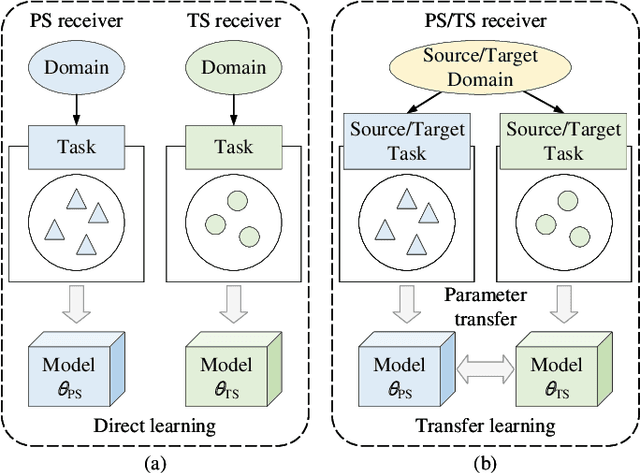
This paper investigates the deep learning based approaches for simultaneous wireless information and power transfer (SWIPT). The quality-of-service (QoS) constrained sum-rate maximization problems are, respectively, formulated for power-splitting (PS) receivers and time-switching (TS) receivers and solved by a unified graph neural network (GNN) based model termed SWIPT net (SWIPTNet). To improve the performance of SWIPTNet, we first propose a single-type output method to reduce the learning complexity and facilitate the satisfaction of QoS constraints, and then, utilize the Laplace transform to enhance input features with the structural information. Besides, we adopt the multi-head attention and layer connection to enhance feature extracting. Furthermore, we present the implementation of transfer learning to the SWIPTNet between PS and TS receivers. Ablation studies show the effectiveness of key components in the SWIPTNet. Numerical results also demonstrate the capability of SWIPTNet in achieving near-optimal performance with millisecond-level inference speed which is much faster than the traditional optimization algorithms. We also show the effectiveness of transfer learning via fast convergence and expressive capability improvement.