 Add to Chrome
 Add to Firefox
 Add to Edge
Does Representation Intervention Really Identify Desired Concepts and Elicit Alignment?
May 24, 2025
Representation intervention aims to locate and modify the representations that encode the underlying concepts in Large Language Models (LLMs) to elicit the aligned and expected behaviors. Despite the empirical success, it has never been examined whether one could locate the faithful concepts for intervention. In this work, we explore the question in safety alignment. If the interventions are faithful, the intervened LLMs should erase the harmful concepts and be robust to both in-distribution adversarial prompts and the out-of-distribution (OOD) jailbreaks. While it is feasible to erase harmful concepts without degrading the benign functionalities of LLMs in linear settings, we show that it is infeasible in the general non-linear setting. To tackle the issue, we propose Concept Concentration (COCA). Instead of identifying the faithful locations to intervene, COCA refractors the training data with an explicit reasoning process, which firstly identifies the potential unsafe concepts and then decides the responses. Essentially, COCA simplifies the decision boundary between harmful and benign representations, enabling more effective linear erasure. Extensive experiments with multiple representation intervention methods and model architectures demonstrate that COCA significantly reduces both in-distribution and OOD jailbreak success rates, and meanwhile maintaining strong performance on regular tasks such as math and code generation.

On the Thinking-Language Modeling Gap in Large Language Models
May 19, 2025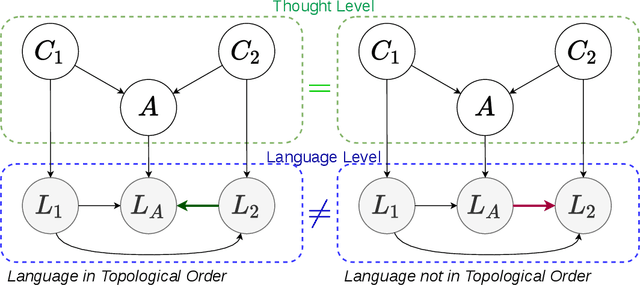
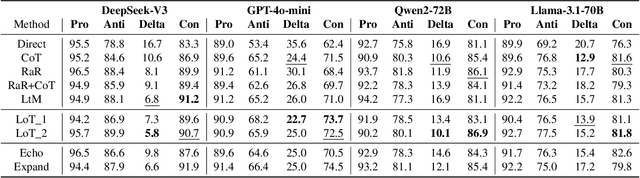
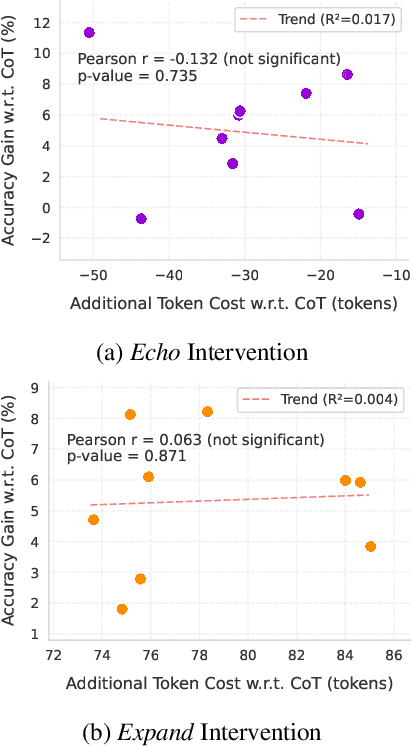
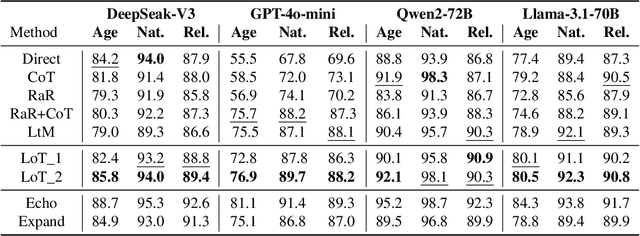
System 2 reasoning is one of the defining characteristics of intelligence, which requires slow and logical thinking. Human conducts System 2 reasoning via the language of thoughts that organizes the reasoning process as a causal sequence of mental language, or thoughts. Recently, it has been observed that System 2 reasoning can be elicited from Large Language Models (LLMs) pre-trained on large-scale natural languages. However, in this work, we show that there is a significant gap between the modeling of languages and thoughts. As language is primarily a tool for humans to share knowledge and thinking, modeling human language can easily absorb language biases into LLMs deviated from the chain of thoughts in minds. Furthermore, we show that the biases will mislead the eliciting of "thoughts" in LLMs to focus only on a biased part of the premise. To this end, we propose a new prompt technique termed Language-of-Thoughts (LoT) to demonstrate and alleviate this gap. Instead of directly eliciting the chain of thoughts from partial information, LoT instructs LLMs to adjust the order and token used for the expressions of all the relevant information. We show that the simple strategy significantly reduces the language modeling biases in LLMs and improves the performance of LLMs across a variety of reasoning tasks.
Exploring Criteria of Loss Reweighting to Enhance LLM Unlearning
May 17, 2025Loss reweighting has shown significant benefits for machine unlearning with large language models (LLMs). However, their exact functionalities are left unclear and the optimal strategy remains an open question, thus impeding the understanding and improvement of existing methodologies. In this paper, we identify two distinct goals of loss reweighting, namely, Saturation and Importance -- the former indicates that those insufficiently optimized data should be emphasized, while the latter stresses some critical data that are most influential for loss minimization. To study their usefulness, we design specific reweighting strategies for each goal and evaluate their respective effects on unlearning. We conduct extensive empirical analyses on well-established benchmarks, and summarize some important observations as follows: (i) Saturation enhances efficacy more than importance-based reweighting, and their combination can yield additional improvements. (ii) Saturation typically allocates lower weights to data with lower likelihoods, whereas importance-based reweighting does the opposite. (iii) The efficacy of unlearning is also largely influenced by the smoothness and granularity of the weight distributions. Based on these findings, we propose SatImp, a simple reweighting method that combines the advantages of both saturation and importance. Empirical results on extensive datasets validate the efficacy of our method, potentially bridging existing research gaps and indicating directions for future research. Our code is available at https://github.com/Puning97/SatImp-for-LLM-Unlearning.
Direct Advantage Regression: Aligning LLMs with Online AI Reward
Apr 19, 2025Online AI Feedback (OAIF) presents a promising alternative to Reinforcement Learning from Human Feedback (RLHF) by utilizing online AI preference in aligning language models (LLMs). However, the straightforward replacement of humans with AI deprives LLMs from learning more fine-grained AI supervision beyond binary signals. In this paper, we propose Direct Advantage Regression (DAR), a simple alignment algorithm using online AI reward to optimize policy improvement through weighted supervised fine-tuning. As an RL-free approach, DAR maintains theoretical consistency with online RLHF pipelines while significantly reducing implementation complexity and improving learning efficiency. Our empirical results underscore that AI reward is a better form of AI supervision consistently achieving higher human-AI agreement as opposed to AI preference. Additionally, evaluations using GPT-4-Turbo and MT-bench show that DAR outperforms both OAIF and online RLHF baselines.
A Knowledge-guided Adversarial Defense for Resisting Malicious Visual Manipulation
Apr 11, 2025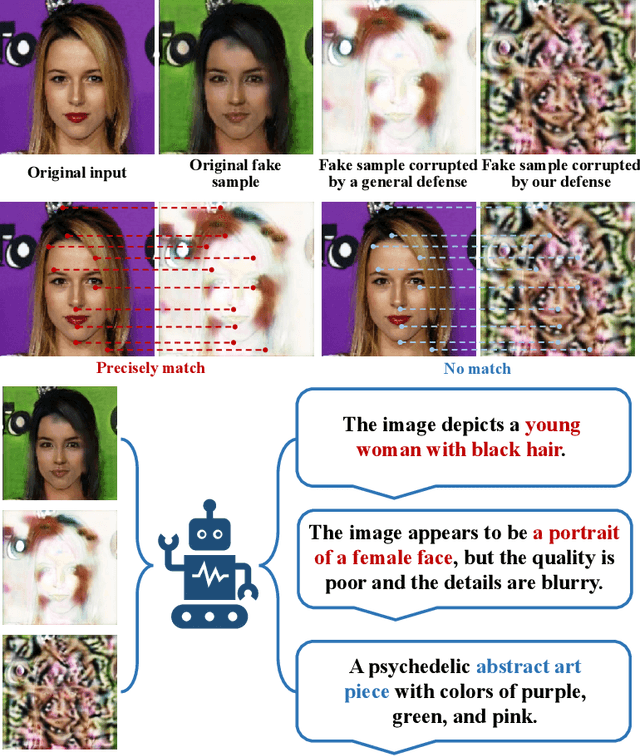
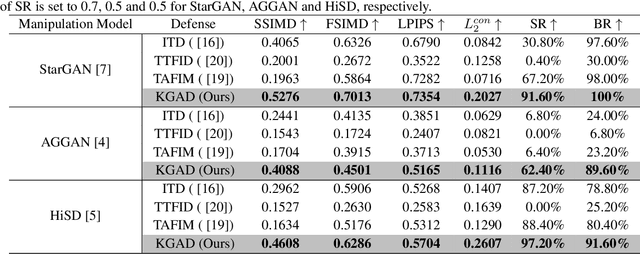
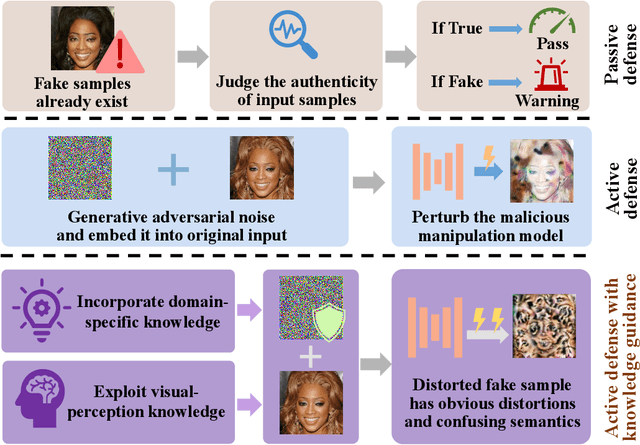

Malicious applications of visual manipulation have raised serious threats to the security and reputation of users in many fields. To alleviate these issues, adversarial noise-based defenses have been enthusiastically studied in recent years. However, ``data-only" methods tend to distort fake samples in the low-level feature space rather than the high-level semantic space, leading to limitations in resisting malicious manipulation. Frontier research has shown that integrating knowledge in deep learning can produce reliable and generalizable solutions. Inspired by these, we propose a knowledge-guided adversarial defense (KGAD) to actively force malicious manipulation models to output semantically confusing samples. Specifically, in the process of generating adversarial noise, we focus on constructing significant semantic confusions at the domain-specific knowledge level, and exploit a metric closely related to visual perception to replace the general pixel-wise metrics. The generated adversarial noise can actively interfere with the malicious manipulation model by triggering knowledge-guided and perception-related disruptions in the fake samples. To validate the effectiveness of the proposed method, we conduct qualitative and quantitative experiments on human perception and visual quality assessment. The results on two different tasks both show that our defense provides better protection compared to state-of-the-art methods and achieves great generalizability.
Advances and Challenges in Foundation Agents: From Brain-Inspired Intelligence to Evolutionary, Collaborative, and Safe Systems
Mar 31, 2025The advent of large language models (LLMs) has catalyzed a transformative shift in artificial intelligence, paving the way for advanced intelligent agents capable of sophisticated reasoning, robust perception, and versatile action across diverse domains. As these agents increasingly drive AI research and practical applications, their design, evaluation, and continuous improvement present intricate, multifaceted challenges. This survey provides a comprehensive overview, framing intelligent agents within a modular, brain-inspired architecture that integrates principles from cognitive science, neuroscience, and computational research. We structure our exploration into four interconnected parts. First, we delve into the modular foundation of intelligent agents, systematically mapping their cognitive, perceptual, and operational modules onto analogous human brain functionalities, and elucidating core components such as memory, world modeling, reward processing, and emotion-like systems. Second, we discuss self-enhancement and adaptive evolution mechanisms, exploring how agents autonomously refine their capabilities, adapt to dynamic environments, and achieve continual learning through automated optimization paradigms, including emerging AutoML and LLM-driven optimization strategies. Third, we examine collaborative and evolutionary multi-agent systems, investigating the collective intelligence emerging from agent interactions, cooperation, and societal structures, highlighting parallels to human social dynamics. Finally, we address the critical imperative of building safe, secure, and beneficial AI systems, emphasizing intrinsic and extrinsic security threats, ethical alignment, robustness, and practical mitigation strategies necessary for trustworthy real-world deployment.
EvAnimate: Event-conditioned Image-to-Video Generation for Human Animation
Mar 24, 2025
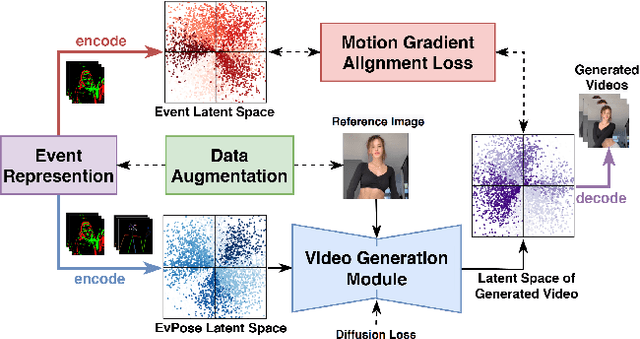
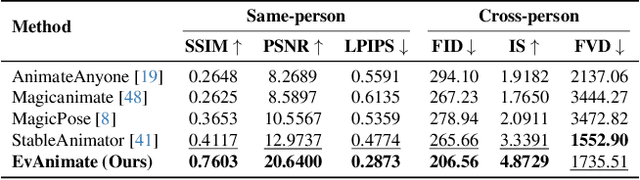
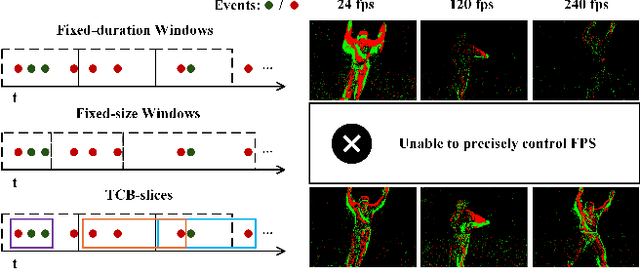
Conditional human animation transforms a static reference image into a dynamic sequence by applying motion cues such as poses. These motion cues are typically derived from video data but are susceptible to limitations including low temporal resolution, motion blur, overexposure, and inaccuracies under low-light conditions. In contrast, event cameras provide data streams with exceptionally high temporal resolution, a wide dynamic range, and inherent resistance to motion blur and exposure issues. In this work, we propose EvAnimate, a framework that leverages event streams as motion cues to animate static human images. Our approach employs a specialized event representation that transforms asynchronous event streams into 3-channel slices with controllable slicing rates and appropriate slice density, ensuring compatibility with diffusion models. Subsequently, a dual-branch architecture generates high-quality videos by harnessing the inherent motion dynamics of the event streams, thereby enhancing both video quality and temporal consistency. Specialized data augmentation strategies further enhance cross-person generalization. Finally, we establish a new benchmarking, including simulated event data for training and validation, and a real-world event dataset capturing human actions under normal and extreme scenarios. The experiment results demonstrate that EvAnimate achieves high temporal fidelity and robust performance in scenarios where traditional video-derived cues fall short.
Jailbreaking the Non-Transferable Barrier via Test-Time Data Disguising
Mar 21, 2025Non-transferable learning (NTL) has been proposed to protect model intellectual property (IP) by creating a "non-transferable barrier" to restrict generalization from authorized to unauthorized domains. Recently, well-designed attack, which restores the unauthorized-domain performance by fine-tuning NTL models on few authorized samples, highlights the security risks of NTL-based applications. However, such attack requires modifying model weights, thus being invalid in the black-box scenario. This raises a critical question: can we trust the security of NTL models deployed as black-box systems? In this work, we reveal the first loophole of black-box NTL models by proposing a novel attack method (dubbed as JailNTL) to jailbreak the non-transferable barrier through test-time data disguising. The main idea of JailNTL is to disguise unauthorized data so it can be identified as authorized by the NTL model, thereby bypassing the non-transferable barrier without modifying the NTL model weights. Specifically, JailNTL encourages unauthorized-domain disguising in two levels, including: (i) data-intrinsic disguising (DID) for eliminating domain discrepancy and preserving class-related content at the input-level, and (ii) model-guided disguising (MGD) for mitigating output-level statistics difference of the NTL model. Empirically, when attacking state-of-the-art (SOTA) NTL models in the black-box scenario, JailNTL achieves an accuracy increase of up to 55.7% in the unauthorized domain by using only 1% authorized samples, largely exceeding existing SOTA white-box attacks.
Identifying Trustworthiness Challenges in Deep Learning Models for Continental-Scale Water Quality Prediction
Mar 13, 2025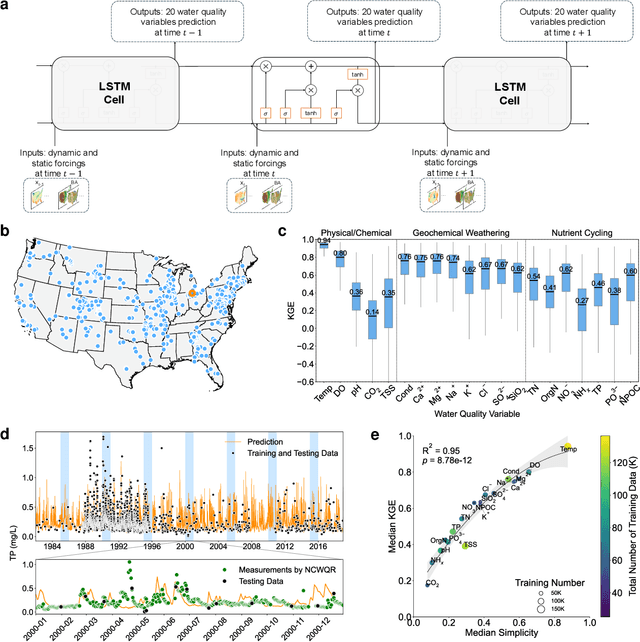
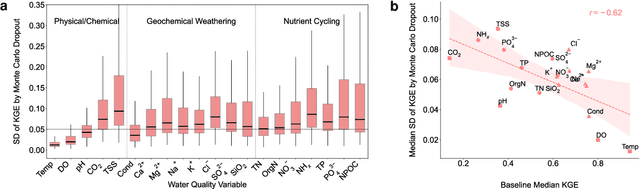
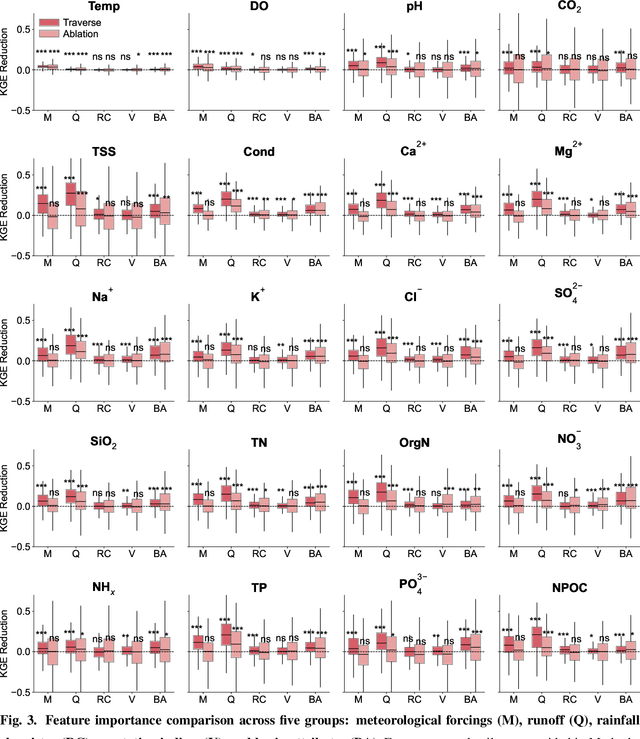
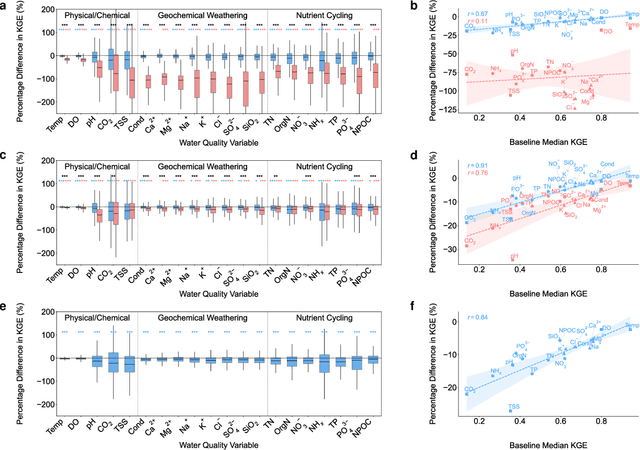
Water quality is foundational to environmental sustainability, ecosystem resilience, and public health. Deep learning models, particularly Long Short-Term Memory (LSTM) networks, offer transformative potential for large-scale water quality prediction and scientific insights generation. However, their widespread adoption in high-stakes decision-making, such as pollution mitigation and equitable resource allocation, is prevented by unresolved trustworthiness challenges including fairness, uncertainty, interpretability, robustness, generalizability, and reproducibility. In this work, we present the first comprehensive evaluation of trustworthiness in a continental-scale multi-task LSTM model predicting 20 water quality variables (encompassing physical/chemical processes, geochemical weathering, and nutrient cycling) across 482 U.S. basins. Our investigation uncovers systematic patterns of model performance disparities linked to basin characteristics, the inherent complexity of biogeochemical processes, and variable predictability, emphasizing critical performance fairness concerns. We further propose methodological frameworks for quantitatively evaluating critical aspects of trustworthiness, including uncertainty, interpretability, and robustness, identifying key limitations that could challenge reliable real-world deployment. This work serves as a timely call to action for advancing trustworthy data-driven methods for water resources management and provides a pathway to offering critical insights for researchers, decision-makers, and practitioners seeking to leverage artificial intelligence (AI) responsibly in environmental management.
MF-VITON: High-Fidelity Mask-Free Virtual Try-On with Minimal Input
Mar 11, 2025Recent advancements in Virtual Try-On (VITON) have significantly improved image realism and garment detail preservation, driven by powerful text-to-image (T2I) diffusion models. However, existing methods often rely on user-provided masks, introducing complexity and performance degradation due to imperfect inputs, as shown in Fig.1(a). To address this, we propose a Mask-Free VITON (MF-VITON) framework that achieves realistic VITON using only a single person image and a target garment, eliminating the requirement for auxiliary masks. Our approach introduces a novel two-stage pipeline: (1) We leverage existing Mask-based VITON models to synthesize a high-quality dataset. This dataset contains diverse, realistic pairs of person images and corresponding garments, augmented with varied backgrounds to mimic real-world scenarios. (2) The pre-trained Mask-based model is fine-tuned on the generated dataset, enabling garment transfer without mask dependencies. This stage simplifies the input requirements while preserving garment texture and shape fidelity. Our framework achieves state-of-the-art (SOTA) performance regarding garment transfer accuracy and visual realism. Notably, the proposed Mask-Free model significantly outperforms existing Mask-based approaches, setting a new benchmark and demonstrating a substantial lead over previous approaches. For more details, visit our project page: https://zhenchenwan.github.io/MF-VITON/.