 Add to Chrome
 Add to Firefox
 Add to Edge
When Agents Learn to Be You: Benchmarking Privacy Leakage, Impersonation Risk, and Defenses in Persona Skills
Aug 04, 2026
Persona skills distill personal interaction histories into portable and executable artifacts for downstream agents. While enabling flexible personalization, this process concentrates fragmented personal signals, amplifies their impact through reuse, and challenges defenses designed for individual records or retrieval-based memory. To systematically investigate the safety of the persona-skill pipeline, we introduce AntiSkillBench, an end-to-end benchmark for evaluating risks and defenses across the persona-skill pipeline. It comprises: (i) a dataset of 7,500 persona-grounded dialogue traces, constructed from 50 behaviorally rich profiles spanning diverse task scenarios; (ii) an evaluation suite that measures skill-level privacy leakage and agent-level attribute disclosure and behavioral impersonation across three skill-distillation strategies; and (iii) a defense evaluation covering four configurations across online and post-hoc interventions, including active risk suppression and passive provenance protection. Experiments across three frontier agents show that persona-skill risks persist across agent backbones and distillation protocols, extending from explicit attributes to communication styles and personality traits. Existing defenses exhibit limited and distillation-dependent effectiveness, failing to generalize across risk and distillation strategies. These results highlight AntiSkillBench as a challenging benchmark for developing privacy-preserving and authenticity-aware persona skills.

A theoretical model for task routing in mixture-of-expert transformers
Jun 12, 2026Mixture-of-experts (MoE) layers enable the scaling of transformer models while keeping the inference compute fixed. While task-expert specialization has been observed in empirical studies of frontier MoE transformer models, existing theoretical work analyzes this using continuous mixture models that cannot be used to model natural language effectively. An important open question is to \textit{theoretically explain task-expert specialization in transformer MoE models using discrete models of language}. To address this, we represent structured knowledge via syntactic templates and finite key-value dictionaries, and prove formally that a single-layer MoE transformer can encode knowledge by using experts that specialize in the corresponding tasks. Our construction shows how queries are routed to unique, task-specific experts whose size depends solely on the intrinsic complexity of the given task (i.e. the combined size of its syntactic templates and factual dictionary). Our construction provides a theoretical support for empirical results on localized knowledge circuits in MoE models. We support our theoretical findings with experiments evaluating model performance under varying MoE loss functions.
When Safety Collides: Resolving Multi-Category Harmful Conflicts in Text-to-Image Diffusion via Adaptive Safety Guidance
Feb 25, 2026Text-to-Image (T2I) diffusion models have demonstrated significant advancements in generating high-quality images, while raising potential safety concerns regarding harmful content generation. Safety-guidance-based methods have been proposed to mitigate harmful outputs by steering generation away from harmful zones, where the zones are averaged across multiple harmful categories based on predefined keywords. However, these approaches fail to capture the complex interplay among different harm categories, leading to "harmful conflicts" where mitigating one type of harm may inadvertently amplify another, thus increasing overall harmful rate. To address this issue, we propose Conflict-aware Adaptive Safety Guidance (CASG), a training-free framework that dynamically identifies and applies the category-aligned safety direction during generation. CASG is composed of two components: (i) Conflict-aware Category Identification (CaCI), which identifies the harmful category most aligned with the model's evolving generative state, and (ii) Conflict-resolving Guidance Application (CrGA), which applies safety steering solely along the identified category to avoid multi-category interference. CASG can be applied to both latent-space and text-space safeguards. Experiments on T2I safety benchmarks demonstrate CASG's state-of-the-art performance, reducing the harmful rate by up to 15.4% compared to existing methods.
VII: Visual Instruction Injection for Jailbreaking Image-to-Video Generation Models
Feb 24, 2026Image-to-Video (I2V) generation models, which condition video generation on reference images, have shown emerging visual instruction-following capability, allowing certain visual cues in reference images to act as implicit control signals for video generation. However, this capability also introduces a previously overlooked risk: adversaries may exploit visual instructions to inject malicious intent through the image modality. In this work, we uncover this risk by proposing Visual Instruction Injection (VII), a training-free and transferable jailbreaking framework that intentionally disguises the malicious intent of unsafe text prompts as benign visual instructions in the safe reference image. Specifically, VII coordinates a Malicious Intent Reprogramming module to distill malicious intent from unsafe text prompts while minimizing their static harmfulness, and a Visual Instruction Grounding module to ground the distilled intent onto a safe input image by rendering visual instructions that preserve semantic consistency with the original unsafe text prompt, thereby inducing harmful content during I2V generation. Empirically, our extensive experiments on four state-of-the-art commercial I2V models (Kling-v2.5-turbo, Gemini Veo-3.1, Seedance-1.5-pro, and PixVerse-V5) demonstrate that VII achieves Attack Success Rates of up to 83.5% while reducing Refusal Rates to near zero, significantly outperforming existing baselines.
Jailbreaking the Non-Transferable Barrier via Test-Time Data Disguising
Mar 21, 2025Non-transferable learning (NTL) has been proposed to protect model intellectual property (IP) by creating a "non-transferable barrier" to restrict generalization from authorized to unauthorized domains. Recently, well-designed attack, which restores the unauthorized-domain performance by fine-tuning NTL models on few authorized samples, highlights the security risks of NTL-based applications. However, such attack requires modifying model weights, thus being invalid in the black-box scenario. This raises a critical question: can we trust the security of NTL models deployed as black-box systems? In this work, we reveal the first loophole of black-box NTL models by proposing a novel attack method (dubbed as JailNTL) to jailbreak the non-transferable barrier through test-time data disguising. The main idea of JailNTL is to disguise unauthorized data so it can be identified as authorized by the NTL model, thereby bypassing the non-transferable barrier without modifying the NTL model weights. Specifically, JailNTL encourages unauthorized-domain disguising in two levels, including: (i) data-intrinsic disguising (DID) for eliminating domain discrepancy and preserving class-related content at the input-level, and (ii) model-guided disguising (MGD) for mitigating output-level statistics difference of the NTL model. Empirically, when attacking state-of-the-art (SOTA) NTL models in the black-box scenario, JailNTL achieves an accuracy increase of up to 55.7% in the unauthorized domain by using only 1% authorized samples, largely exceeding existing SOTA white-box attacks.
Toward Robust Non-Transferable Learning: A Survey and Benchmark
Feb 19, 2025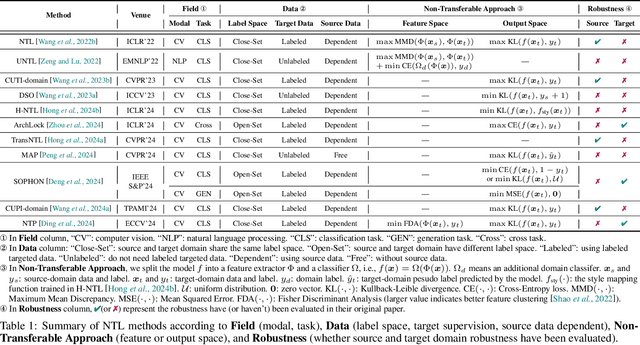
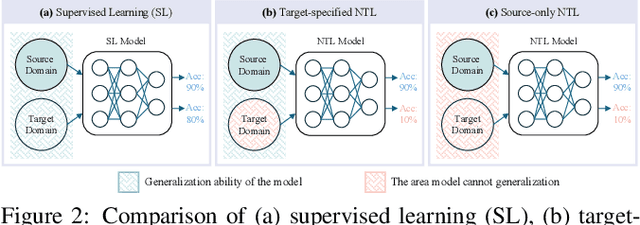
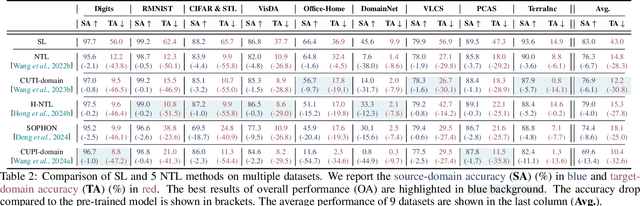

Over the past decades, researchers have primarily focused on improving the generalization abilities of models, with limited attention given to regulating such generalization. However, the ability of models to generalize to unintended data (e.g., harmful or unauthorized data) can be exploited by malicious adversaries in unforeseen ways, potentially resulting in violations of model ethics. Non-transferable learning (NTL), a task aimed at reshaping the generalization abilities of deep learning models, was proposed to address these challenges. While numerous methods have been proposed in this field, a comprehensive review of existing progress and a thorough analysis of current limitations remain lacking. In this paper, we bridge this gap by presenting the first comprehensive survey on NTL and introducing NTLBench, the first benchmark to evaluate NTL performance and robustness within a unified framework. Specifically, we first introduce the task settings, general framework, and criteria of NTL, followed by a summary of NTL approaches. Furthermore, we emphasize the often-overlooked issue of robustness against various attacks that can destroy the non-transferable mechanism established by NTL. Experiments conducted via NTLBench verify the limitations of existing NTL methods in robustness. Finally, we discuss the practical applications of NTL, along with its future directions and associated challenges.