 Add to Chrome
 Add to Firefox
 Add to Edge
AudioMosaic: Contrastive Masked Audio Representation Learning
May 14, 2026
Audio self-supervised learning (SSL) aims to learn general-purpose representations from large-scale unlabeled audio data. While recent advances have been driven mainly by generative reconstruction objectives, contrastive approaches remain less explored, partly due to the difficulty of designing effective audio augmentations and the large batch sizes required for contrastive pre-training. We introduce \textbf{AudioMosaic}, a contrastive learning-based audio encoder for general audio understanding. During pre-training, AudioMosaic constructs positive pairs by applying structured time-frequency masking to spectrogram patches, which reduces memory usage and enables efficient large-batch training. Compared with generative approaches, the AudioMosaic encoder learns more discriminative utterance-level representations that demonstrate strong transferability across datasets, domains, and acoustic conditions. Extensive experiments show that AudioMosaic achieves state-of-the-art performance on several standard audio benchmarks under both linear probing and fine-tuning. We further show that integrating the pretrained AudioMosaic encoder into audio-language models improves performance on audio-language tasks. The code is publicly available in our \href{https://github.com/HanxunH/AudioMosaic}{GitHub repository}.

Belief Memory: Agent Memory Under Partial Observability
May 07, 2026LLM agents that operate over long context depend on external memory to accumulate knowledge over time. However, existing methods typically store each observation as a single deterministic conclusion (e.g., inferring "API~X failed" from temporary errors), even though such observations are inherently partial and potentially ambiguous. By committing to one conclusion and discarding uncertainty, these methods introduce self-reinforcing error: the agent acts on the stored conclusion, never revisits alternatives, and reinforces the conclusion over time. To address this issue, we propose BeliefMem, which shifts the memory paradigm from committing to a single conclusion per observation to retaining multiple candidate conclusions with their probabilities. Concretely, BeliefMem stores the candidate conclusions as separate memory entries, each carrying a probability that is updated via Noisy-OR rules as new observations arrive. At retrieval, all candidates surface together with their probabilities, keeping alternatives visible to the agent. Since each conclusion in memory retains its probability, BeliefMem preserves the uncertainty that the deterministic paradigm discards, enabling the agent to act with high confidence on well-evidenced knowledge while retaining the capacity to update its confidence when new evidence arrives. Empirical evaluations on LoCoMo and ALFWorld benchmarks show that, even with limited data, BeliefMem achieves the best average performance, remarkably outperforming well-known baselines. More broadly, such probabilistic memory produces substantial gains and explores a new direction for agent memory in partially observable environments.
Graph Federated Unlearning for Privacy Preservation
May 04, 2026Graph federated learning (GFL) facilitates decentralized training on distributed graph data while keeping sensitive user information local, aligning with policies such as GDPR and CCPA that grant users the right to freely join or withdraw from learning systems. However, even decentralized, user information can persist after quitting, potentially propagating to central servers and then redistributing to malicious clients. This privacy leakage during user withdrawal, despite its importance, has received seldom attention in GFL. To fill the gap, we explore the potential of machine unlearning (MU) to thoroughly remove user information. However, classical MU methods are known to degrade overall performance, a problem that is exacerbated in GFL due to local message passing and global model collaboration. To this end, we make two adjustments to mitigate this challenge for GFL. First, we ensure unlearning updates that minimally affect overall performance, steering them in directions orthogonal to the gradients from learning other data. Second, we introduce virtual clients, maintained by the central server, to preserve graph topology and global embeddings without recovering information of removed entities. We conduct comprehensive experiments under a representative user-withdrawal scenario and propose a novel membership inference framework to rigorously evaluate and validate the reliability of our privacy preservation. The experimental results demonstrate the effectiveness of our approach, which also surpasses the performance of seven state-of-the-art baseline methods.
SurFITR: A Dataset for Surveillance Image Forgery Detection and Localisation
Apr 08, 2026We present the Surveillance Forgery Image Test Range (SurFITR), a dataset for surveillance-style image forgery detection and localisation, in response to recent advances in open-access image generation models that raise concerns about falsifying visual evidence. Existing forgery models, trained on datasets with full-image synthesis or large manipulated regions in object-centric images, struggle to generalise to surveillance scenarios. This is because tampering in surveillance imagery is typically localised and subtle, occurring in scenes with varied viewpoints, small or occluded subjects, and lower visual quality. To address this gap, SurFITR provides a large collection of forensically valuable imagery generated via a multimodal LLM-powered pipeline, enabling semantically aware, fine-grained editing across diverse surveillance scenes. It contains over 137k tampered images with varying resolutions and edit types, generated using multiple image editing models. Extensive experiments show that existing detectors degrade significantly on SurFITR, while training on SurFITR yields substantial improvements in both in-domain and cross-domain performance. SurFITR is publicly available on GitHub.
Is Gradient Ascent Really Necessary? Memorize to Forget for Machine Unlearning
Feb 06, 2026For ethical and safe AI, machine unlearning rises as a critical topic aiming to protect sensitive, private, and copyrighted knowledge from misuse. To achieve this goal, it is common to conduct gradient ascent (GA) to reverse the training on undesired data. However, such a reversal is prone to catastrophic collapse, which leads to serious performance degradation in general tasks. As a solution, we propose model extrapolation as an alternative to GA, which reaches the counterpart direction in the hypothesis space from one model given another reference model. Therefore, we leverage the original model as the reference, further train it to memorize undesired data while keeping prediction consistency on the rest retained data, to obtain a memorization model. Counterfactual as it might sound, a forget model can be obtained via extrapolation from the memorization model to the reference model. Hence, we avoid directly acquiring the forget model using GA, but proceed with gradient descent for the memorization model, which successfully stabilizes the machine unlearning process. Our model extrapolation is simple and efficient to implement, and it can also effectively converge throughout training to achieve improved unlearning performance.
AEGIS: Adversarial Target-Guided Retention-Data-Free Robust Concept Erasure from Diffusion Models
Feb 06, 2026Concept erasure helps stop diffusion models (DMs) from generating harmful content; but current methods face robustness retention trade off. Robustness means the model fine-tuned by concept erasure methods resists reactivation of erased concepts, even under semantically related prompts. Retention means unrelated concepts are preserved so the model's overall utility stays intact. Both are critical for concept erasure in practice, yet addressing them simultaneously is challenging, as existing works typically improve one factor while sacrificing the other. Prior work typically strengthens one while degrading the other, e.g., mapping a single erased prompt to a fixed safe target leaves class level remnants exploitable by prompt attacks, whereas retention-oriented schemes underperform against adaptive adversaries. This paper introduces Adversarial Erasure with Gradient Informed Synergy (AEGIS), a retention-data-free framework that advances both robustness and retention.
* 30 pages,12 figures
HierCon: Hierarchical Contrastive Attention for Audio Deepfake Detection
Feb 01, 2026Audio deepfakes generated by modern TTS and voice conversion systems are increasingly difficult to distinguish from real speech, raising serious risks for security and online trust. While state-of-the-art self-supervised models provide rich multi-layer representations, existing detectors treat layers independently and overlook temporal and hierarchical dependencies critical for identifying synthetic artefacts. We propose HierCon, a hierarchical layer attention framework combined with margin-based contrastive learning that models dependencies across temporal frames, neighbouring layers, and layer groups, while encouraging domain-invariant embeddings. Evaluated on ASVspoof 2021 DF and In-the-Wild datasets, our method achieves state-of-the-art performance (1.93% and 6.87% EER), improving over independent layer weighting by 36.6% and 22.5% respectively. The results and attention visualisations confirm that hierarchical modelling enhances generalisation to cross-domain generation techniques and recording conditions.
CEDL: Centre-Enhanced Discriminative Learning for Anomaly Detection
Nov 15, 2025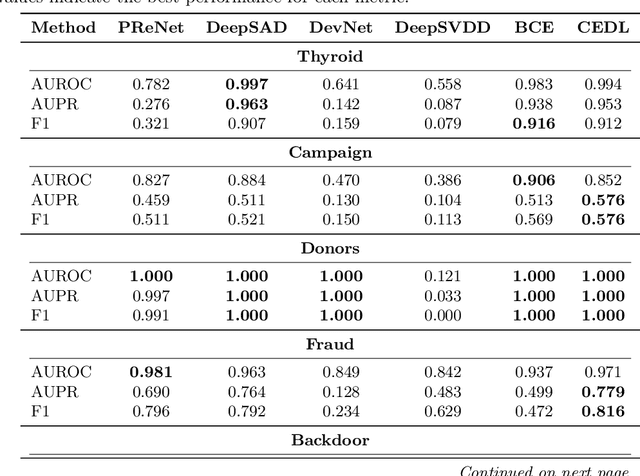
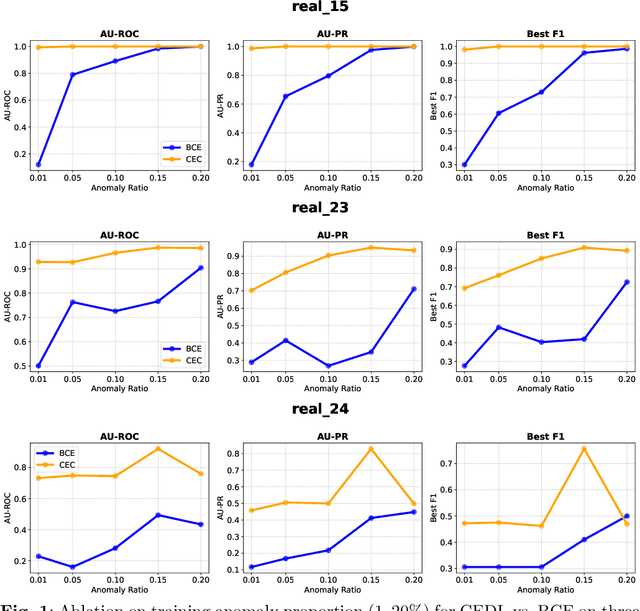
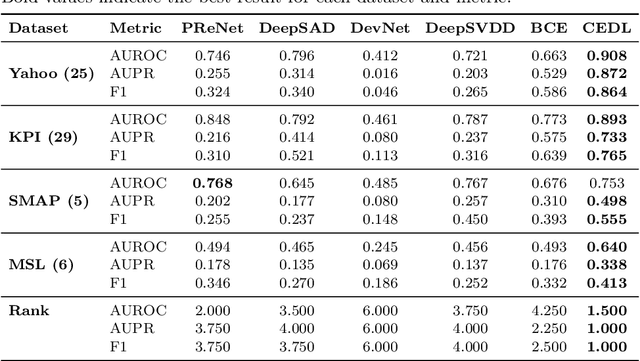
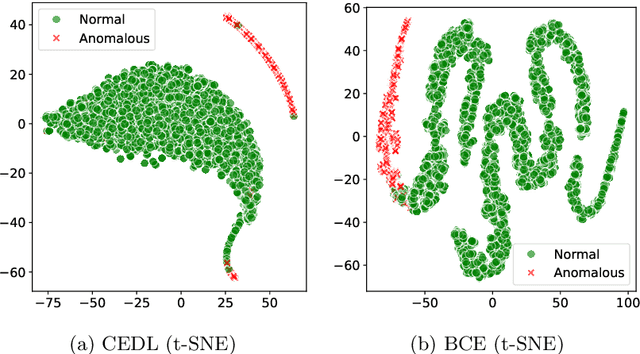
Supervised anomaly detection methods perform well in identifying known anomalies that are well represented in the training set. However, they often struggle to generalise beyond the training distribution due to decision boundaries that lack a clear definition of normality. Existing approaches typically address this by regularising the representation space during training, leading to separate optimisation in latent and label spaces. The learned normality is therefore not directly utilised at inference, and their anomaly scores often fall within arbitrary ranges that require explicit mapping or calibration for probabilistic interpretation. To achieve unified learning of geometric normality and label discrimination, we propose Centre-Enhanced Discriminative Learning (CEDL), a novel supervised anomaly detection framework that embeds geometric normality directly into the discriminative objective. CEDL reparameterises the conventional sigmoid-derived prediction logit through a centre-based radial distance function, unifying geometric and discriminative learning in a single end-to-end formulation. This design enables interpretable, geometry-aware anomaly scoring without post-hoc thresholding or reference calibration. Extensive experiments on tabular, time-series, and image data demonstrate that CEDL achieves competitive and balanced performance across diverse real-world anomaly detection tasks, validating its effectiveness and broad applicability.
AUDETER: A Large-scale Dataset for Deepfake Audio Detection in Open Worlds
Sep 04, 2025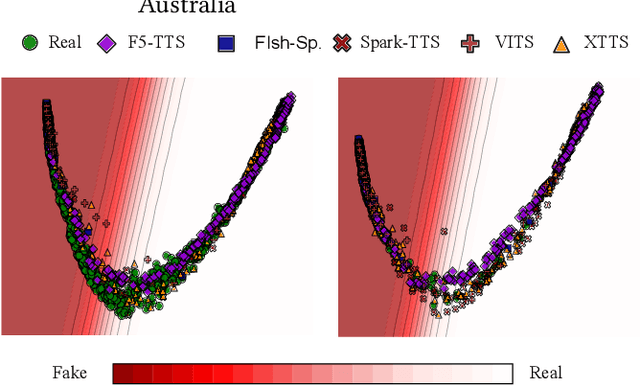
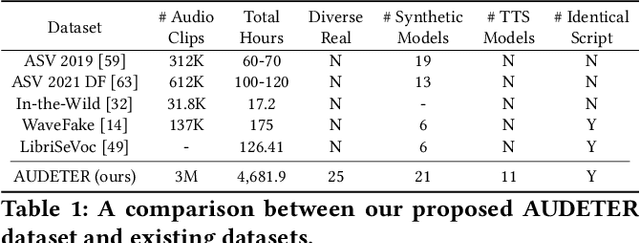
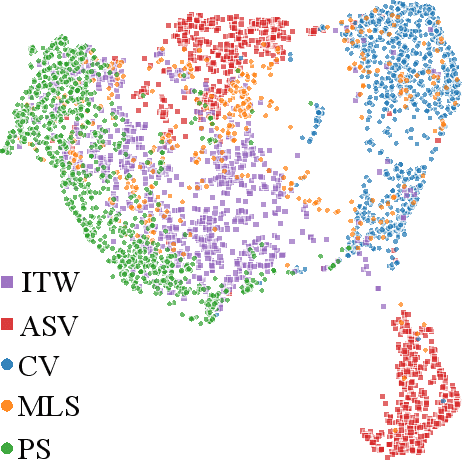
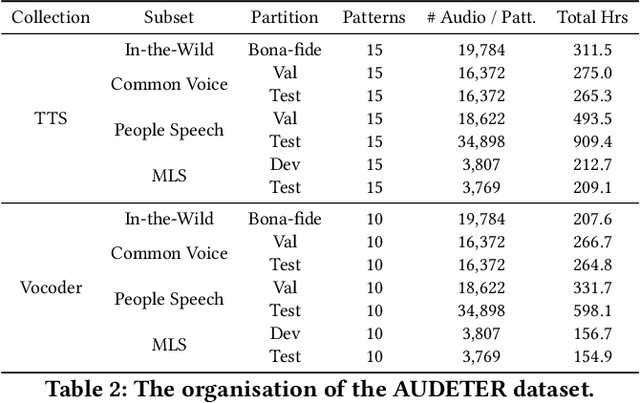
Speech generation systems can produce remarkably realistic vocalisations that are often indistinguishable from human speech, posing significant authenticity challenges. Although numerous deepfake detection methods have been developed, their effectiveness in real-world environments remains unrealiable due to the domain shift between training and test samples arising from diverse human speech and fast evolving speech synthesis systems. This is not adequately addressed by current datasets, which lack real-world application challenges with diverse and up-to-date audios in both real and deep-fake categories. To fill this gap, we introduce AUDETER (AUdio DEepfake TEst Range), a large-scale, highly diverse deepfake audio dataset for comprehensive evaluation and robust development of generalised models for deepfake audio detection. It consists of over 4,500 hours of synthetic audio generated by 11 recent TTS models and 10 vocoders with a broad range of TTS/vocoder patterns, totalling 3 million audio clips, making it the largest deepfake audio dataset by scale. Through extensive experiments with AUDETER, we reveal that i) state-of-the-art (SOTA) methods trained on existing datasets struggle to generalise to novel deepfake audio samples and suffer from high false positive rates on unseen human voice, underscoring the need for a comprehensive dataset; and ii) these methods trained on AUDETER achieve highly generalised detection performance and significantly reduce detection error rate by 44.1% to 51.6%, achieving an error rate of only 4.17% on diverse cross-domain samples in the popular In-the-Wild dataset, paving the way for training generalist deepfake audio detectors. AUDETER is available on GitHub.
Exploring Criteria of Loss Reweighting to Enhance LLM Unlearning
May 17, 2025Loss reweighting has shown significant benefits for machine unlearning with large language models (LLMs). However, their exact functionalities are left unclear and the optimal strategy remains an open question, thus impeding the understanding and improvement of existing methodologies. In this paper, we identify two distinct goals of loss reweighting, namely, Saturation and Importance -- the former indicates that those insufficiently optimized data should be emphasized, while the latter stresses some critical data that are most influential for loss minimization. To study their usefulness, we design specific reweighting strategies for each goal and evaluate their respective effects on unlearning. We conduct extensive empirical analyses on well-established benchmarks, and summarize some important observations as follows: (i) Saturation enhances efficacy more than importance-based reweighting, and their combination can yield additional improvements. (ii) Saturation typically allocates lower weights to data with lower likelihoods, whereas importance-based reweighting does the opposite. (iii) The efficacy of unlearning is also largely influenced by the smoothness and granularity of the weight distributions. Based on these findings, we propose SatImp, a simple reweighting method that combines the advantages of both saturation and importance. Empirical results on extensive datasets validate the efficacy of our method, potentially bridging existing research gaps and indicating directions for future research. Our code is available at https://github.com/Puning97/SatImp-for-LLM-Unlearning.