 Add to Chrome
 Add to Firefox
 Add to Edge
Hashtag-Guided Low-Resource Tweet Classification
Feb 20, 2023

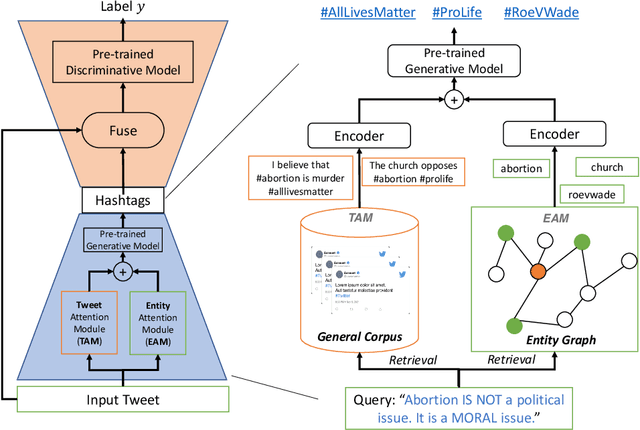

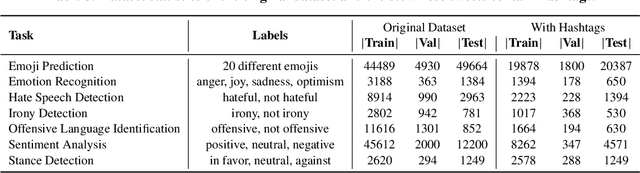
Social media classification tasks (e.g., tweet sentiment analysis, tweet stance detection) are challenging because social media posts are typically short, informal, and ambiguous. Thus, training on tweets is challenging and demands large-scale human-annotated labels, which are time-consuming and costly to obtain. In this paper, we find that providing hashtags to social media tweets can help alleviate this issue because hashtags can enrich short and ambiguous tweets in terms of various information, such as topic, sentiment, and stance. This motivates us to propose a novel Hashtag-guided Tweet Classification model (HashTation), which automatically generates meaningful hashtags for the input tweet to provide useful auxiliary signals for tweet classification. To generate high-quality and insightful hashtags, our hashtag generation model retrieves and encodes the post-level and entity-level information across the whole corpus. Experiments show that HashTation achieves significant improvements on seven low-resource tweet classification tasks, in which only a limited amount of training data is provided, showing that automatically enriching tweets with model-generated hashtags could significantly reduce the demand for large-scale human-labeled data. Further analysis demonstrates that HashTation is able to generate high-quality hashtags that are consistent with the tweets and their labels. The code is available at https://github.com/shizhediao/HashTation.

On the Convergence of Federated Averaging with Cyclic Client Participation
Feb 06, 2023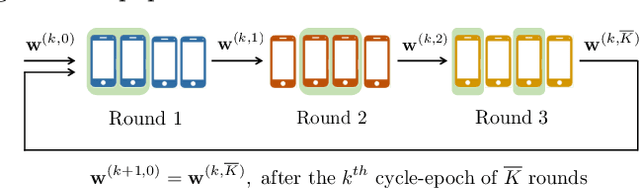
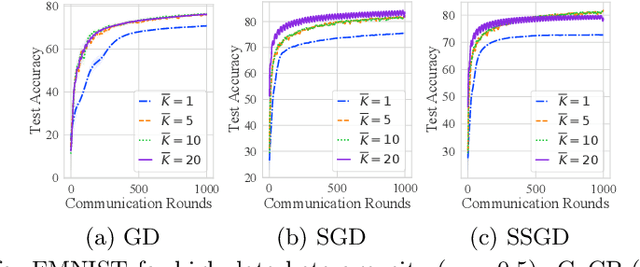
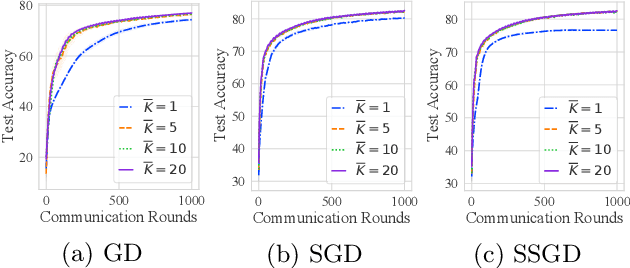
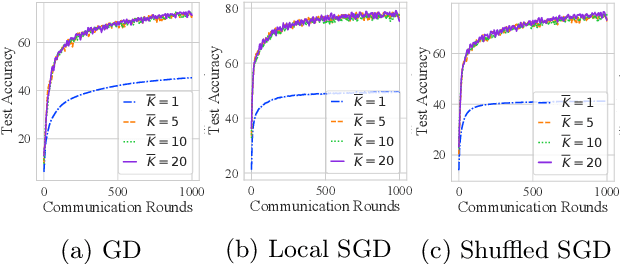
Federated Averaging (FedAvg) and its variants are the most popular optimization algorithms in federated learning (FL). Previous convergence analyses of FedAvg either assume full client participation or partial client participation where the clients can be uniformly sampled. However, in practical cross-device FL systems, only a subset of clients that satisfy local criteria such as battery status, network connectivity, and maximum participation frequency requirements (to ensure privacy) are available for training at a given time. As a result, client availability follows a natural cyclic pattern. We provide (to our knowledge) the first theoretical framework to analyze the convergence of FedAvg with cyclic client participation with several different client optimizers such as GD, SGD, and shuffled SGD. Our analysis discovers that cyclic client participation can achieve a faster asymptotic convergence rate than vanilla FedAvg with uniform client participation under suitable conditions, providing valuable insights into the design of client sampling protocols.
Learning in POMDPs is Sample-Efficient with Hindsight Observability
Feb 03, 2023POMDPs capture a broad class of decision making problems, but hardness results suggest that learning is intractable even in simple settings due to the inherent partial observability. However, in many realistic problems, more information is either revealed or can be computed during some point of the learning process. Motivated by diverse applications ranging from robotics to data center scheduling, we formulate a Hindsight Observable Markov Decision Process (HOMDP) as a POMDP where the latent states are revealed to the learner in hindsight and only during training. We introduce new algorithms for the tabular and function approximation settings that are provably sample-efficient with hindsight observability, even in POMDPs that would otherwise be statistically intractable. We give a lower bound showing that the tabular algorithm is optimal in its dependence on latent state and observation cardinalities.
History-Aware Hierarchical Transformer for Multi-session Open-domain Dialogue System
Feb 02, 2023With the evolution of pre-trained language models, current open-domain dialogue systems have achieved great progress in conducting one-session conversations. In contrast, Multi-Session Conversation (MSC), which consists of multiple sessions over a long term with the same user, is under-investigated. In this paper, we propose History-Aware Hierarchical Transformer (HAHT) for multi-session open-domain dialogue. HAHT maintains a long-term memory of history conversations and utilizes history information to understand current conversation context and generate well-informed and context-relevant responses. Specifically, HAHT first encodes history conversation sessions hierarchically into a history memory. Then, HAHT leverages historical information to facilitate the understanding of the current conversation context by encoding the history memory together with the current context with attention-based mechanisms. Finally, to explicitly utilize historical information, HAHT uses a history-aware response generator that switches between a generic vocabulary and a history-aware vocabulary. Experimental results on a large-scale MSC dataset suggest that the proposed HAHT model consistently outperforms baseline models. Human evaluation results support that HAHT generates more human-like, context-relevant and history-relevant responses than baseline models.
ADAPT: Action-aware Driving Caption Transformer
Feb 01, 2023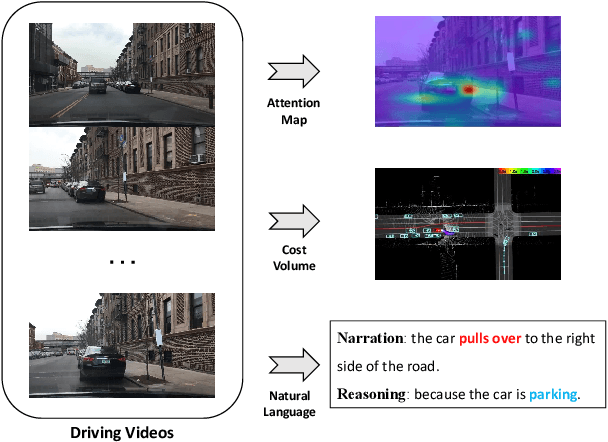
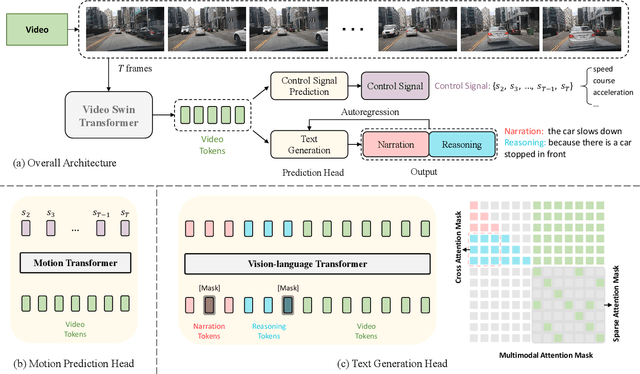


End-to-end autonomous driving has great potential in the transportation industry. However, the lack of transparency and interpretability of the automatic decision-making process hinders its industrial adoption in practice. There have been some early attempts to use attention maps or cost volume for better model explainability which is difficult for ordinary passengers to understand. To bridge the gap, we propose an end-to-end transformer-based architecture, ADAPT (Action-aware Driving cAPtion Transformer), which provides user-friendly natural language narrations and reasoning for each decision making step of autonomous vehicular control and action. ADAPT jointly trains both the driving caption task and the vehicular control prediction task, through a shared video representation. Experiments on BDD-X (Berkeley DeepDrive eXplanation) dataset demonstrate state-of-the-art performance of the ADAPT framework on both automatic metrics and human evaluation. To illustrate the feasibility of the proposed framework in real-world applications, we build a novel deployable system that takes raw car videos as input and outputs the action narrations and reasoning in real time. The code, models and data are available at https://github.com/jxbbb/ADAPT.
Probabilistic Bilevel Coreset Selection
Jan 24, 2023The goal of coreset selection in supervised learning is to produce a weighted subset of data, so that training only on the subset achieves similar performance as training on the entire dataset. Existing methods achieved promising results in resource-constrained scenarios such as continual learning and streaming. However, most of the existing algorithms are limited to traditional machine learning models. A few algorithms that can handle large models adopt greedy search approaches due to the difficulty in solving the discrete subset selection problem, which is computationally costly when coreset becomes larger and often produces suboptimal results. In this work, for the first time we propose a continuous probabilistic bilevel formulation of coreset selection by learning a probablistic weight for each training sample. The overall objective is posed as a bilevel optimization problem, where 1) the inner loop samples coresets and train the model to convergence and 2) the outer loop updates the sample probability progressively according to the model's performance. Importantly, we develop an efficient solver to the bilevel optimization problem via unbiased policy gradient without trouble of implicit differentiation. We provide the convergence property of our training procedure and demonstrate the superiority of our algorithm against various coreset selection methods in various tasks, especially in more challenging label-noise and class-imbalance scenarios.
Model Agnostic Sample Reweighting for Out-of-Distribution Learning
Jan 24, 2023
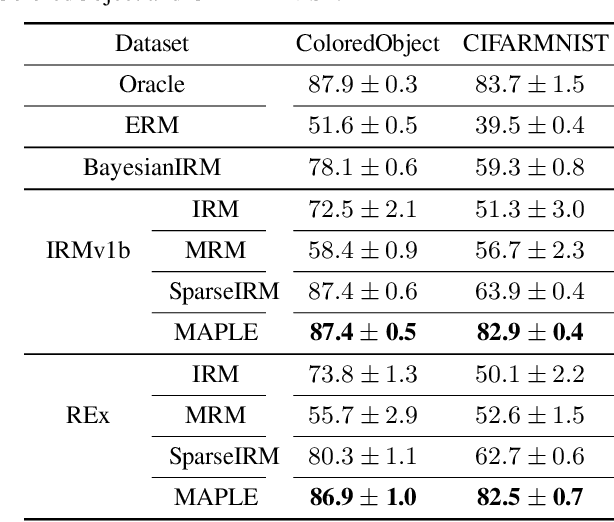
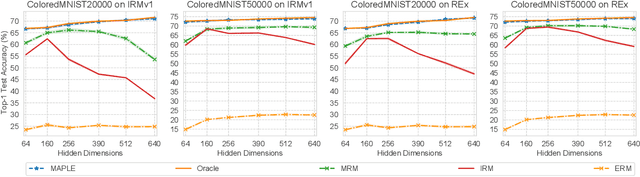
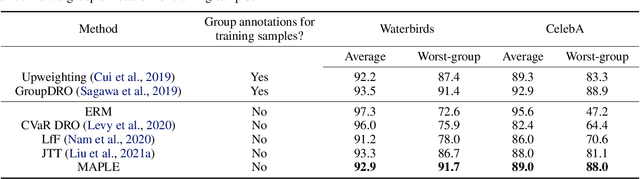
Distributionally robust optimization (DRO) and invariant risk minimization (IRM) are two popular methods proposed to improve out-of-distribution (OOD) generalization performance of machine learning models. While effective for small models, it has been observed that these methods can be vulnerable to overfitting with large overparameterized models. This work proposes a principled method, \textbf{M}odel \textbf{A}gnostic sam\textbf{PL}e r\textbf{E}weighting (\textbf{MAPLE}), to effectively address OOD problem, especially in overparameterized scenarios. Our key idea is to find an effective reweighting of the training samples so that the standard empirical risk minimization training of a large model on the weighted training data leads to superior OOD generalization performance. The overfitting issue is addressed by considering a bilevel formulation to search for the sample reweighting, in which the generalization complexity depends on the search space of sample weights instead of the model size. We present theoretical analysis in linear case to prove the insensitivity of MAPLE to model size, and empirically verify its superiority in surpassing state-of-the-art methods by a large margin. Code is available at \url{https://github.com/x-zho14/MAPLE}.
TempSAL -- Uncovering Temporal Information for Deep Saliency Prediction
Jan 05, 2023Deep saliency prediction algorithms complement the object recognition features, they typically rely on additional information, such as scene context, semantic relationships, gaze direction, and object dissimilarity. However, none of these models consider the temporal nature of gaze shifts during image observation. We introduce a novel saliency prediction model that learns to output saliency maps in sequential time intervals by exploiting human temporal attention patterns. Our approach locally modulates the saliency predictions by combining the learned temporal maps. Our experiments show that our method outperforms the state-of-the-art models, including a multi-duration saliency model, on the SALICON benchmark. Our code will be publicly available on GitHub.
DSI2I: Dense Style for Unpaired Image-to-Image Translation
Dec 29, 2022Unpaired exemplar-based image-to-image (UEI2I) translation aims to translate a source image to a target image domain with the style of a target image exemplar, without ground-truth input-translation pairs. Existing UEI2I methods represent style using either a global, image-level feature vector, or one vector per object instance/class but requiring knowledge of the scene semantics. Here, by contrast, we propose to represent style as a dense feature map, allowing for a finer-grained transfer to the source image without requiring any external semantic information. We then rely on perceptual and adversarial losses to disentangle our dense style and content representations, and exploit unsupervised cross-domain semantic correspondences to warp the exemplar style to the source content. We demonstrate the effectiveness of our method on two datasets using standard metrics together with a new localized style metric measuring style similarity in a class-wise manner. Our results evidence that the translations produced by our approach are more diverse and closer to the exemplars than those of the state-of-the-art methods while nonetheless preserving the source content.
VolRecon: Volume Rendering of Signed Ray Distance Functions for Generalizable Multi-View Reconstruction
Dec 15, 2022


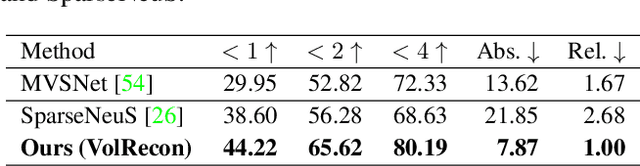
With the success of neural volume rendering in novel view synthesis, neural implicit reconstruction with volume rendering has become popular. However, most methods optimize per-scene functions and are unable to generalize to novel scenes. We introduce VolRecon, a generalizable implicit reconstruction method with Signed Ray Distance Function (SRDF). To reconstruct with fine details and little noise, we combine projection features, aggregated from multi-view features with a view transformer, and volume features interpolated from a coarse global feature volume. A ray transformer computes SRDF values of all the samples along a ray to estimate the surface location, which are used for volume rendering of color and depth. Extensive experiments on DTU and ETH3D demonstrate the effectiveness and generalization ability of our method. On DTU, our method outperforms SparseNeuS by about 30% in sparse view reconstruction and achieves comparable quality as MVSNet in full view reconstruction. Besides, our method shows good generalization ability on the large-scale ETH3D benchmark. Project page: https://fangjinhuawang.github.io/VolRecon.