 Add to Chrome
 Add to Firefox
 Add to Edge
OnlineCache: Learning Dynamic Caching Policies with Error Correction for Efficient Diffusion Inference
Jul 31, 2026
Diffusion models have revolutionized generative tasks but incur high latency due to iterative denoising. While cache-based strategies accelerate inference by reusing intermediate features, they largely rely on static, sample-agnostic schedules. We argue that this rigidity overlooks two facts empirically validated in this paper: (i) generation difficulty varies across prompts, requiring adaptive resource allocation--complex inputs demand more computation while simpler ones require less; (ii) error sensitivity fluctuates across timesteps, where static policies may cache high-error steps or waste computation on low-error ones. We therefore propose OnlineCache, a dynamic caching framework that jointly learns when to cache and how to correct approximation errors. We leverage policy gradient to train a lightweight network for adaptive speed-quality trade-offs, and incorporate a learnable corrector to mitigate caching-induced errors. Both modules are jointly optimized under a bilevel optimization framework, with the policy targeting global generation quality and the corrector minimizing local errors. Our method automatically allocates computational resources across both samples and timesteps, improving overall generation quality. Extensive experiments demonstrate clear superiority. On FLUX.1-dev model, OnlineCache achieves nearly 3 speedup while preserving generation fidelity. On DiT and CogVideoX, it similarly delivers competitive acceleration without compromising quality; across all scenarios, it consistently outperforms existing cache-based acceleration baselines.

LongStraw: Long-Context RL Beyond 2M Tokens under a Fixed GPU Budget
Jul 16, 2026A growing gap separates inference context lengths from RL post-training: inference systems are approaching million-token contexts, while post-training workloads often remain at 256K tokens or below and rely on length generalization at deployment. The gap is especially important for AI agents, whose observations, tool outputs, documents, and prior decisions accumulate over long trajectories. LongStraw is an architecture-aware execution stack for million-token RL post-training under a fixed GPU budget, instantiated with Group Relative Policy Optimization (GRPO). It evaluates the shared prompt without autograd, retains only model-specific state needed by later tokens, and replays short response branches one at a time, reducing the live training graph at the cost of additional replay time. We implement it for the hybrid recurrent and full-attention Qwen3.6-27B and the compressed-attention mixture-of-experts GLM-5.2. On eight H20 GPUs, LongStraw completes grouped Qwen scoring and response backward at 2.1M positions for groups of 2 and 8; increasing the group size adds only 0.21 GB of peak allocated memory, while a separate stress test reaches 4.46M positions. On 32 H20 GPUs, we validate the end-to-end LongStraw execution path for a 2.1M-token prompt across all 78 layers of GLM-5.2. These experiments establish execution capacity rather than complete training correctness because the captured prompt state is detached and some distributed forward and gradient composition paths remain incomplete.
Distill on a Diet: Efficient Knowledge Distillation via Learnable Data Pruning
Jun 24, 2026Knowledge Distillation (KD) is widely used to obtain compact models for efficient inference in resource-constrained environments. Yet the computational overhead of the distillation process itself is often overlooked, raising the question of whether a better student model can be obtained with less data and less compute via data pruning. However, existing data pruning methods are not designed for KD: some introduce substantial overhead, such as obtaining training dynamics through retraining, while others rely on heuristic selection rules that fail to capture what KD actually requires, often resulting in suboptimal subsets. To address these issues, we propose IF-Beta, an efficient data pruning framework that combines influence functions with a learnable sampling policy. Empirically, we first demonstrate that influence functions can serve as an effective and efficient estimator of sample impact in KD settings, where only a pretrained teacher is available. Building on this, our sampling policy is specifically parameterized by a Beta distribution, whose highly flexible two-parameter family allows the policy to adapt to diverse pruning regimes rather than being tied to fixed heuristic forms. Next, we formulate KD pruning as optimizing this policy through a bilevel objective, where the inner loop operates in the teacher feature space with a KD-aligned objective, enabling fast proxy training, while the outer loop updates the policy parameters to maximize distillation performance. This design ensures that IF-Beta is both computationally efficient and inherently aligned with the goals of KD. Extensive experiments on CIFAR-10/100 and ImageNet show that IF-Beta consistently outperforms other baselines across a wide range of pruning ratios. Remarkably, IF-Beta enables students trained on less data and less compute to surpass the performance of students distilled on the full dataset.
Holistic Scaling Laws for Optimal Mixture-of-Experts Architecture Optimization
Mar 23, 2026Scaling laws for Large Language Models govern macroscopic resource allocation, yet translating them into precise Mixture-of-Experts (MoE) architectural configurations remains an open problem due to the combinatorially vast design space. Existing MoE scaling studies are constrained by experimental budgets to either augment scaling formulas with extra MoE variables, risking unreliable fits, or fix all non-MoE factors, ignoring global interactions. We propose a reusable framework for holistic MoE architectural optimization that bridges this gap. We first show that FLOPs per token alone is an inadequate fairness metric for MoE models because differing computational densities across layer types can inflate parameters without proportional compute cost, and establish a joint constraint triad of FLOPs per token, active parameters, and total parameters. We then reduce the 16-dimensional architectural search space to two sequential low-dimensional phases through algebraic constraints and a rank-preserving property of the hidden dimension. Validated across hundreds of MoE models spanning six orders of magnitude in compute, our framework yields robust scaling laws that map any compute budget to a complete, optimal MoE architecture. A key finding is that the near-optimal configuration band widens with scale, giving practitioners quantitative flexibility to balance scaling law recommendations against infrastructure constraints.
Timestep-Aware Block Masking for Efficient Diffusion Model Inference
Mar 20, 2026Diffusion Probabilistic Models (DPMs) have achieved great success in image generation but suffer from high inference latency due to their iterative denoising nature. Motivated by the evolving feature dynamics across the denoising trajectory, we propose a novel framework to optimize the computational graph of pre-trained DPMs on a per-timestep basis. By learning timestep-specific masks, our method dynamically determines which blocks to execute or bypass through feature reuse at each inference stage. Unlike global optimization methods that incur prohibitive memory costs via full-chain backpropagation, our method optimizes masks for each timestep independently, ensuring a memory-efficient training process. To guide this process, we introduce a timestep-aware loss scaling mechanism that prioritizes feature fidelity during sensitive denoising phases, complemented by a knowledge-guided mask rectification strategy to prune redundant spatial-temporal dependencies. Our approach is architecture-agnostic and demonstrates significant efficiency gains across a broad spectrum of models, including DDPM, LDM, DiT, and PixArt. Experimental results show that by treating the denoising process as a sequence of optimized computational paths, our method achieves a superior balance between sampling speed and generative quality. Our code will be released.
AutoQRA: Joint Optimization of Mixed-Precision Quantization and Low-rank Adapters for Efficient LLM Fine-Tuning
Feb 25, 2026Quantization followed by parameter-efficient fine-tuning has emerged as a promising paradigm for downstream adaptation under tight GPU memory constraints. However, this sequential pipeline fails to leverage the intricate interaction between quantization bit-width and LoRA rank. Specifically, a carefully optimized quantization allocation with low quantization error does not always translate to strong fine-tuning performance, and different bit-width and rank configurations can lead to significantly varying outcomes under the same memory budget. To address this limitation, we propose AutoQRA, a joint optimization framework that simultaneously optimizes the bit-width and LoRA rank configuration for each layer during the mixed quantized fine-tuning process. To tackle the challenges posed by the large discrete search space and the high evaluation cost associated with frequent fine-tuning iterations, AutoQRA decomposes the optimization process into two stages. First, it first conducts a global multi-fidelity evolutionary search, where the initial population is warm-started by injecting layer-wise importance priors. This stage employs specific operators and a performance model to efficiently screen candidate configurations. Second, trust-region Bayesian optimization is applied to locally refine promising regions of the search space and identify optimal configurations under the given memory budget. This approach enables active compensation for quantization noise in specific layers during training. Experiments show that AutoQRA achieves performance close to full-precision fine-tuning with a memory footprint comparable to uniform 4-bit methods.
Investigating Data Pruning for Pretraining Biological Foundation Models at Scale
Dec 15, 2025Biological foundation models (BioFMs), pretrained on large-scale biological sequences, have recently shown strong potential in providing meaningful representations for diverse downstream bioinformatics tasks. However, such models often rely on millions to billions of training sequences and billions of parameters, resulting in prohibitive computational costs and significant barriers to reproducibility and accessibility, particularly for academic labs. To address these challenges, we investigate the feasibility of data pruning for BioFM pretraining and propose a post-hoc influence-guided data pruning framework tailored to biological domains. Our approach introduces a subset-based self-influence formulation that enables efficient estimation of sample importance at low computational cost, and builds upon it two simple yet effective selection strategies, namely Top-k Influence (Top I) and Coverage-Centric Influence (CCI). We empirically validate our method on two representative BioFMs, RNA-FM and ESM-C. For RNA, our framework consistently outperforms random selection baselines under an extreme pruning rate of over 99 percent, demonstrating its effectiveness. Furthermore, we show the generalizability of our framework on protein-related tasks using ESM-C. In particular, our coreset even outperforms random subsets that are ten times larger in both RNA and protein settings, revealing substantial redundancy in biological sequence datasets. These findings underscore the potential of influence-guided data pruning to substantially reduce the computational cost of BioFM pretraining, paving the way for more efficient, accessible, and sustainable biological AI research.
Explore and Establish Synergistic Effects Between Weight Pruning and Coreset Selection in Neural Network Training
Nov 17, 2025Modern deep neural networks rely heavily on massive model weights and training samples, incurring substantial computational costs. Weight pruning and coreset selection are two emerging paradigms proposed to improve computational efficiency. In this paper, we first explore the interplay between redundant weights and training samples through a transparent analysis: redundant samples, particularly noisy ones, cause model weights to become unnecessarily overtuned to fit them, complicating the identification of irrelevant weights during pruning; conversely, irrelevant weights tend to overfit noisy data, undermining coreset selection effectiveness. To further investigate and harness this interplay in deep learning, we develop a Simultaneous Weight and Sample Tailoring mechanism (SWaST) that alternately performs weight pruning and coreset selection to establish a synergistic effect in training. During this investigation, we observe that when simultaneously removing a large number of weights and samples, a phenomenon we term critical double-loss can occur, where important weights and their supportive samples are mistakenly eliminated at the same time, leading to model instability and nearly irreversible degradation that cannot be recovered in subsequent training. Unlike classic machine learning models, this issue can arise in deep learning due to the lack of theoretical guarantees on the correctness of weight pruning and coreset selection, which explains why these paradigms are often developed independently. We mitigate this by integrating a state preservation mechanism into SWaST, enabling stable joint optimization. Extensive experiments reveal a strong synergy between pruning and coreset selection across varying prune rates and coreset sizes, delivering accuracy boosts of up to 17.83% alongside 10% to 90% FLOPs reductions.
Advanced Black-Box Tuning of Large Language Models with Limited API Calls
Nov 17, 2025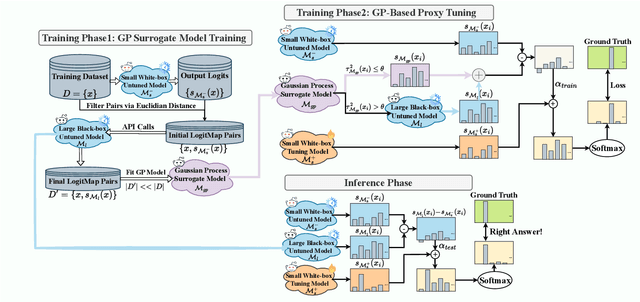
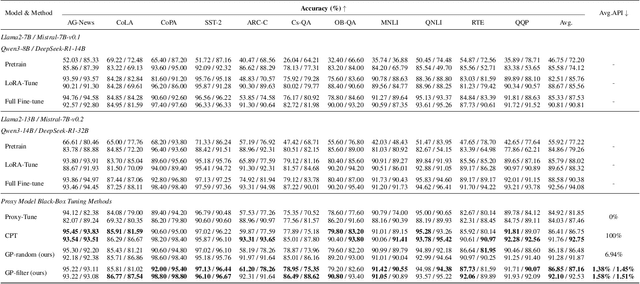

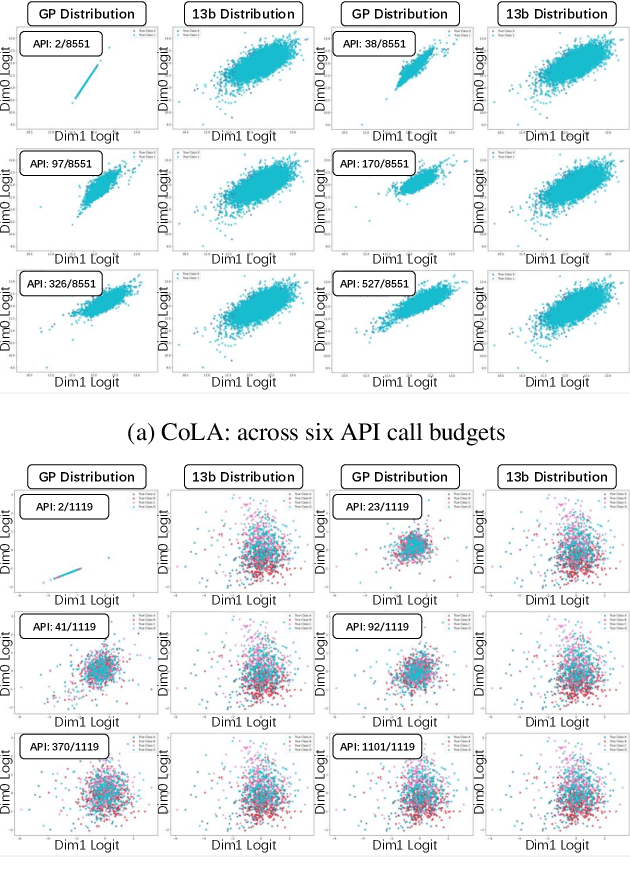
Black-box tuning is an emerging paradigm for adapting large language models (LLMs) to better achieve desired behaviors, particularly when direct access to model parameters is unavailable. Current strategies, however, often present a dilemma of suboptimal extremes: either separately train a small proxy model and then use it to shift the predictions of the foundation model, offering notable efficiency but often yielding limited improvement; or making API calls in each tuning iteration to the foundation model, which entails prohibitive computational costs. Therefore, we propose a novel advanced black-box tuning method for LLMs with limited API calls. Our core strategy involves training a Gaussian Process (GP) surrogate model with "LogitMap Pairs" derived from querying the foundation model on a minimal but highly informative training subset. This surrogate can approximate the outputs of the foundation model to guide the training of the proxy model, thereby effectively reducing the need for direct queries to the foundation model. Extensive experiments verify that our approach elevates pre-trained language model accuracy from 55.92% to 86.85%, reducing the frequency of API queries to merely 1.38%. This significantly outperforms offline approaches that operate entirely without API access. Notably, our method also achieves comparable or superior accuracy to query-intensive approaches, while significantly reducing API costs. This offers a robust and high-efficiency paradigm for language model adaptation.
Towards Robust Influence Functions with Flat Validation Minima
May 25, 2025The Influence Function (IF) is a widely used technique for assessing the impact of individual training samples on model predictions. However, existing IF methods often fail to provide reliable influence estimates in deep neural networks, particularly when applied to noisy training data. This issue does not stem from inaccuracies in parameter change estimation, which has been the primary focus of prior research, but rather from deficiencies in loss change estimation, specifically due to the sharpness of validation risk. In this work, we establish a theoretical connection between influence estimation error, validation set risk, and its sharpness, underscoring the importance of flat validation minima for accurate influence estimation. Furthermore, we introduce a novel estimation form of Influence Function specifically designed for flat validation minima. Experimental results across various tasks validate the superiority of our approach.