 Add to Chrome
 Add to Firefox
 Add to Edge
TAIJI: MCP-based Multi-Modal Data Analytics on Data Lakes
May 16, 2025
The variety of data in data lakes presents significant challenges for data analytics, as data scientists must simultaneously analyze multi-modal data, including structured, semi-structured, and unstructured data. While Large Language Models (LLMs) have demonstrated promising capabilities, they still remain inadequate for multi-modal data analytics in terms of accuracy, efficiency, and freshness. First, current natural language (NL) or SQL-like query languages may struggle to precisely and comprehensively capture users' analytical intent. Second, relying on a single unified LLM to process diverse data modalities often leads to substantial inference overhead. Third, data stored in data lakes may be incomplete or outdated, making it essential to integrate external open-domain knowledge to generate timely and relevant analytics results. In this paper, we envision a new multi-modal data analytics system. Specifically, we propose a novel architecture built upon the Model Context Protocol (MCP), an emerging paradigm that enables LLMs to collaborate with knowledgeable agents. First, we define a semantic operator hierarchy tailored for querying multi-modal data in data lakes and develop an AI-agent-powered NL2Operator translator to bridge user intent and analytical execution. Next, we introduce an MCP-based execution framework, in which each MCP server hosts specialized foundation models optimized for specific data modalities. This design enhances both accuracy and efficiency, while supporting high scalability through modular deployment. Finally, we propose a updating mechanism by harnessing the deep research and machine unlearning techniques to refresh the data lakes and LLM knowledges, with the goal of balancing the data freshness and inference efficiency.

PDE: Gene Effect Inspired Parameter Dynamic Evolution for Low-light Image Enhancement
May 14, 2025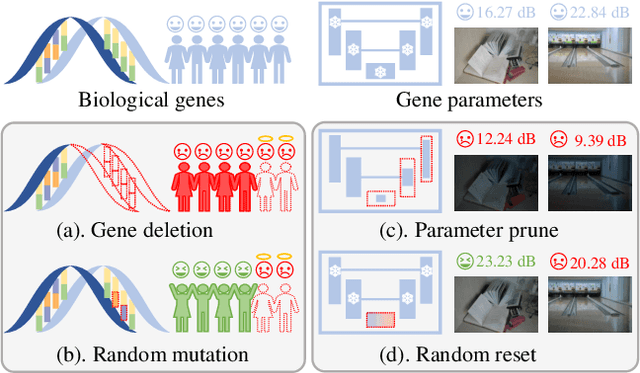
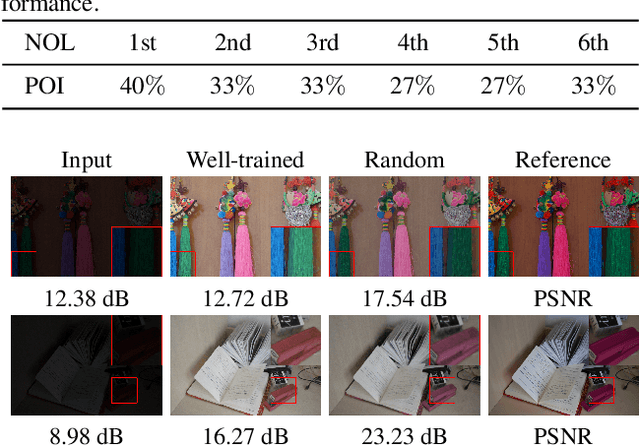
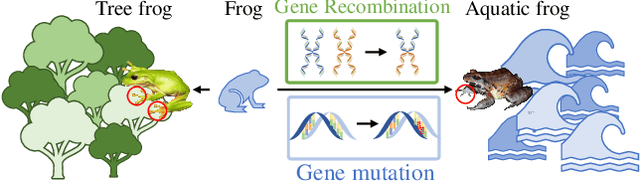
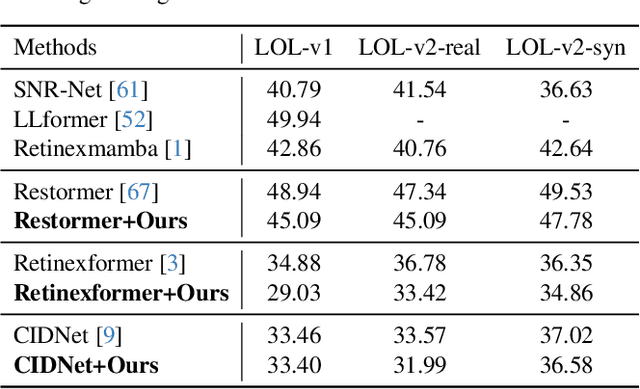
Low-light image enhancement (LLIE) is a fundamental task in computational photography, aiming to improve illumination, reduce noise, and enhance image quality. While recent advancements focus on designing increasingly complex neural network models, we observe a peculiar phenomenon: resetting certain parameters to random values unexpectedly improves enhancement performance for some images. Drawing inspiration from biological genes, we term this phenomenon the gene effect. The gene effect limits enhancement performance, as even random parameters can sometimes outperform learned ones, preventing models from fully utilizing their capacity. In this paper, we investigate the reason and propose a solution. Based on our observations, we attribute the gene effect to static parameters, analogous to how fixed genetic configurations become maladaptive when environments change. Inspired by biological evolution, where adaptation to new environments relies on gene mutation and recombination, we propose parameter dynamic evolution (PDE) to adapt to different images and mitigate the gene effect. PDE employs a parameter orthogonal generation technique and the corresponding generated parameters to simulate gene recombination and gene mutation, separately. Experiments validate the effectiveness of our techniques. The code will be released to the public.
Traceback of Poisoning Attacks to Retrieval-Augmented Generation
Apr 30, 2025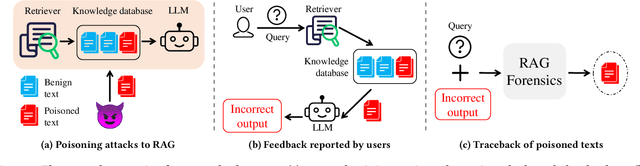
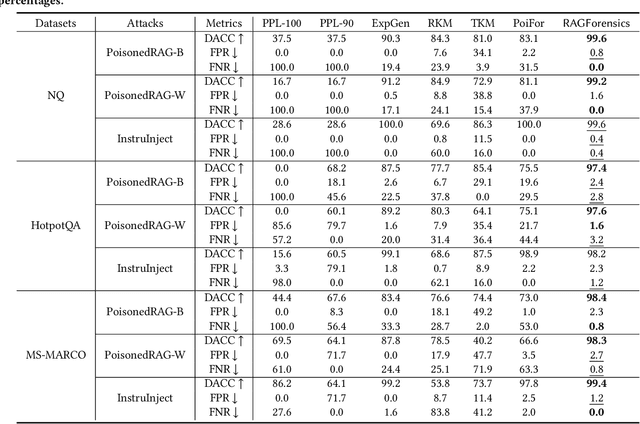
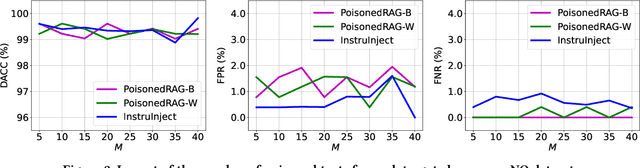
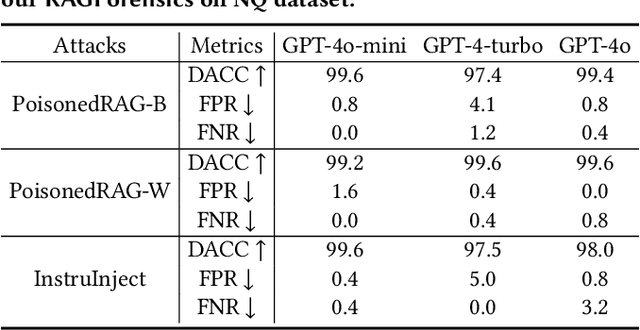
Large language models (LLMs) integrated with retrieval-augmented generation (RAG) systems improve accuracy by leveraging external knowledge sources. However, recent research has revealed RAG's susceptibility to poisoning attacks, where the attacker injects poisoned texts into the knowledge database, leading to attacker-desired responses. Existing defenses, which predominantly focus on inference-time mitigation, have proven insufficient against sophisticated attacks. In this paper, we introduce RAGForensics, the first traceback system for RAG, designed to identify poisoned texts within the knowledge database that are responsible for the attacks. RAGForensics operates iteratively, first retrieving a subset of texts from the database and then utilizing a specially crafted prompt to guide an LLM in detecting potential poisoning texts. Empirical evaluations across multiple datasets demonstrate the effectiveness of RAGForensics against state-of-the-art poisoning attacks. This work pioneers the traceback of poisoned texts in RAG systems, providing a practical and promising defense mechanism to enhance their security.
A Survey of Large Language Model-Powered Spatial Intelligence Across Scales: Advances in Embodied Agents, Smart Cities, and Earth Science
Apr 14, 2025Over the past year, the development of large language models (LLMs) has brought spatial intelligence into focus, with much attention on vision-based embodied intelligence. However, spatial intelligence spans a broader range of disciplines and scales, from navigation and urban planning to remote sensing and earth science. What are the differences and connections between spatial intelligence across these fields? In this paper, we first review human spatial cognition and its implications for spatial intelligence in LLMs. We then examine spatial memory, knowledge representations, and abstract reasoning in LLMs, highlighting their roles and connections. Finally, we analyze spatial intelligence across scales -- from embodied to urban and global levels -- following a framework that progresses from spatial memory and understanding to spatial reasoning and intelligence. Through this survey, we aim to provide insights into interdisciplinary spatial intelligence research and inspire future studies.
Practical Poisoning Attacks against Retrieval-Augmented Generation
Apr 04, 2025Large language models (LLMs) have demonstrated impressive natural language processing abilities but face challenges such as hallucination and outdated knowledge. Retrieval-Augmented Generation (RAG) has emerged as a state-of-the-art approach to mitigate these issues. While RAG enhances LLM outputs, it remains vulnerable to poisoning attacks. Recent studies show that injecting poisoned text into the knowledge database can compromise RAG systems, but most existing attacks assume that the attacker can insert a sufficient number of poisoned texts per query to outnumber correct-answer texts in retrieval, an assumption that is often unrealistic. To address this limitation, we propose CorruptRAG, a practical poisoning attack against RAG systems in which the attacker injects only a single poisoned text, enhancing both feasibility and stealth. Extensive experiments across multiple datasets demonstrate that CorruptRAG achieves higher attack success rates compared to existing baselines.
Can Large Language Models Identify Implicit Suicidal Ideation? An Empirical Evaluation
Feb 25, 2025We present a comprehensive evaluation framework for assessing Large Language Models' (LLMs) capabilities in suicide prevention, focusing on two critical aspects: the Identification of Implicit Suicidal ideation (IIS) and the Provision of Appropriate Supportive responses (PAS). We introduce \ourdata, a novel dataset of 1,308 test cases built upon psychological frameworks including D/S-IAT and Negative Automatic Thinking, alongside real-world scenarios. Through extensive experiments with 8 widely used LLMs under different contextual settings, we find that current models struggle significantly with detecting implicit suicidal ideation and providing appropriate support, highlighting crucial limitations in applying LLMs to mental health contexts. Our findings underscore the need for more sophisticated approaches in developing and evaluating LLMs for sensitive psychological applications.
An Aspect Performance-aware Hypergraph Neural Network for Review-based Recommendation
Jan 26, 2025Online reviews allow consumers to provide detailed feedback on various aspects of items. Existing methods utilize these aspects to model users' fine-grained preferences for specific item features through graph neural networks. We argue that the performance of items on different aspects is important for making precise recommendations, which has not been taken into account by existing approaches, due to lack of data. In this paper, we propose an aspect performance-aware hypergraph neural network (APH) for the review-based recommendation, which learns the performance of items from the conflicting sentiment polarity of user reviews. Specifically, APH comprehensively models the relationships among users, items, aspects, and sentiment polarity by systematically constructing an aspect hypergraph based on user reviews. In addition, APH aggregates aspects representing users and items by employing an aspect performance-aware hypergraph aggregation method. It aggregates the sentiment polarities from multiple users by jointly considering user preferences and the semantics of their sentiments, determining the weights of sentiment polarities to infer the performance of items on various aspects. Such performances are then used as weights to aggregate neighboring aspects. Experiments on six real-world datasets demonstrate that APH improves MSE, Precision@5, and Recall@5 by an average of 2.30%, 4.89%, and 1.60% over the best baseline. The source code and data are available at https://github.com/dianziliu/APH.
SOP-Agent: Empower General Purpose AI Agent with Domain-Specific SOPs
Jan 16, 2025Despite significant advancements in general-purpose AI agents, several challenges still hinder their practical application in real-world scenarios. First, the limited planning capabilities of Large Language Models (LLM) restrict AI agents from effectively solving complex tasks that require long-horizon planning. Second, general-purpose AI agents struggle to efficiently utilize domain-specific knowledge and human expertise. In this paper, we introduce the Standard Operational Procedure-guided Agent (SOP-agent), a novel framework for constructing domain-specific agents through pseudocode-style Standard Operational Procedures (SOPs) written in natural language. Formally, we represent a SOP as a decision graph, which is traversed to guide the agent in completing tasks specified by the SOP. We conduct extensive experiments across tasks in multiple domains, including decision-making, search and reasoning, code generation, data cleaning, and grounded customer service. The SOP-agent demonstrates excellent versatility, achieving performance superior to general-purpose agent frameworks and comparable to domain-specific agent systems. Additionally, we introduce the Grounded Customer Service Benchmark, the first benchmark designed to evaluate the grounded decision-making capabilities of AI agents in customer service scenarios based on SOPs.
Positive2Negative: Breaking the Information-Lossy Barrier in Self-Supervised Single Image Denoising
Dec 21, 2024


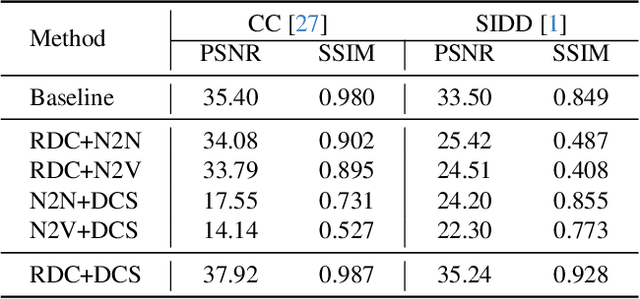
Image denoising enhances image quality, serving as a foundational technique across various computational photography applications. The obstacle to clean image acquisition in real scenarios necessitates the development of self-supervised image denoising methods only depending on noisy images, especially a single noisy image. Existing self-supervised image denoising paradigms (Noise2Noise and Noise2Void) rely heavily on information-lossy operations, such as downsampling and masking, culminating in low quality denoising performance. In this paper, we propose a novel self-supervised single image denoising paradigm, Positive2Negative, to break the information-lossy barrier. Our paradigm involves two key steps: Renoised Data Construction (RDC) and Denoised Consistency Supervision (DCS). RDC renoises the predicted denoised image by the predicted noise to construct multiple noisy images, preserving all the information of the original image. DCS ensures consistency across the multiple denoised images, supervising the network to learn robust denoising. Our Positive2Negative paradigm achieves state-of-the-art performance in self-supervised single image denoising with significant speed improvements. The code will be released to the public.
Rethinking Model Redundancy for Low-light Image Enhancement
Dec 21, 2024Low-light image enhancement (LLIE) is a fundamental task in computational photography, aiming to improve illumination, reduce noise, and enhance the image quality of low-light images. While recent advancements primarily focus on customizing complex neural network models, we have observed significant redundancy in these models, limiting further performance improvement. In this paper, we investigate and rethink the model redundancy for LLIE, identifying parameter harmfulness and parameter uselessness. Inspired by the rethinking, we propose two innovative techniques to mitigate model redundancy while improving the LLIE performance: Attention Dynamic Reallocation (ADR) and Parameter Orthogonal Generation (POG). ADR dynamically reallocates appropriate attention based on original attention, thereby mitigating parameter harmfulness. POG learns orthogonal basis embeddings of parameters and prevents degradation to static parameters, thereby mitigating parameter uselessness. Experiments validate the effectiveness of our techniques. We will release the code to the public.