 Add to Chrome
 Add to Firefox
 Add to Edge
OpenComputer: Verifiable Software Worlds for Computer-Use Agents
May 19, 2026
We present OpenComputer, a verifier-grounded framework for constructing verifiable software worlds for computer-use agents. OpenComputer integrates four components: (1) app-specific state verifiers that expose structured inspection endpoints over real applications, (2) a self-evolving verification layer that improves verifier reliability using execution-grounded feedback, (3) a task-generation pipeline that synthesizes realistic and machine-checkable desktop tasks, and (4) an evaluation harness that records full trajectories and computes auditable partial-credit rewards. In its current form, OpenComputer covers 33 desktop applications and 1,000 finalized tasks spanning browsers, office tools, creative software, development environments, file managers, and communication applications. Experiments show that OpenComputer's hard-coded verifiers align more closely with human adjudication than LLM-as-judge evaluation, especially when success depends on fine-grained application state. Frontier agents struggle with end-to-end completion despite partial progress, and open-source models exhibit sharp drops from their OSWorld-Verified scores, exposing a persistent gap in robust computer automation.

Open-Sora 2.0: Training a Commercial-Level Video Generation Model in $200k
Mar 12, 2025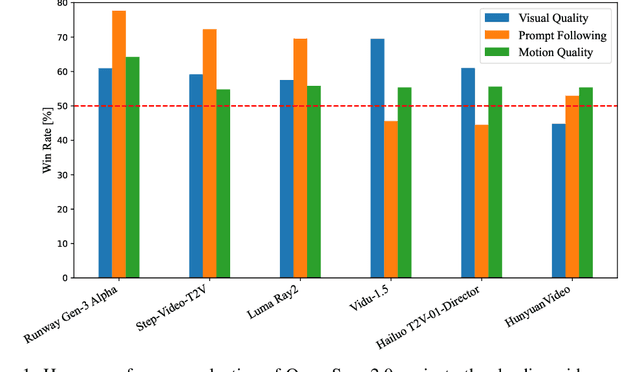
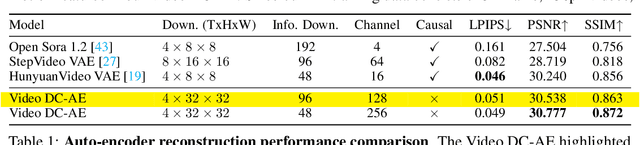
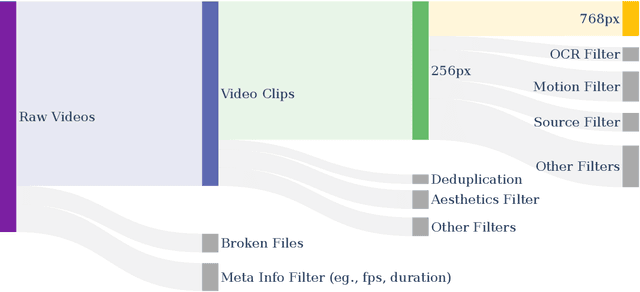

Video generation models have achieved remarkable progress in the past year. The quality of AI video continues to improve, but at the cost of larger model size, increased data quantity, and greater demand for training compute. In this report, we present Open-Sora 2.0, a commercial-level video generation model trained for only $200k. With this model, we demonstrate that the cost of training a top-performing video generation model is highly controllable. We detail all techniques that contribute to this efficiency breakthrough, including data curation, model architecture, training strategy, and system optimization. According to human evaluation results and VBench scores, Open-Sora 2.0 is comparable to global leading video generation models including the open-source HunyuanVideo and the closed-source Runway Gen-3 Alpha. By making Open-Sora 2.0 fully open-source, we aim to democratize access to advanced video generation technology, fostering broader innovation and creativity in content creation. All resources are publicly available at: https://github.com/hpcaitech/Open-Sora.
SOP-Agent: Empower General Purpose AI Agent with Domain-Specific SOPs
Jan 16, 2025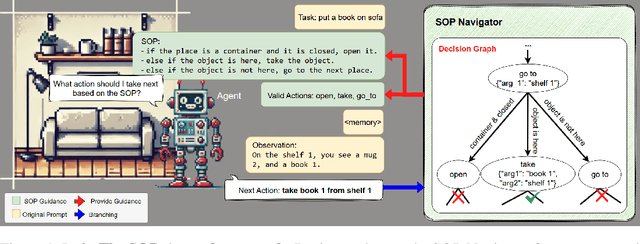
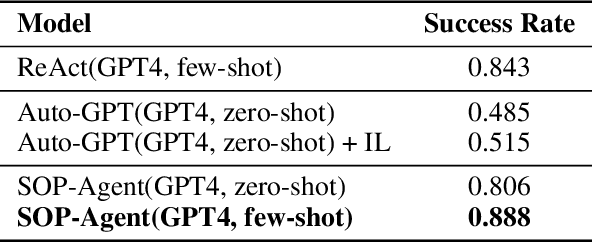
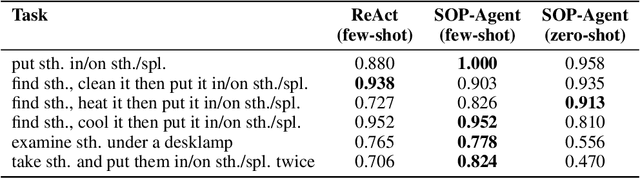
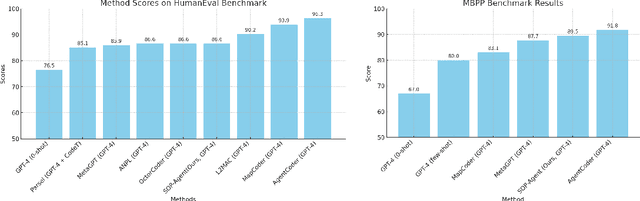
Despite significant advancements in general-purpose AI agents, several challenges still hinder their practical application in real-world scenarios. First, the limited planning capabilities of Large Language Models (LLM) restrict AI agents from effectively solving complex tasks that require long-horizon planning. Second, general-purpose AI agents struggle to efficiently utilize domain-specific knowledge and human expertise. In this paper, we introduce the Standard Operational Procedure-guided Agent (SOP-agent), a novel framework for constructing domain-specific agents through pseudocode-style Standard Operational Procedures (SOPs) written in natural language. Formally, we represent a SOP as a decision graph, which is traversed to guide the agent in completing tasks specified by the SOP. We conduct extensive experiments across tasks in multiple domains, including decision-making, search and reasoning, code generation, data cleaning, and grounded customer service. The SOP-agent demonstrates excellent versatility, achieving performance superior to general-purpose agent frameworks and comparable to domain-specific agent systems. Additionally, we introduce the Grounded Customer Service Benchmark, the first benchmark designed to evaluate the grounded decision-making capabilities of AI agents in customer service scenarios based on SOPs.