 Add to Chrome
 Add to Firefox
 Add to Edge
Is Per-Agent Policy Composition Safe? Rethinking Successor-Feature Transfer in Cooperative Multi-Agent Reinforcement Learning
Aug 12, 2026
Many reinforcement learning systems, from fleet management to traffic signal control, must serve an objective that changes dynamically after deployment, and retraining a policy for each new objective is prohibitively expensive. For a single agent, this problem is well understood: successor features with generalized policy improvement, together with their universal extension, recombine a library of learned policies into a policy for any new objective, with a guarantee that the result is never worse than any policy in the library. However, multi-agent transfer has received far less attention, and the common practice of letting each agent recombine its own library independently inherits the recipe but not the guarantee. We prove that this independent composition can produce joint behavior strictly worse than every policy in the library, because recombining teammates changes the environment each agent faces and invalidates the values it relies on, a failure with no single-agent counterpart. We further show that the only unconditionally safe fixed rule is synchronized composition, which moves the whole team to one jointly trained policy but cannot serve objectives that assign different goals to different agents. To attain safety and flexibility at once, we propose MA-USFA, a hierarchical method with two layers: a lower layer of universal successor feature approximators that predicts each agent's successor features while conditioned on its teammates' objectives, and an upper composer that selects, across agents, which library entry each agent should follow and supplies the cross-agent correction a per-agent value cannot represent. Trained once over the distribution of objectives, it is applied at deployment with no per-task adaptation.

Low-Interaction-Rank Learning: Unifying Multiplicative Dual-Encoder Heads
Aug 12, 2026A multiplicative dual-encoder network computes a real-valued output for a pair of inputs as the inner product of their separate encodings. This architecture has been developed independently in operator learning, bipartite matching, contrastive vision-language models, retrieval, and other areas, yet no unified theory guides the basic design decisions: how many interaction modes to represent, how to normalize the encoders, and when the architecture should be avoided. We provide such a foundation by introducing the class of functions of low interaction rank, a class whose intrinsic complexity is measured by its interaction spectrum. Within this framework, approximation error decomposes into a spectral truncation term and an encoder-realization term; sample complexity is governed by the sum of the two encoder complexities rather than their product; and a usability criterion based on spectral decay determines when the architecture can succeed. The same framework exposes a central identifiability problem: the encoders are defined only up to a linear gauge symmetry that leaves the learned coordinates arbitrary. We show that normalization is gauge fixing and that whitening pins the interaction modes up to permutation and sign, thereby explaining the uninterpretability of contrastive dimensions and providing a constructive remedy. Experiments on synthetic kernels, operator learning, and CLIP models validate the theoretical predictions: spectral decay rates match the predicted scaling, whitening recovers the true modes, and independently trained CLIP models are related by a single rotation which, after removal by whitening, exposes interpretable concept axes. The code of this paper is provided at https://github.com/RS2002/Mul-Net .
Aggregate in the Advantage, Not the Ratio: A Canonical-Form Analysis of Cooperative Multi-Agent Policy Optimization
Jul 20, 2026Multi-agent policy optimization, exemplified by PPO-based methods, is a key branch of cooperative Multi-Agent Reinforcement Learning (MARL). A central design question is how many neighboring agents\footnote{In this paper, "neighbors" refer not only to physical proximity but also to agents whose actions influence one another.} to aggregate in order to effectively utilize global information for cooperation. This decision must be made along two dimensions: in the advantage (which agents' rewards contribute to the credit signal) and in the ratio (which agents' likelihood ratios form the clipped importance weight). Existing methods occupy scattered, underexplored points on these two axes: IPPO treats both separately; MAPPO pairs a team-level advantage with per-agent ratios; HAPPO employs sequential ratios with per-agent advantages; and single-agent reductions operating on factorized joint policies aggregate both into fully joint products. We formalize these two design choices as support matrices $\SA$ and $\SR$, and prove a canonical structure: the expected multi-agent policy optimization objective depends on the pair $(\SA,\SR)$ only through their matrix product $\tS=\SR\SA$. This yields two key consequences: (i) Redundancy: the two support matrices are interchangeable with respect to the signal, meaning neither aggregation pattern is inherently superior.(ii) Variance Ordering: the advantage aggregates rewards as a sum (additive variance with an interior bias-variance optimum at the coupling neighborhood), whereas the ratio aggregates likelihood ratios as a product (multiplicative variance that grows exponentially with support size, with no accompanying bias reduction). The resulting design principle is unambiguous: aggregate neighbors in the advantage, sized to the coupling neighborhood, and keep the ratio per-agent.
Stage Light is Sequence$^2$: Multi-Light Control via Imitation Learning
May 05, 2026Music-inspired Automatic Stage Lighting Control (ASLC) has gained increasing attention in recent years due to the substantial time and financial costs associated with hiring and training professional lighting engineers. However, existing methods suffer from several notable limitations: the low interpretability of rule-based approaches, the restriction to single-primary-light control in music-to-color-space methods, and the limited transferability of music-to-controlling-parameter frameworks. To address these gaps, we propose SeqLight, a hierarchical deep learning framework that maps music to multi-light Hue-Saturation-Value (HSV) space. Our approach first customizes SkipBART, an end-to-end single primary light generation model, to predict the full light color distribution for each frame, followed by hybrid Imitation Learning (IL) techniques to derive an effective decomposition strategy that distributes the global color distribution among individual lights. Notably, the light decomposition module can be trained under varying venue-specific lighting configurations using only mixed light data and no professional demonstrations, thereby flexibly adapting across diverse venues. In this stage, we formulate the light decomposition task as a Goal-Conditioned Markov Decision Process (GCMDP), construct an expert demonstration set inspired by Hindsight Experience Replay (HER), and introduce a three-phase IL training pipeline, achieving strong generalization capability. To validate our IL solution for the proposed GCMDP, we conduct a series of quantitative analysis and human study. The code and trained models are provided at https://github.com/RS2002/SeqLight .
Bridging MARL to SARL: An Order-Independent Multi-Agent Transformer via Latent Consensus
Apr 15, 2026Cooperative multi-agent reinforcement learning (MARL) is widely used to address large joint observation and action spaces by decomposing a centralized control problem into multiple interacting agents. However, such decomposition often introduces additional challenges, including non-stationarity, unstable training, weak coordination, and limited theoretical guarantees. In this paper, we propose the Consensus Multi-Agent Transformer (CMAT), a centralized framework that bridges cooperative MARL to a hierarchical single-agent reinforcement learning (SARL) formulation. CMAT treats all agents as a unified entity and employs a Transformer encoder to process the large joint observation space. To handle the extensive joint action space, we introduce a hierarchical decision-making mechanism in which a Transformer decoder autoregressively generates a high-level consensus vector, simulating the process by which agents reach agreement on their strategies in latent space. Conditioned on this consensus, all agents generate their actions simultaneously, enabling order-independent joint decision making and avoiding the sensitivity to action-generation order in conventional Multi-Agent Transformers (MAT). This factorization allows the joint policy to be optimized using single-agent PPO while preserving expressive coordination through the latent consensus. To evaluate the proposed method, we conduct experiments on benchmark tasks from StarCraft II, Multi-Agent MuJoCo, and Google Research Football. The results show that CMAT achieves superior performance over recent centralized solutions, sequential MARL methods, and conventional MARL baselines. The code for this paper is available at:https://github.com/RS2002/CMAT .
Pushing the Boundaries of Natural Reasoning: Interleaved Bonus from Formal-Logic Verification
Jan 30, 2026Large Language Models (LLMs) show remarkable capabilities, yet their stochastic next-token prediction creates logical inconsistencies and reward hacking that formal symbolic systems avoid. To bridge this gap, we introduce a formal logic verification-guided framework that dynamically interleaves formal symbolic verification with the natural language generation process, providing real-time feedback to detect and rectify errors as they occur. Distinguished from previous neuro-symbolic methods limited by passive post-hoc validation, our approach actively penalizes intermediate fallacies during the reasoning chain. We operationalize this framework via a novel two-stage training pipeline that synergizes formal logic verification-guided supervised fine-tuning and policy optimization. Extensive evaluation on six benchmarks spanning mathematical, logical, and general reasoning demonstrates that our 7B and 14B models outperform state-of-the-art baselines by average margins of 10.4% and 14.2%, respectively. These results validate that formal verification can serve as a scalable mechanism to significantly push the performance boundaries of advanced LLM reasoning.
AutoFed: Manual-Free Federated Traffic Prediction via Personalized Prompt
Dec 31, 2025Accurate traffic prediction is essential for Intelligent Transportation Systems, including ride-hailing, urban road planning, and vehicle fleet management. However, due to significant privacy concerns surrounding traffic data, most existing methods rely on local training, resulting in data silos and limited knowledge sharing. Federated Learning (FL) offers an efficient solution through privacy-preserving collaborative training; however, standard FL struggles with the non-independent and identically distributed (non-IID) problem among clients. This challenge has led to the emergence of Personalized Federated Learning (PFL) as a promising paradigm. Nevertheless, current PFL frameworks require further adaptation for traffic prediction tasks, such as specialized graph feature engineering, data processing, and network architecture design. A notable limitation of many prior studies is their reliance on hyper-parameter optimization across datasets-information that is often unavailable in real-world scenarios-thus impeding practical deployment. To address this challenge, we propose AutoFed, a novel PFL framework for traffic prediction that eliminates the need for manual hyper-parameter tuning. Inspired by prompt learning, AutoFed introduces a federated representor that employs a client-aligned adapter to distill local data into a compact, globally shared prompt matrix. This prompt then conditions a personalized predictor, allowing each client to benefit from cross-client knowledge while maintaining local specificity. Extensive experiments on real-world datasets demonstrate that AutoFed consistently achieves superior performance across diverse scenarios. The code of this paper is provided at https://github.com/RS2002/AutoFed .
Zero-Effort Image-to-Music Generation: An Interpretable RAG-based VLM Approach
Sep 26, 2025Recently, Image-to-Music (I2M) generation has garnered significant attention, with potential applications in fields such as gaming, advertising, and multi-modal art creation. However, due to the ambiguous and subjective nature of I2M tasks, most end-to-end methods lack interpretability, leaving users puzzled about the generation results. Even methods based on emotion mapping face controversy, as emotion represents only a singular aspect of art. Additionally, most learning-based methods require substantial computational resources and large datasets for training, hindering accessibility for common users. To address these challenges, we propose the first Vision Language Model (VLM)-based I2M framework that offers high interpretability and low computational cost. Specifically, we utilize ABC notation to bridge the text and music modalities, enabling the VLM to generate music using natural language. We then apply multi-modal Retrieval-Augmented Generation (RAG) and self-refinement techniques to allow the VLM to produce high-quality music without external training. Furthermore, we leverage the generated motivations in text and the attention maps from the VLM to provide explanations for the generated results in both text and image modalities. To validate our method, we conduct both human studies and machine evaluations, where our method outperforms others in terms of music quality and music-image consistency, indicating promising results. Our code is available at https://github.com/RS2002/Image2Music .
Each to Their Own: Exploring the Optimal Embedding in RAG
Jul 23, 2025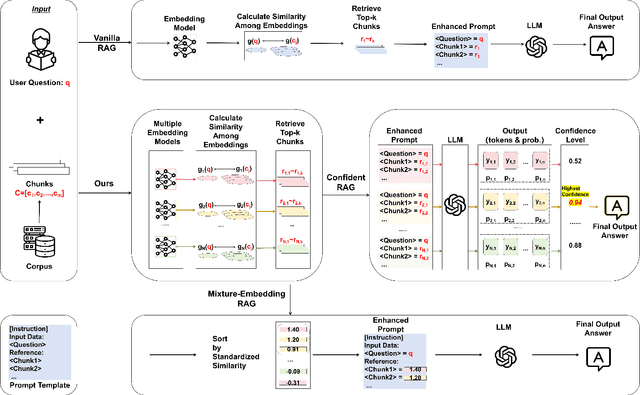
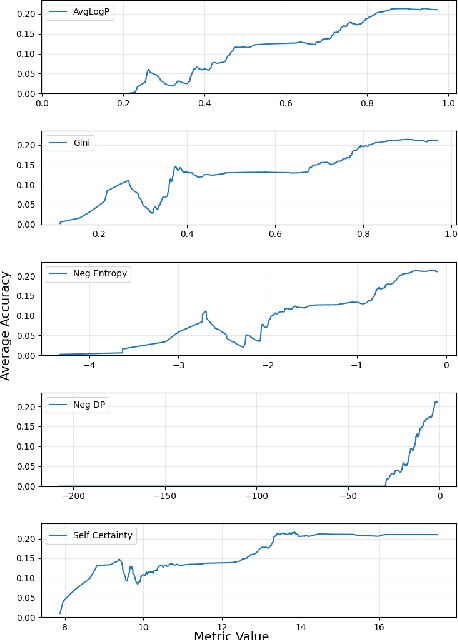
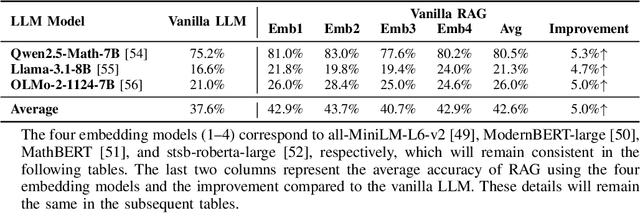
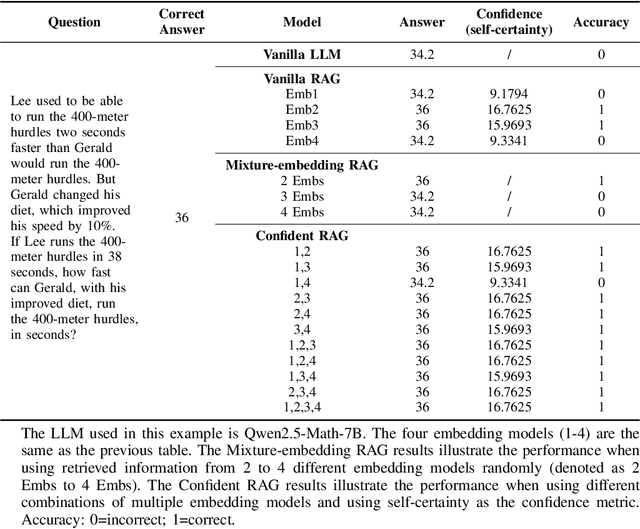
Recently, as Large Language Models (LLMs) have fundamentally impacted various fields, the methods for incorporating up-to-date information into LLMs or adding external knowledge to construct domain-specific models have garnered wide attention. Retrieval-Augmented Generation (RAG), serving as an inference-time scaling method, is notable for its low cost and minimal effort for parameter tuning. However, due to heterogeneous training data and model architecture, the variant embedding models used in RAG exhibit different benefits across various areas, often leading to different similarity calculation results and, consequently, varying response quality from LLMs. To address this problem, we propose and examine two approaches to enhance RAG by combining the benefits of multiple embedding models, named Mixture-Embedding RAG and Confident RAG. Mixture-Embedding RAG simply sorts and selects retrievals from multiple embedding models based on standardized similarity; however, it does not outperform vanilla RAG. In contrast, Confident RAG generates responses multiple times using different embedding models and then selects the responses with the highest confidence level, demonstrating average improvements of approximately 10% and 5% over vanilla LLMs and RAG, respectively. The consistent results across different LLMs and embedding models indicate that Confident RAG is an efficient plug-and-play approach for various domains. We will release our code upon publication.
A Short Overview of Multi-Modal Wi-Fi Sensing
May 10, 2025Wi-Fi sensing has emerged as a significant technology in wireless sensing and Integrated Sensing and Communication (ISAC), offering benefits such as low cost, high penetration, and enhanced privacy. Currently, it is widely utilized in various applications, including action recognition, human localization, and crowd counting. However, Wi-Fi sensing also faces challenges, such as low robustness and difficulties in data collection. Recently, there has been an increasing focus on multi-modal Wi-Fi sensing, where other modalities can act as teachers, providing ground truth or robust features for Wi-Fi sensing models to learn from, or can be directly fused with Wi-Fi for enhanced sensing capabilities. Although these methods have demonstrated promising results and substantial value in practical applications, there is a lack of comprehensive surveys reviewing them. To address this gap, this paper reviews the multi-modal Wi-Fi sensing literature \textbf{from the past 24 months} and highlights the current limitations, challenges and future directions in this field.