 Add to Chrome
 Add to Firefox
 Add to Edge
An Empirical Study of LLM-Generated Specifications for VeriFast
Jun 25, 2026
Static verification tools can assure industrial scale software, but require significant human labor to write specifications. This is particularly true of static verifiers based on separation logic (SL verifiers), which excel at verifying heapmanipulating programs, but require many complex auxiliary specifications to reason about heap structure. Recent work applies large language models (LLMs) to generate code, tests, and proofs, including specifications for verifiers, but mostly targeting non-SL verifiers. To address this gap, this paper thoroughly evaluates how well LLMs perform when prompted to generate specifications for verifying 303 C functions with the SL verifier VeriFast. We explored eight prompting approaches, ten LLMs, and three input types in two stages. Quantitative and qualitative analyses are used to assess the LLM-generated code and specifications for functional behavior, verifiability and errors. The results show that LLMs preserve functional behavior in source code and specifications (both over 91%), but achieve modest verification success (31.4%). Using Gemini 2.5 Pro and providing formal contracts lead to higher success rates in our setting. Moreover, most errors (94%) come from LLMs' mistakes in the domainspecific knowledge of SL verifiers such as VeriFast. These findings provide guidance for optimizing LLM-generated specifications for SL verifiers.

TacVerse: A Multi-Sensor Dataset and Benchmark for Cross-Sensor Vision-Based Tactile Perception
Jun 24, 2026Vision-based tactile sensors (VBTSs) enable robots to infer contact geometry and force-related cues by imaging deformation through an internal camera, yet generalisation across sensor designs remains poorly understood. We present TacVerse, a multi-sensor dataset and benchmark for cross-sensor vision-based tactile perception. The dataset contains 106,800 tactile images from seven VBTSs and supports three downstream tasks: shape classification, grating classification, and force regression. Experiments are conducted under three settings: within-sensor training, zero-shot cross-sensor transfer, and few-shot adaptation. Strong within-sensor performance across all tasks indicates that the collected tactile observations are informative for the target objectives. Direct cross-sensor transfer, however, leads to substantial degradation. Shape classification is comparatively robust, whereas grating classification and force regression are more sensitive to sensor shift. Few-shot adaptation for force regression consistently improves performance on unseen target sensors but does not fully close the gap to within-sensor upper bounds. A representation study further shows that MAE (Masked Autoencoder) pretraining provides the most consistent gains across tasks and sensors. TacVerse provides a controlled testbed for studying sensor shift, data-efficient adaptation, and self-supervised learning in tactile perception.
Propagating Structural Guidance: Synthesizing Fluorescein Angiography from Fundus Images and Sparse OCT Scans
Jun 15, 2026Fundus fluorescein angiography (FFA) is critical for assessing retinal vascular abnormalities, but its acquisition is invasive and not always feasible. In contrast, color fundus photography (CFP) is non-invasive and widely accessible, which has motivated studies on CFP-to-FFA synthesis. However, prior works rely solely on CFP surface texture, fundamentally limiting the ability to reconstruct functional vascular information and subtle pathological changes. To address this, we propose a novel framework that synthesizes FFA from CFP with structural guidance provided by optical coherence tomography (OCT). We construct a multi-modal retinal imaging dataset with paired CFP, FFA, and OCT from 3,676 patient eyes--the first tri-modally aligned dataset in retinal imaging. To bridge the spatial gap between OCT and fundus modalities, we propose a Spatially Aligned Cross-Modal Fusion (SACMF) module that projects depth-resolved OCT features onto the fundus plane and injects them into the CFP encoder via adaptive layer normalization. Beyond feature fusion, we further introduce Token-wise Cross-Modality Alignment (TCMA), a token-level contrastive learning strategy that explicitly aligns CFP and FFA representations at corresponding spatial positions. Our method achieves superior synthesis performance compared to state-of-the-art methods. Moreover, extensive experiments demonstrate that the FFA images synthesized by our approach bring greater improvements in downstream disease diagnosis performance than existing methods, highlighting the clinical potential of our approach as a non-invasive decision-support tool in routine workflows. The code is available at https://github.com/while-plus/OCT-guide-FFA-Syn.
ADM-DP: Adaptive Dynamic Modality Diffusion Policy through Vision-Tactile-Graph Fusion for Multi-Agent Manipulation
Feb 25, 2026Multi-agent robotic manipulation remains challenging due to the combined demands of coordination, grasp stability, and collision avoidance in shared workspaces. To address these challenges, we propose the Adaptive Dynamic Modality Diffusion Policy (ADM-DP), a framework that integrates vision, tactile, and graph-based (multi-agent pose) modalities for coordinated control. ADM-DP introduces four key innovations. First, an enhanced visual encoder merges RGB and point-cloud features via Feature-wise Linear Modulation (FiLM) modulation to enrich perception. Second, a tactile-guided grasping strategy uses Force-Sensitive Resistor (FSR) feedback to detect insufficient contact and trigger corrective grasp refinement, improving grasp stability. Third, a graph-based collision encoder leverages shared tool center point (TCP) positions of multiple agents as structured kinematic context to maintain spatial awareness and reduce inter-agent interference. Fourth, an Adaptive Modality Attention Mechanism (AMAM) dynamically re-weights modalities according to task context, enabling flexible fusion. For scalability and modularity, a decoupled training paradigm is employed in which agents learn independent policies while sharing spatial information. This maintains low interdependence between agents while retaining collective awareness. Across seven multi-agent tasks, ADM-DP achieves 12-25% performance gains over state-of-the-art baselines. Ablation studies show the greatest improvements in tasks requiring multiple sensory modalities, validating our adaptive fusion strategy and demonstrating its robustness for diverse manipulation scenarios.
TactEx: An Explainable Multimodal Robotic Interaction Framework for Human-Like Touch and Hardness Estimation
Feb 21, 2026Accurate perception of object hardness is essential for safe and dexterous contact-rich robotic manipulation. Here, we present TactEx, an explainable multimodal robotic interaction framework that unifies vision, touch, and language for human-like hardness estimation and interactive guidance. We evaluate TactEx on fruit-ripeness assessment, a representative task that requires both tactile sensing and contextual understanding. The system fuses GelSight-Mini tactile streams with RGB observations and language prompts. A ResNet50+LSTM model estimates hardness from sequential tactile data, while a cross-modal alignment module combines visual cues with guidance from a large language model (LLM). This explainable multimodal interface allows users to distinguish ripeness levels with statistically significant class separation (p < 0.01 for all fruit pairs). For touch placement, we compare YOLO with Grounded-SAM (GSAM) and find GSAM to be more robust for fine-grained segmentation and contact-site selection. A lightweight LLM parses user instructions and produces grounded natural-language explanations linked to the tactile outputs. In end-to-end evaluations, TactEx attains 90% task success on simple user queries and generalises to novel tasks without large-scale tuning. These results highlight the promise of combining pretrained visual and tactile models with language grounding to advance explainable, human-like touch perception and decision-making in robotics.
WHU-STree: A Multi-modal Benchmark Dataset for Street Tree Inventory
Sep 16, 2025Street trees are vital to urban livability, providing ecological and social benefits. Establishing a detailed, accurate, and dynamically updated street tree inventory has become essential for optimizing these multifunctional assets within space-constrained urban environments. Given that traditional field surveys are time-consuming and labor-intensive, automated surveys utilizing Mobile Mapping Systems (MMS) offer a more efficient solution. However, existing MMS-acquired tree datasets are limited by small-scale scene, limited annotation, or single modality, restricting their utility for comprehensive analysis. To address these limitations, we introduce WHU-STree, a cross-city, richly annotated, and multi-modal urban street tree dataset. Collected across two distinct cities, WHU-STree integrates synchronized point clouds and high-resolution images, encompassing 21,007 annotated tree instances across 50 species and 2 morphological parameters. Leveraging the unique characteristics, WHU-STree concurrently supports over 10 tasks related to street tree inventory. We benchmark representative baselines for two key tasks--tree species classification and individual tree segmentation. Extensive experiments and in-depth analysis demonstrate the significant potential of multi-modal data fusion and underscore cross-domain applicability as a critical prerequisite for practical algorithm deployment. In particular, we identify key challenges and outline potential future works for fully exploiting WHU-STree, encompassing multi-modal fusion, multi-task collaboration, cross-domain generalization, spatial pattern learning, and Multi-modal Large Language Model for street tree asset management. The WHU-STree dataset is accessible at: https://github.com/WHU-USI3DV/WHU-STree.
MagicGripper: A Multimodal Sensor-Integrated Gripper for Contact-Rich Robotic Manipulation
May 30, 2025Contact-rich manipulation in unstructured environments demands precise, multimodal perception to enable robust and adaptive control. Vision-based tactile sensors (VBTSs) have emerged as an effective solution; however, conventional VBTSs often face challenges in achieving compact, multi-modal functionality due to hardware constraints and algorithmic complexity. In this work, we present MagicGripper, a multimodal sensor-integrated gripper designed for contact-rich robotic manipulation. Building on our prior design, MagicTac, we develop a compact variant, mini-MagicTac, which features a three-dimensional, multi-layered grid embedded in a soft elastomer. MagicGripper integrates mini-MagicTac, enabling high-resolution tactile feedback alongside proximity and visual sensing within a compact, gripper-compatible form factor. We conduct a thorough evaluation of mini-MagicTac's performance, demonstrating its capabilities in spatial resolution, contact localization, and force regression. We also assess its robustness across manufacturing variability, mechanical deformation, and sensing performance under real-world conditions. Furthermore, we validate the effectiveness of MagicGripper through three representative robotic tasks: a teleoperated assembly task, a contact-based alignment task, and an autonomous robotic grasping task. Across these experiments, MagicGripper exhibits reliable multimodal perception, accurate force estimation, and high adaptability to challenging manipulation scenarios. Our results highlight the potential of MagicGripper as a practical and versatile tool for embodied intelligence in complex, contact-rich environments.
MM-Retinal V2: Transfer an Elite Knowledge Spark into Fundus Vision-Language Pretraining
Jan 27, 2025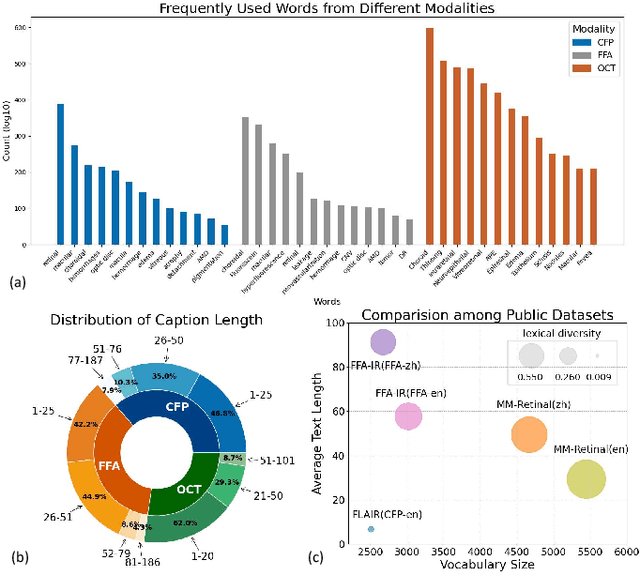


Vision-language pretraining (VLP) has been investigated to generalize across diverse downstream tasks for fundus image analysis. Although recent methods showcase promising achievements, they significantly rely on large-scale private image-text data but pay less attention to the pretraining manner, which limits their further advancements. In this work, we introduce MM-Retinal V2, a high-quality image-text paired dataset comprising CFP, FFA, and OCT image modalities. Then, we propose a novel fundus vision-language pretraining model, namely KeepFIT V2, which is pretrained by integrating knowledge from the elite data spark into categorical public datasets. Specifically, a preliminary textual pretraining is adopted to equip the text encoder with primarily ophthalmic textual knowledge. Moreover, a hybrid image-text knowledge injection module is designed for knowledge transfer, which is essentially based on a combination of global semantic concepts from contrastive learning and local appearance details from generative learning. Extensive experiments across zero-shot, few-shot, and linear probing settings highlight the generalization and transferability of KeepFIT V2, delivering performance competitive to state-of-the-art fundus VLP models trained on large-scale private image-text datasets. Our dataset and model are publicly available via https://github.com/lxirich/MM-Retinal.
Design and Benchmarking of A Multi-Modality Sensor for Robotic Manipulation with GAN-Based Cross-Modality Interpretation
Jan 04, 2025


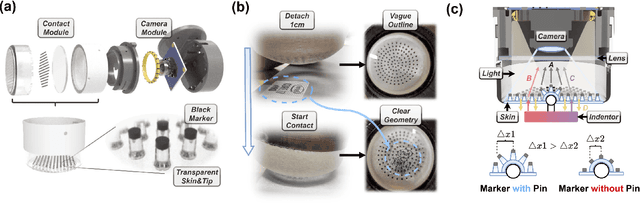
In this paper, we present the design and benchmark of an innovative sensor, ViTacTip, which fulfills the demand for advanced multi-modal sensing in a compact design. A notable feature of ViTacTip is its transparent skin, which incorporates a `see-through-skin' mechanism. This mechanism aims at capturing detailed object features upon contact, significantly improving both vision-based and proximity perception capabilities. In parallel, the biomimetic tips embedded in the sensor's skin are designed to amplify contact details, thus substantially augmenting tactile and derived force perception abilities. To demonstrate the multi-modal capabilities of ViTacTip, we developed a multi-task learning model that enables simultaneous recognition of hardness, material, and textures. To assess the functionality and validate the versatility of ViTacTip, we conducted extensive benchmarking experiments, including object recognition, contact point detection, pose regression, and grating identification. To facilitate seamless switching between various sensing modalities, we employed a Generative Adversarial Network (GAN)-based approach. This method enhances the applicability of the ViTacTip sensor across diverse environments by enabling cross-modality interpretation.
CrystalTac: 3D-Printed Vision-Based Tactile Sensor Family through Rapid Monolithic Manufacturing Technique
Aug 01, 2024
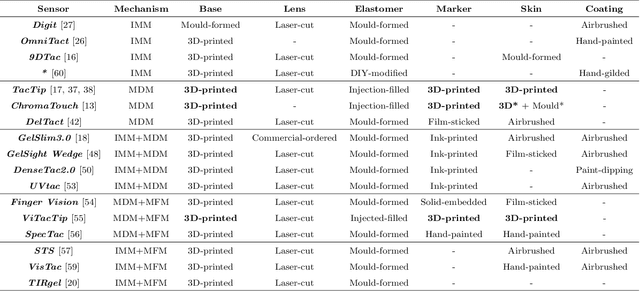


Recently, vision-based tactile sensors (VBTSs) have gained popularity in robotics systems. The sensing mechanisms of most VBTSs can be categorised based on the type of tactile features they capture. Each category requires specific structural designs to convert physical contact into optical information. The complex architectures of VBTSs pose challenges for traditional manufacturing techniques in terms of design flexibility, cost-effectiveness, and quality stability. Previous research has shown that monolithic manufacturing using multi-material 3D printing technology can partially address these challenges. This study introduces the CrystalTac family, a series of VBTSs designed with a unique sensing mechanism and fabricated through rapid monolithic manufacturing. Case studies on CrystalTac-type sensors demonstrate their effective performance in tasks involving tactile perception, along with impressive cost-effectiveness and design flexibility. The CrystalTac family aims to highlight the potential of monolithic manufacturing in VBTS development and inspire further research in tactile sensing and manipulation.