 Add to Chrome
 Add to Firefox
 Add to Edge
Code as Representation: A Compilable Parsing Paradigm for Academic Documents
Aug 18, 2026
Academic papers are a primary carrier of scientific knowledge, yet most of this knowledge remains locked in PDFs that are optimized for human reading rather than machine use. For Multimodal Large Language Models (MLLMs), the core challenge is not only perception, but representation: scientific pages interleave text with Structured Academic Elements (SAEs) such as tables, formulas, charts, and pseudocode, whose structure, data, and logic are poorly preserved by common surrogates like Markdown. We therefore propose Compilable Academic Document Parsing (CADP), a paradigm that reconstructs a full page as contextual \LaTeX{} plus executable Python, so that structure-preserving elements and executable chart representations can be reconstructed, recompiled, and directly verified against the source page. To support this setting, we introduce CADP-Bench, an expert-verified benchmark of full academic pages containing tightly coupled text and multiple SAE types, evaluated through a re-injection compilation protocol. We further study current capabilities using SOTA MLLMs and an exploratory multi-agent baseline that incorporates common agentic techniques. Results show that even frontier models still struggle to produce high-fidelity executable reconstructions, highlighting substantial room for improvement in structure-aware scientific document parsing. CADP-Bench is released for future research.

EvoThink: Evolving Thinking in Large Reasoning Models via Self-Pruning and Aha-Moment Preference Optimization
Jul 22, 2026Large Reasoning Models (LRMs) often suffer from overthinking due to redundant verification steps. Existing approaches for mitigating overthinking, such as fast-slow thinking switching and reasoning trajectory compression, fail to make a fine-grained distinction between beneficial and redundant steps within the LRM's reasoning process, and may thus impair reasoning capability in their pursuit of efficiency. To simultaneously improve reasoning efficiency and capability, we propose EvoThink, a framework that reduces redundant verification and encourages the exploration of new reasoning paths. EvoThink comprises two key components: Self-Pruning Training (SPT), an unsupervised method that iteratively prunes redundant reasoning steps and self-trains on the concise trajectories; and Aha-Moment Preference Optimization (AMPO), which, inspired by genetic algorithms, identifies valuable failed reasoning attempts, synthesizes from-wrong-to-right aha-moment data, and optimizes the model to internalize this reasoning pattern. Extensive evaluations across mathematical reasoning and code generation benchmarks demonstrate that EvoThink not only substantially reduces inference-time token usage but also improves the reasoning capability of LRMs.
OneEval: Benchmarking LLM Knowledge-intensive Reasoning over Diverse Knowledge Bases
Jun 14, 2025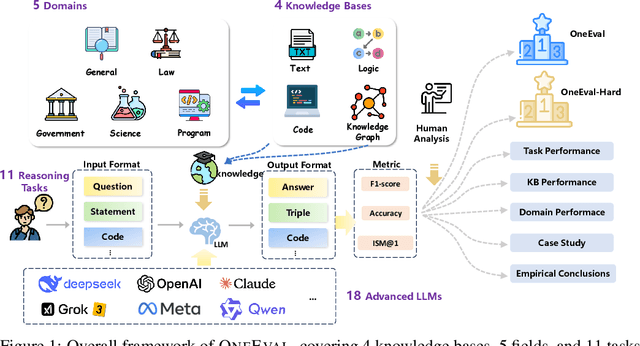
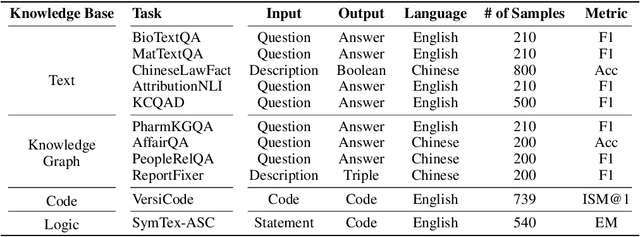
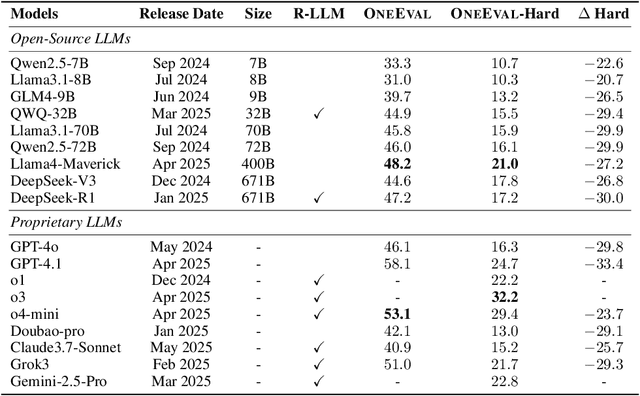
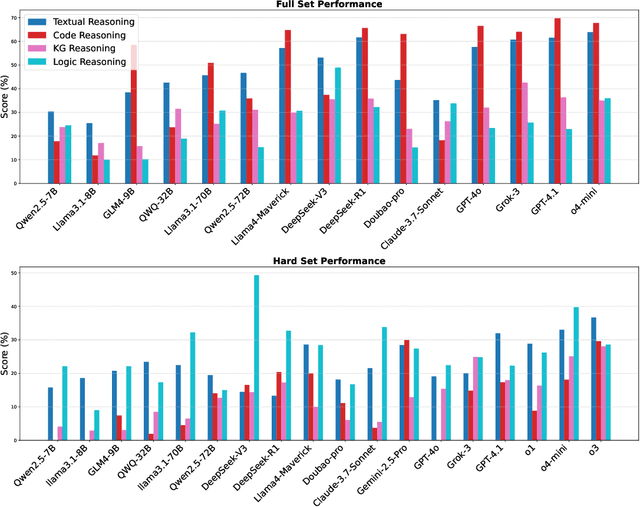
Large Language Models (LLMs) have demonstrated substantial progress on reasoning tasks involving unstructured text, yet their capabilities significantly deteriorate when reasoning requires integrating structured external knowledge such as knowledge graphs, code snippets, or formal logic. This limitation is partly due to the absence of benchmarks capable of systematically evaluating LLM performance across diverse structured knowledge modalities. To address this gap, we introduce \textbf{\textsc{OneEval}}, a comprehensive benchmark explicitly designed to assess the knowledge-intensive reasoning capabilities of LLMs across four structured knowledge modalities, unstructured text, knowledge graphs, code, and formal logic, and five critical domains (general knowledge, government, science, law, and programming). \textsc{OneEval} comprises 4,019 carefully curated instances and includes a challenging subset, \textsc{OneEval}\textsubscript{Hard}, consisting of 1,285 particularly difficult cases. Through extensive evaluation of 18 state-of-the-art open-source and proprietary LLMs, we establish three core findings: a) \emph{persistent limitations in structured reasoning}, with even the strongest model achieving only 32.2\% accuracy on \textsc{OneEval}\textsubscript{Hard}; b) \emph{performance consistently declines as the structural complexity of the knowledge base increases}, with accuracy dropping sharply from 53\% (textual reasoning) to 25\% (formal logic); and c) \emph{diminishing returns from extended reasoning chains}, highlighting the critical need for models to adapt reasoning depth appropriately to task complexity. We release the \textsc{OneEval} datasets, evaluation scripts, and baseline results publicly, accompanied by a leaderboard to facilitate ongoing advancements in structured knowledge reasoning.
Research on the Offshore Marine Communication Environment Based on Satellite Remote Sensing Data
Feb 19, 2025Air-sea interface fluxes significantly impact the reliability and efficiency of maritime communication. Compared to sparse in-situ ocean observations, satellite remote sensing data offers broader coverage and extended temporal span. This study utilizes COARE V3.5 algorithm to calculate momentum flux, sensible heat flux, and latent heat flux at the air-sea interface, based on satellite synthetic aperture radar (SAR) wind speed data, reanalysis data, and buoy measurements, combined with neural network methods. Findings indicate that SAR wind speed data corrected via neural networks show improved consistency with buoy-measured wind speeds in flux calculations. Specifically, the bias in friction velocity decreased from -0.03 m/s to 0.01 m/s, wind stress bias from -0.03 N/m^2 to 0.00 N/m^2, drag coefficient bias from -0.29 to -0.21, latent heat flux bias from -8.32 W/m^2 to 5.41 W/m^2, and sensible heat flux bias from 0.67 W/m^2 to 0.06 W/m^2. Results suggest that the neural network-corrected SAR wind speed data can provide more reliable environmental data for maritime communication.