 Add to Chrome
 Add to Firefox
 Add to Edge
Benchmarking and Improving GUI Agents in High-Dynamic Environments
Apr 28, 2026
Recent advancements in Graphical User Interface (GUI) agents have predominantly focused on training paradigms like supervised fine-tuning (SFT) and reinforcement learning (RL). However, the challenge of high-dynamic GUI environments remains largely underexplored. Existing agents typically rely on a single screenshot after each action for decision-making, leading to a partially observable (or even unobservable) Markov decision process, where the key GUI state including important information for actions is often inadequately captured. To systematically explore this challenge, we introduce DynamicGUIBench, a comprehensive online GUI benchmark spanning ten applications and diverse interaction scenarios characterized by important interface changes between actions. Furthermore, we present DynamicUI, an agent designed for dynamic interfaces, which takes screen-recording videos of the interaction process as input and consists of three components: a dynamic perceiver, a refinement strategy, and a reflection. Specifically, the dynamic perceiver clusters frames of the GUI video, generates captions for the centroids, and iteratively selects the most informative frames as the salient dynamic context. Considering that there may be inconsistencies and noise between the selected frames and the textual context of the agent, the refinement strategy employs an action-conditioned filtering to refine thoughts to mitigate thought-action inconsistency and redundancy. Based on the refined agent trajectories, the reflection module provides effective and accurate guidance for further actions. Experiments on DynamicGUIBench demonstrate that DynamicUI significantly improves the performance in dynamic GUI environments, while maintaining competitive performance on other public benchmarks.

Adaptive Attention Distillation for Robust Few-Shot Segmentation under Environmental Perturbations
Jan 07, 2026Few-shot segmentation (FSS) aims to rapidly learn novel class concepts from limited examples to segment specific targets in unseen images, and has been widely applied in areas such as medical diagnosis and industrial inspection. However, existing studies largely overlook the complex environmental factors encountered in real world scenarios-such as illumination, background, and camera viewpoint-which can substantially increase the difficulty of test images. As a result, models trained under laboratory conditions often fall short of practical deployment requirements. To bridge this gap, in this paper, an environment-robust FSS setting is introduced that explicitly incorporates challenging test cases arising from complex environments-such as motion blur, small objects, and camouflaged targets-to enhance model's robustness under realistic, dynamic conditions. An environment robust FSS benchmark (ER-FSS) is established, covering eight datasets across multiple real world scenarios. In addition, an Adaptive Attention Distillation (AAD) method is proposed, which repeatedly contrasts and distills key shared semantics between known (support) and unknown (query) images to derive class-specific attention for novel categories. This strengthens the model's ability to focus on the correct targets in complex environments, thereby improving environmental robustness. Comparative experiments show that AAD improves mIoU by 3.3% - 8.5% across all datasets and settings, demonstrating superior performance and strong generalization. The source code and dataset are available at: https://github.com/guoqianyu-alberta/Adaptive-Attention-Distillation-for-FSS.
Enhancing Environmental Robustness in Few-shot Learning via Conditional Representation Learning
Feb 03, 2025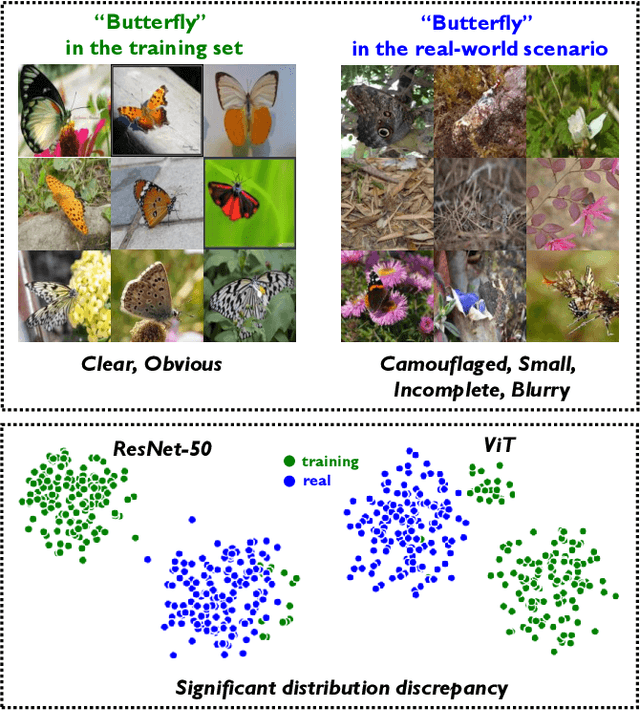
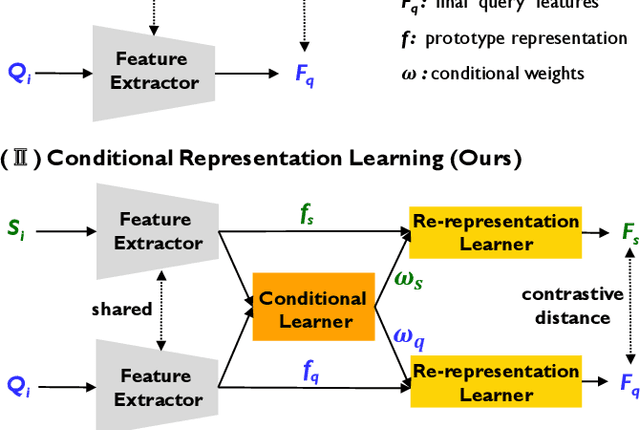
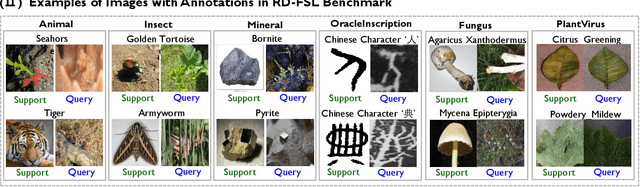
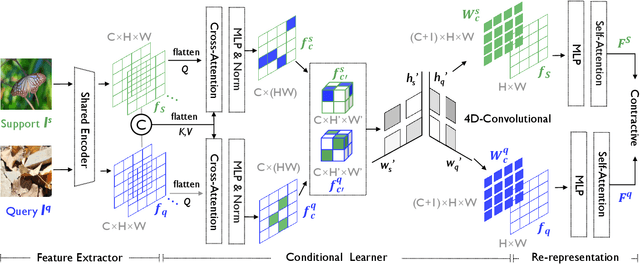
Few-shot learning (FSL) has recently been extensively utilized to overcome the scarcity of training data in domain-specific visual recognition. In real-world scenarios, environmental factors such as complex backgrounds, varying lighting conditions, long-distance shooting, and moving targets often cause test images to exhibit numerous incomplete targets or noise disruptions. However, current research on evaluation datasets and methodologies has largely ignored the concept of "environmental robustness", which refers to maintaining consistent performance in complex and diverse physical environments. This neglect has led to a notable decline in the performance of FSL models during practical testing compared to their training performance. To bridge this gap, we introduce a new real-world multi-domain few-shot learning (RD-FSL) benchmark, which includes four domains and six evaluation datasets. The test images in this benchmark feature various challenging elements, such as camouflaged objects, small targets, and blurriness. Our evaluation experiments reveal that existing methods struggle to utilize training images effectively to generate accurate feature representations for challenging test images. To address this problem, we propose a novel conditional representation learning network (CRLNet) that integrates the interactions between training and testing images as conditional information in their respective representation processes. The main goal is to reduce intra-class variance or enhance inter-class variance at the feature representation level. Finally, comparative experiments reveal that CRLNet surpasses the current state-of-the-art methods, achieving performance improvements ranging from 6.83% to 16.98% across diverse settings and backbones. The source code and dataset are available at https://github.com/guoqianyu-alberta/Conditional-Representation-Learning.