 Add to Chrome
 Add to Firefox
 Add to Edge
KCoEvo: A Knowledge Graph Augmented Framework for Evolutionary Code Generation
Mar 08, 2026
Code evolution is inevitable in modern software development. Changes to third-party APIs frequently break existing code and complicate maintenance, posing practical challenges for developers. While large language models (LLMs) have shown promise in code generation, they struggle to reason without a structured representation of these evolving relationships, often leading them to produce outdated APIs or invalid outputs. In this work, we propose a knowledge graph-augmented framework that decomposes the migration task into two synergistic stages: evolution path retrieval and path-informed code generation. Our approach constructs static and dynamic API graphs to model intra-version structures and cross-version transitions, enabling structured reasoning over API evolution. Both modules are trained with synthetic supervision automatically derived from real-world API diffs, ensuring scalability and minimal human effort. Extensive experiments across single-package and multi-package benchmarks demonstrate that our framework significantly improves migration accuracy, controllability, and execution success over standard LLM baselines. The source code and datasets are available at: https://github.com/kangjz1203/KCoEvo.

LFPO: Likelihood-Free Policy Optimization for Masked Diffusion Models
Mar 02, 2026Reinforcement Learning with Verifiable Rewards (RLVR) has achieved remarkable success in improving autoregressive models, especially in domains requiring correctness like mathematical reasoning and code generation. However, directly applying such paradigms to Diffusion Large Language Models (dLLMs) is fundamentally hindered by the intractability of exact likelihood computation, which forces existing methods to rely on high-variance approximations. To bridge this gap, we propose Likelihood-Free Policy Optimization (LFPO), a native framework that maps the concept of vector field flow matching to the discrete token space. Specifically, LFPO formulates alignment as geometric velocity rectification, which directly optimizes denoising logits via contrastive updates. This design effectively bypasses the errors inherent in likelihood approximation, yielding the precise gradient estimation. Furthermore, LFPO enforce consistency by predicting final solutions from intermediate steps, effectively straightening the probability flow to enable high-quality generation with significantly fewer iterations. Extensive experiments demonstrate that LFPO not only outperforms state-of-the-art baselines on code and reasoning benchmarks but also accelerates inference by approximately 20% through reduced diffusion steps.
OneEval: Benchmarking LLM Knowledge-intensive Reasoning over Diverse Knowledge Bases
Jun 14, 2025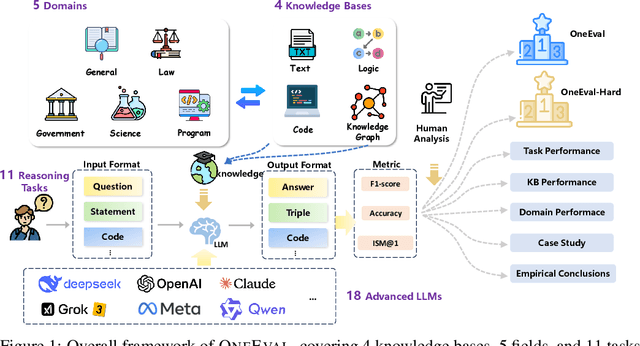
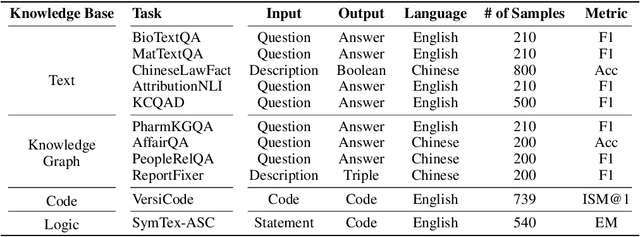
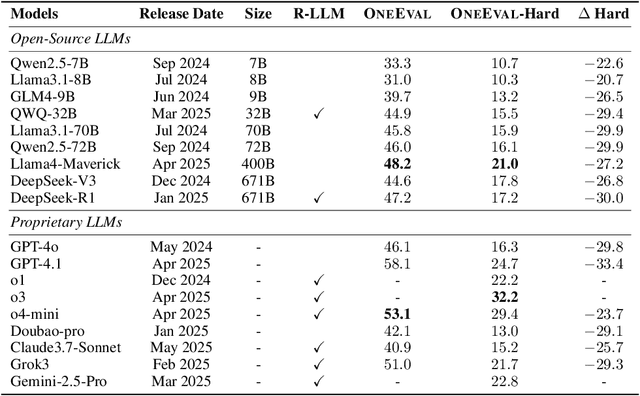
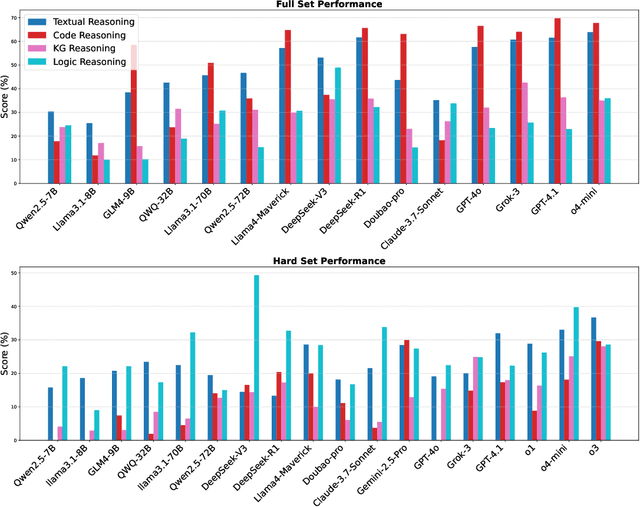
Large Language Models (LLMs) have demonstrated substantial progress on reasoning tasks involving unstructured text, yet their capabilities significantly deteriorate when reasoning requires integrating structured external knowledge such as knowledge graphs, code snippets, or formal logic. This limitation is partly due to the absence of benchmarks capable of systematically evaluating LLM performance across diverse structured knowledge modalities. To address this gap, we introduce \textbf{\textsc{OneEval}}, a comprehensive benchmark explicitly designed to assess the knowledge-intensive reasoning capabilities of LLMs across four structured knowledge modalities, unstructured text, knowledge graphs, code, and formal logic, and five critical domains (general knowledge, government, science, law, and programming). \textsc{OneEval} comprises 4,019 carefully curated instances and includes a challenging subset, \textsc{OneEval}\textsubscript{Hard}, consisting of 1,285 particularly difficult cases. Through extensive evaluation of 18 state-of-the-art open-source and proprietary LLMs, we establish three core findings: a) \emph{persistent limitations in structured reasoning}, with even the strongest model achieving only 32.2\% accuracy on \textsc{OneEval}\textsubscript{Hard}; b) \emph{performance consistently declines as the structural complexity of the knowledge base increases}, with accuracy dropping sharply from 53\% (textual reasoning) to 25\% (formal logic); and c) \emph{diminishing returns from extended reasoning chains}, highlighting the critical need for models to adapt reasoning depth appropriately to task complexity. We release the \textsc{OneEval} datasets, evaluation scripts, and baseline results publicly, accompanied by a leaderboard to facilitate ongoing advancements in structured knowledge reasoning.