 Add to Chrome
 Add to Firefox
 Add to Edge
ROVER: Routing Object-Centric Visual Evidence for Grounded Multi-Image Reasoning
May 28, 2026
Multimodal Large Language Models (MLLMs) have increasingly localized and interleaved visual evidence for deliberative reasoning. Grounding-based approaches typically focus on regions of interest (RoIs) by injecting cropped image patches or RoI-specific features into the reasoning context. However, such designs can weaken holistic scene understanding and inter-object relations, while incurring decoding costs that scale with the number and size of RoIs. Alternatively, adaptive visual feature selection often requires fine-grained supervision or complex heuristics. To address these limitations, we propose ROVER (Routing Object-centric Visual Evidence for grounded multi-image Reasoning), a lightweight, learnable plugin for efficient global visual evidence routing. Upon each object grounding prediction, ROVER injects a step-specific token triplet to synergistically: (i) aggregate the ongoing reasoning context, (ii) distill intra-image cues into a visual working space via object-centric differential attention, and (iii) route and integrate history-aware evidence across objects and images within this space for subsequent reasoning. We integrate ROVER into Qwen2.5-VL-7B and develop an interleaved SFT-to-GRPO training pipeline. Strictly adhering to the original datasets and evaluation protocols, our method achieves the best performance on MM-GCoT (+4.8% answer accuracy, +14.6% grounding accuracy) and VideoEspresso (+8.6% answer accuracy). The VideoEspresso-trained model demonstrates strong transferability, outperforming the base model by +4.7% on average across diverse benchmarks.

DIVA-GRPO: Enhancing Multimodal Reasoning through Difficulty-Adaptive Variant Advantage
Mar 01, 2026Reinforcement learning (RL) with group relative policy optimization (GRPO) has become a widely adopted approach for enhancing the reasoning capabilities of multimodal large language models (MLLMs). While GRPO enables long-chain reasoning without a critic, it often suffers from sparse rewards on difficult problems and advantage vanishing when group-level rewards are too consistent for overly easy or hard problems. Existing solutions (sample expansion, selective utilization, and indirect reward design) often fail to maintain enough variance in within-group reward distributions to yield clear optimization signals. To address this, we propose DIVA-GRPO, a difficulty-adaptive variant advantage method that adjusts variant difficulty distributions from a global perspective. DIVA-GRPO dynamically assesses problem difficulty, samples variants with appropriate difficulty levels, and calculates advantages across local and global groups using difficulty-weighted and normalized scaling. This alleviates reward sparsity and advantage vanishing while improving training stability. Extensive experiments on six reasoning benchmarks demonstrate that DIVA-GRPO outperforms existing approaches in training efficiency and reasoning performance. Code: https://github.com/Siaaaaaa1/DIVA-GRPO
QARM V2: Quantitative Alignment Multi-Modal Recommendation for Reasoning User Sequence Modeling
Feb 09, 2026With the evolution of large language models (LLMs), there is growing interest in leveraging their rich semantic understanding to enhance industrial recommendation systems (RecSys). Traditional RecSys relies on ID-based embeddings for user sequence modeling in the General Search Unit (GSU) and Exact Search Unit (ESU) paradigm, which suffers from low information density, knowledge isolation, and weak generalization ability. While LLMs offer complementary strengths with dense semantic representations and strong generalization, directly applying LLM embeddings to RecSys faces critical challenges: representation unmatch with business objectives and representation unlearning end-to-end with downstream tasks. In this paper, we present QARM V2, a unified framework that bridges LLM semantic understanding with RecSys business requirements for user sequence modeling.
OneMall: One Architecture, More Scenarios -- End-to-End Generative Recommender Family at Kuaishou E-Commerce
Feb 02, 2026In the wave of generative recommendation, we present OneMall, an end-to-end generative recommendation framework tailored for e-commerce services at Kuaishou. Our OneMall systematically unifies the e-commerce's multiple item distribution scenarios, such as Product-card, short-video and live-streaming. Specifically, it comprises three key components, aligning the entire model training pipeline to the LLM's pre-training/post-training: (1) E-commerce Semantic Tokenizer: we provide a tokenizer solution that captures both real-world semantics and business-specific item relations across different scenarios; (2) Transformer-based Architecture: we largely utilize Transformer as our model backbone, e.g., employing Query-Former for long sequence compression, Cross-Attention for multi-behavior sequence fusion, and Sparse MoE for scalable auto-regressive generation; (3) Reinforcement Learning Pipeline: we further connect retrieval and ranking models via RL, enabling the ranking model to serve as a reward signal for end-to-end policy retrieval model optimization. Extensive experiments demonstrate that OneMall achieves consistent improvements across all e-commerce scenarios: +13.01\% GMV in product-card, +15.32\% Orders in Short-Video, and +2.78\% Orders in Live-Streaming. OneMall has been deployed, serving over 400 million daily active users at Kuaishou.
OneMall: One Model, More Scenarios -- End-to-End Generative Recommender Family at Kuaishou E-Commerce
Jan 29, 2026In the wave of generative recommendation, we present OneMall, an end-to-end generative recommendation framework tailored for e-commerce services at Kuaishou. Our OneMall systematically unifies the e-commerce's multiple item distribution scenarios, such as Product-card, short-video and live-streaming. Specifically, it comprises three key components, aligning the entire model training pipeline to the LLM's pre-training/post-training: (1) E-commerce Semantic Tokenizer: we provide a tokenizer solution that captures both real-world semantics and business-specific item relations across different scenarios; (2) Transformer-based Architecture: we largely utilize Transformer as our model backbone, e.g., employing Query-Former for long sequence compression, Cross-Attention for multi-behavior sequence fusion, and Sparse MoE for scalable auto-regressive generation; (3) Reinforcement Learning Pipeline: we further connect retrieval and ranking models via RL, enabling the ranking model to serve as a reward signal for end-to-end policy retrieval model optimization. Extensive experiments demonstrate that OneMall achieves consistent improvements across all e-commerce scenarios: +13.01\% GMV in product-card, +15.32\% Orders in Short-Video, and +2.78\% Orders in Live-Streaming. OneMall has been deployed, serving over 400 million daily active users at Kuaishou.
Reliable Imputed-Sample Assisted Vertical Federated Learning
Jan 11, 2025Vertical Federated Learning (VFL) is a well-known FL variant that enables multiple parties to collaboratively train a model without sharing their raw data. Existing VFL approaches focus on overlapping samples among different parties, while their performance is constrained by the limited number of these samples, leaving numerous non-overlapping samples unexplored. Some previous work has explored techniques for imputing missing values in samples, but often without adequate attention to the quality of the imputed samples. To address this issue, we propose a Reliable Imputed-Sample Assisted (RISA) VFL framework to effectively exploit non-overlapping samples by selecting reliable imputed samples for training VFL models. Specifically, after imputing non-overlapping samples, we introduce evidence theory to estimate the uncertainty of imputed samples, and only samples with low uncertainty are selected. In this way, high-quality non-overlapping samples are utilized to improve VFL model. Experiments on two widely used datasets demonstrate the significant performance gains achieved by the RISA, especially with the limited overlapping samples, e.g., a 48% accuracy gain on CIFAR-10 with only 1% overlapping samples.
FedAds: A Benchmark for Privacy-Preserving CVR Estimation with Vertical Federated Learning
May 15, 2023


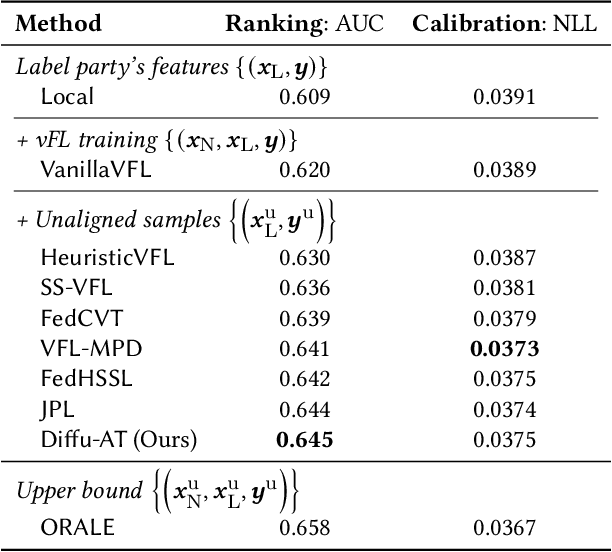
Conversion rate (CVR) estimation aims to predict the probability of conversion event after a user has clicked an ad. Typically, online publisher has user browsing interests and click feedbacks, while demand-side advertising platform collects users' post-click behaviors such as dwell time and conversion decisions. To estimate CVR accurately and protect data privacy better, vertical federated learning (vFL) is a natural solution to combine two sides' advantages for training models, without exchanging raw data. Both CVR estimation and applied vFL algorithms have attracted increasing research attentions. However, standardized and systematical evaluations are missing: due to the lack of standardized datasets, existing studies adopt public datasets to simulate a vFL setting via hand-crafted feature partition, which brings challenges to fair comparison. We introduce FedAds, the first benchmark for CVR estimation with vFL, to facilitate standardized and systematical evaluations for vFL algorithms. It contains a large-scale real world dataset collected from Alibaba's advertising platform, as well as systematical evaluations for both effectiveness and privacy aspects of various vFL algorithms. Besides, we also explore to incorporate unaligned data in vFL to improve effectiveness, and develop perturbation operations to protect privacy well. We hope that future research work in vFL and CVR estimation benefits from the FedAds benchmark.