 Add to Chrome
 Add to Firefox
 Add to Edge
CRISP: Constrained Refinement via Iterative Squeezing Process for Robust Medical Image Segmentation under Domain Shift
Jul 16, 2026
Distribution shift in medical imaging remains a central bottleneck for the clinical translation of medical AI. Failure to address it can lead to severe performance degradation in unseen environments and exacerbate health inequities. Existing methods for domain adaptation are inherently limited by exhausting predefined possibilities through simulated shifts or pseudo-supervision. Such strategies struggle in the open-ended and unpredictable real world, where distribution shifts are effectively infinite. To address this challenge, we adopt the "Rank Stability of Positive Regions" as a working assumption under distribution shift, and use it to derive robust spatial hints for source-only segmentation. Guided by this assumption, we propose CRISP, a model-agnostic framework that, unlike deployment-time adaptation, requires no test-time parameter updates and no target-domain data--a target-free, plug-in refinement framework that segments with frozen weights. Rather than using ranking to directly output masks, CRISP exploits the stability of probability rankings under distribution shift to derive robust spatial priors. Via latent feature perturbation, perturbation-invariant high-grade regions define a high-precision (HP) core, while voxels that remain potentially foreground under at least one perturbation define a high-recall (HR) support; these dual priors are then recursively refined under perturbation. We then design an iterative training framework that progressively squeezes HP and HR toward the final segmentation. Extensive evaluations on multi-center cardiac MRI and CT-based lung vessel segmentation demonstrate CRISP's superior robustness, significantly outperforming state-of-the-art methods with striking HD95 reductions of up to 0.14 (7.0% improvement), 1.90 (13.1% improvement), and 8.39 (38.9% improvement) pixels across multi-center, demographic, and modality shifts, respectively.

CRISP: Rank-Guided Iterative Squeezing for Robust Medical Image Segmentation under Domain Shift
Apr 07, 2026Distribution shift in medical imaging remains a central bottleneck for the clinical translation of medical AI. Failure to address it can lead to severe performance degradation in unseen environments and exacerbate health inequities. Existing methods for domain adaptation are inherently limited by exhausting predefined possibilities through simulated shifts or pseudo-supervision. Such strategies struggle in the open-ended and unpredictable real world, where distribution shifts are effectively infinite. To address this challenge, we introduce an empirical law called ``Rank Stability of Positive Regions'', which states that the relative rank of predicted probabilities for positive voxels remains stable under distribution shift. Guided by this principle, we propose CRISP, a parameter-free and model-agnostic framework requiring no target-domain information. CRISP is the first framework to make segmentation based on rank rather than probabilities. CRISP simulates model behavior under distribution shift via latent feature perturbation, where voxel probability rankings exhibit two stable patterns: regions that consistently retain high probabilities (destined positives according to the principle) and those that remain low-probability (can be safely classified as negatives). Based on these patterns, we construct high-precision (HP) and high-recall (HR) priors and recursively refine them under perturbation. We then design an iterative training framework, making HP and HR progressively ``squeeze'' to the final segmentation. Extensive evaluations on multi-center cardiac MRI and CT-based lung vessel segmentation demonstrate CRISP's superior robustness, significantly outperforming state-of-the-art methods with striking HD95 reductions of up to 0.14 (7.0\% improvement), 1.90 (13.1\% improvement), and 8.39 (38.9\% improvement) pixels across multi-center, demographic, and modality shifts, respectively.
LUMOS: Universal Semi-Supervised OCT Retinal Layer Segmentation with Hierarchical Reliable Mutual Learning
Apr 07, 2026Optical Coherence Tomography (OCT) layer segmentation faces challenges due to annotation scarcity and heterogeneous label granularities across datasets. While semi-supervised learning helps alleviate label scarcity, existing methods typically assume a fixed granularity, failing to fully exploit cross-granularity supervision. This paper presents LUMOS, a semi-supervised universal OCT retinal layer segmentation framework based on a Dual-Decoder Network with a Hierarchical Prompting Strategy (DDN-HPS) and Reliable Progressive Multi-granularity Learning (RPML). DDN-HPS combines a dual-branch architecture with a multi-granularity prompting strategy to effectively suppress pseudo-label noise propagation. Meanwhile, RPML introduces region-level reliability weighing and a progressive training approach that guides the model from easier to more difficult tasks, ensuring the reliable selection of cross-granularity consistency targets, thereby achieving stable cross-granularity alignment. Experiments on six OCT datasets demonstrate that LUMOS largely outperforms existing methods and exhibits exceptional cross-domain and cross-granularity generalization capability.
Phys-Liquid: A Physics-Informed Dataset for Estimating 3D Geometry and Volume of Transparent Deformable Liquids
Nov 14, 2025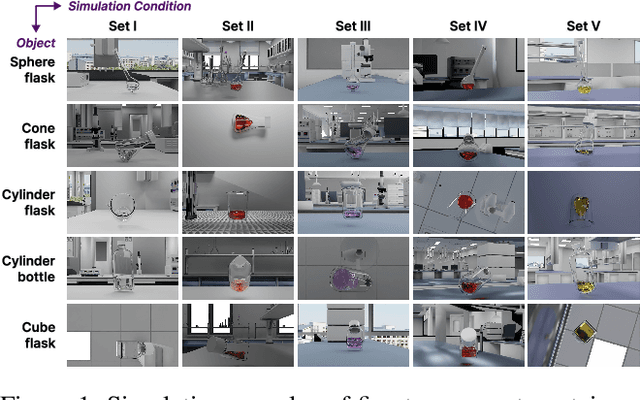
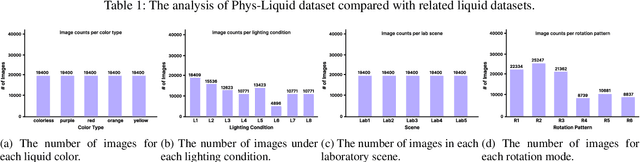
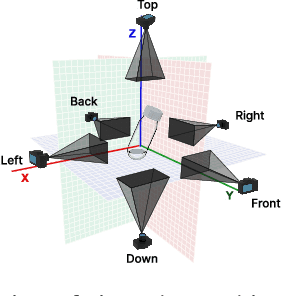

Estimating the geometric and volumetric properties of transparent deformable liquids is challenging due to optical complexities and dynamic surface deformations induced by container movements. Autonomous robots performing precise liquid manipulation tasks, such as dispensing, aspiration, and mixing, must handle containers in ways that inevitably induce these deformations, complicating accurate liquid state assessment. Current datasets lack comprehensive physics-informed simulation data representing realistic liquid behaviors under diverse dynamic scenarios. To bridge this gap, we introduce Phys-Liquid, a physics-informed dataset comprising 97,200 simulation images and corresponding 3D meshes, capturing liquid dynamics across multiple laboratory scenes, lighting conditions, liquid colors, and container rotations. To validate the realism and effectiveness of Phys-Liquid, we propose a four-stage reconstruction and estimation pipeline involving liquid segmentation, multi-view mask generation, 3D mesh reconstruction, and real-world scaling. Experimental results demonstrate improved accuracy and consistency in reconstructing liquid geometry and volume, outperforming existing benchmarks. The dataset and associated validation methods facilitate future advancements in transparent liquid perception tasks. The dataset and code are available at https://dualtransparency.github.io/Phys-Liquid/.