 Add to Chrome
 Add to Firefox
 Add to Edge
HAFI-VLM: A Frequency Perspective for Diagnosing and Enhancing Visual Perception in Vision-Language Models
Aug 03, 2026
Vision-language models (VLMs) remain unreliable when predictions require fine-grained visual evidence. We identify a previously overlooked cause: spectral response rigidity. Despite substantial frequency variation across images and tasks, pretrained vision encoders exhibit persistent, encoder-specific layerwise spectral profiles that change only marginally under downstream fine-tuning. Since pretrained vision encoders only receive images, they cannot adapt spectral extraction to the evidence required by the current query. We therefore propose HAFI-VLM, which introduces a task-conditioned frequency pathway while preserving the pretrained semantic representation. Hierarchical Adaptive Frequency Injection (HAFI) retrieves complementary low-, mid-, and high-frequency evidence at multiple encoder depths using text-modulated, spatially aligned cross-attention. A Visual Enrichment Layer Adapter further recalibrates shallow LLM attention to effectively utilize the enriched visual tokens. Experiments on LLaVA-1.5 and Qwen2.5-VL demonstrate consistent improvements in general VQA, text-rich understanding, and hallucination robustness, outperforming representation-level enhancement methods and most resolution- or cropping-based approaches without additional high-resolution encoding. Mechanistic analyses show that HAFI restores task-dependent spectral allocation while retaining semantic attention, establishing frequency enrichment as a distinct and effective route for improving VLM perception.

Look Where It Matters: Adaptive Visual Refinement for Vision-Language-Action Models
Aug 03, 2026Visual representations of VLA models remain unreliable for spatially precise robotic manipulation. We uncover that vision encoders in VLAs also exhibit attention artifacts previously documented in generic Vision Transformers, and further show that, in embodied policies, these artifacts are closely associated with spatial perception capabilities acquired during post-training. As the encoder learns task-relevant information such as object location, depth ordering, and local geometry, limited global-token capacity causes part of this information to spill into low-information patch tokens. We introduce AtVLA, a framework that inserts learnable register tokens into the visual encoder. Trained end-to-end using only embodied data and the original action objective, these registers emerge as dedicated carriers of embodied spatial information, while the remaining patch tokens recover clean and spatially faithful attention distributions crucial for precise target localization and fine-grained contact. Clean attention restores reliable localization, but cannot recover geometric details lost in low-resolution observations. AtVLA therefore couples attention rectification with uncertainty-gated local refinement. The action expert samples multiple action chunks and estimates uncertainty from their disagreement; only for uncertain predictions, action-conditioned attention rollout identifies the task-relevant region, which is cropped, re-encoded at high resolution, and appended to the cached prefix for refined action generation. Across LIBERO, SimplerEnv, and a challenging single-view real-world benchmark, AtVLA improves the average LIBERO success rate from 94.2% to 98.4% and real-world success from 46.5% to 69.0%. The cropping is triggered on approximately 30% of replanning steps, resulting in only 1.4-1.6x the total computation of the base model under the representative deployment setting.
Distill What RGB Can Recover: Privileged 3D Evidence for RGB-Only Vision-Language Models
Jul 31, 20263D scene understanding requires reasoning about entity existence, spatial layout, and object relations, yet RGB images alone often provide insufficient 3D cues. Existing 3D-VLMs commonly rely on depth or 3D-position-aware inputs at inference time, introducing additional acquisition, reconstruction, or annotation costs that limit RGB-only deployment. We therefore study how training-time 3D evidence can be converted into spatial reasoning capabilities retained under RGB-only inference. We propose a privileged-evidence distillation framework that constructs a distillable teacher through a unified evidence interface and controlled residual injection, and transfers its knowledge to a deployable student receiving only RGB images and questions through logit and structured representation distillation. To avoid imitating teacher signals unsupported by RGB, we further introduce evidence-sensitivity-guided distillation, which uses corrupted evidence to identify highly evidence-dependent targets and down-weight their supervision. We also define a recoverability decomposition based on the matched baseline, teacher, and student, separating privileged gains into RGB-recoverable improvements and residual teacher advantages. Across four benchmarks, the teacher achieves the best result on 7 of 11 reported metrics among the compared methods. The RGB-only student outperforms its matched baseline on all 11 metrics, including gains of 10.4 ScanQA CIDEr and 19.1 Scan2Cap CIDEr@0.5, without additional inference-time inputs. These results validate the effectiveness of training-time privileged 3D evidence distillation for both teacher performance and deployable RGB-only spatial reasoning. Separately, our matched baseline-teacher-student analysis characterizes privileged-gain transfer across evidence types and spatial skills.
CAST: Collapse-Aware multi-Scale Topology Fusion for Multimodal Coreset Selection
May 12, 2026The training of large multimodal models fundamentally relies on massive image-text datasets, which inevitably incur prohibitive computational overhead. Dataset selection offers a promising paradigm by identifying a highly informative coreset. However, existing approaches suffer from two critical limitations: (i) single-modality-dominated sampling methods, which ignore the fine-grained cross-modal information imbalance inherent in multimodal datasets and thus lead to semantic loss in the other modality; and (ii) coarse-grained sample-scoring-based sampling methods, where the selected coreset tends to be biased toward the scoring model, making it difficult to guarantee distributional equivalence between the coreset and the original dataset. Meanwhile, existing distribution matching and discrete sampling strategies often fail to jointly account for global semantic structure, local fine-grained details, and redundancy-aware coverage in dense regions. To this end, we propose CAST, a Collapse-Aware multi-Scale Topology fusion framework for multimodal coreset selection. We first construct image- and text-modality topologies, and derive a unified topology via local-collapse-aware refinement and cross-modal fusion. We then introduce a multi-scale distribution matching criterion in the diffusion wavelet domain, encouraging the coreset to approximate the original dataset at multiple scales. Finally, we introduce a local soft relational coverage mechanism that extends pure geometric coverage to relation-aware indirect coverage, penalizing redundant selections in dense clusters. Extensive experiments on Flickr30K and MS-COCO show that CAST outperforms existing dataset selection baselines, showcasing great superiority in cross-architecture generalization and energy efficiency over state-of-the-art multimodal synthesis methods.
GeGS-PCR: Effective and Robust 3D Point Cloud Registration with Two-Stage Color-Enhanced Geometric-3DGS Fusion
Apr 20, 2026We address the challenge of point cloud registration using color information, where traditional methods relying solely on geometric features often struggle in low-overlap and incomplete scenarios. To overcome these limitations, we propose GeGS-PCR, a novel two-stage method that combines geometric, color, and Gaussian information for robust registration. Our approach incorporates a dedicated color encoder that enhances color features by extracting multi-level geometric and color data from the original point cloud. We introduce the \textbf{Ge}ometric-3D\textbf{GS} module, which encodes the local neighborhood information of colored superpoints to ensure a globally invariant geometric-color context. Leveraging LORA optimization, we maintain high performance while preserving the expressiveness of 3DGS. Additionally, fast differentiable rendering is utilized to refine the registration process, leading to improved convergence. To further enhance performance, we propose a joint photometric loss that exploits both geometric and color features. This enables strong performance in challenging conditions with extremely low point cloud overlap. We validate our method by colorizing the Kitti dataset as ColorKitti and testing on both Color3DMatch and Color3DLoMatch datasets. Our method achieves state-of-the-art performance with \textit{Registration Recall} at 99.9\%, \textit{Relative Rotation Error} as low as 0.013, and \textit{Relative Translation Error} as low as 0.024, improving precision by at least a factor of 2.
MIND: From Passive Mimicry to Active Reasoning through Capability-Aware Multi-Perspective CoT Distillation
Jan 07, 2026While Large Language Models (LLMs) have emerged with remarkable capabilities in complex tasks through Chain-of-Thought reasoning, practical resource constraints have sparked interest in transferring these abilities to smaller models. However, achieving both domain performance and cross-domain generalization remains challenging. Existing approaches typically restrict students to following a single golden rationale and treat different reasoning paths independently. Due to distinct inductive biases and intrinsic preferences, alongside the student's evolving capacity and reasoning preferences during training, a teacher's "optimal" rationale could act as out-of-distribution noise. This misalignment leads to a degeneration of the student's latent reasoning distribution, causing suboptimal performance. To bridge this gap, we propose MIND, a capability-adaptive framework that transitions distillation from passive mimicry to active cognitive construction. We synthesize diverse teacher perspectives through a novel "Teaching Assistant" network. By employing a Feedback-Driven Inertia Calibration mechanism, this network utilizes inertia-filtered training loss to align supervision with the student's current adaptability, effectively enhancing performance while mitigating catastrophic forgetting. Extensive experiments demonstrate that MIND achieves state-of-the-art performance on both in-distribution and out-of-distribution benchmarks, and our sophisticated latent space analysis further confirms the mechanism of reasoning ability internalization.
DeepKD: A Deeply Decoupled and Denoised Knowledge Distillation Trainer
May 21, 2025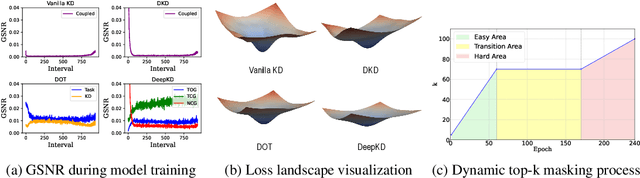
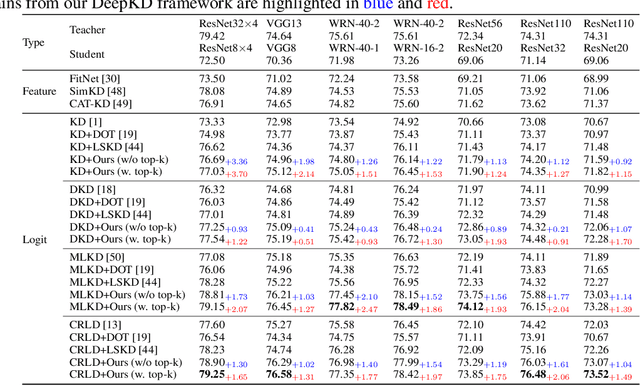
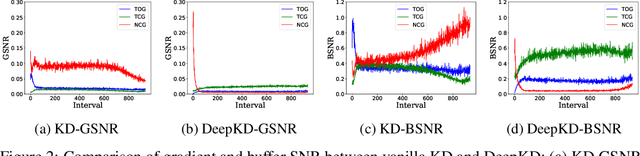
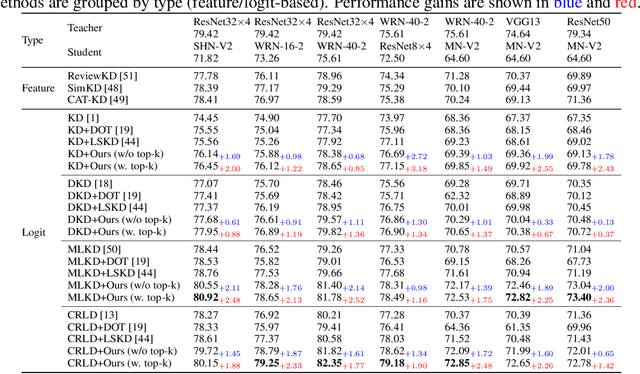
Recent advances in knowledge distillation have emphasized the importance of decoupling different knowledge components. While existing methods utilize momentum mechanisms to separate task-oriented and distillation gradients, they overlook the inherent conflict between target-class and non-target-class knowledge flows. Furthermore, low-confidence dark knowledge in non-target classes introduces noisy signals that hinder effective knowledge transfer. To address these limitations, we propose DeepKD, a novel training framework that integrates dual-level decoupling with adaptive denoising. First, through theoretical analysis of gradient signal-to-noise ratio (GSNR) characteristics in task-oriented and non-task-oriented knowledge distillation, we design independent momentum updaters for each component to prevent mutual interference. We observe that the optimal momentum coefficients for task-oriented gradient (TOG), target-class gradient (TCG), and non-target-class gradient (NCG) should be positively related to their GSNR. Second, we introduce a dynamic top-k mask (DTM) mechanism that gradually increases K from a small initial value to incorporate more non-target classes as training progresses, following curriculum learning principles. The DTM jointly filters low-confidence logits from both teacher and student models, effectively purifying dark knowledge during early training. Extensive experiments on CIFAR-100, ImageNet, and MS-COCO demonstrate DeepKD's effectiveness. Our code is available at https://github.com/haiduo/DeepKD.
A Self-supervised Learning Method for Raman Spectroscopy based on Masked Autoencoders
Apr 21, 2025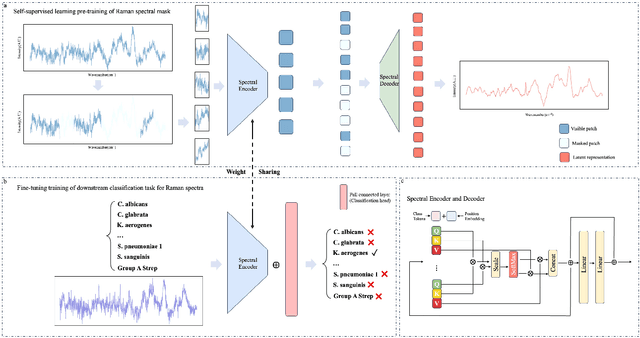
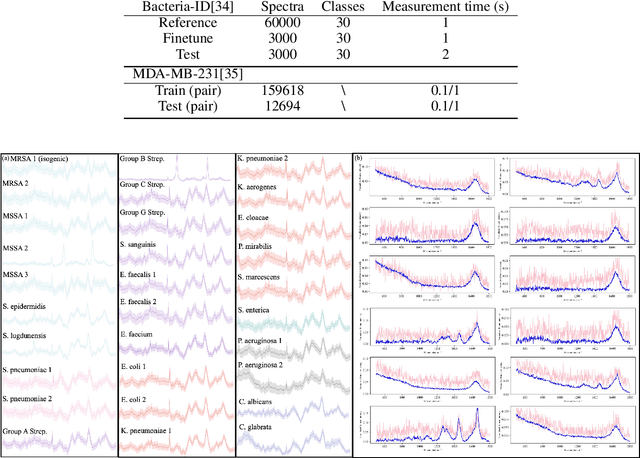

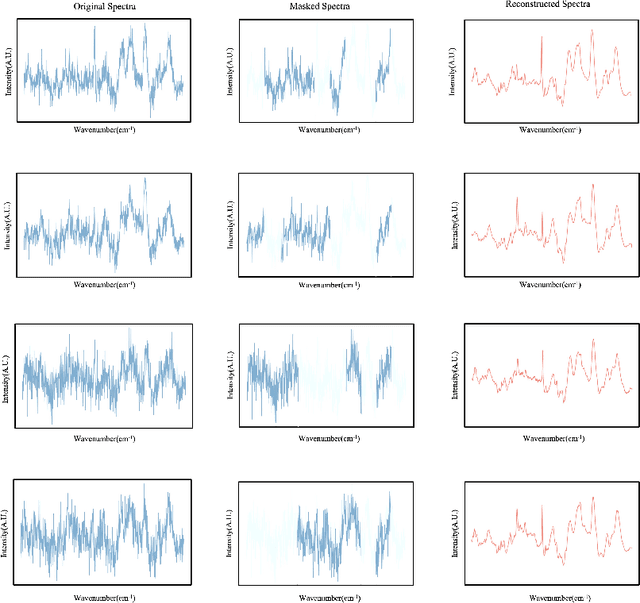
Raman spectroscopy serves as a powerful and reliable tool for analyzing the chemical information of substances. The integration of Raman spectroscopy with deep learning methods enables rapid qualitative and quantitative analysis of materials. Most existing approaches adopt supervised learning methods. Although supervised learning has achieved satisfactory accuracy in spectral analysis, it is still constrained by costly and limited well-annotated spectral datasets for training. When spectral annotation is challenging or the amount of annotated data is insufficient, the performance of supervised learning in spectral material identification declines. In order to address the challenge of feature extraction from unannotated spectra, we propose a self-supervised learning paradigm for Raman Spectroscopy based on a Masked AutoEncoder, termed SMAE. SMAE does not require any spectral annotations during pre-training. By randomly masking and then reconstructing the spectral information, the model learns essential spectral features. The reconstructed spectra exhibit certain denoising properties, improving the signal-to-noise ratio (SNR) by more than twofold. Utilizing the network weights obtained from masked pre-training, SMAE achieves clustering accuracy of over 80% for 30 classes of isolated bacteria in a pathogenic bacterial dataset, demonstrating significant improvements compared to classical unsupervised methods and other state-of-the-art deep clustering methods. After fine-tuning the network with a limited amount of annotated data, SMAE achieves an identification accuracy of 83.90% on the test set, presenting competitive performance against the supervised ResNet (83.40%).
KernelDNA: Dynamic Kernel Sharing via Decoupled Naive Adapters
Mar 30, 2025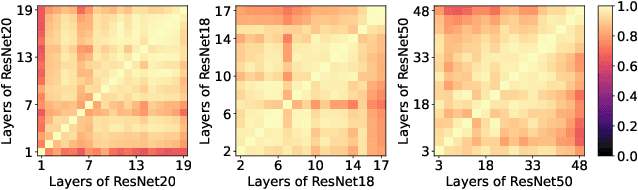
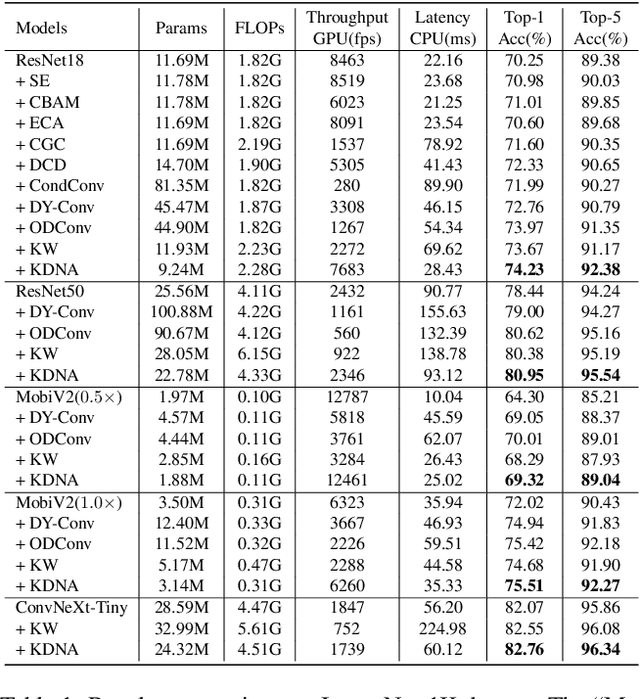
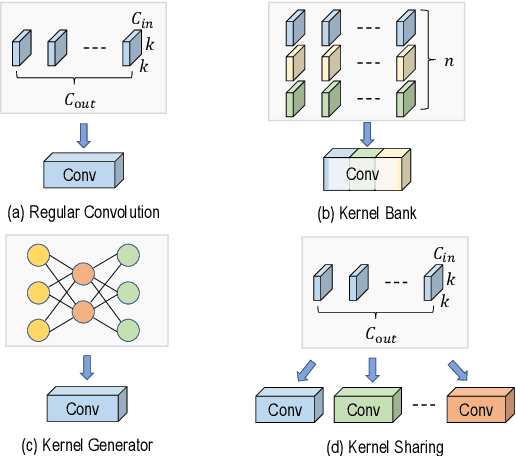
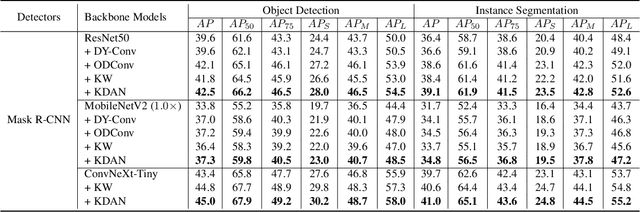
Dynamic convolution enhances model capacity by adaptively combining multiple kernels, yet faces critical trade-offs: prior works either (1) incur significant parameter overhead by scaling kernel numbers linearly, (2) compromise inference speed through complex kernel interactions, or (3) struggle to jointly optimize dynamic attention and static kernels. We also observe that pre-trained Convolutional Neural Networks (CNNs) exhibit inter-layer redundancy akin to that in Large Language Models (LLMs). Specifically, dense convolutional layers can be efficiently replaced by derived ``child" layers generated from a shared ``parent" convolutional kernel through an adapter. To address these limitations and implement the weight-sharing mechanism, we propose a lightweight convolution kernel plug-in, named KernelDNA. It decouples kernel adaptation into input-dependent dynamic routing and pre-trained static modulation, ensuring both parameter efficiency and hardware-friendly inference. Unlike existing dynamic convolutions that expand parameters via multi-kernel ensembles, our method leverages cross-layer weight sharing and adapter-based modulation, enabling dynamic kernel specialization without altering the standard convolution structure. This design preserves the native computational efficiency of standard convolutions while enhancing representation power through input-adaptive kernel adjustments. Experiments on image classification and dense prediction tasks demonstrate that KernelDNA achieves state-of-the-art accuracy-efficiency balance among dynamic convolution variants. Our codes are available at https://github.com/haiduo/KernelDNA.
Partial Convolution Meets Visual Attention
Mar 05, 2025Designing an efficient and effective neural network has remained a prominent topic in computer vision research. Depthwise onvolution (DWConv) is widely used in efficient CNNs or ViTs, but it needs frequent memory access during inference, which leads to low throughput. FasterNet attempts to introduce partial convolution (PConv) as an alternative to DWConv but compromises the accuracy due to underutilized channels. To remedy this shortcoming and consider the redundancy between feature map channels, we introduce a novel Partial visual ATtention mechanism (PAT) that can efficiently combine PConv with visual attention. Our exploration indicates that the partial attention mechanism can completely replace the full attention mechanism and reduce model parameters and FLOPs. Our PAT can derive three types of blocks: Partial Channel-Attention block (PAT_ch), Partial Spatial-Attention block (PAT_sp) and Partial Self-Attention block (PAT_sf). First, PAT_ch integrates the enhanced Gaussian channel attention mechanism to infuse global distribution information into the untouched channels of PConv. Second, we introduce the spatial-wise attention to the MLP layer to further improve model accuracy. Finally, we replace PAT_ch in the last stage with the self-attention mechanism to extend the global receptive field. Building upon PAT, we propose a novel hybrid network family, named PATNet, which achieves superior top-1 accuracy and inference speed compared to FasterNet on ImageNet-1K classification and excel in both detection and segmentation on the COCO dataset. Particularly, our PATNet-T2 achieves 1.3% higher accuracy than FasterNet-T2, while exhibiting 25% higher GPU throughput and 24% lower CPU latency.