 Add to Chrome
 Add to Firefox
 Add to Edge
RecoReward: Recommender-Guided Multimodal Description Generation for Recommendation
Jul 28, 2026
Multimodal large language models (MLLMs) can convert multimodal item content into structured descriptions used as semantic features for recommendation. Conventional content-only generation, however, cannot use downstream user signals to determine which semantics should be emphasized. Recent user-conditioned methods incorporate these signals through user histories or profiles, but they require user information at inference and make generation user-dependent. In this paper, we introduce RecoReward, which instead uses behavior-derived rewards during training and preserves content-only inference. To instantiate this idea in live-stream recommendation, we treat historically engaged users as a proxy for future target users and use observational non-target users to estimate affinity shared broadly across users. The Recommender Affinity Score (RAS) contrasts these signals to provide user-selective feedback for reinforcement learning, allowing the learned policy to generate a single shared description without user inputs. In our offline benchmark, RecoReward-9B outperforms its Qwen3.5-9B baseline and all other evaluated models across seven recall metrics. Online A/B testing also shows performance gains. These results show that RecoReward trains the MLLM to produce item features that benefit downstream recommendation while retaining content-only serving.

Staypoint Detection from Noisy Trajectory Data [Experiment Paper]
Jul 21, 2026Detecting staypoints from raw trajectory data is fundamental to numerous spatial computing applications. This process transforms raw numeric sequences of geolocations into semantically meaningful locations, such as homes, workplaces, or restaurants. Despite its importance for semantic trajectory analysis, staypoint detection lacks standard benchmarks, and existing algorithms have never been systematically evaluated. This gap persists because no publicly available datasets provide both raw individual trajectories and ground-truth staypoint annotations. This benchmark paper addresses this limitation with two key contributions: (1) we introduce 16 large-scale simulated datasets capturing thousands of agents with annotated staypoints across varying trajectory noise levels, and (2) we evaluate nine staypoint detection algorithms-including both state-of-the-art and novel methods-to analyze their robustness to noise. Our evaluation reveals that existing state-of-the-art algorithms perform poorly under realistic noise conditions. Conversely, our proposed unsupervised methods yield substantial improvements, while supervised approaches drastically outperform existing baselines. While these results are very promising, these datasets and methods are only meant as starting points for future research in staypoint detection.
Mobility Anomaly Generation using LLM-Driven Behavior with Kinematic Constraints
Jun 09, 2026Although the study of human trajectory anomalies is critical for advancing spatial data mining, empirical research remains severely hindered by a pervasive lack of ground-truth datasets. Despite the availability of several real-world and simulated human trajectory collections, these datasets exclusively capture normal mobility patterns and lack annotated anomalies. This specific scarcity is fundamentally driven by the inherent statistical rarity of anomalous events, precluding the feasibility of conventional observational methods. Compounding this challenge, the systematic acquisition of large-scale mobility data is strictly bottlenecked by prohibitive costs and stringent privacy regulations. To overcome these fundamental limitations and establish a reliable human trajectory anomalies dataset with annotated ground truth, we introduce a novel, end-to-end generative framework designed to synthesize realistic trajectory anomalies at scale. Our architecture bridges the gap between purely synthetic mobility data and complex real-world physical constraints by operating directly on baseline simulated trajectories. We employ Large Language Model (LLM) agents to systematically inject semantically meaningful behavioral anomalies such as irregular out-of-distribution check-ins and skipped routine visits. To ensure rigorous spatial validity, the system leverages map-constrained routing reconstruction to recalculate the physical transitions between these LLM agent-modified staypoints. Moreover, to narrow the simulation-to-reality gap, we augment the resulting trajectories with a context-aware spatial noise model, parameterized by environmental and location-specific variables, to accurately emulate heterogeneous GPS sensor degradation.
Strategic Advice in the Age of Personal AI
Mar 02, 2026Personal AI assistants have changed how people use institutional and professional advice. We study this new strategic setting in which individuals may stochastically consult a personal AI whose recommendation is predictable to the focal advisor. Personal AI enters this strategic environment along two dimensions: how often it is consulted and how much weight it receives in the human's decision when consulted. Anticipating this, the advisor responds by counteracting the personal AI recommendation. Counteraction becomes more aggressive as personal AI is consulted more often. Yet advisor performance is non-monotone: equilibrium loss is highest at intermediate levels of adoption and vanishes when personal AI is never used or always used. Trust affects performance through a single relative influence index, and greater relative influence of personal AI increases advisor vulnerability. Extending the framework to costly credibility building, we characterize how personal AI adoption reshapes incentives to invest in trust.
SARM: LLM-Augmented Semantic Anchor for End-to-End Live-Streaming Ranking
Feb 10, 2026Large-scale live-streaming recommendation requires precise modeling of non-stationary content semantics under strict real-time serving constraints. In industrial deployment, two common approaches exhibit fundamental limitations: discrete semantic abstractions sacrifice descriptive precision through clustering, while dense multimodal embeddings are extracted independently and remain weakly aligned with ranking optimization, limiting fine-grained content-aware ranking. To address these limitations, we propose \textbf{SARM}, an end-to-end ranking architecture that integrates natural-language semantic anchors directly into ranking optimization, enabling fine-grained author representations conditioned on multimodal content. Each semantic anchor is represented as learnable text tokens jointly optimized with ranking features, allowing the model to adapt content descriptions to ranking objectives. A lightweight dual-token gated design captures domain-specific live-streaming semantics, while an asymmetric deployment strategy preserves low-latency online training and serving. Extensive offline evaluation and large-scale A/B tests show consistent improvements over production baselines. SARM is fully deployed and serves over 400 million users daily.
QARM V2: Quantitative Alignment Multi-Modal Recommendation for Reasoning User Sequence Modeling
Feb 09, 2026With the evolution of large language models (LLMs), there is growing interest in leveraging their rich semantic understanding to enhance industrial recommendation systems (RecSys). Traditional RecSys relies on ID-based embeddings for user sequence modeling in the General Search Unit (GSU) and Exact Search Unit (ESU) paradigm, which suffers from low information density, knowledge isolation, and weak generalization ability. While LLMs offer complementary strengths with dense semantic representations and strong generalization, directly applying LLM embeddings to RecSys faces critical challenges: representation unmatch with business objectives and representation unlearning end-to-end with downstream tasks. In this paper, we present QARM V2, a unified framework that bridges LLM semantic understanding with RecSys business requirements for user sequence modeling.
OneLive: Dynamically Unified Generative Framework for Live-Streaming Recommendation
Feb 09, 2026Live-streaming recommender system serves as critical infrastructure that bridges the patterns of real-time interactions between users and authors. Similar to traditional industrial recommender systems, live-streaming recommendation also relies on cascade architectures to support large-scale concurrency. Recent advances in generative recommendation unify the multi-stage recommendation process with Transformer-based architectures, offering improved scalability and higher computational efficiency. However, the inherent complexity of live-streaming prevents the direct transfer of these methods to live-streaming scenario, where continuously evolving content, limited lifecycles, strict real-time constraints, and heterogeneous multi-objectives introduce unique challenges that invalidate static tokenization and conventional model framework. To address these issues, we propose OneLive, a dynamically unified generative recommendation framework tailored for live-streaming scenario. OneLive integrates four key components: (i) A Dynamic Tokenizer that continuously encodes evolving real-time live content fused with behavior signal through residual quantization; (ii) A Time-Aware Gated Attention mechanism that explicitly models temporal dynamics for timely decision making; (iii) An efficient decoder-only generative architecture enhanced with Sequential MTP and QK Norm for stable training and accelerated inference; (iv) A Unified Multi-Objective Alignment Framework reinforces policy optimization for personalized preferences.
LLM-Alignment Live-Streaming Recommendation
Apr 07, 2025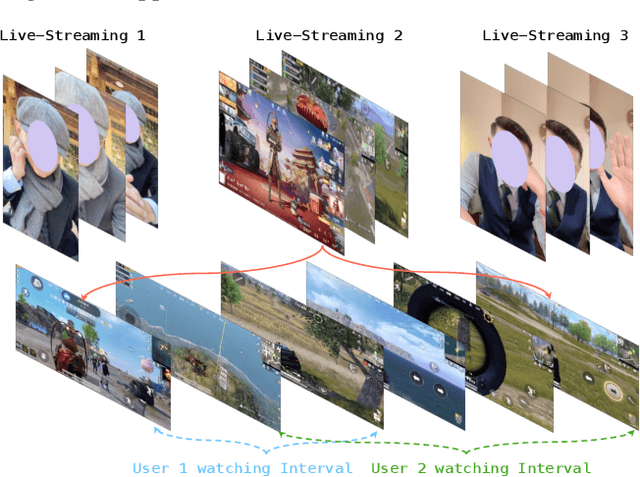
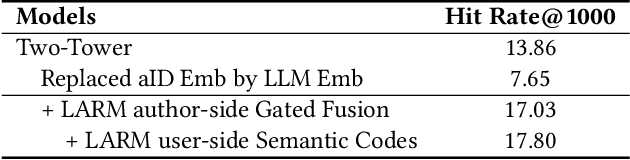
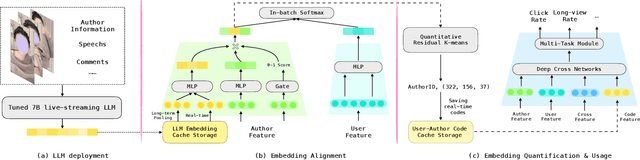

In recent years, integrated short-video and live-streaming platforms have gained massive global adoption, offering dynamic content creation and consumption. Unlike pre-recorded short videos, live-streaming enables real-time interaction between authors and users, fostering deeper engagement. However, this dynamic nature introduces a critical challenge for recommendation systems (RecSys): the same live-streaming vastly different experiences depending on when a user watching. To optimize recommendations, a RecSys must accurately interpret the real-time semantics of live content and align them with user preferences.
FARM: Frequency-Aware Model for Cross-Domain Live-Streaming Recommendation
Feb 13, 2025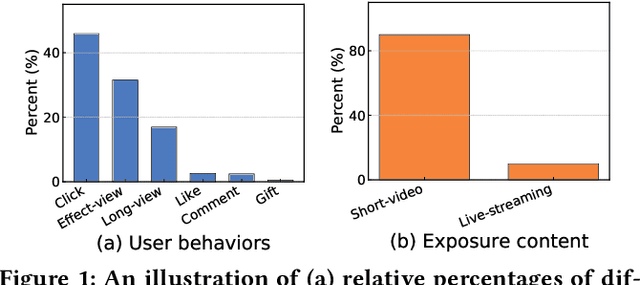
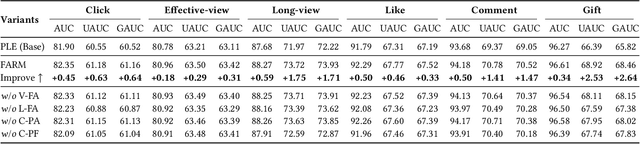
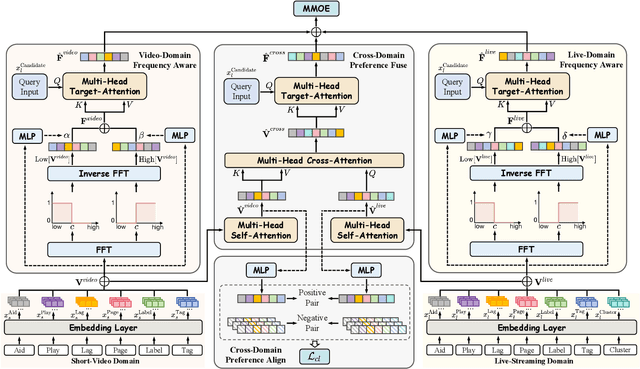
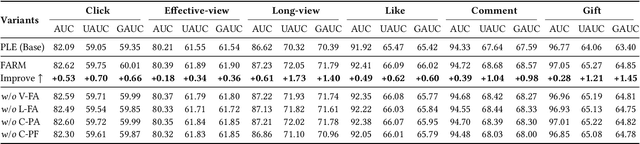
Live-streaming services have attracted widespread popularity due to their real-time interactivity and entertainment value. Users can engage with live-streaming authors by participating in live chats, posting likes, or sending virtual gifts to convey their preferences and support. However, the live-streaming services faces serious data-sparsity problem, which can be attributed to the following two points: (1) User's valuable behaviors are usually sparse, e.g., like, comment and gift, which are easily overlooked by the model, making it difficult to describe user's personalized preference. (2) The main exposure content on our platform is short-video, which is 9 times higher than the exposed live-streaming, leading to the inability of live-streaming content to fully model user preference. To this end, we propose a Frequency-Aware Model for Cross-Domain Live-Streaming Recommendation, termed as FARM. Specifically, we first present the intra-domain frequency aware module to enable our model to perceive user's sparse yet valuable behaviors, i.e., high-frequency information, supported by the Discrete Fourier Transform (DFT). To transfer user preference across the short-video and live-streaming domains, we propose a novel preference align before fuse strategy, which consists of two parts: the cross-domain preference align module to align user preference in both domains with contrastive learning, and the cross-domain preference fuse module to further fuse user preference in both domains using a serious of tailor-designed attention mechanisms. Extensive offline experiments and online A/B testing on Kuaishou live-streaming services demonstrate the effectiveness and superiority of FARM. Our FARM has been deployed in online live-streaming services and currently serves hundreds of millions of users on Kuaishou.
Neural Collaborative Filtering to Detect Anomalies in Human Semantic Trajectories
Sep 27, 2024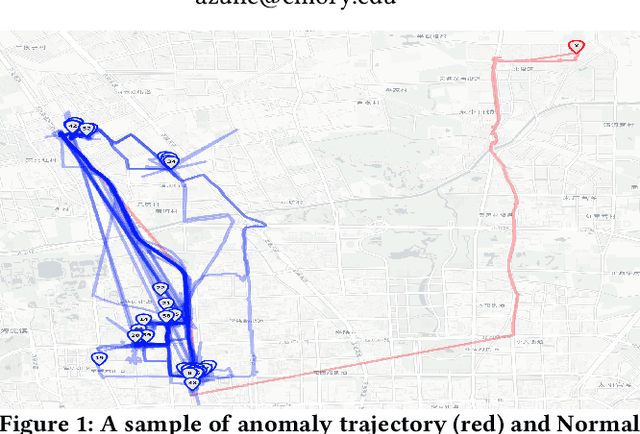
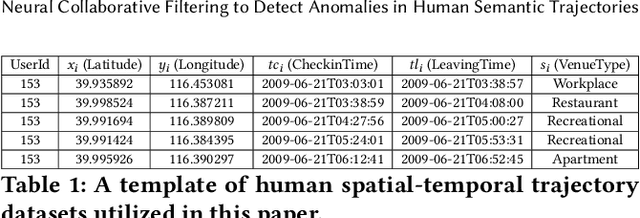
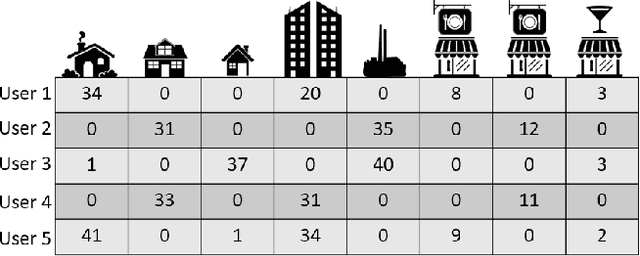
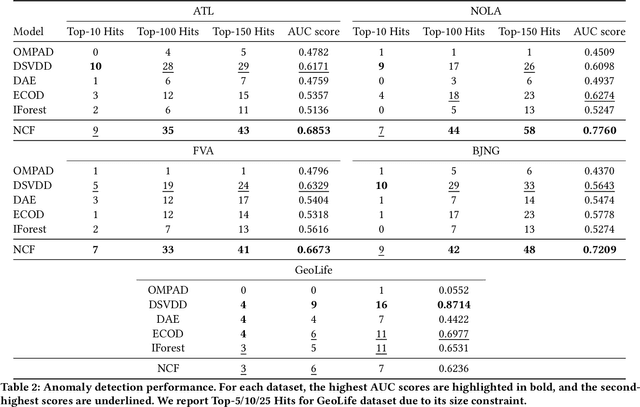
Human trajectory anomaly detection has become increasingly important across a wide range of applications, including security surveillance and public health. However, existing trajectory anomaly detection methods are primarily focused on vehicle-level traffic, while human-level trajectory anomaly detection remains under-explored. Since human trajectory data is often very sparse, machine learning methods have become the preferred approach for identifying complex patterns. However, concerns regarding potential biases and the robustness of these models have intensified the demand for more transparent and explainable alternatives. In response to these challenges, our research focuses on developing a lightweight anomaly detection model specifically designed to detect anomalies in human trajectories. We propose a Neural Collaborative Filtering approach to model and predict normal mobility. Our method is designed to model users' daily patterns of life without requiring prior knowledge, thereby enhancing performance in scenarios where data is sparse or incomplete, such as in cold start situations. Our algorithm consists of two main modules. The first is the collaborative filtering module, which applies collaborative filtering to model normal mobility of individual humans to places of interest. The second is the neural module, responsible for interpreting the complex spatio-temporal relationships inherent in human trajectory data. To validate our approach, we conducted extensive experiments using simulated and real-world datasets comparing to numerous state-of-the-art trajectory anomaly detection approaches.