 Add to Chrome
 Add to Firefox
 Add to Edge
CMSL: Constructive Multi-Sequence Learning for Recommendation Systems
Jun 26, 2026
Sequence learning has emerged as the promising paradigm in recommendation systems, surpassing traditional Deep Learning Recommendation Models (DLRM) by capturing the temporal nuances of user behavior. However, current state-of-the-art architectures operate under a limiting analogy: they treat user history as a monolithic chronological sequence like a sentence in a Large Language Model (LLM). We observe a fundamental divergence between natural language and recommendation data: unlike the linear, logical flow of text, user history is inherently multi-faceted. A user's journey is a fragmented reflection of diverse interests, resulting in much weaker coherence between items than is found in LLM training data. This lack of structural unity leads to context pollution. In single-sequence modeling, unrelated behaviors compete for the same attention budget. This "noisy" signal dilutes the model's focus, effectively capping its ability to discern high-intent patterns from background activity. To address this, we propose Constructive Multi-Sequence Learning (CMSL), a paradigm shift from passive sequence ingestion to active "context engineering" that constructs multiple coherent sequences in latent space. CMSL leverages a learnable Sequence Construction Module to disentangle user history into "pure" thematic strands, followed by a linear attention mechanism to efficiently model these strands at scale. CMSL has been deployed across ranking and retrieval tasks and across four major surfaces at Meta.

RankGraph-2: Lifecycle Co-Design for Billion-Node Graph Learning in Recommendation
Jun 16, 2026Graph-based retrieval at billion-node scale requires jointly solving three tightly coupled problems -- graph construction, representation learning, and real-time serving -- yet existing work addresses each in isolation. We present RankGraph-2, a framework deployed at Meta that co-designs all three lifecycle stages for similarity-based retrieval (U2U2I and U2I2I), where each stage's requirements shape the others. Serving requires a co-learned cluster index to avoid expensive online KNN -- this pushes index co-training into the training objective. Training benefits from the observation that similarity-based retrieval tolerates pre-computed neighborhoods, eliminating online graph infrastructure -- this requires construction to produce self-contained data. Construction must also support hour-level refresh for item coverage. Acting on these cascading requirements, RankGraph-2 reduces hundreds of trillions of edges to hundreds of billions via subsampling with popularity bias correction, pre-computes multi-hop neighborhoods via personalized PageRank, and co-learns a residual-quantization cluster index that reduces serving computational cost by 83%. This lifecycle co-design enables a simple architecture to achieve 3.8 x higher recall than a GAT + Deep Graph Infomax model on a bipartite graph and 2.1 x higher than PyTorch-BigGraph on item retrieval. RankGraph-2 delivers up to +0.96% CTR and +2.75% CVR, and has powered 20+ retrieval launches across major surfaces.
DUET -- Dual User Embedding Transformers for Offsite Conversion Prediction
Jun 08, 2026Offsite conversion rate (OCVR) prediction is an important ranking problem in computational recommendation systems. This task presents a modeling challenge: click signals are abundant and exhibit short temporal horizons, whereas conversion signals are inherently sparse, long-delayed, and frequently unattributed. Despite these statistical disparities, both signal types must inform models that operate within strict serving-latency constraints. Prior pre-training approaches address this heterogeneity with a single, undifferentiated encoder applied uniformly across both data streams. We propose DUET (Dual User Embedding Transformers), a framework that explicitly partitions user behavioral data into two domain-coherent streams -- clicks and conversions -- and pre-trains dedicated transformer encoders with architectures tailored to each stream's statistical characteristics: multi-layer self-attention for the dense click stream and interleaved cross- and self-attention for the sparse conversion stream. The resulting complementary embeddings are jointly consumed by a downstream ranker without exceeding serving-latency budgets. Evaluation demonstrates up to 0.38% normalized entropy (NE) reduction relative to the strongest baseline, and A/B test shows consistent improvements in OCVR prediction accuracy.
Memento: Personalized RAG-Style Long-Retention Data Scaling for META Ads Recommendation
May 22, 2026Modeling of long history data suffers from long-context window attention dilution, system efficiency and catastrophic forgetting problems, where naive linear scaling approach like LastN would fail. We introduce Memento, a personalized retrieval-augmented framework that treats historical user engagements as a document corpus and ad requests as queries, retrieving relevant interactions via Maximal Marginal Relevance (MMR) to balance similarity with diversity. We identify two complementary applications: Representation Memento, which retrieves historical embeddings for feature augmentation, and Data Memento, which retrieves past training examples for multipass training. Through infrastructure co-design -- temporal chunking, INT8 quantization, and asynchronous serving -- Memento achieves 5-10$\times$ resource efficiency over linear scaling. Memento processes daily requests with sub-10ms latency, yielding 0.25-0.3% Normalized Entropy gain on both click-through and conversion prediction. In production, Memento delivers a 1% CTR lift on Facebook Feed and Reels and a 1.2% CVR lift, scaling personalization to 365+ days of history.
LLaTTE: Scaling Laws for Multi-Stage Sequence Modeling in Large-Scale Ads Recommendation
Jan 27, 2026We present LLaTTE (LLM-Style Latent Transformers for Temporal Events), a scalable transformer architecture for production ads recommendation. Through systematic experiments, we demonstrate that sequence modeling in recommendation systems follows predictable power-law scaling similar to LLMs. Crucially, we find that semantic features bend the scaling curve: they are a prerequisite for scaling, enabling the model to effectively utilize the capacity of deeper and longer architectures. To realize the benefits of continued scaling under strict latency constraints, we introduce a two-stage architecture that offloads the heavy computation of large, long-context models to an asynchronous upstream user model. We demonstrate that upstream improvements transfer predictably to downstream ranking tasks. Deployed as the largest user model at Meta, this multi-stage framework drives a 4.3\% conversion uplift on Facebook Feed and Reels with minimal serving overhead, establishing a practical blueprint for harnessing scaling laws in industrial recommender systems.
Async Learned User Embeddings for Ads Delivery Optimization
Jun 09, 2024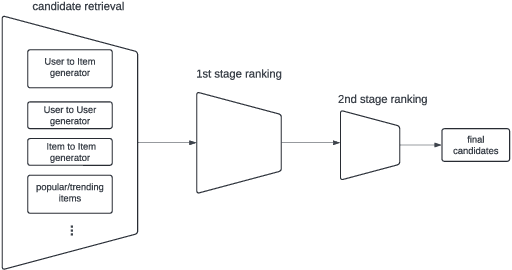
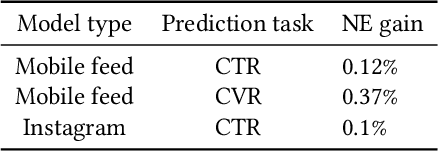
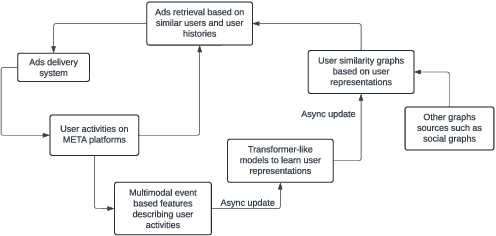
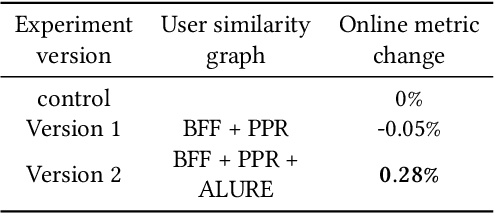
User representation is crucial for recommendation systems as it helps to deliver personalized recommendations by capturing user preferences and behaviors in low-dimensional vectors. High-quality user embeddings can capture subtle preferences, enable precise similarity calculations, and adapt to changing preferences over time to maintain relevance. The effectiveness of recommendation systems depends significantly on the quality of user embedding. We propose to asynchronously learn high fidelity user embeddings for billions of users each day from sequence based multimodal user activities in Meta platforms through a Transformer-like large scale feature learning module. The async learned user representations embeddings (ALURE) are further converted to user similarity graphs through graph learning and then combined with user realtime activities to retrieval highly related ads candidates for the entire ads delivery system. Our method shows significant gains in both offline and online experiments.
Scaling User Modeling: Large-scale Online User Representations for Ads Personalization in Meta
Nov 16, 2023


Effective user representations are pivotal in personalized advertising. However, stringent constraints on training throughput, serving latency, and memory, often limit the complexity and input feature set of online ads ranking models. This challenge is magnified in extensive systems like Meta's, which encompass hundreds of models with diverse specifications, rendering the tailoring of user representation learning for each model impractical. To address these challenges, we present Scaling User Modeling (SUM), a framework widely deployed in Meta's ads ranking system, designed to facilitate efficient and scalable sharing of online user representation across hundreds of ads models. SUM leverages a few designated upstream user models to synthesize user embeddings from massive amounts of user features with advanced modeling techniques. These embeddings then serve as inputs to downstream online ads ranking models, promoting efficient representation sharing. To adapt to the dynamic nature of user features and ensure embedding freshness, we designed SUM Online Asynchronous Platform (SOAP), a latency free online serving system complemented with model freshness and embedding stabilization, which enables frequent user model updates and online inference of user embeddings upon each user request. We share our hands-on deployment experiences for the SUM framework and validate its superiority through comprehensive experiments. To date, SUM has been launched to hundreds of ads ranking models in Meta, processing hundreds of billions of user requests daily, yielding significant online metric gains and infrastructure cost savings.