 Add to Chrome
 Add to Firefox
 Add to Edge
Learning to Generate and Extract: A Multi-Agent Collaboration Framework For Zero-shot Document-level Event Arguments Extraction
Mar 04, 2026
Document-level event argument extraction (DEAE) is essential for knowledge acquisition, aiming to extract participants of events from documents . In the zero-shot setting, existing methods employ LLMs to generate synthetic data to address the challenge posed by the scarcity of annotated data. However, relying solely on Event-type-only prompts makes it difficult for the generated content to accurately capture the contextual and structural relationships of unseen events. Moreover, ensuring the reliability and usability of synthetic data remains a significant challenge due to the absence of quality evaluation mechanisms. To this end, we introduce a multi-agent collaboration framework for zero-shot document-level event argument extraction (ZS-DEAE), which simulates the human collaborative cognitive process of "Propose-Evaluate-Revise." Specifically, the framework comprises a generation agent and an evaluation agent. The generation agent synthesizes data for unseen events by leveraging knowledge from seen events, while the evaluation agent extracts arguments from the synthetic data and assesses their semantic consistency with the context. The evaluation results are subsequently converted into reward signals, with event structure constraints incorporated into the reward design to enable iterative optimization of both agents via reinforcement learning.In three zero-shot scenarios constructed from the RAMS and WikiEvents datasets, our method achieves improvements both in data generation quality and argument extraction performance, while the generated data also effectively enhances the zero-shot performance of other DEAE models.

Chain Of Thought Compression: A Theoritical Analysis
Jan 29, 2026Chain-of-Thought (CoT) has unlocked advanced reasoning abilities of Large Language Models (LLMs) with intermediate steps, yet incurs prohibitive computational costs due to generation of extra tokens. Recent studies empirically show that compressing reasoning steps into latent states, or implicit CoT compression, offers a token-efficient alternative. However, the mechanism behind CoT compression remains unclear. In this paper, we provide the first theoretical analysis of the difficulty of learning to internalize intermediate reasoning steps. By introducing Order-r Interaction, we prove that the learning signal for high-order logical dependencies exponentially decays to solve irreducible problem, where skipping intermediate steps inevitably leads to high-order interaction barriers. To empirically validate this, we introduce NatBool-DAG, a challenging benchmark designed to enforce irreducible logical reasoning and eliminate semantic shortcuts. Guided by our theoretical findings, we propose ALiCoT (Aligned Implicit CoT), a novel framework that overcomes the signal decay by aligning latent token distributions with intermediate reasoning states. Experimental results demonstrate that ALiCoT successfully unlocks efficient reasoning: it achieves a 54.4x speedup while maintaining performance comparable to explicit CoT.
LogicScore: Fine-grained Logic Evaluation of Conciseness, Completeness, and Determinateness in Attributed Question Answering
Jan 22, 2026Current evaluation methods for Attributed Question Answering (AQA) suffer from \textit{attribution myopia}: they emphasize verification of isolated statements and their attributions but overlook the global logical integrity of long-form answers. Consequently, Large Language Models (LLMs) often produce factually grounded yet logically incoherent responses with elusive deductive gaps. To mitigate this limitation, we present \textsc{LogicScore}, a unified evaluation framework that shifts the paradigm from local assessment to global reasoning scrutiny. Grounded in Horn Rules, our approach integrates a backward verification mechanism to systematically evaluate three key reasoning dimensions: \textit{Completeness} (logically sound deduction), \textit{Conciseness} (non-redundancy), and \textit{Determinateness} (consistent answer entailment). Extensive experiments across three multi-hop QA datasets (HotpotQA, MusiQue, and 2WikiMultiHopQA) and over 20 LLMs (including GPT-5, Gemini-3-Pro, LLaMA3, and task-specific tuned models) reveal a critical capability gap: leading models often achieve high attribution scores (e.g., 92.85\% precision for Gemini-3 Pro) but struggle with global reasoning quality (e.g., 35.11\% Conciseness for Gemini-3 Pro). Our work establishes a robust standard for logical evaluation, highlighting the need to prioritize reasoning coherence alongside factual grounding in LLM development. Codes are available at: https://github.com/zhichaoyan11/LogicScore.
\textsc{LogicScore}: Fine-grained Logic Evaluation of Conciseness, Completeness, and Determinateness in Attributed Question Answering
Jan 21, 2026Current evaluation methods for Attributed Question Answering (AQA) suffer from \textit{attribution myopia}: they emphasize verification of isolated statements and their attributions but overlook the global logical integrity of long-form answers. Consequently, Large Language Models (LLMs) often produce factually grounded yet logically incoherent responses with elusive deductive gaps. To mitigate this limitation, we present \textsc{LogicScore}, a unified evaluation framework that shifts the paradigm from local assessment to global reasoning scrutiny. Grounded in Horn Rules, our approach integrates a backward verification mechanism to systematically evaluate three key reasoning dimensions: \textit{Completeness} (logically sound deduction), \textit{Conciseness} (non-redundancy), and \textit{Determinateness} (consistent answer entailment). Extensive experiments across three multi-hop QA datasets (HotpotQA, MusiQue, and 2WikiMultiHopQA) and over 20 LLMs (including GPT-5, Gemini-3-Pro, LLaMA3, and task-specific tuned models) reveal a critical capability gap: leading models often achieve high attribution scores (e.g., 92.85\% precision for Gemini-3 Pro) but struggle with global reasoning quality (e.g., 35.11\% Conciseness for Gemini-3 Pro). Our work establishes a robust standard for logical evaluation, highlighting the need to prioritize reasoning coherence alongside factual grounding in LLM development. Codes are available at: https://github.com/zhichaoyan11/LogicScore.
Uncovering and Mitigating Transient Blindness in Multimodal Model Editing
Nov 17, 2025Multimodal Model Editing (MMED) aims to correct erroneous knowledge in multimodal models. Existing evaluation methods, adapted from textual model editing, overstate success by relying on low-similarity or random inputs, obscure overfitting. We propose a comprehensive locality evaluation framework, covering three key dimensions: random-image locality, no-image locality, and consistent-image locality, operationalized through seven distinct data types, enabling a detailed and structured analysis of multimodal edits. We introduce De-VQA, a dynamic evaluation for visual question answering, uncovering a phenomenon we term transient blindness, overfitting to edit-similar text while ignoring visuals. Token analysis shows edits disproportionately affect textual tokens. We propose locality-aware adversarial losses to balance cross-modal representations. Empirical results demonstrate that our approach consistently outperforms existing baselines, reducing transient blindness and improving locality by 17% on average.
Memorization $ eq$ Understanding: Do Large Language Models Have the Ability of Scenario Cognition?
Sep 05, 2025Driven by vast and diverse textual data, large language models (LLMs) have demonstrated impressive performance across numerous natural language processing (NLP) tasks. Yet, a critical question persists: does their generalization arise from mere memorization of training data or from deep semantic understanding? To investigate this, we propose a bi-perspective evaluation framework to assess LLMs' scenario cognition - the ability to link semantic scenario elements with their arguments in context. Specifically, we introduce a novel scenario-based dataset comprising diverse textual descriptions of fictional facts, annotated with scenario elements. LLMs are evaluated through their capacity to answer scenario-related questions (model output perspective) and via probing their internal representations for encoded scenario elements-argument associations (internal representation perspective). Our experiments reveal that current LLMs predominantly rely on superficial memorization, failing to achieve robust semantic scenario cognition, even in simple cases. These findings expose critical limitations in LLMs' semantic understanding and offer cognitive insights for advancing their capabilities.
Explaining Black-box Language Models with Knowledge Probing Systems: A Post-hoc Explanation Perspective
Aug 23, 2025Pre-trained Language Models (PLMs) are trained on large amounts of unlabeled data, yet they exhibit remarkable reasoning skills. However, the trustworthiness challenges posed by these black-box models have become increasingly evident in recent years. To alleviate this problem, this paper proposes a novel Knowledge-guided Probing approach called KnowProb in a post-hoc explanation way, which aims to probe whether black-box PLMs understand implicit knowledge beyond the given text, rather than focusing only on the surface level content of the text. We provide six potential explanations derived from the underlying content of the given text, including three knowledge-based understanding and three association-based reasoning. In experiments, we validate that current small-scale (or large-scale) PLMs only learn a single distribution of representation, and still face significant challenges in capturing the hidden knowledge behind a given text. Furthermore, we demonstrate that our proposed approach is effective for identifying the limitations of existing black-box models from multiple probing perspectives, which facilitates researchers to promote the study of detecting black-box models in an explainable way.
Path-Adaptive Matting for Efficient Inference Under Various Computational Cost Constraints
Mar 05, 2025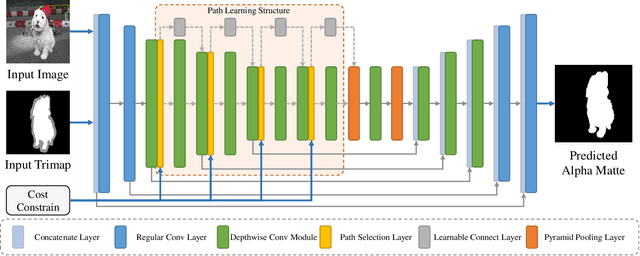
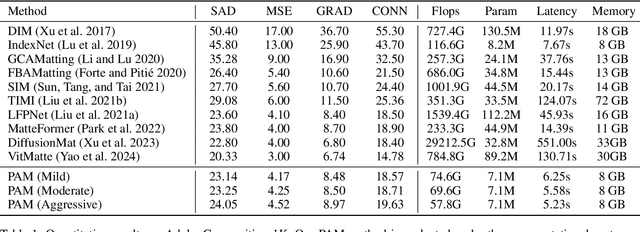
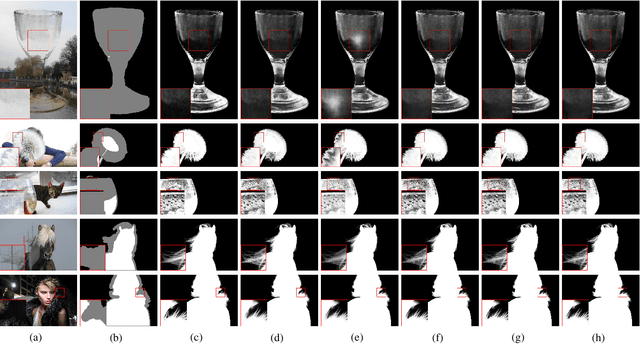
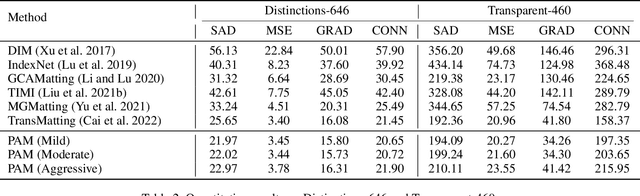
In this paper, we explore a novel image matting task aimed at achieving efficient inference under various computational cost constraints, specifically FLOP limitations, using a single matting network. Existing matting methods which have not explored scalable architectures or path-learning strategies, fail to tackle this challenge. To overcome these limitations, we introduce Path-Adaptive Matting (PAM), a framework that dynamically adjusts network paths based on image contexts and computational cost constraints. We formulate the training of the computational cost-constrained matting network as a bilevel optimization problem, jointly optimizing the matting network and the path estimator. Building on this formalization, we design a path-adaptive matting architecture by incorporating path selection layers and learnable connect layers to estimate optimal paths and perform efficient inference within a unified network. Furthermore, we propose a performance-aware path-learning strategy to generate path labels online by evaluating a few paths sampled from the prior distribution of optimal paths and network estimations, enabling robust and efficient online path learning. Experiments on five image matting datasets demonstrate that the proposed PAM framework achieves competitive performance across a range of computational cost constraints.
Multi-level Matching Network for Multimodal Entity Linking
Dec 11, 2024Multimodal entity linking (MEL) aims to link ambiguous mentions within multimodal contexts to corresponding entities in a multimodal knowledge base. Most existing approaches to MEL are based on representation learning or vision-and-language pre-training mechanisms for exploring the complementary effect among multiple modalities. However, these methods suffer from two limitations. On the one hand, they overlook the possibility of considering negative samples from the same modality. On the other hand, they lack mechanisms to capture bidirectional cross-modal interaction. To address these issues, we propose a Multi-level Matching network for Multimodal Entity Linking (M3EL). Specifically, M3EL is composed of three different modules: (i) a Multimodal Feature Extraction module, which extracts modality-specific representations with a multimodal encoder and introduces an intra-modal contrastive learning sub-module to obtain better discriminative embeddings based on uni-modal differences; (ii) an Intra-modal Matching Network module, which contains two levels of matching granularity: Coarse-grained Global-to-Global and Fine-grained Global-to-Local, to achieve local and global level intra-modal interaction; (iii) a Cross-modal Matching Network module, which applies bidirectional strategies, Textual-to-Visual and Visual-to-Textual matching, to implement bidirectional cross-modal interaction. Extensive experiments conducted on WikiMEL, RichpediaMEL, and WikiDiverse datasets demonstrate the outstanding performance of M3EL when compared to the state-of-the-art baselines.
Atomic Fact Decomposition Helps Attributed Question Answering
Oct 22, 2024


Attributed Question Answering (AQA) aims to provide both a trustworthy answer and a reliable attribution report for a given question. Retrieval is a widely adopted approach, including two general paradigms: Retrieval-Then-Read (RTR) and post-hoc retrieval. Recently, Large Language Models (LLMs) have shown remarkable proficiency, prompting growing interest in AQA among researchers. However, RTR-based AQA often suffers from irrelevant knowledge and rapidly changing information, even when LLMs are adopted, while post-hoc retrieval-based AQA struggles with comprehending long-form answers with complex logic, and precisely identifying the content needing revision and preserving the original intent. To tackle these problems, this paper proposes an Atomic fact decomposition-based Retrieval and Editing (ARE) framework, which decomposes the generated long-form answers into molecular clauses and atomic facts by the instruction-tuned LLMs. Notably, the instruction-tuned LLMs are fine-tuned using a well-constructed dataset, generated from large scale Knowledge Graphs (KGs). This process involves extracting one-hop neighbors from a given set of entities and transforming the result into coherent long-form text. Subsequently, ARE leverages a search engine to retrieve evidences related to atomic facts, inputting these evidences into an LLM-based verifier to determine whether the facts require expansion for re-retrieval or editing. Furthermore, the edited facts are backtracked into the original answer, with evidence aggregated based on the relationship between molecular clauses and atomic facts. Extensive evaluations demonstrate the superior performance of our proposed method over the state-of-the-arts on several datasets, with an additionally proposed new metric $Attr_{p}$ for evaluating the precision of evidence attribution.