 Add to Chrome
 Add to Firefox
 Add to Edge
Frontis-MA1: Training an AI4AI Model towards Recursive Self-Improvement in Machine Learning Engineering
Jul 30, 2026
Recursive self-improvement (RSI) requires AI systems that improve the process of building AI (i.e., AI4AI); machine learning engineering (MLE) offers a concrete, executable testbed for studying this capability. We introduce OpenMLE, an open full-stack system for RSI research in MLE, spanning verifiable task environments with execution feedback (OpenMLE-Gym), operator learning (OpenMLE-RL), and long-horizon search (OpenMLE-Evo). On this stack we post-train Frontis-MA1 (35B) as a meta-evolution agent for MLE, aligning post-training and inference around four atomic program-evolution operators (Draft, Improve, Debug, Crossover): the same operators are trained via execution-grounded SFT and RL on data deduplicated against all evaluation benchmarks, then composed into long-horizon search, coupling learning and evolution in a single loop. On MLE-Bench Lite under a 12-hour per-task budget on one RTX 4090 capped at 12 GB VRAM, Frontis-MA1 (35B) improves Medal Average from 39.39% to 60.61% over its base model with OpenMLE-Evo, and reaches 71.21% with OpenMLE-Evo-Max (benchmark-independent experience priors and asynchronous search), exceeding GPT-5.5 + Codex and approaching GPT-5.6 Sol and the 2.8T Kimi K3. On held-out NatureBench Lite, both components transfer: with the framework fixed, swapping in the trained model raises Match-SOTA from 50% to 70%; with the model fixed, swapping in OpenMLE-Evo raises it from 20% to 50%. We release the model weights and the full OpenMLE stack to enable reproducible research on executable AI4AI toward RSI. Code: https://github.com/FrontisAI/OpenRSI

CMSL: Constructive Multi-Sequence Learning for Recommendation Systems
Jun 26, 2026Sequence learning has emerged as the promising paradigm in recommendation systems, surpassing traditional Deep Learning Recommendation Models (DLRM) by capturing the temporal nuances of user behavior. However, current state-of-the-art architectures operate under a limiting analogy: they treat user history as a monolithic chronological sequence like a sentence in a Large Language Model (LLM). We observe a fundamental divergence between natural language and recommendation data: unlike the linear, logical flow of text, user history is inherently multi-faceted. A user's journey is a fragmented reflection of diverse interests, resulting in much weaker coherence between items than is found in LLM training data. This lack of structural unity leads to context pollution. In single-sequence modeling, unrelated behaviors compete for the same attention budget. This "noisy" signal dilutes the model's focus, effectively capping its ability to discern high-intent patterns from background activity. To address this, we propose Constructive Multi-Sequence Learning (CMSL), a paradigm shift from passive sequence ingestion to active "context engineering" that constructs multiple coherent sequences in latent space. CMSL leverages a learnable Sequence Construction Module to disentangle user history into "pure" thematic strands, followed by a linear attention mechanism to efficiently model these strands at scale. CMSL has been deployed across ranking and retrieval tasks and across four major surfaces at Meta.
Qwen-AgentWorld: Language World Models for General Agents
Jun 23, 2026A world model predicts environment dynamics based on current observations and actions, serving as a core cognitive mechanism for reasoning and planning. In this work, we investigate how world modeling based on language models can further push the boundaries of general agents. (i) We first focus on building foundation models for agentic environment simulation. We introduce Qwen-AgentWorld-35B-A3B and Qwen-AgentWorld-397B-A17B, the first language world models capable of simulating agentic environments covering 7 domains via long chain-of-thought reasoning. Leveraging more than 10M environment interaction trajectories of 7 domains in real-world environments, we develop Qwen-AgentWorld through a three-stage training pipeline: CPT injects general-purpose world modeling capabilities from the state transition dynamics and augmented professional corpora, SFT activates next-state-prediction reasoning, and RL sharpens simulation fidelity through a tailored framework with hybrid rubric-and-rule rewards. To evaluate language world models, we present AgentWorldBench, a comprehensive benchmark constructed from real-world interactions of 5 frontier models on 9 established benchmarks. Empirical results demonstrate that Qwen-AgentWorld significantly outperforms existing frontier models. (ii) Beyond foundation models, we further investigate two complementary paradigms through which world modeling enhances general agents. First, as a decoupled environment simulator, Qwen-AgentWorld supports scalable and controllable simulation of thousands of real-world environments for agentic RL, yielding gains that surpass real-environment training alone. Second, as a unified agent foundation model, world-model training acts as a highly effective warm-up that improves downstream performance across 7 agentic benchmarks. Code: https://github.com/QwenLM/Qwen-AgentWorld
Post-Trained MoE Can Skip Half Experts via Self-Distillation
May 18, 2026Mixture-of-Experts (MoE) scales language models efficiently through sparse expert activation, and its dynamic variant further reduces computation by adjusting the activated experts in an input-dependent manner. Existing dynamic MoE methods usually rely on pre-training from scratch or task-specific adaptation, leaving the practical conversion of fully trained MoE underexplored. Enabling such adaptation would directly alleviate the inference costs by allowing easy tokens to bypass unnecessary expert during serving. This paper introduces Zero-Expert Self-Distillation Adaptation (ZEDA), a low-cost framework that transforms post-trained static MoE models into efficient dynamic ones. To stabilize this architectural conversion, ZEDA injects parameter-free zero-output experts into each MoE layer and adapts the augmented model through two-stage self-distillation, utilizing the original MoE as a frozen teacher and applying a group-level balancing loss. On Qwen3-30B-A3B and GLM-4.7-Flash across 11 benchmarks spanning math, code, and instruction following, ZEDA eliminates over 50% of expert FLOPs at marginal accuracy loss. It outperforms the strongest dynamic MoE baseline by 6.1 and 4.0 points on the two models, and delivers ~1.20$\times$ end-to-end inference speedup.
How Far Can Unsupervised RLVR Scale LLM Training?
Mar 09, 2026Unsupervised reinforcement learning with verifiable rewards (URLVR) offers a pathway to scale LLM training beyond the supervision bottleneck by deriving rewards without ground truth labels. Recent works leverage model intrinsic signals, showing promising early gains, yet their potential and limitations remain unclear. In this work, we revisit URLVR and provide a comprehensive analysis spanning taxonomy, theory and extensive experiments. We first classify URLVR methods into intrinsic versus external based on reward sources, then establish a unified theoretical framework revealing that all intrinsic methods converge toward sharpening the model's initial distribution This sharpening mechanism succeeds when initial confidence aligns with correctness but fails catastrophically when misaligned. Through systematic experiments, we show intrinsic rewards consistently follow a rise-then-fall pattern across methods, with collapse timing determined by model prior rather than engineering choices. Despite these scaling limits, we find intrinsic rewards remain valuable in test-time training on small datasets, and propose Model Collapse Step to measure model prior, serving as a practical indicator for RL trainability. Finally, we explore external reward methods that ground verification in computational asymmetries, showing preliminary evidence they may escape the confidence-correctness ceiling. Our findings chart boundaries for intrinsic URLVR while motivating paths toward scalable alternatives.
P1-VL: Bridging Visual Perception and Scientific Reasoning in Physics Olympiads
Feb 10, 2026The transition from symbolic manipulation to science-grade reasoning represents a pivotal frontier for Large Language Models (LLMs), with physics serving as the critical test anchor for binding abstract logic to physical reality. Physics demands that a model maintain physical consistency with the laws governing the universe, a task that fundamentally requires multimodal perception to ground abstract logic in reality. At the Olympiad level, diagrams are often constitutive rather than illustrative, containing essential constraints, such as boundary conditions and spatial symmetries, that are absent from the text. To bridge this visual-logical gap, we introduce P1-VL, a family of open-source vision-language models engineered for advanced scientific reasoning. Our method harmonizes Curriculum Reinforcement Learning, which employs progressive difficulty expansion to stabilize post-training, with Agentic Augmentation, enabling iterative self-verification at inference. Evaluated on HiPhO, a rigorous benchmark of 13 exams from 2024-2025, our flagship P1-VL-235B-A22B becomes the first open-source Vision-Language Model (VLM) to secure 12 gold medals and achieves the state-of-the-art performance in the open-source models. Our agent-augmented system achieves the No.2 overall rank globally, trailing only Gemini-3-Pro. Beyond physics, P1-VL demonstrates remarkable scientific reasoning capacity and generalizability, establishing significant leads over base models in STEM benchmarks. By open-sourcing P1-VL, we provide a foundational step toward general-purpose physical intelligence to better align visual perceptions with abstract physical laws for machine scientific discovery.
P1: Mastering Physics Olympiads with Reinforcement Learning
Nov 17, 2025Recent progress in large language models (LLMs) has moved the frontier from puzzle-solving to science-grade reasoning-the kind needed to tackle problems whose answers must stand against nature, not merely fit a rubric. Physics is the sharpest test of this shift, which binds symbols to reality in a fundamental way, serving as the cornerstone of most modern technologies. In this work, we manage to advance physics research by developing large language models with exceptional physics reasoning capabilities, especially excel at solving Olympiad-level physics problems. We introduce P1, a family of open-source physics reasoning models trained entirely through reinforcement learning (RL). Among them, P1-235B-A22B is the first open-source model with Gold-medal performance at the latest International Physics Olympiad (IPhO 2025), and wins 12 gold medals out of 13 international/regional physics competitions in 2024/2025. P1-30B-A3B also surpasses almost all other open-source models on IPhO 2025, getting a silver medal. Further equipped with an agentic framework PhysicsMinions, P1-235B-A22B+PhysicsMinions achieves overall No.1 on IPhO 2025, and obtains the highest average score over the 13 physics competitions. Besides physics, P1 models also present great performance on other reasoning tasks like math and coding, showing the great generalibility of P1 series.
TTRL: Test-Time Reinforcement Learning
Apr 22, 2025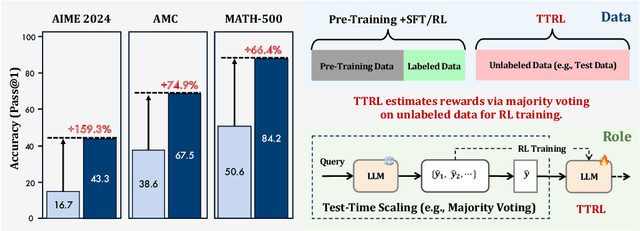
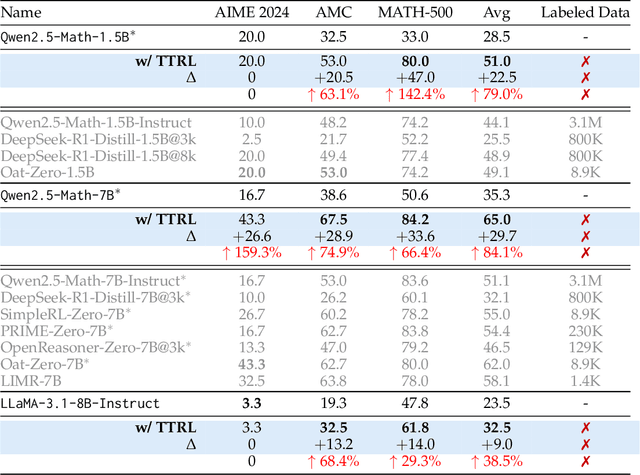
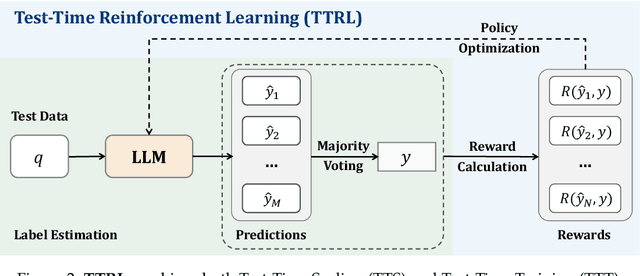
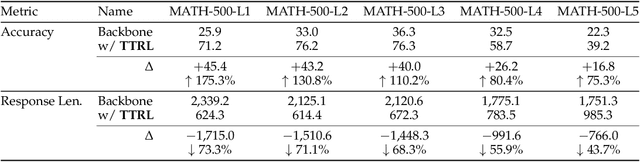
This paper investigates Reinforcement Learning (RL) on data without explicit labels for reasoning tasks in Large Language Models (LLMs). The core challenge of the problem is reward estimation during inference while not having access to ground-truth information. While this setting appears elusive, we find that common practices in Test-Time Scaling (TTS), such as majority voting, yield surprisingly effective rewards suitable for driving RL training. In this work, we introduce Test-Time Reinforcement Learning (TTRL), a novel method for training LLMs using RL on unlabeled data. TTRL enables self-evolution of LLMs by utilizing the priors in the pre-trained models. Our experiments demonstrate that TTRL consistently improves performance across a variety of tasks and models. Notably, TTRL boosts the pass@1 performance of Qwen-2.5-Math-7B by approximately 159% on the AIME 2024 with only unlabeled test data. Furthermore, although TTRL is only supervised by the Maj@N metric, TTRL has demonstrated performance to consistently surpass the upper limit of the initial model, and approach the performance of models trained directly on test data with ground-truth labels. Our experimental findings validate the general effectiveness of TTRL across various tasks, and highlight TTRL's potential for broader tasks and domains. GitHub: https://github.com/PRIME-RL/TTRL
UltraIF: Advancing Instruction Following from the Wild
Feb 06, 2025
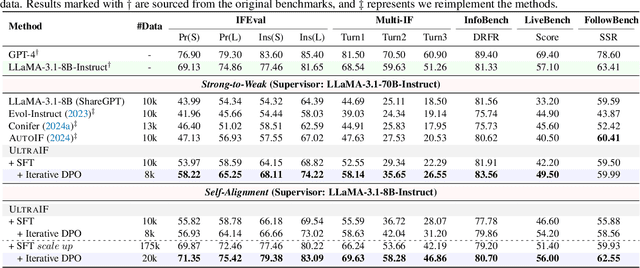

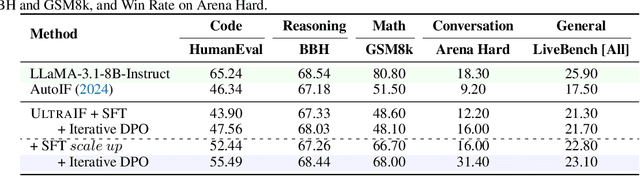
Instruction-following made modern large language models (LLMs) helpful assistants. However, the key to taming LLMs on complex instructions remains mysterious, for that there are huge gaps between models trained by open-source community and those trained by leading companies. To bridge the gap, we propose a simple and scalable approach UltraIF for building LLMs that can follow complex instructions with open-source data. UltraIF first decomposes real-world user prompts into simpler queries, constraints, and corresponding evaluation questions for the constraints. Then, we train an UltraComposer to compose constraint-associated prompts with evaluation questions. This prompt composer allows us to synthesize complicated instructions as well as filter responses with evaluation questions. In our experiment, for the first time, we successfully align LLaMA-3.1-8B-Base to catch up with its instruct version on 5 instruction-following benchmarks without any benchmark information, using only 8B model as response generator and evaluator. The aligned model also achieved competitive scores on other benchmarks. Moreover, we also show that UltraIF could further improve LLaMA-3.1-8B-Instruct through self-alignment, motivating broader use cases for the method. Our code will be available at https://github.com/kkk-an/UltraIF.
Depression Detection on Social Media with Large Language Models
Mar 16, 2024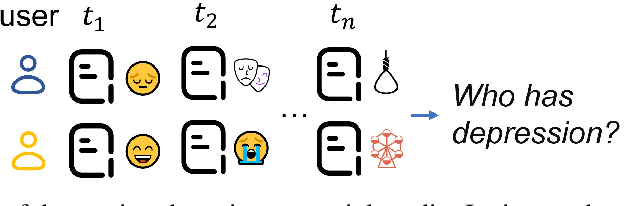
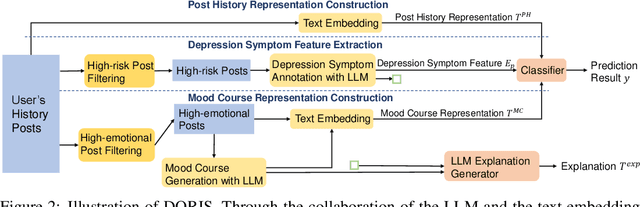
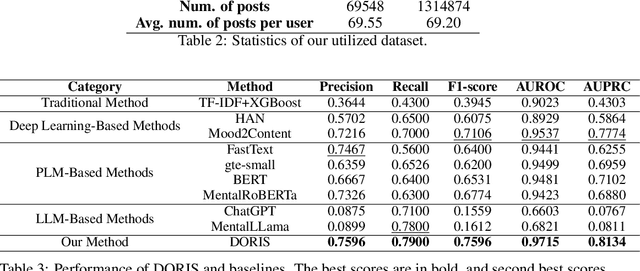
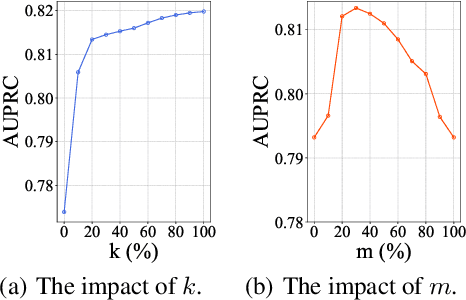
Depression harms. However, due to a lack of mental health awareness and fear of stigma, many patients do not actively seek diagnosis and treatment, leading to detrimental outcomes. Depression detection aims to determine whether an individual suffers from depression by analyzing their history of posts on social media, which can significantly aid in early detection and intervention. It mainly faces two key challenges: 1) it requires professional medical knowledge, and 2) it necessitates both high accuracy and explainability. To address it, we propose a novel depression detection system called DORIS, combining medical knowledge and the recent advances in large language models (LLMs). Specifically, to tackle the first challenge, we proposed an LLM-based solution to first annotate whether high-risk texts meet medical diagnostic criteria. Further, we retrieve texts with high emotional intensity and summarize critical information from the historical mood records of users, so-called mood courses. To tackle the second challenge, we combine LLM and traditional classifiers to integrate medical knowledge-guided features, for which the model can also explain its prediction results, achieving both high accuracy and explainability. Extensive experimental results on benchmarking datasets show that, compared to the current best baseline, our approach improves by 0.036 in AUPRC, which can be considered significant, demonstrating the effectiveness of our approach and its high value as an NLP application.