 Add to Chrome
 Add to Firefox
 Add to Edge
Kimi K3: Open Frontier Intelligence
Jul 27, 2026
We introduce Kimi K3, a 2.8T parameter Mixture-of-Experts model with 104 billion activated parameters, native vision capabilities, and a 1-million-token context window. Kimi K3 is built on Kimi Delta Attention and Attention Residuals, which improve information flow across sequence length and model depth. Together with Stable LatentMoE, which effectively activates 16 of 896 routed experts per token, and refined training and data recipes, these advances yield an approximately 2.5x improvement in overall scaling efficiency over Kimi K2. Post-training highlights reinforcement learning across general, agentic, and coding domains and multiple reasoning-effort levels, enabling compositional generalization and robust long-horizon execution. At 2.8T scale, Kimi K3 is supported by infrastructure advances in multiple areas: algorithm-system co-design for KDA, perfectly balanced expert-parallel training with efficient memory management, million-token agentic RL with persistent rollout and sandbox states, and deployment innovations. Extensive evaluations show that Kimi K3 achieves frontier-level performance across long-horizon coding, agentic, knowledge, reasoning, and vision tasks. While its overall performance still trails the most powerful proprietary models, namely Claude Fable 5 and GPT-5.6 Sol, Kimi K3 consistently outperforms other open and proprietary models evaluated in our suite. We release the full Kimi K3 model weights to facilitate future research and accelerate the broader deployment and adoption of frontier intelligence.

CLOSER-Bench: Evaluating Budgeted Cross-Stage Design Closure for Hardware Agents
Jul 18, 2026Hardware engineering exposes coding agents to a form of long-horizon work that is difficult to capture with pass-at-k: progress is continuous, tool feedback is delayed and heterogeneous, and a backend failure may require revising RTL rather than tuning another physical-design parameter. Existing benchmarks measure RTL generation, repository repair, verification, PPA evolution, or physical implementation, but their different designs and oracles make it hard to determine where an agent succeeds or fails across abstraction boundaries. We introduce CLOSER-Bench, a controlled evaluation protocol for budgeted cross-stage design closure. For one design and one hidden objective, it pairs spec-to-RTL, RTL-to-GDS, and spec-to-GDS tasks, records every simulator, synthesis, STA, and place-and-route invocation, and measures final quality, anytime progress, tool cost, and cross-stage recovery. The benchmark is built on open-source Verilator, Yosys, OpenROAD, KLayout, Sky130, and the Harbor agent harness. A ten-task pilot spanning RTL repair, mutation-based verification, coverage, PPA optimization, design-space exploration, cross-model debugging, and security establishes the executable harness and exposes a sharp completion--closure gap: three agents solve a localized AXI repair task, while the matched verification-closure task separates a frontier agent from two otherwise successful baselines. We further validate a full RTL-to-GDS flow and construct a macro-based AXI/DMA streaming accelerator for the stage-paired evaluation. These results motivate treating hardware closure as a budgeted sequential decision problem rather than a collection of independent code generation tasks.
Alpha-RTL: Test-Time Training for RTL Hardware Optimization
Jun 03, 2026Large language models (LLMs) have shown increasing promise in generating functionally correct register-transfer-level (RTL) hardware designs. Recent systems improve further through EDA-integrated reinforcement learning with syntax, simulation, and PPA rewards, but train a general RTL generator before deployment while test-time approaches search with a frozen policy. We instead perform reinforcement learning at test time, allowing the LLM policy to adapt to executable EDA feedback for the specific RTL problem at hand. We propose TTT-RTL, to our knowledge the first per-design test-time training framework that closes the loop between an LLM policy and an EDA pipeline for RTL optimization. TTT-RTL samples candidate implementations, verifies them through syntax checking and simulation, scores valid designs using synthesis-derived PPA product, reuses high-reward variants through a PUCT-indexed design-state pool, and updates the policy with an entropic policy-gradient objective. To stabilize policy updates under sparse or plateaued rewards, we introduce an adaptive KL-budget controller that adjusts the entropy constraint using reference KL, effective sample size, and reward saturation signals. On RTLLM v2.0 under Nangate 45nm, TTT-RTL reduces the geometric-mean PPA product by 65.1% over the reference, outperforming the strongest published frozen-policy agent baseline at 26.1%. On an industrial XuanTie C910 FPU leading-zero-anticipation unit under Sky130, TTT-RTL achieves a 59.4% ADP reduction, and ablations confirm that policy adaptation, state reuse, and KL-budget control each contribute. These results suggest that test-time training with executable EDA feedback can move LLM-based RTL generation beyond functional correctness toward physically optimized hardware.
TopoHR: Hierarchical Centerline Representation for Cyclic Topology Reasoning in Driving Scenes with Point-to-Instance Relations
Apr 27, 2026Topology reasoning is crucial for autonomous driving. Current methods primarily focus on instance-level learning for centerline detection, followed by a sequential module for topology reasoning that relies on simplified MLP layers. Moreover, they often neglect the importance of \textit{point-to-instance} (P2I) relationships in topology reasoning. To address these limitations, we present TopoHR (Topological Hierarchical Representation), a novel end-to-end framework that establishes cyclic interaction between centerline detection and topology reasoning, allowing them to iteratively enhance each other. Specifically, we introduce a hierarchical centerline representation including point queries, instance queries, and semantic representations. These multi-level features are seamlessly integrated and fused within a hierarchical centerline decoder. Furthermore, we design a hierarchical topology reasoning module that captures both fine-grained P2I relationships and global instance-to-instance (I2I) connections within a unified architecture. With these novel components, TopoHR ensures accurate and robust topology reasoning. On the OpenLane-V2 benchmark, TopoHR refreshes state-of-the-art performance with significant improvements. Notably, compared with previous best results, TopoHR achieves +3.8 in $\mathrm{DET}_{\text{l}}$, +5.4 in $\mathrm{TOP}_{\text{ll}}$ on $\text{subset_A}$ and +11.0 in $\mathrm{DET}_{\text{l}}$, +7.9 in $\mathrm{TOP}_{\text{ll}}$ on $\text{subset_B}$, validating the effectiveness of the proposed components. The code will be shared publicly at https://github.com/Yifeng-Bai/TopoHR.git.
TriMoE: Augmenting GPU with AMX-Enabled CPU and DIMM-NDP for High-Throughput MoE Inference via Offloading
Mar 01, 2026To deploy large Mixture-of-Experts (MoE) models cost-effectively, offloading-based single-GPU heterogeneous inference is crucial. While GPU-CPU architectures that offload cold experts are constrained by host memory bandwidth, emerging GPU-NDP architectures utilize DIMM-NDP to offload non-hot experts. However, non-hot experts are not a homogeneous memory-bound group: a significant subset of warm experts exists is severely penalized by high GPU I/O latency yet can saturate NDP compute throughput, exposing a critical compute gap. We present TriMoE, a novel GPU-CPU-NDP architecture that fills this gap by synergistically leveraging AMX-enabled CPU to precisely map hot, warm, and cold experts onto their optimal compute units. We further introduce a bottleneck-aware expert scheduling policy and a prediction-driven dynamic relayout/rebalancing scheme. Experiments demonstrate that TriMoE achieves up to 2.83x speedup over state-of-the-art solutions.
Kimi K2.5: Visual Agentic Intelligence
Feb 02, 2026We introduce Kimi K2.5, an open-source multimodal agentic model designed to advance general agentic intelligence. K2.5 emphasizes the joint optimization of text and vision so that two modalities enhance each other. This includes a series of techniques such as joint text-vision pre-training, zero-vision SFT, and joint text-vision reinforcement learning. Building on this multimodal foundation, K2.5 introduces Agent Swarm, a self-directed parallel agent orchestration framework that dynamically decomposes complex tasks into heterogeneous sub-problems and executes them concurrently. Extensive evaluations show that Kimi K2.5 achieves state-of-the-art results across various domains including coding, vision, reasoning, and agentic tasks. Agent Swarm also reduces latency by up to $4.5\times$ over single-agent baselines. We release the post-trained Kimi K2.5 model checkpoint to facilitate future research and real-world applications of agentic intelligence.
LLaTTE: Scaling Laws for Multi-Stage Sequence Modeling in Large-Scale Ads Recommendation
Jan 27, 2026We present LLaTTE (LLM-Style Latent Transformers for Temporal Events), a scalable transformer architecture for production ads recommendation. Through systematic experiments, we demonstrate that sequence modeling in recommendation systems follows predictable power-law scaling similar to LLMs. Crucially, we find that semantic features bend the scaling curve: they are a prerequisite for scaling, enabling the model to effectively utilize the capacity of deeper and longer architectures. To realize the benefits of continued scaling under strict latency constraints, we introduce a two-stage architecture that offloads the heavy computation of large, long-context models to an asynchronous upstream user model. We demonstrate that upstream improvements transfer predictably to downstream ranking tasks. Deployed as the largest user model at Meta, this multi-stage framework drives a 4.3\% conversion uplift on Facebook Feed and Reels with minimal serving overhead, establishing a practical blueprint for harnessing scaling laws in industrial recommender systems.
Natural language is not enough: Benchmarking multi-modal generative AI for Verilog generation
Jul 11, 2024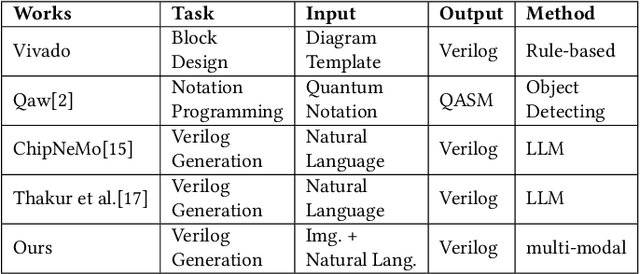
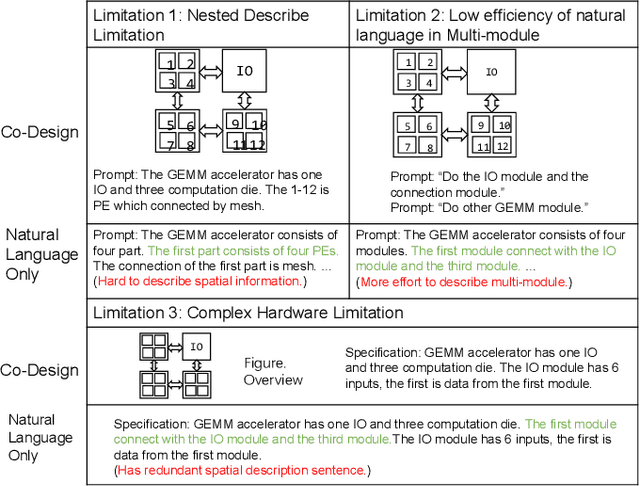
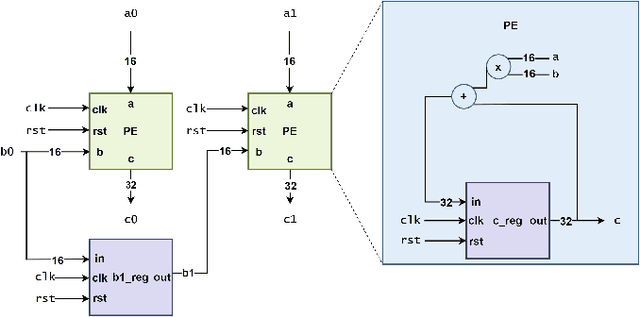
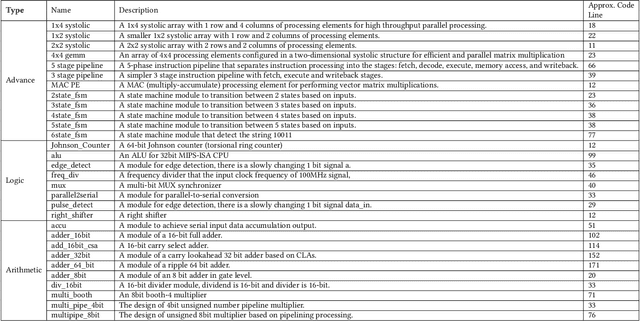
Natural language interfaces have exhibited considerable potential in the automation of Verilog generation derived from high-level specifications through the utilization of large language models, garnering significant attention. Nevertheless, this paper elucidates that visual representations contribute essential contextual information critical to design intent for hardware architectures possessing spatial complexity, potentially surpassing the efficacy of natural-language-only inputs. Expanding upon this premise, our paper introduces an open-source benchmark for multi-modal generative models tailored for Verilog synthesis from visual-linguistic inputs, addressing both singular and complex modules. Additionally, we introduce an open-source visual and natural language Verilog query language framework to facilitate efficient and user-friendly multi-modal queries. To evaluate the performance of the proposed multi-modal hardware generative AI in Verilog generation tasks, we compare it with a popular method that relies solely on natural language. Our results demonstrate a significant accuracy improvement in the multi-modal generated Verilog compared to queries based solely on natural language. We hope to reveal a new approach to hardware design in the large-hardware-design-model era, thereby fostering a more diversified and productive approach to hardware design.
Data is all you need: Finetuning LLMs for Chip Design via an Automated design-data augmentation framework
Mar 17, 2024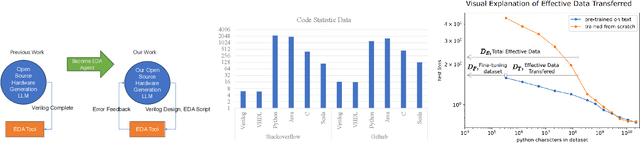

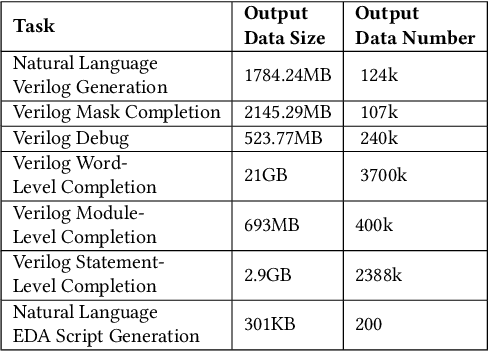
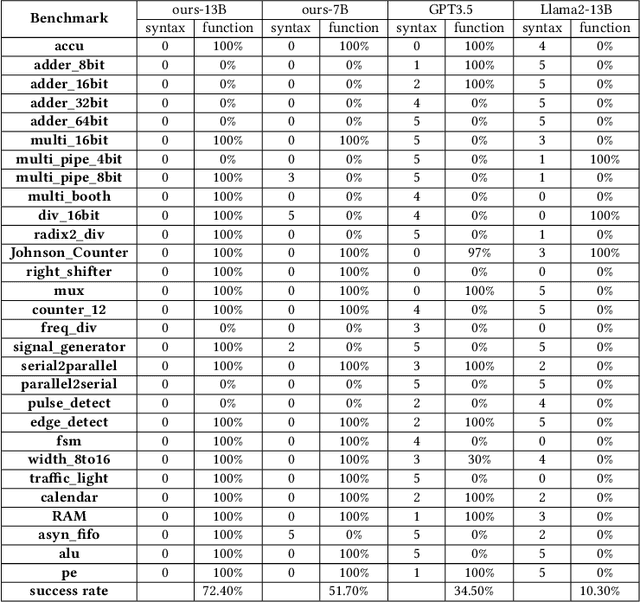
Recent advances in large language models have demonstrated their potential for automated generation of hardware description language (HDL) code from high-level prompts. Researchers have utilized fine-tuning to enhance the ability of these large language models (LLMs) in the field of Chip Design. However, the lack of Verilog data hinders further improvement in the quality of Verilog generation by LLMs. Additionally, the absence of a Verilog and Electronic Design Automation (EDA) script data augmentation framework significantly increases the time required to prepare the training dataset for LLM trainers. This paper proposes an automated design-data augmentation framework, which generates high-volume and high-quality natural language aligned with Verilog and EDA scripts. For Verilog generation, it translates Verilog files to an abstract syntax tree and then maps nodes to natural language with a predefined template. For Verilog repair, it uses predefined rules to generate the wrong verilog file and then pairs EDA Tool feedback with the right and wrong verilog file. For EDA Script generation, it uses existing LLM(GPT-3.5) to obtain the description of the Script. To evaluate the effectiveness of our data augmentation method, we finetune Llama2-13B and Llama2-7B models using the dataset generated by our augmentation framework. The results demonstrate a significant improvement in the Verilog generation tasks with LLMs. Moreover, the accuracy of Verilog generation surpasses that of the current state-of-the-art open-source Verilog generation model, increasing from 58.8% to 70.6% with the same benchmark. Our 13B model (ChipGPT-FT) has a pass rate improvement compared with GPT-3.5 in Verilog generation and outperforms in EDA script (i.e., SiliconCompiler) generation with only 200 EDA script data.
CurveFormer++: 3D Lane Detection by Curve Propagation with Temporal Curve Queries and Attention
Feb 09, 2024In autonomous driving, 3D lane detection using monocular cameras is an important task for various downstream planning and control tasks. Recent CNN and Transformer approaches usually apply a two-stage scheme in the model design. The first stage transforms the image feature from a front image into a bird's-eye-view (BEV) representation. Subsequently, a sub-network processes the BEV feature map to generate the 3D detection results. However, these approaches heavily rely on a challenging image feature transformation module from a perspective view to a BEV representation. In our work, we present CurveFormer++, a single-stage Transformer-based method that does not require the image feature view transform module and directly infers 3D lane detection results from the perspective image features. Specifically, our approach models the 3D detection task as a curve propagation problem, where each lane is represented by a curve query with a dynamic and ordered anchor point set. By employing a Transformer decoder, the model can iteratively refine the 3D lane detection results. A curve cross-attention module is introduced in the Transformer decoder to calculate similarities between image features and curve queries of lanes. To handle varying lane lengths, we employ context sampling and anchor point restriction techniques to compute more relevant image features for a curve query. Furthermore, we apply a temporal fusion module that incorporates selected informative sparse curve queries and their corresponding anchor point sets to leverage historical lane information. In the experiments, we evaluate our approach for the 3D lane detection task on two publicly available real-world datasets. The results demonstrate that our method provides outstanding performance compared with both CNN and Transformer based methods. We also conduct ablation studies to analyze the impact of each component in our approach.