 Add to Chrome
 Add to Firefox
 Add to Edge
Your LLM, Your Style: Behavioral Mode Axes for LLM Behavioral Control
Aug 11, 2026
Large language models (LLMs) increasingly act in interactive settings where their behavioral styles affect user experience, safety, and downstream decision making. Existing LLM personality studies largely rely on self-report questionnaires administered in first-person settings, making the resulting profiles sensitive to surface elicitation choices and poorly grounded in concrete model behavior. In this work, we introduce a situated behavioral-data (B-data) framework for studying and controlling LLM behavioral personality. We construct 3,200 contrastive behavioral scenarios spanning 20 behavioral patterns and four prompt registers, grounded in validated psychometric facets such as BFI-2, DOSPERT, and HEXACO. Using this framework, we find that LLMs exhibit stable and model-specific behavioral profiles, while also revealing register-dependent shifts across first-person decisions, advice-giving, and task execution. We then show that these behavioral patterns can be controlled through Behavioral Mode Axes (BMAs), activation-space directions derived from contrastive behavioral traces. Compared with response-derived BMAs, which are more prone to trait drift, thought-derived BMAs more faithfully capture the intended behavioral mechanism and provide cleaner control over situated behavioral styles. Our results suggest that LLM personality-like tendencies are better understood not as abstract self-report traits, but as measurable and controllable behavioral modes grounded in concrete interaction contexts. Our code and data are available at https://github.com/lhz191/LLM-Behavioral-Personality.

See2Think: Do Multimodal Models Really Use Intermediate Visual States?
Jul 29, 2026Multimodal large language models increasingly use sketches, annotations, tools, and intermediate images during reasoning, but it remains unclear whether they truly rely on these visual states. Existing benchmarks are limited both by task collections with narrow coverage or partially text-solvable samples and by evaluations that emphasize final answers without diagnosing how intermediate visual states are generated, rendered, and used. We introduce See2Think, a unified evaluation framework comprising See2ThinkBench and Visual Action-of-Thought (VAoT). See2ThinkBench contains 1,200 open-ended, visually dependent problems across 12 task categories spanning 2D structured, 3D scene, and real-world reasoning. VAoT records textual thoughts, visual actions, rendered states, and subsequent reasoning under four controlled inference settings. Evaluating representative proprietary and open-source multimodal models, we find that visual reasoning is strongly model- and environment-dependent, with no single setting consistently dominating across tasks. Process analysis further shows that models usually select relevant visual operations, while faithful rendering remains the clearest bottleneck and high feedback uptake does not necessarily translate into accuracy gains. Under task-relevant corrupted feedback, models exhibit behavioral dependence on visual states, with accuracy dropping by over 10 percentage points in controlled interventions.
DataEvolver: Self-Evolving Multi-Agent Data Construction for Text-Rich Image Generation
Jun 30, 2026Text-rich image generation is one of the most challenging settings in image generation, since models must simultaneously produce visually realistic images and render legible, semantically aligned, and layout-consistent text. Existing data pipelines usually follow a static crawl-filter-freeze paradigm. They collect candidate samples, filter them once, and freeze the accepted data for training. However, rejected samples are usually discarded, although they often contain useful failure signals such as OCR errors and semantic mismatches. As a result, later construction rounds may repeat the same failure modes. To address these limitations, we propose DataEvolver, a self-evolving multi-agent framework for text-rich image data construction. DataEvolver treats data construction as feedback-driven construction policy evolution. A Retriever collects candidate samples, a Verifier assigns quality scores and rejection causes, a Critic summarizes round-level feedback into semantic feedback, and a Generator completes under-covered regions through targeted synthesis. The updated feedback memory then guides the next construction round. Experiments on text-rich image generation benchmarks show that DataEvolver produces more useful training data than fixed-dataset baselines under matched data budgets. At the 0.75M scale on PixArt-alpha, DataEvolver improves OCR-F1 over the strongest baseline by 85.3 percent on TextScenesHQ and 35.3 percent on LongTextBench. The improvements are consistent across both evaluated benchmarks and also transfer to Show-o2, indicating that the benefit of DataEvolver is not tied to a single downstream generator. These results suggest that rejected samples can provide actionable feedback for improving text-rich image data construction.
Eliciting Trustworthiness Priors of Large Language Models via Economic Games
Jan 31, 2026One critical aspect of building human-centered, trustworthy artificial intelligence (AI) systems is maintaining calibrated trust: appropriate reliance on AI systems outperforms both overtrust (e.g., automation bias) and undertrust (e.g., disuse). A fundamental challenge, however, is how to characterize the level of trust exhibited by an AI system itself. Here, we propose a novel elicitation method based on iterated in-context learning (Zhu and Griffiths, 2024a) and apply it to elicit trustworthiness priors using the Trust Game from behavioral game theory. The Trust Game is particularly well suited for this purpose because it operationalizes trust as voluntary exposure to risk based on beliefs about another agent, rather than self-reported attitudes. Using our method, we elicit trustworthiness priors from several leading large language models (LLMs) and find that GPT-4.1's trustworthiness priors closely track those observed in humans. Building on this result, we further examine how GPT-4.1 responds to different player personas in the Trust Game, providing an initial characterization of how such models differentiate trust across agent characteristics. Finally, we show that variation in elicited trustworthiness can be well predicted by a stereotype-based model grounded in perceived warmth and competence.
MUSE: MCTS-Driven Red Teaming Framework for Enhanced Multi-Turn Dialogue Safety in Large Language Models
Sep 18, 2025As large language models~(LLMs) become widely adopted, ensuring their alignment with human values is crucial to prevent jailbreaks where adversaries manipulate models to produce harmful content. While most defenses target single-turn attacks, real-world usage often involves multi-turn dialogues, exposing models to attacks that exploit conversational context to bypass safety measures. We introduce MUSE, a comprehensive framework tackling multi-turn jailbreaks from both attack and defense angles. For attacks, we propose MUSE-A, a method that uses frame semantics and heuristic tree search to explore diverse semantic trajectories. For defense, we present MUSE-D, a fine-grained safety alignment approach that intervenes early in dialogues to reduce vulnerabilities. Extensive experiments on various models show that MUSE effectively identifies and mitigates multi-turn vulnerabilities. Code is available at \href{https://github.com/yansiyu02/MUSE}{https://github.com/yansiyu02/MUSE}.
Beyond Quality: Unlocking Diversity in Ad Headline Generation with Large Language Models
Aug 26, 2025
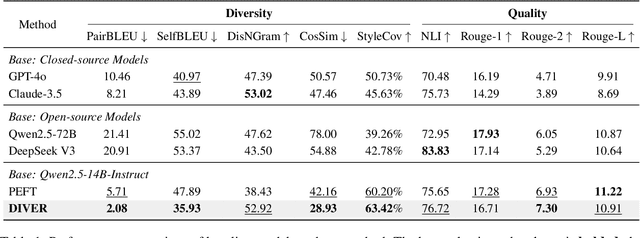
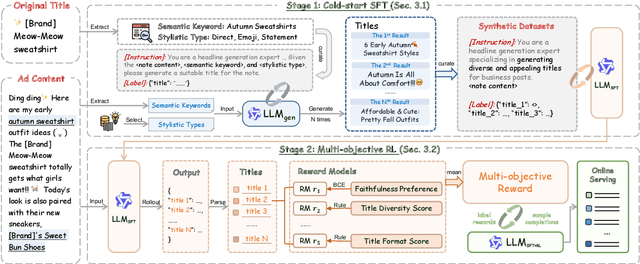
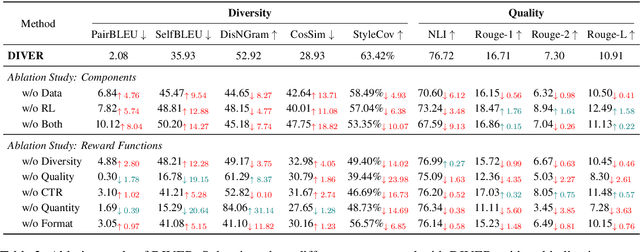
The generation of ad headlines plays a vital role in modern advertising, where both quality and diversity are essential to engage a broad range of audience segments. Current approaches primarily optimize language models for headline quality or click-through rates (CTR), often overlooking the need for diversity and resulting in homogeneous outputs. To address this limitation, we propose DIVER, a novel framework based on large language models (LLMs) that are jointly optimized for both diversity and quality. We first design a semantic- and stylistic-aware data generation pipeline that automatically produces high-quality training pairs with ad content and multiple diverse headlines. To achieve the goal of generating high-quality and diversified ad headlines within a single forward pass, we propose a multi-stage multi-objective optimization framework with supervised fine-tuning (SFT) and reinforcement learning (RL). Experiments on real-world industrial datasets demonstrate that DIVER effectively balances quality and diversity. Deployed on a large-scale content-sharing platform serving hundreds of millions of users, our framework improves advertiser value (ADVV) and CTR by 4.0% and 1.4%.
HKD4VLM: A Progressive Hybrid Knowledge Distillation Framework for Robust Multimodal Hallucination and Factuality Detection in VLMs
Jun 16, 2025Driven by the rapid progress in vision-language models (VLMs), the responsible behavior of large-scale multimodal models has become a prominent research area, particularly focusing on hallucination detection and factuality checking. In this paper, we present the solution for the two tracks of Responsible AI challenge. Inspirations from the general domain demonstrate that a smaller distilled VLM can often outperform a larger VLM that is directly tuned on downstream tasks, while achieving higher efficiency. We thus jointly tackle two tasks from the perspective of knowledge distillation and propose a progressive hybrid knowledge distillation framework termed HKD4VLM. Specifically, the overall framework can be decomposed into Pyramid-like Progressive Online Distillation and Ternary-Coupled Refinement Distillation, hierarchically moving from coarse-grained knowledge alignment to fine-grained refinement. Besides, we further introduce the mapping shift-enhanced inference and diverse augmentation strategies to enhance model performance and robustness. Extensive experimental results demonstrate the effectiveness of our HKD4VLM. Ablation studies provide insights into the critical design choices driving performance gains.
AgentRM: Enhancing Agent Generalization with Reward Modeling
Feb 25, 2025Existing LLM-based agents have achieved strong performance on held-in tasks, but their generalizability to unseen tasks remains poor. Hence, some recent work focus on fine-tuning the policy model with more diverse tasks to improve the generalizability. In this work, we find that finetuning a reward model to guide the policy model is more robust than directly finetuning the policy model. Based on this finding, we propose AgentRM, a generalizable reward model, to guide the policy model for effective test-time search. We comprehensively investigate three approaches to construct the reward model, including explicit reward modeling, implicit reward modeling and LLM-as-a-judge. We then use AgentRM to guide the answer generation with Best-of-N sampling and step-level beam search. On four types of nine agent tasks, AgentRM enhances the base policy model by $8.8$ points on average, surpassing the top general agent by $4.0$. Moreover, it demonstrates weak-to-strong generalization, yielding greater improvement of $12.6$ on LLaMA-3-70B policy model. As for the specializability, AgentRM can also boost a finetuned policy model and outperform the top specialized agent by $11.4$ on three held-in tasks. Further analysis verifies its effectiveness in test-time scaling. Codes will be released to facilitate the research in this area.
The Joint Entity-Relation Extraction Model Based on Span and Interactive Fusion Representation for Chinese Medical Texts with Complex Semantics
Feb 13, 2025Joint entity-relation extraction is a critical task in transforming unstructured or semi-structured text into triplets, facilitating the construction of large-scale knowledge graphs, and supporting various downstream applications. Despite its importance, research on Chinese text, particularly with complex semantics in specialized domains like medicine, remains limited. To address this gap, we introduce the CH-DDI, a Chinese drug-drug interactions dataset designed to capture the intricacies of medical text. Leveraging the strengths of attention mechanisms in capturing long-range dependencies, we propose the SEA module, which enhances the extraction of complex contextual semantic information, thereby improving entity recognition and relation extraction. Additionally, to address the inefficiencies of existing methods in facilitating information exchange between entity recognition and relation extraction, we present an interactive fusion representation module. This module employs Cross Attention for bidirectional information exchange between the tasks and further refines feature extraction through BiLSTM. Experimental results on both our CH-DDI dataset and public CoNLL04 dataset demonstrate that our model exhibits strong generalization capabilities. On the CH-DDI dataset, our model achieves an F1-score of 96.73% for entity recognition and 78.43% for relation extraction. On the CoNLL04 dataset, it attains an entity recognition precision of 89.54% and a relation extraction accuracy of 71.64%.
Static and multivariate-temporal attentive fusion transformer for readmission risk prediction
Jul 15, 2024
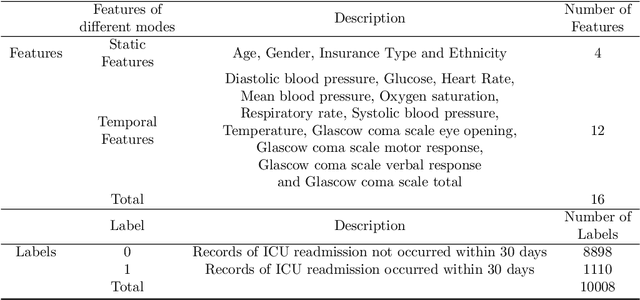


Background: Accurate short-term readmission prediction of ICU patients is significant in improving the efficiency of resource assignment by assisting physicians in making discharge decisions. Clinically, both individual static static and multivariate temporal data collected from ICU monitors play critical roles in short-term readmission prediction. Informative static and multivariate temporal feature representation capturing and fusion present challenges for accurate readmission prediction. Methods:We propose a novel static and multivariate-temporal attentive fusion transformer (SMTAFormer) to predict short-term readmission of ICU patients by fully leveraging the potential of demographic and dynamic temporal data. In SMTAFormer, we first apply an MLP network and a temporal transformer network to learn useful static and temporal feature representations, respectively. Then, the well-designed static and multivariate temporal feature fusion module is applied to fuse static and temporal feature representations by modeling intra-correlation among multivariate temporal features and constructing inter-correlation between static and multivariate temporal features. Results: We construct a readmission risk assessment (RRA) dataset based on the MIMIC-III dataset. The extensive experiments show that SMTAFormer outperforms advanced methods, in which the accuracy of our proposed method is up to 86.6%, and the area under the receiver operating characteristic curve (AUC) is up to 0.717. Conclusion: Our proposed SMTAFormer can efficiently capture and fuse static and multivariate temporal feature representations. The results show that SMTAFormer significantly improves the short-term readmission prediction performance of ICU patients through comparisons to strong baselines.